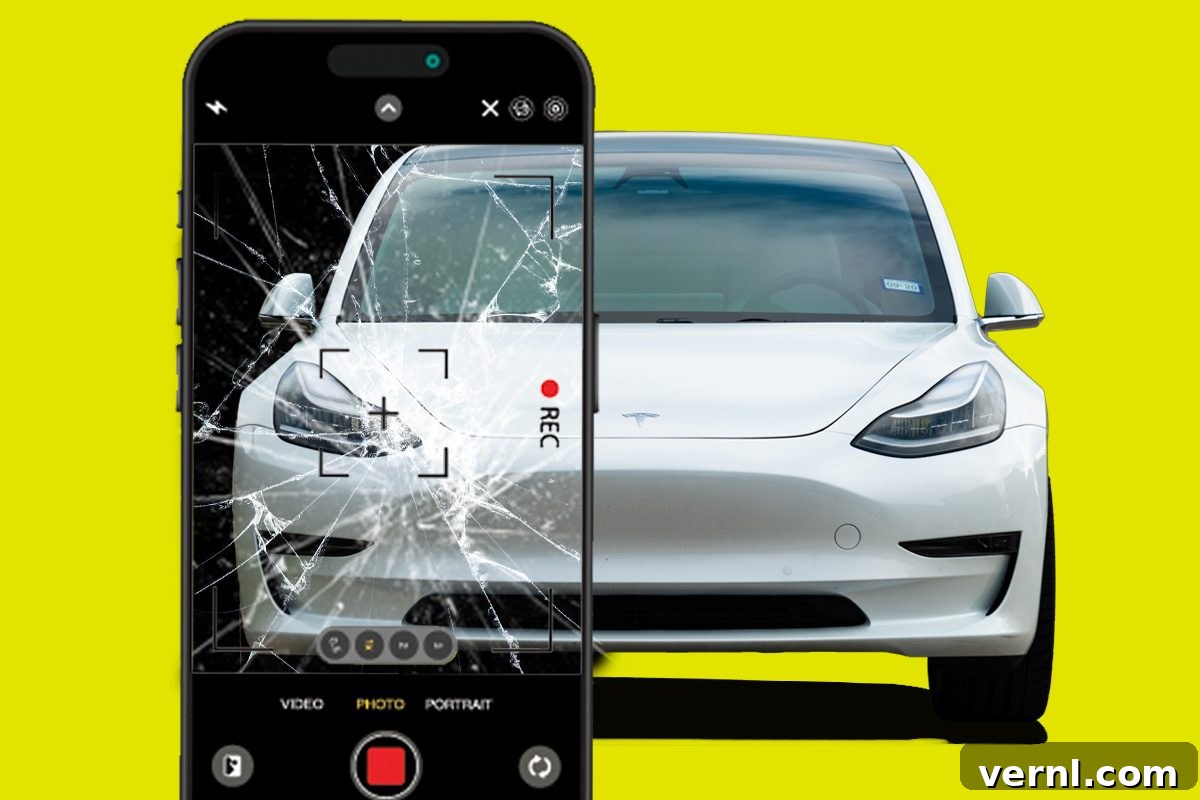
In the evolving landscape of automotive technology, certain innovations spark both admiration and curiosity. One such recent occurrence that captured the attention of online car enthusiasts involved an intriguing video circulating through various online forums, showcasing a Volvo’s advanced Lidar sensors causing peculiar damage to a camera. The original footage, seemingly innocuous at first, features a vehicle, with the camera’s focus gradually drawing towards its Lidar unit. What unfolds next is a visual anomaly: a proliferation of vibrant, colorful dots begins to fill the screen, a mesmerizing yet alarming indication of irreversible camera damage.
This incident, while captivating, highlighted a critical, often overlooked aspect of cutting-edge automotive safety systems. For many, the idea of a car’s sensor array actively damaging a modern camera device like an iPhone or a professional-grade camera seemed baffling. Unless one possesses a deep understanding of the intricate workings of car lasers and imaging technology, comprehending how these sophisticated systems could render a camera inoperable might appear to be a complex puzzle. This phenomenon underscores the necessity for increased awareness regarding the powerful technologies integrated into our vehicles, especially as they become more prevalent and sophisticated.
Understanding Lidar: The Eyes of Modern Vehicles
If you’re accustomed to newer car models, particularly those equipped with advanced driver-assistance systems (ADAS), you might already be benefiting from Lidar technology, even if the name isn’t immediately familiar. Lidar, an acronym for Light Detection and Ranging, represents a cornerstone in the evolution of automotive safety and autonomous driving. It functions as a highly sophisticated remote sensing method that works in perfect synergy with other onboard sensors such as traditional cameras, radar, and ultrasonic sensors, collectively forming a comprehensive perception system designed to enhance safety and provide crucial information about the vehicle’s environment.
At its core, Lidar technology is a laser-based system that continuously scans the surroundings of your vehicle. As Volvo, a pioneer in automotive safety, explains, Lidar actively collects detailed information about the environment, which is then utilized by a suite of driver support features. This capability allows your car to precisely detect other vehicles ahead, identify potential obstructions on the road, map out lane boundaries, and even discern pedestrians or cyclists, all with remarkable accuracy. This goes beyond what standard cameras or radar can achieve independently, especially in challenging lighting or weather conditions, marking Lidar as an indispensable component in the pursuit of safer and more autonomous driving experiences.
How Lidar Technology Works: Mapping the World in 3D
The operational principle behind Lidar is both elegant and incredibly effective. The system works by emitting pulses of invisible infrared light. These light waves are continuously sent out from the Lidar unit and travel through the air until they encounter an object in their path. Upon striking an object, these light waves bounce back, reflecting towards the Lidar sensor. The system then precisely measures the “time-of-flight”—the exact duration it takes for each laser pulse to leave the sensor, hit an object, and return.
By calculating these time differences, combined with the known speed of light, the Lidar system can determine the precise distance to countless objects in its immediate vicinity. Furthermore, by emitting millions of these pulses per second and combining the distance measurements with the angular position of the scanner, Lidar constructs a highly detailed three-dimensional “point cloud” map of the vehicle’s surroundings. This intricate data allows the vehicle’s onboard computers to identify the distance to objects, discern their shape and size, and even track aspects of their movement or appearance in real-time. When functioning optimally, this continuous stream of precise environmental data provides the car with an unparalleled understanding of the road layout and surrounding traffic, significantly augmenting its ability to assist in safe driving.
Lidar’s Indispensable Role in Automotive Safety and Autonomous Driving
The advent of Lidar technology has ushered in a new era of vehicle safety and paved the way for increasingly sophisticated autonomous driving capabilities. Its ability to create high-resolution 3D maps of the environment offers significant advantages over other sensing modalities, especially in critical situations. For instance, Lidar plays a crucial role in advanced emergency braking (AEB) systems, enabling vehicles to detect potential collisions with other cars, pedestrians, or cyclists and initiate braking much faster than a human driver might react. This precise spatial awareness is fundamental to preventing accidents and mitigating their severity.
Beyond collision avoidance, Lidar enhances various other driver-assistance features. It contributes to adaptive cruise control by maintaining safe distances from preceding vehicles, improves lane-keeping assist by accurately delineating lane boundaries, and even aids in parking assistance by precisely mapping obstacles. One of Lidar’s standout attributes is its robust performance in conditions where traditional cameras might struggle, such as low light, complete darkness, or adverse weather like heavy rain, fog, or snow. Unlike cameras that rely on visible light and can be obscured by such conditions, Lidar’s infrared lasers can often penetrate environmental disturbances more effectively, ensuring a consistent and reliable perception of the world around the vehicle. This makes Lidar not just an enhancement but a critical enabling technology for achieving higher levels of autonomous driving, where continuous and accurate environmental understanding is paramount for safety and reliability.
The Unseen Danger: Why Lidar Exposure Can Wreck Your Camera
While Lidar is an extraordinary tool for enhancing safety, it harbors a hidden danger, particularly for camera devices. The Lidar systems on your car, fundamentally, are powerful laser emitters. The core reason they can damage cameras, including those found in smartphones like iPhones or professional digital cameras, lies in the intense nature of the infrared light waves they emit.
Camera sensors, whether CMOS (Complementary Metal-Oxide-Semiconductor) or CCD (Charge-Coupled Device) arrays, are designed to capture visible light. While they can detect some infrared light, they are not typically engineered to withstand direct, concentrated exposure to high-intensity infrared lasers. When a Lidar system’s powerful infrared pulses directly strike a camera’s sensor, the energy absorbed by the sensitive photosites (pixels) can be overwhelming. This intense energy influx can literally “burn out” or permanently damage individual pixels or even entire sections of the sensor array.
The “colorful dots” seen in the viral video are a classic symptom of this damage. These artifacts represent pixels that have been permanently overcharged or fried, causing them to either stick on a specific color or become completely unresponsive. This damage is often irreparable, meaning that once a camera sensor is exposed to a damaging level of Lidar’s infrared light, the functionality of the camera may be permanently compromised. Volvo, recognizing this potential hazard, explicitly warns users against pointing cameras directly at the Lidar unit, stating that its infrared light waves “may cause damage to certain camera devices,” including smartphones. The invisible nature of infrared light makes this threat particularly insidious; you cannot see the light that is causing the damage, making it easy to inadvertently expose your camera to harm.
Safeguarding Your Devices from Lidar Exposure
Given the potential for Lidar systems to damage sensitive camera equipment, it’s crucial for consumers and enthusiasts to exercise caution. The most straightforward and effective way to avoid this danger is to heed the manufacturers’ warnings: never point your camera directly at a vehicle’s Lidar sensor while it is active. This advice extends to all types of cameras, from the ubiquitous smartphone camera to more specialized photographic equipment. While professional cameras might incorporate some level of infrared filtering, these filters are generally designed to manage ambient infrared light, not to withstand the direct, concentrated beam of a powerful Lidar laser.
Understanding that Lidar emits invisible infrared light makes exercising caution even more important. You won’t see a visible beam, but the damaging energy is still present. When filming or photographing modern vehicles equipped with Lidar, it’s best to maintain a respectful distance and avoid direct, close-up shots of the Lidar unit itself, especially when the vehicle is powered on and its systems are active. This simple preventive measure can save your expensive camera equipment from irreversible damage and ensure you can continue to capture moments without concern. As automotive technology advances, so too must our awareness and understanding of its operational nuances and potential interactions with other devices.
The Road Ahead: The Future of Lidar in Automotive and Beyond
The incident of Lidar damaging a camera, while concerning, also serves as a potent reminder of the incredible power and sophistication of modern automotive technology. Lidar is not just a passing trend; it is increasingly being integrated into a wider array of vehicle segments, moving beyond luxury and high-end models to become a more standard feature for enhanced safety. The technology itself is also evolving rapidly. Next-generation Lidar systems, particularly solid-state Lidar, promise to be more compact, cost-effective, and robust, further accelerating their adoption.
These advancements are critical for the progression towards higher levels of autonomous driving. As vehicles move closer to Level 3, 4, and even 5 autonomy, where human intervention is minimal or non-existent, the reliability and comprehensiveness of their perception systems become paramount. Lidar, with its unparalleled ability to generate precise 3D environmental maps in varied conditions, will undoubtedly remain a cornerstone of this future. As this technology becomes more ubiquitous, it will be essential for both manufacturers to continue educating consumers and for the public to remain informed about how these advanced systems operate, including any potential interactions or precautions. The balance between deploying cutting-edge safety features and ensuring public understanding and safety will define the journey toward fully autonomous mobility.
Source
Lidar detection and limitations, Volvo, 2025
RELATED:
- Do You Know What That Little Button on Your Seat Belt Is For?
- What Those Lines on Your Backup Camera Really Tell You
- Here’s What The Small Panel On Your Car’s Front Bumper Is For