
The early months of 2021 presented an unexpected challenge for many embarking on home renovation or construction projects. As the world grappled with the initial uncertainties of the pandemic, lumber prices surged to unprecedented levels. Suddenly, a standard 2×4, which cost under $4 just a year prior, was fetching an astounding $16. For those undertaking minor remodels, like our own, the impact was manageable. However, for anyone planning a full home build, these skyrocketing material costs often meant re-evaluating, delaying, or even abandoning their entire project. This dramatic period highlighted the extreme volatility of the lumber market and its profound influence on construction expenses.
Now, a new economic storm looms on the horizon: the potential imposition of a 25% tariff on Canadian lumber imports. This raises a critical question: will we see a return to those unsettling, record-high wood prices? Economic experts and industry analysts largely agree that a significant price increase is not only probable but highly likely, for reasons deeply rooted in the interconnectedness of the North American lumber supply chain and global trade dynamics.
Where Does the US Get Its Softwood Lumber?
The United States boasts a vast and productive forest industry, supplying a substantial portion of its domestic lumber needs. In 2024, approximately 72% of the country’s softwood lumber originated from its own abundant forests. This domestic supply is a cornerstone of the US construction sector, providing a foundational source of materials for everything from residential homes to commercial buildings.
However, domestic production alone isn’t sufficient to meet the nation’s immense demand for building materials. The remaining 28% of softwood lumber is imported from various international sources, with Canada standing out as by far the most significant contributor. Last year, the US imported an impressive 28.1 million cubic meters of softwood lumber from its northern neighbor. According to a detailed report by the US Department of Commerce, Canada accounts for a staggering 84.3% of all US softwood lumber imports. While other countries like Germany (6.1%), Sweden (2.8%), and Brazil (1.4%) also contribute, their combined share pales in comparison to Canada’s dominant position. This data underscores Canada’s indispensable role in the US lumber supply chain and highlights the potential vulnerabilities that arise from a heavy reliance on a single foreign source.
Why Does the US Rely So Heavily on Canadian Lumber?
The United States’ significant reliance on Canadian lumber is not merely a matter of convenience; it’s a critical component of the integrated North American construction material market. The simple truth is that despite its own substantial forestry resources, the U.S. cannot produce enough softwood to satisfy its robust and ever-growing domestic demand. Softwood lumber, primarily sourced from conifer trees like pine, spruce, and fir, is the preferred material for residential construction due to its strength, versatility, and cost-effectiveness. Canada, with its vast boreal forests and highly developed forestry industry, is one of the world’s largest and most efficient producers of softwood lumber, making it a natural and essential trading partner.
While theoretical alternatives exist, such as diversifying imports from other lumber-producing nations, the practicalities present formidable challenges. No other country possesses Canada’s immense production capacity and logistical advantages. Frederik Laleicke, an assistant professor and wood products extension specialist at NC State University, emphasizes the complexity and high cost of altering established supply chains, particularly for a bulk commodity like lumber. “Because Canada directly borders the US,” Laleicke explains, “it is an integral part of the North American construction material market.” This geographical proximity translates into unparalleled efficiencies. The lumber industry has, over decades, developed an “extremely efficient logistics” network for moving logs from forests to sawmills, processing them into dimension lumber, and then transporting the finished product across the border directly to construction sites. This seamless integration encompasses everything from harvesting and primary processing to long-haul transportation, making Canada an almost irreplaceable cog in the US building materials machine. Attempting to replicate this complex, cost-optimized system with distant suppliers would incur massive expenses and lead to considerable delays, inevitably driving up prices for builders and consumers alike.
How Will Tariffs On Canadian Lumber Impact Wood Prices?
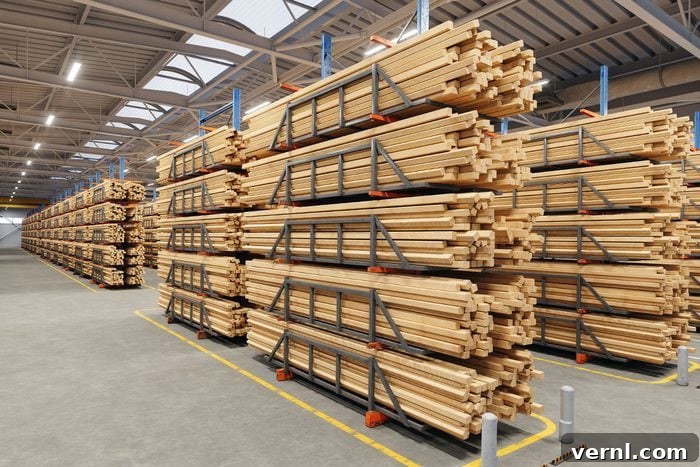
The looming prospect of a 25% tariff on Canadian softwood lumber imports is poised to significantly escalate lumber prices, with a direct and detrimental ripple effect on the cost of new housing and renovation projects. The fundamental economic principle at play is straightforward: as long as the demand for lumber remains consistent or high, US companies importing Canadian-sourced lumber will invariably pass on the additional cost of the tariffs to their customers. This effectively means that builders and, ultimately, homebuyers will bear the brunt of the increased import duties, making wood products, and consequently construction, more expensive.
Frederik Laleicke draws a parallel to the severe price disruptions experienced during the COVID-19 pandemic. “We saw something similar to these price troubles during the COVID-19 pandemic, during which the supply of softwood lumber declined rapidly while demand remained high,” he recounts. “That made softwood prices rise for a while, and it wasn’t until after the supply grew again that prices dropped significantly.” Tariffs, by artificially increasing the cost of a major supply source, create a similar market dynamic: a reduction in the *effective* supply of affordable lumber, leading to an upward pressure on prices.
Proponents of tariffs often argue that such measures will incentivize US companies to invest more heavily in domestic lumber production, thereby reducing reliance on foreign imports and potentially stabilizing prices in the long term. However, economists widely caution that even if increased domestic investment does occur, the immediate and medium-term effect will almost certainly be higher prices. A compelling historical example is the 2006 US-Canada Softwood Lumber Agreement. This accord, which was in effect until 2015, permitted Canadian provinces to levy tariffs on their lumber exports to the US. During this period, US domestic production did indeed see an increase, and imports of Canadian softwood lumber decreased by nearly 8%. Yet, the intended savings or benefits did not trickle down to builders or homebuyers. Instead, as cited by North Carolina University’s College of Natural Resources, US producers reaped an additional $1.6 billion in profits, while US consumers collectively paid an extra $2.3 billion for lumber under the agreement. This historical precedent serves as a stark warning: tariffs can enrich specific domestic industries at the direct expense of the broader consumer base and the housing market.
How Will Tariffs On Canadian Lumber Impact Housing Costs?
The vast majority of softwood lumber imported from Canada is destined for residential and commercial construction. In fact, in 2023, a remarkable 93% of new residential homes constructed in the United States utilized softwood as their primary structural material. Given this overwhelming reliance, the imposition of tariffs on Canadian lumber will inevitably have a profound and detrimental impact on the cost of building new homes. The National Association of Home Builders (NAHB) estimates that these tariffs could drive up new home prices by as much as 15%. This significant increase will not only affect the primary market for new constructions but will also trigger a broader ripple effect throughout the entire housing market, influencing the prices of existing home sales and rentals across the country.
The timing of these potential tariffs is particularly concerning, as the housing market is already grappling with severe affordability challenges. “Over the past few years, new home prices have already skyrocketed in many markets due to factors beyond just the cost of lumber, making homeownership increasingly unaffordable for Millennials and Gen Z,” notes Laleicke. These additional costs from tariffs would exacerbate an already precarious situation, pushing the dream of homeownership further out of reach for a growing segment of the population. Factors such as high interest rates, limited housing inventory, and persistent inflation have already strained homebuyers’ budgets. Adding a substantial increase in material costs will only compound these pressures, leading to reduced housing starts, slower market growth, and potentially a widening gap in housing equity. The economic consequences extend beyond just the purchase price of a home; higher construction costs can also translate into increased rental rates as landlords face higher maintenance and development expenses, further squeezing household budgets and contributing to a broader cost-of-living crisis.
About the Expert
- Frederik Laleicke is an esteemed assistant professor and a dedicated wood products extension specialist at NC State University. His extensive expertise spans the entire lifecycle of wood products, from sustainable harvesting practices to advanced processing techniques. Beyond his academic contributions, Professor Laleicke actively engages with the industry, leading workshops on wood processing and regularly consulting with sawmills and various wood product companies both within North Carolina and across broader regions. His insights are crucial for understanding the intricate dynamics of the lumber market and its economic implications.
Sources
- Softwood Lumber Subsidies Report to the Congress, US Department of Commerce report, December, 2024.
- Navigating the US Housing Market: Positive Trends and Regulatory Challenges, February, 2025.
- USA with reduced softwood lumber imports in 2023, September, 2023.
- Wood-Framed Home Share Decreased in 2023, August, 2024.
- Framing Lumber Prices, NAHB, February, 2025.
- Will the US Lumber Market Thrive or Break Under Trump? NC State University College of Natural Resources report, January, 2025.