
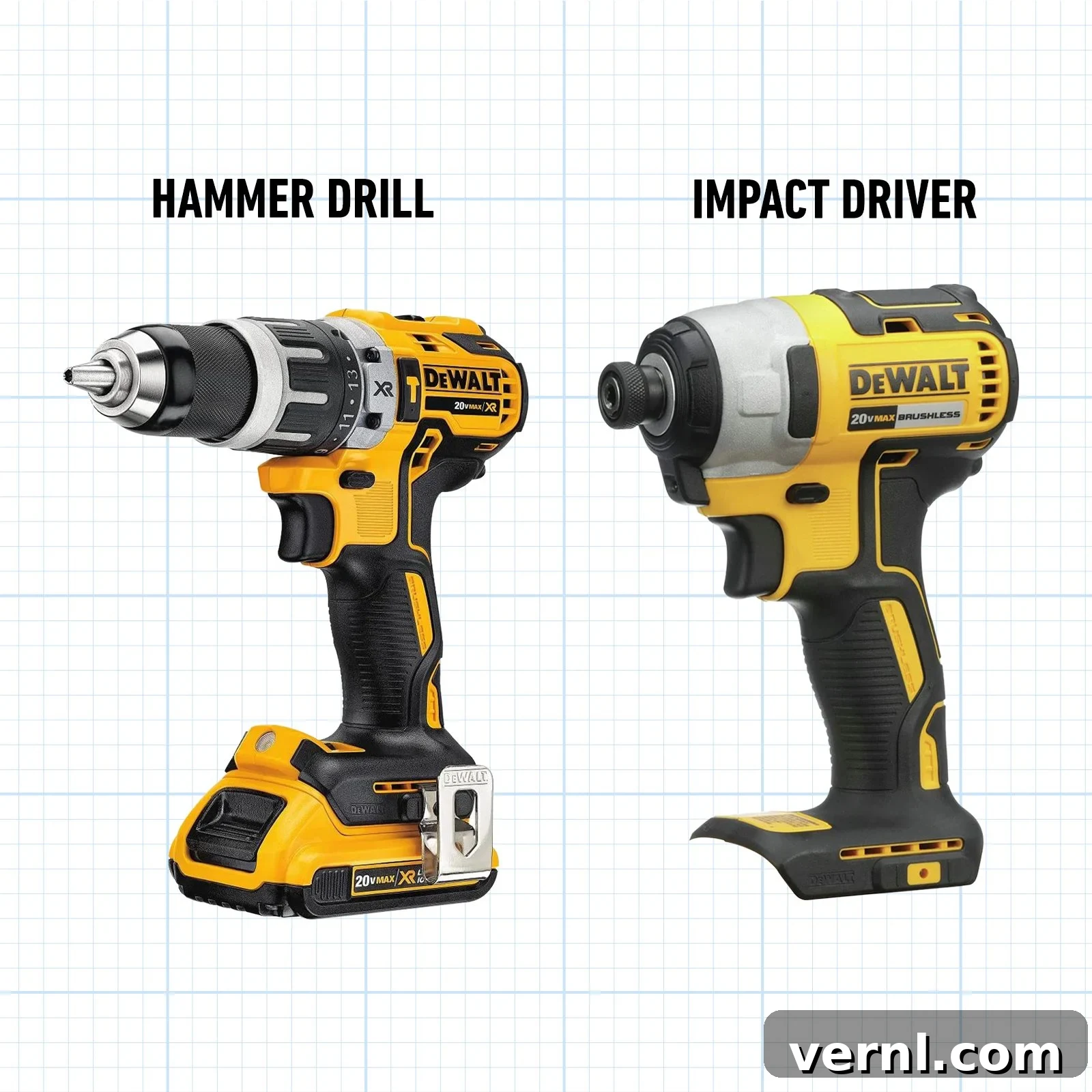
For both seasoned professionals and enthusiastic new DIYers, the world of power tools can sometimes feel like a maze, especially when encountering tools that appear similar but serve distinct purposes. Among the most frequently confused are hammer drills and impact drivers. This confusion is entirely understandable. Both are formidable, often loud, feature percussive striking mechanisms, and are designed to tackle challenging tasks involving drilling or driving fasteners.
However, beneath their surface similarities, these tools are fundamentally different. While they may share some operational aspects and even some overlapping functions, each possesses a unique set of strengths and weaknesses, making them indispensable for specific applications. Understanding these differences is crucial for selecting the right tool for the job, ensuring efficiency, preventing damage, and ultimately achieving professional-quality results in your home improvement projects.
What Exactly Is a Hammer Drill?
A hammer drill is a specialized type of power drill primarily engineered for boring holes through exceptionally tough and dense surfaces such as concrete, brick, stone, and mortar. At first glance, a hammer drill largely resembles a conventional power drill, featuring a standard chuck, a trigger for activation, and speed control settings. However, upon closer inspection and in operation, its enhanced power and robust construction become evident. They are generally larger and more robust than their standard drill counterparts. Like traditional drills, a hammer drill offers both clockwise and counterclockwise rotation, making it versatile for both drilling and driving light fasteners in non-hammer mode.
The defining characteristic of a hammer drill is its unique “hammer” setting. When activated, this mechanism creates a rapid, percussive forward and backward motion of the drill bit, in addition to its rotational spin. Internally, two corrugated discs engage, causing the chuck to strike the back of the drill bit repeatedly and forcefully along its axis. These axial strikes, often referred to as “blows,” literally punch the bit forward into the material with every rotation. The sheer force generated by this action allows the drill bit to chisel away at hard materials, making quick work of tasks that would be nearly impossible with a standard drill. Some advanced hammer drills are capable of delivering an astounding 48,000 blows per minute (BPM), enabling them to pulverize and penetrate even the most stubborn masonry with relative ease.
It’s important to note that while incredibly powerful, hammer drills are distinct from rotary hammers, which are even heavier-duty tools designed for larger demolition and drilling tasks in concrete. Hammer drills typically offer a clutch mechanism and variable speed control, allowing them to also function as regular drills for wood, metal, and plastics when the hammer function is disengaged. This dual functionality adds to their versatility, making them a valuable addition to many workshops.
Regarding cost, battery-operated hammer drills, favored for their portability and convenience, generally range from $100 to $250. Corded models, which often provide continuous power without battery limitations, typically fall between $75 and $200. Modern advancements in lithium-ion battery technology have significantly boosted the performance and run-time of cordless models, making them a popular choice for many users, though corded versions remain the preference for sustained, heavy-duty applications requiring maximum power.
What Exactly Is an Impact Driver?
An impact driver is a highly specialized power tool primarily designed for efficiently driving fasteners – such as screws, lag bolts, and other threaded hardware – into dense materials or for long durations. Unlike a hammer drill, which focuses on drilling, an impact driver excels at fastening tasks that would typically strain a conventional drill, making it a favorite among carpenters, cabinet installers, and anyone regularly working with fasteners.
One of the most distinguishing features of an impact driver is its chuck system. Instead of the typical three-jaw chuck found on standard drills, impact drivers utilize a quick-change, ball-bearing chuck. This specialized chuck is designed exclusively for hex-shank, impact-ready driver bits or drill bits. Standard drill bits with round shanks are incompatible with these chucks. This design allows for rapid bit changes and ensures a secure connection during high-torque applications. Physically, impact drivers are typically much shorter, more compact, and stubbier than standard drills or hammer drills, making them exceptionally maneuverable in confined spaces or awkward angles.
Similar to a standard drill, impact drivers can rotate fasteners clockwise for driving and counterclockwise for removal, and they operate at impressively high speeds. However, their true power is unleashed when the tool encounters resistance while driving a fastener. At this point, an internal mechanism automatically activates a rotational impact anvil. These anvil strikes, known as “impacts,” deliver short, powerful bursts of rotational force to the bit, significantly augmenting the torque. This unique mechanism allows impact drivers to drive longer and larger fasteners with far less effort and strain on the user than a standard drill could ever manage. Some high-performance impact drivers can generate up to 4,000 impacts per minute (IPM).
The rotational action of an impact driver is also quite ingenious in preventing stripped screws and cam-outs. While appearing to rotate continuously, the tool’s internal mechanism actually drives the bit forward a tiny amount before quickly twisting it backward slightly. This micro-reversal, often described as “two steps forward, one step back,” happens so rapidly that it’s virtually unnoticeable to the user. This intermittent action helps the driver bit maintain better contact with the fastener head, reducing slippage and ensuring a more secure drive, especially crucial when working with soft screw heads or dense materials.
The market for impact drivers is predominantly cordless, leveraging the benefits of portability and ease of use. Cordless impact drivers generally cost between $100 and $200 for a decent model. Corded impact drivers are quite rare, as their primary advantage lies in their compact, maneuverable design, which is best utilized without the tether of a power cord.
Hammer Drill vs. Impact Driver: What Are They Used For?
While both hammer drills and impact drivers are robust power tools designed to handle tough jobs, they are optimized for fundamentally different tasks. Understanding their specific strengths will guide you in choosing the appropriate tool for your project.
Hammer Drill Uses
The hammer drill truly shines when you need to bore holes into exceptionally hard and abrasive materials that would quickly dull or stall a conventional drill. If you’ve ever attempted to drill into concrete, brick, tile, or stone with a regular drill, you know the frustration of slow progress and often damaged bits. This is precisely where a hammer drill becomes indispensable. With its hammer function engaged, the drill rapidly punches the tip of the bit forward, chipping away at the material while simultaneously rotating to clear debris. This combined action makes what would otherwise be a tedious, monotonous, and often impossible task, remarkably efficient.
Some common and highly effective uses for hammer drills include:
- Starting and drilling clean holes into slippery surfaces like ceramic or porcelain tile, or glass backsplashes, using appropriate bits and techniques.
- Boring through basement concrete slabs or foundation walls to attach framing lumber, run conduit, or install anchors.
- Drilling precisely into concrete steps or patios for securely attaching handrails, railings, or decorative elements.
- Hanging heavy objects such as large TV wall mounts, robust shelving units, or pictures on interior or exterior brick walls where a strong anchor is required.
- Creating holes in a garage floor to permanently fix heavy power tool stands, workbenches, or machinery to the ground for stability and safety.
- Drilling necessary holes for attaching mechanical system brackets, plumbing fixtures, or electrical boxes to a concrete utility room floor or wall.
Note: To achieve optimal results and prevent damage to both the tool and the material, drilling through masonry surfaces with a hammer drill requires special carbide-tipped masonry bits, specifically designed to withstand the percussive forces and abrasive nature of these materials.
Impact Driver Uses
Impact drivers are engineered to deliver maximum rotational force in a compact package, making them the undisputed champions of driving fasteners. Their design is centered around efficiency and power, particularly when dealing with long, large, or stubborn screws and bolts. They excel where a standard drill would struggle, strip fasteners, or simply lack the torque to complete the job.
Common and highly effective uses for impact drivers include:
- Efficiently driving smaller to medium-sized screws into dense hardwoods or thick engineered wood products, where a standard drill might bog down or fail. (Caution: Their power can split thin wood, so adjust technique accordingly).
- Driving longer, heavy-duty screws, such as those used for hanging kitchen cabinets, securing decking, assembling large furniture, or other applications requiring substantial fastening power quickly and repeatedly.
- Fastening a deck ledger board to a house structure using lag bolts or structural screws, tasks that demand significant torque.
- Driving screws in notoriously tight or awkward spots, such as between closely spaced joists or studs, inside cabinets, or in other confined areas where a larger drill would be cumbersome or unable to fit. Their compact size is a major advantage here.
- Assembling flat-pack furniture or children’s playsets where hundreds of screws need to be driven quickly and securely, saving significant time and reducing hand fatigue.
- Breaking loose rusted or seized bolts and screws by applying rapid, high-torque impacts, which often succeed where continuous torque might fail.
Hammer Drill vs. Impact Driver: Key Differences Illuminated
While both tools generate powerful impacts, the nature and application of those impacts are fundamentally different. Understanding these distinctions is critical for selecting the optimal tool for your task. Let’s delve into the core differences between hammer drills and impact drivers:
- Impact Mechanism: The most significant difference lies in how they deliver their force. A hammer drill delivers axial impacts, pushing the drill bit forward into the material along its axis, like a miniature jackhammer. An impact driver delivers rotational impacts, twisting the fastener with bursts of torque around its axis, akin to rapidly hitting a wrench with a hammer.
- Primary Function: Hammer drills are designed primarily for drilling holes, especially into hard masonry. Impact drivers are designed primarily for driving fasteners, particularly screws and bolts, quickly and powerfully.
- Chuck Type and Bit Compatibility: Impact drivers feature a quick-change, hex-shank chuck that only accepts 1/4-inch hex-shank impact-ready bits. Hammer drills typically come with a standard 3-jaw chuck (keyed or keyless) that can accommodate a wide range of bits, including round-shank twist bits, spade bits, and specific masonry bits.
- Size and Ergonomics: Impact drivers are notably more compact, shorter, and lighter than hammer drills. This smaller form factor makes them vastly superior for working in tight spots, overhead, or in awkward angles where a bulkier hammer drill would be impractical.
- Power Control: Hammer drills often offer multiple speed and torque settings, providing greater versatility for various drilling tasks, and the hammer setting can be manually engaged or disengaged. Impact drivers typically rely on a pressure-sensitive trigger for variable speed control, and their impact mechanism engages automatically once a certain level of resistance is met, providing on-demand torque.
- Fastener Engagement: Due to their unique rotational impact action and the “two steps forward, one step back” motion, impact drivers are inherently better at maintaining consistent contact with the fastener head. This significantly reduces the likelihood of stripping screws or cam-out, even when the hammer setting on a hammer drill is disengaged, where continuous rotation still presents a higher risk of slippage.
- Versatility vs. Specialization: A hammer drill offers more versatility as it can function as a regular drill for wood and metal (by disengaging the hammer function) in addition to its masonry drilling capability. An impact driver is highly specialized for driving fasteners and is not suitable for most drilling tasks that require precision or larger diameter holes.
Choosing the Right Tool: A Decision Guide
Deciding between a hammer drill and an impact driver boils down to understanding the primary nature of your work. While some DIYers might find themselves needing both, identifying your most frequent tasks will guide your initial purchase.
- If your projects frequently involve drilling into concrete, brick, stone, or similar masonry materials for anchors, wiring, plumbing, or structural attachments, a hammer drill is your indispensable tool. Its percussive drilling action is unmatched for these challenging surfaces.
- If your work primarily consists of driving a high volume of screws, lag bolts, or other fasteners into wood, composite materials, or even light metal, especially long or large fasteners that bog down a regular drill, an impact driver is the clear choice. Its high torque and anti-strip mechanism will save you time, effort, and frustration.
- For general household tasks that involve a mix of light drilling (wood, metal, plastic) and occasional screw driving, a standard cordless drill might suffice, but if tough masonry drilling is on the horizon, consider a hammer drill. If you’re constantly driving fasteners for decks, fences, or cabinet installations, the impact driver will revolutionize your workflow.
- Consider the “one tool” scenario: If you can only afford one tool, and you expect to encounter masonry drilling, a hammer drill offers more versatility as it can also function as a regular drill. However, for serious fastener driving, it won’t replace an impact driver’s specialized capabilities.
Conclusion
The confusion surrounding hammer drills and impact drivers is a common hurdle for many, yet understanding their unique designs and applications is key to enhancing your efficiency and success in any DIY or professional project. While both are powerful tools that utilize striking mechanisms, a hammer drill excels at aggressively drilling holes into tough masonry, while an impact driver is the master of driving fasteners with unparalleled speed and torque, preventing stripping and reducing user fatigue.
By recognizing their distinct strengths – the hammer drill’s axial force for concrete and brick, and the impact driver’s rotational impacts for screws and bolts – you can confidently choose the right tool for the job. Investing in the correct power tool not only makes your work easier and faster but also ensures cleaner results and prolongs the life of your equipment. For serious DIYers and tradespeople, having both a hammer drill and an impact driver in your arsenal often proves to be the ultimate solution, providing a comprehensive toolkit capable of tackling a vast range of demanding tasks effectively.