Ensure Your Safety: A Comprehensive Guide to Tire Tread Depth and Maintenance
Your vehicle’s tires are its only point of contact with the road, making them paramount for your safety, handling, and fuel efficiency. Often overlooked, the condition of your tires, especially their tread depth, plays a critical role in how your car performs in various driving conditions. Neglecting tire maintenance, particularly ignoring worn treads, can lead to dangerous situations like hydroplaning, blowouts, and reduced braking capability, not to mention a noticeable dip in your vehicle’s fuel economy. This comprehensive guide will delve into what optimal tire tread depth means, how to accurately measure it, and why proactive tire care is essential for every driver.
Why Optimal Tire Tread is Crucial for Performance and Safety
The tread on your tires is more than just a pattern; it’s a sophisticated design engineered to provide grip, channel water away, and enhance overall driving dynamics. When tire treads wear down, their ability to perform these vital functions diminishes significantly, posing several risks:
- Reduced Grip and Handling: As tread depth decreases, the tire’s ability to maintain traction with the road surface, especially during cornering or braking, is severely compromised. This leads to a longer stopping distance and less responsive handling, increasing the risk of accidents.
- Hydroplaning Risk: In wet conditions, the grooves in your tire tread are designed to displace water from beneath the tire, allowing it to maintain contact with the road. Worn treads cannot effectively channel water, causing the tire to ride on a film of water—a phenomenon known as hydroplaning. This results in a complete loss of steering and braking control, making an accident almost inevitable.
- Increased Blowout Potential: Worn tires often have thinner rubber, making them more susceptible to punctures and structural failure. Over time, the internal components of a tire can weaken, and combined with excessive wear, the risk of a sudden and dangerous blowout increases dramatically, particularly at higher speeds.
- Decreased Fuel Economy: Tires with insufficient tread cause your engine to work harder to maintain speed. This increased rolling resistance means your vehicle consumes more fuel, directly impacting your wallet. For instance, a vehicle that typically achieves 33 miles per gallon (mpg) on new tires might see its efficiency drop below 30 mpg as its tires wear out.
The minimum legal limit for tire tread depth in many regions is 2/32 of an inch (approximately 1.6 mm). However, tire experts like Jason Banys, assistant district manager for Goodyear Tires, recommend paying close attention to your tire tread once its depth reaches 4/32 of an inch (approximately 3.2 mm). This proactive approach ensures you replace your tires before they become a safety hazard, offering a crucial buffer for wet weather performance.
Effective Methods for Measuring Tire Tread Depth
Regularly checking your tire tread depth is a simple yet vital habit for every driver. Fortunately, you don’t need specialized tools to get an accurate reading. Several methods, ranging from everyday items to dedicated gauges, can help you determine if your tires are safe for the road.
1. The Penny Test: A Simple and Reliable Check
The penny test is perhaps the easiest and most widely recognized method for quickly assessing tire tread depth, requiring nothing more than a U.S. penny. It’s a convenient on-the-go check that can tell you if your tires are at or below the legal minimum tread depth.
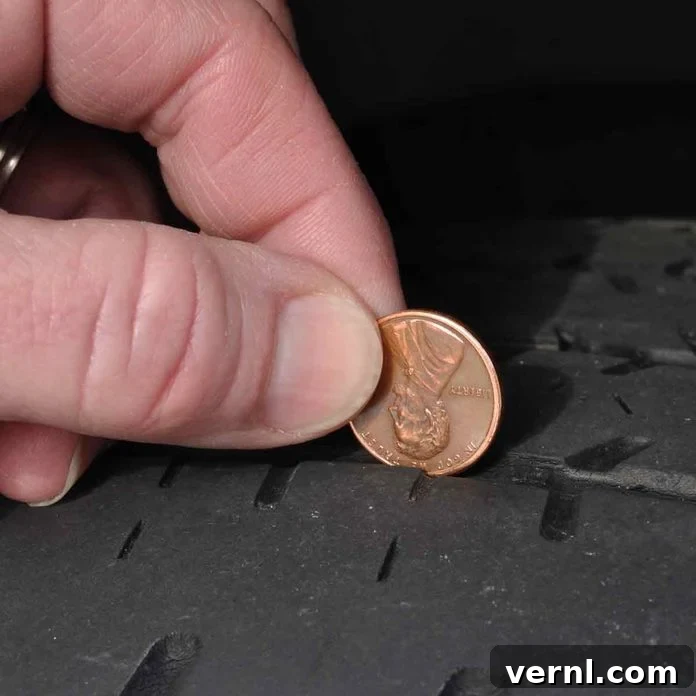
To perform the penny test, follow these steps:
- Locate several tread grooves around your tire, ensuring you check different areas, especially where wear might be most prominent.
- Insert a penny into one of the deepest tread grooves with Abraham Lincoln’s head upside down and facing you.
- Observe how much of Lincoln’s head is visible.
Interpretation: If you can see all of Lincoln’s head, your tire tread depth is less than 2/32 of an inch. At this point, your tires have reached their legal limit and must be replaced immediately to ensure your safety and comply with regulations.
2. The Quarter Test: An Early Warning System
While the penny test tells you when your tires are legally worn out, the quarter test provides an excellent early warning, signaling when your tires are nearing the replacement stage. It helps you monitor your tires proactively, aligning with Goodyear’s recommendation to consider replacement around 4/32 of an inch.
To conduct the quarter test:
- Find a good tread groove, preferably one that appears somewhat worn.
- Place a U.S. quarter into the tread groove with George Washington’s head upside down.
Interpretation: If the tread touches Washington’s head, you have at least 4/32 of an inch of tread remaining. This indicates your tires are still within a safe range, particularly for dry conditions, but it’s a good time to start researching and budgeting for new tires, especially if you frequently drive in wet or snowy conditions. If the tread does not touch Washington’s head, your tires are likely below 4/32 of an inch and should be replaced soon.
3. Utilizing a Tire Tread Depth Gauge: Precision at Your Fingertips
For the most accurate and precise measurement of your tire tread depth, a dedicated tire tread depth gauge is an invaluable tool. These gauges are inexpensive, readily available at any auto parts store for around $5, and provide measurements in 32nds of an inch (or millimeters).
To use a tire tread depth gauge:
- Push the gauge’s probe into the deepest part of a major tread groove until the base of the gauge is flush with the tire’s surface.
- Read the measurement indicated on the gauge.
- Repeat this process at various points around each tire, as tires can wear unevenly. Note down the lowest measurement you find.
Measuring in multiple locations is crucial because factors like improper inflation, misalignment, or unbalanced wheels can cause uneven wear patterns. The lowest measurement you record is the most critical for determining your tire’s overall safety and replacement urgency.
4. Identifying Built-in Tread Wear Indicators (Tread Bars)
Most modern tires come equipped with built-in tread wear indicators, also known as “wear bars” or “tread bars.” These are small, raised bars molded into the tread grooves themselves, typically at a depth of 2/32 of an inch from the bottom of the groove.
To check for tread wear indicators:
- Visually inspect your tire treads across the width of the tire.
- Look for these small, smooth bars that appear perpendicular to the main tread grooves.
Interpretation: When your tire tread wears down to become flush or even with these indicator bars, it signifies that your tire has reached the legal minimum tread depth of 2/32 of an inch. At this point, the tire should be replaced immediately. These indicators offer a clear, unambiguous visual cue that your tires are no longer safe for operation.
When to Replace Your Tires: Beyond Tread Depth
While tread depth is a primary indicator for tire replacement, it’s not the only factor. Drivers often ignore their tires until performance becomes noticeably poor or, worse, until a dangerous situation arises. Adopting a routine of comprehensive tire maintenance, including visual inspections, can help you identify other critical signs that your tires need attention.
- Obvious Tread Depth: As established, replace your tires when the tread depth reaches 2/32 of an inch or less, using any of the methods described above. For optimal safety, especially in wet conditions, consider replacement when tread depth drops to 4/32 of an inch.
- Bulges or Blisters in the Sidewall: If you observe any bulges or blisters on the sidewall of your tire, it indicates that the tire’s internal structure has been compromised. This could be due to impact damage (e.g., hitting a pothole) or manufacturing defects. A bulge is a critical safety hazard and a precursor to a sudden tire blowout. If you find one, replace the tire immediately.
- Cracks in the Sidewall: Cracks, cuts, or weathering in the sidewall are signs of tire deterioration, often caused by exposure to UV light, extreme temperatures, or simply age. These cracks, often referred to as “dry rot,” weaken the tire’s structural integrity and can lead to air leaks or blowouts. Like bulges, severe sidewall cracking means the tire needs urgent replacement.
- Excessive Vibrations: If you notice unusual vibrations through the steering wheel or the car’s floor, especially at certain speeds, it could be a sign of uneven tire wear, an unbalanced tire, or even internal tire damage. While vibrations can stem from other vehicle issues, faulty tires are a common culprit and should be checked promptly.
- Decreased Ride Comfort: A noticeable decrease in ride comfort, where you feel every bump in the road more acutely, can indicate that your tires have lost their cushioning ability due to wear or improper inflation.
- Age of Tires: Even if your tires have sufficient tread depth, they have a limited lifespan. Rubber components degrade over time, regardless of mileage. Most manufacturers recommend replacing tires every 6 to 10 years from their manufacturing date (found in the DOT code on the sidewall), even if they appear to be in good condition.
Comprehensive Tire Maintenance for Extended Life and Safety
Extending the life of your tires and ensuring consistent safety involves more than just checking tread depth. A holistic approach to tire maintenance can prevent premature wear, improve handling, and save you money in the long run.
- Regular Tire Pressure Checks: Maintaining correct tire pressure is paramount. Underinflated tires generate excessive heat, accelerate tread wear on the outer edges, reduce fuel efficiency, and increase the risk of blowouts. Overinflated tires can cause premature wear in the center of the tread and lead to a harsher ride. Check your tire pressure at least once a month and before long trips, using the recommended pressure found in your vehicle’s owner’s manual or on a sticker inside the driver’s side door jamb.
- Tire Rotation: Rotating your tires regularly (typically every 5,000 to 8,000 miles) helps ensure even wear across all four tires. Different positions on the vehicle cause tires to wear differently. Regular rotation prevents one tire from wearing out significantly faster than the others, thus maximizing the overall lifespan of your tire set.
- Wheel Balancing: Unbalanced wheels can lead to vibrations, premature wear, and strain on your vehicle’s suspension components. If you experience vibrations, especially at highway speeds, have your wheels balanced by a professional. This involves adding small weights to the rim to distribute the tire and wheel assembly’s weight evenly.
- Wheel Alignment: Proper wheel alignment ensures that your tires are correctly oriented with the road and with each other. Misalignment can cause rapid and uneven tread wear, pulling to one side, and poor steering response. If you notice uneven wear patterns (like excessive wear on one side of the tire) or your vehicle pulls to one side, have your alignment checked by a qualified technician.
FAQ: Your Questions About Tire Care Answered
How often should I check my tire tread?
According to Jason Banys from Goodyear, it’s recommended to check your tire tread depth every 3,000 miles (approximately 5,000 km). You should increase the frequency of checks, examining them more often, once the depth reaches 4/32 of an inch, as this indicates they are approaching replacement status.
What are other critical signs your tires may need repair or replacement?
Beyond tread depth, obvious signs like severe cracks, cuts, or bulges in the sidewalls necessitate immediate replacement. Other indicators include experiencing a shaky or rough ride, feeling every minor bump in the road, strange noises coming from the tires, or a significant decrease in your vehicle’s fuel mileage. Any of these symptoms warrant a professional inspection.
What causes uneven tire wear?
Uneven tire wear is often a sign of underlying issues that need addressing. Common causes include improper tire inflation (under- or over-inflation), misaligned wheels, unbalanced tires, worn suspension components, or improper tire rotation practices. Addressing these issues promptly can save your tires and improve your vehicle’s performance.
Can I mix different brands or types of tires on my vehicle?
It is generally not recommended to mix different brands, types (e.g., all-season with winter tires), or even tread patterns on your vehicle. Mixing tires can adversely affect handling, braking, and overall vehicle stability, as tires with different characteristics will react differently to road conditions. For optimal safety and performance, always use four matching tires.
How does tire pressure specifically affect tread wear and fuel economy?
Incorrect tire pressure is a leading cause of premature and uneven tread wear. Underinflated tires put more pressure on the outer edges of the tread, causing them to wear faster, while overinflated tires wear out more quickly in the center. Both scenarios reduce the tire’s lifespan. From a fuel economy standpoint, underinflated tires increase rolling resistance, forcing your engine to work harder and consume more gasoline. Maintaining the manufacturer’s recommended tire pressure is crucial for both tread longevity and fuel efficiency.
For additional maintenance tips, learn how to clean car tires to keep them looking their best and prevent premature aging.
About the Expert
- Jason Banys serves as the assistant district manager for Goodyear Tires, bringing extensive expertise in tire technology and maintenance.