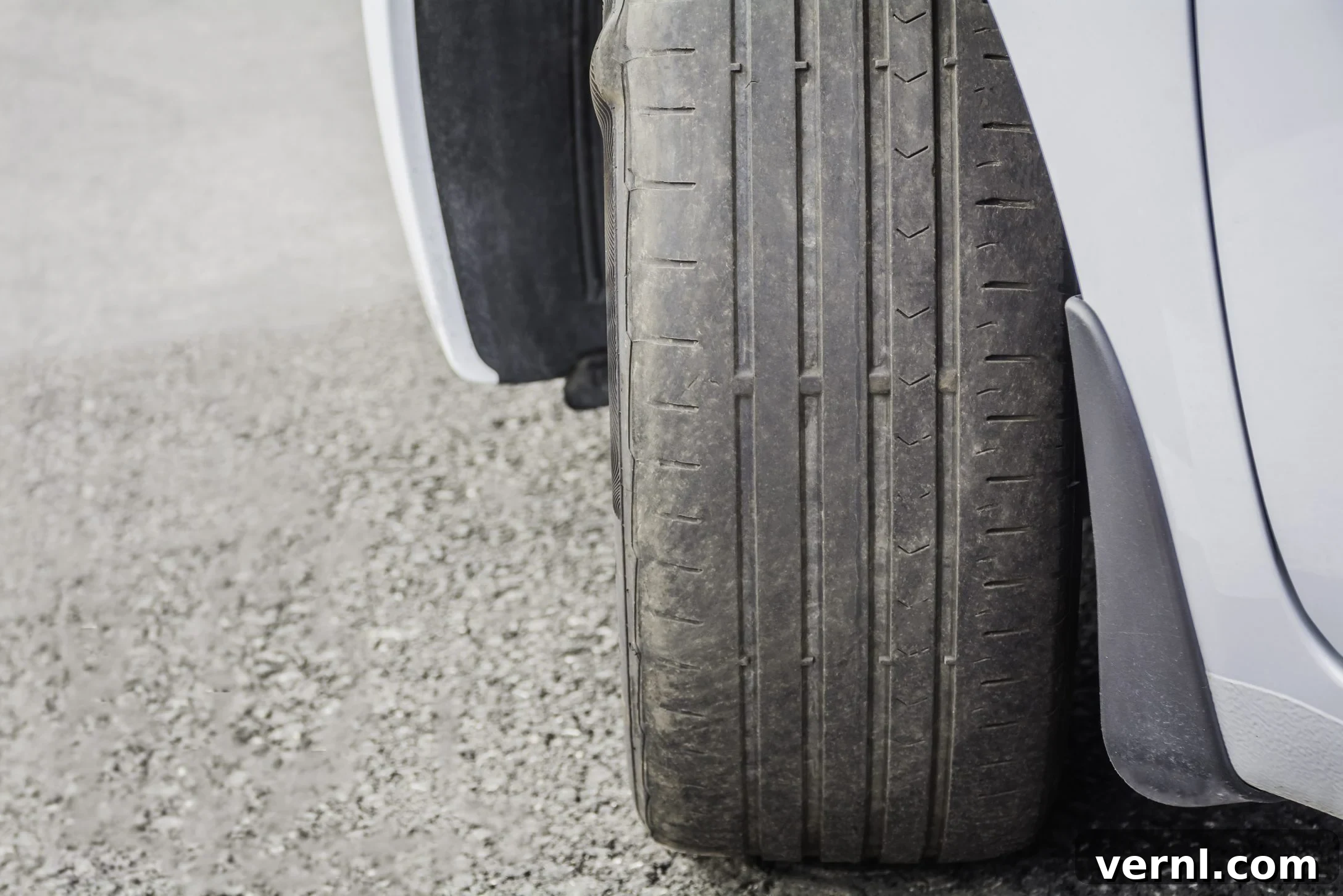
Your vehicle’s tires are more than just rubber rings; they are the sole point of contact between your car and the road. Working in crucial harmony with your braking and suspension systems, they form the bedrock of your car’s most essential safety features. Understanding and proactively monitoring tire wear is not just about extending the life of your tires; it’s a critical practice that directly impacts your safety, the safety of your passengers, and the overall performance of your vehicle.
The small area where your tire meets the road is known as the contact patch or footprint. Despite its vital role, this patch is surprisingly no larger than the palm of your hand for each tire. It is precisely engineered to match the size and weight of your specific vehicle, distributing its mass and handling all forces of acceleration, braking, and turning. When tires experience uneven wear, the effective contact area between the tire and the road is significantly reduced. This compromised contact translates directly into decreased steering control, extended stopping distances, and a heightened risk of hydroplaning in wet conditions, making timely diagnosis and correction paramount for road safety.
Regularly inspecting your tires should be an integral part of your vehicle maintenance routine. When performing these checks, always look for any signs of an uneven wear pattern across the tire’s tread. Subtle irregularities can be early indicators of underlying issues that, if left unaddressed, can lead to severe problems and costly repairs. If you observe considerable wear in specific areas, especially if the tread depth falls below the safe limit (typically 2/32 inches or 1.6 mm, though 4/32 inches is often recommended for optimal performance), tire replacement may be the only safe and viable option. Prompt action ensures your vehicle remains reliable and safe on the road.
Understanding the different types of tire wear patterns can help you diagnose problems early, potentially saving you money and preventing hazardous driving conditions. Each pattern tells a story about what’s happening with your tires or your vehicle’s mechanical systems. Here are five of the most common tire wear patterns and what they typically indicate:
Center Wear
Center wear, characterized by excessive tread loss predominantly in the middle section of the tire, is almost always a direct result of overinflation. When a tire is inflated beyond its recommended pressure, the central portion of the tread bulges outwards, bearing the majority of the vehicle’s weight and road contact. This leads to accelerated wear in the middle while the outer edges remain relatively intact. Beyond the visible wear, an overinflated tire drastically compromises ride comfort, making for a rough and jarring experience due to its reduced ability to absorb road imperfections. More critically, it diminishes the effectiveness of your braking and steering. The smaller, stiffer contact patch reduces overall grip, meaning longer stopping distances and a less responsive steering feel, which can be particularly dangerous in emergency maneuvers. Furthermore, overinflated tires are more susceptible to impact damage from potholes or road debris, increasing the risk of punctures or sidewall bulges due to increased tension on the tire’s structure.
Outer Edge Wear
Conversely, rapid wear occurring on both outer edges of a tire is a classic symptom of underinflation or persistently low tire pressure. When a tire lacks sufficient air, it sags in the middle, causing the tire’s shoulders (outer edges) to flex and support more of the vehicle’s weight and make more contact with the road surface. This increased friction and load on the edges accelerate tread wear there. Driving on underinflated tires not only significantly reduces your fuel economy due to increased rolling resistance but is also extremely dangerous. The constant excessive flexing of the tire sidewalls generates considerable heat. This heat buildup weakens the tire’s internal structure, leading to delamination and, ultimately, a catastrophic blowout, especially at highway speeds. A tire blowout at speed can result in a sudden loss of control, potentially causing serious accidents. Checking tire pressure regularly and inflating to the manufacturer’s recommended specifications is a simple yet crucial safety measure.
Excessive Inner or Outer Wear
When you observe significant wear on only one side of the tire – either the inner or outer edge – it’s a strong indicator of a wheel alignment problem. Proper wheel alignment ensures that all four wheels are parallel to each other and perpendicular to the ground, allowing for optimal handling, tire longevity, and fuel efficiency. This specific wear pattern usually points to issues with the camber angles or toe settings.
Camber refers to the inward or outward tilt of the wheel when viewed from the front of the car. If the top of the wheel tilts too far inward (negative camber) or too far outward (positive camber), it concentrates pressure on one edge of the tire, causing uneven wear. For example, excessive negative camber will wear the inner edge, while excessive positive camber will wear the outer edge.
Toe-in or toe-out measurements describe the angle or distance between the front of the tires on the same axle when viewed from above. If the front of the tires point inward (toe-in) or outward (toe-out) too much, the tires will continuously scrub against the road as you drive straight, leading to feathered or excessive wear on either the inner or outer edge. This constant scrubbing reduces tire life and impacts steering stability.
While caster, the third major alignment angle, primarily influences steering stability and the vehicle’s ability to track straight, it rarely causes abnormal tire wear itself. However, if caster is severely out of spec, it can lead to your car pulling to one side or creating general steering difficulties, which might indirectly contribute to driver overcorrection and subsequent uneven tire stress. Addressing alignment issues promptly is crucial for safety and tire longevity.
Cupping
Cupping, also commonly referred to as scalloping, manifests as a series of patchy, scooped-out worn sections around the tire’s circumference. This distinctive pattern resembles cups or indentations and is almost invariably a tell-tale sign of a compromised suspension system. Specifically, it points to worn shock absorbers or struts. Shocks and struts are vital components designed to dampen the vertical motion of your vehicle’s wheels. When they are worn out, they lose their ability to control the tire’s up-and-down movement effectively, causing the tire to bounce excessively on the road surface rather than maintaining constant contact. Each bounce, or “skip,” results in a localized area of increased pressure and wear, leading to the characteristic cupped pattern.
Cupping is a serious problem that necessitates immediate attention. Beyond tire wear, worn shocks or struts can lead to reduced braking efficiency, poor handling, excessive body roll during turns, and a general lack of vehicle control, especially on rough roads. It’s imperative to have your vehicle’s suspension system inspected by a qualified mechanic without delay. Any worn or damaged parts, such as shocks, struts, or bushings, should be replaced promptly. After suspension repairs, it’s highly recommended to get a wheel alignment to ensure proper geometry. Additionally, having your tires rotated and balanced can help distribute any remaining wear more evenly across the tire’s surface, potentially extending its useful life after the underlying suspension issue is fixed. Understanding the difference between tire alignment and balance is key to proper tire care.
Feathering
Feathering is a tire wear pattern that you might feel or hear before you visibly notice it. It often results in a distinct noise, sometimes described as a “sawtooth” sound, particularly noticeable at lower speeds. To identify feathering, run your hand across the tread block both ways – you’ll feel that one edge of the tread block is sharper or higher than the other, creating an angled or sharply diagonal wear pattern across the tire’s surface. It’s like the tread blocks have been progressively scrubbed in one direction.
Fortunately, feathering is almost always an indication of an out-of-spec wheel alignment, specifically an issue with the toe settings. When the toe-in or toe-out is incorrect, the tires continuously scrub sideways as the vehicle moves forward, grinding down one edge of each tread block more than the other. This constant lateral friction causes the characteristic feathered edge. The good news is that a professional wheel alignment is a straightforward and relatively easy remedy for this condition. Once aligned, the tires should begin to wear evenly again. However, feathering can also occur as a result of aggressive driving habits, particularly consistently taking corners at high speeds. The intense lateral forces generated during hard cornering can scrub the tires unevenly, mimicking the effects of poor alignment. If feathering has caused excessive wear, reducing the tread depth significantly, it may be necessary to replace your tires to ensure optimal safety and performance, even after correcting the alignment or driving habits.
Additional Causes of Uneven Tire Wear
While the five patterns above cover many common issues, several other factors can contribute to or exacerbate uneven tire wear, often involving components that work in tandem with your tires and suspension. These issues highlight the interconnectedness of your vehicle’s systems:
- Worn or Damaged Suspension System Linkage and Components: Beyond just shocks and struts, other parts of your suspension system can significantly impact tire wear. Worn ball joints, control arm bushings, tie rod ends, or bent steering linkages can lead to excessive play or improper wheel angles. This instability and misalignment can directly cause excessive inner or outer tire wear, as well as lead to feathering and cupping by allowing the tire to move erratically or maintain an incorrect angle relative to the road. These components are critical for maintaining proper wheel geometry and should be inspected during any alignment check.
- Often Overlooked Mechanical Causes:
- Over-torqued Lug Nuts: While seemingly minor, lug nuts that are tightened too much can warp the wheel hub or rotor, causing the wheel to sit unevenly on the axle. This slight misalignment can induce vibrations and lead to uneven tire wear over time.
- Rust Build-up: Accumulation of rust between disk brake rotors and wheel hubs can prevent the wheel from sitting perfectly flush against the hub. Even a small amount of rust can create an imbalance, leading to vibrations and localized tire wear.
- Bent or Damaged Wheels: A wheel that has been bent or damaged, perhaps from hitting a pothole or curb, can no longer spin perfectly true. This eccentricity causes the tire to wobble, creating uneven pressure points and accelerated wear.
- Worn Wheel or Hub Bearings: Wheel bearings allow your wheels to spin freely. If these bearings become worn, they can introduce excessive play in the wheel, causing it to wobble and resulting in irregular tire wear patterns, often accompanied by humming or grinding noises.
It’s crucial to ask your mechanic to carefully examine all these crucial mechanisms as part of a comprehensive pre-alignment check or during routine service to catch potential problems before they escalate.
- Flat Spots in the Middle of a Tire: If you notice distinct flat spots localized in the middle of a tire, this is highly indicative of brake problems. Consistently slamming the brakes, especially during emergency stops, can cause the tire to skid and wear down rapidly in one area. More commonly, underlying hydraulic or mechanical issues within the braking system—such as a seized brake caliper, a malfunctioning master cylinder, or an ABS system fault—can cause a specific wheel to brake lock-up or apply pressure unevenly. This results in localized, accelerated wear in the form of flat spots. Whether your vehicle is equipped with standard brakes or an anti-lock braking system (ABS), persistent flat spots require immediate professional attention to diagnose and repair the underlying braking issue, preventing further tire damage and ensuring safe stopping performance.
How To Prevent Uneven Tire Wear
Preventing uneven tire wear is a multi-faceted approach that combines diligent maintenance, responsible driving habits, and regular professional checks. By integrating these practices into your routine, you can significantly extend the lifespan of your tires, enhance your vehicle’s safety, and improve overall driving performance:
- Practice Defensive Driving and Avoid Road Hazards: Be mindful of your driving environment. Avoid potholes, speed bumps taken too quickly, and certainly bouncing off curbs. These impacts can cause immediate damage to your tires and wheels, bend suspension components, or knock your alignment out of specification, initiating a cascade of uneven wear.
- Schedule Annual Wheel Alignment Checks: Get your vehicle’s wheel alignment checked at least once a year. This is particularly important after a rough winter season, which can be brutal on roads and thus on your vehicle’s suspension. An annual check ensures that the camber, caster, and toe angles are within manufacturer specifications, preventing the kind of scrubbing that leads to feathered or uneven edge wear.
- Adopt Smooth Driving and Braking Habits: Aggressive driving, characterized by rapid acceleration, hard cornering, and sudden braking, puts immense stress on your tires. These forces cause exaggerated friction and localized wear. By accelerating gently, cornering smoothly, and braking progressively, you distribute wear more evenly across the tire’s surface, preserving tread life.
- Rotate Your Tires Regularly: Implement a tire rotation schedule every six months or approximately every 6,000 to 8,000 miles, or as recommended by your vehicle manufacturer. Tire rotation involves moving each tire to a different position on the vehicle (e.g., front to back, or in a cross-pattern). This practice ensures that all four tires wear at a more consistent rate, as each wheel position experiences different loads and stresses. Regular rotation also contributes to quieter operation and significantly prolongs the overall lifespan of your tire set.
- Rebalance Tires When Necessary: If you begin to notice vibrations or shaking, particularly at medium to highway speeds, it’s a strong indicator that one or more of your tires may be out of balance. This could be due to a lost wheel weight, tire damage, or uneven wear that has created an imbalance. Have your tires rebalanced promptly; unbalanced tires not only cause uncomfortable vibrations but also accelerate uneven tire wear and can stress suspension components.
- Maintain Optimal Tire Pressure: Adhere strictly to your vehicle manufacturer’s recommended tire pressure specifications, which can typically be found on a sticker inside the driver’s side door jamb or in your owner’s manual. Make checking your tire pressure a consistent part of your monthly maintenance routine. Properly inflated tires are not only safer and provide better handling but also significantly extend tire life and improve fuel efficiency. Invest in essential tools for tire care: a reliable tire tread depth gauge to monitor wear, an accurate tire air pressure gauge for monthly checks, and a portable tire inflator for convenient top-ups. Crucially, replace any tire with a tread depth measuring 4/32-inch or less, as reduced tread dramatically compromises grip, especially in wet conditions.