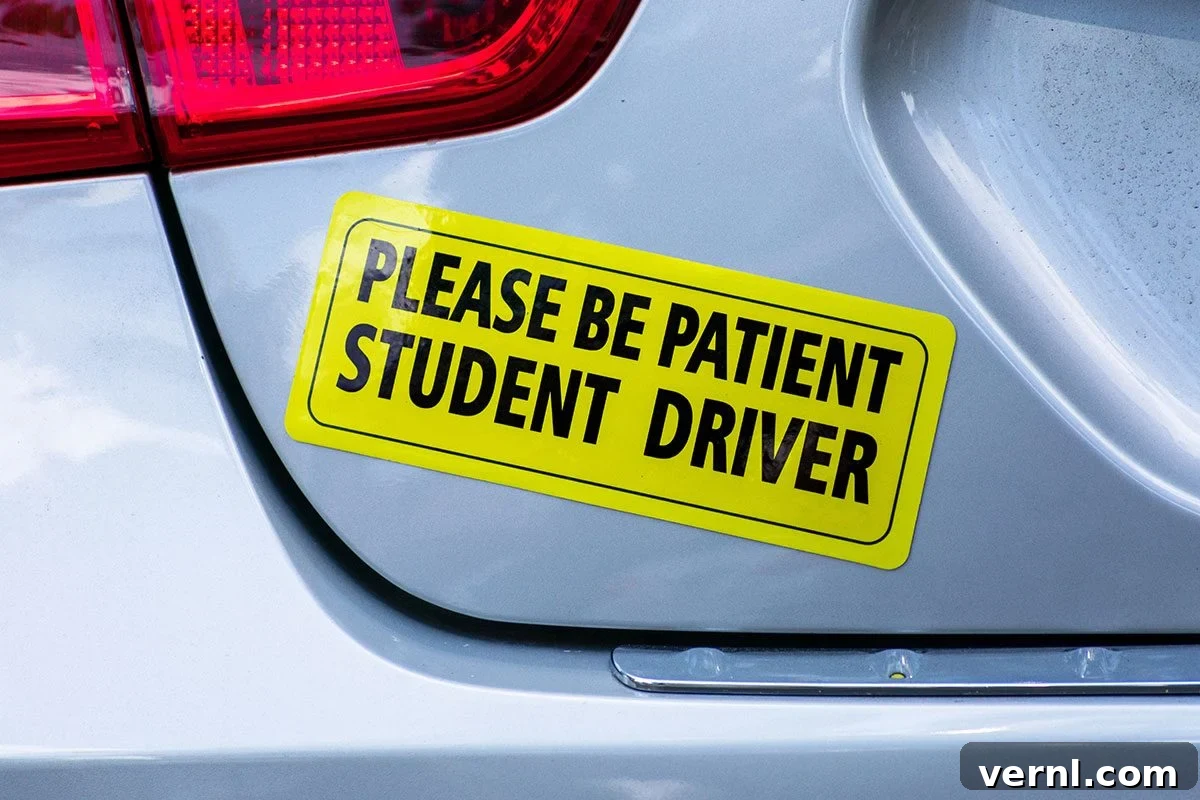
The road can be an unpredictable place, a dynamic environment shared by drivers of all experience levels. Among the familiar sights – sleek sports cars, bustling delivery vans, and everyday family sedans – you might occasionally spot a vehicle adorned with a distinctive label: a “student driver” sticker. This small, often brightly colored decal, usually placed near a car’s rear, quietly signals to the world that the person behind the wheel is still in the learning phase, navigating the nuances of traffic laws and developing essential driving skills. But what exactly does this sticker signify? Is it a legal requirement, a helpful courtesy, or perhaps something else entirely? Many new drivers and curious motorists alike ponder the true implications of these seemingly simple markers.
To demystify the world of student driver stickers and understand their real-world impact, we turned to an expert in driving education. Lucas Waldenback, co-founder of Zutobi, a prominent platform dedicated to driving education, shares his valuable insights on what these stickers mean for learner drivers, other road users, and the overall learning process. His perspective helps us explore whether these stickers are a crucial aid or merely an optional accessory in the journey towards becoming a proficient and safe driver.
What Exactly Is a Student Driver Sticker?
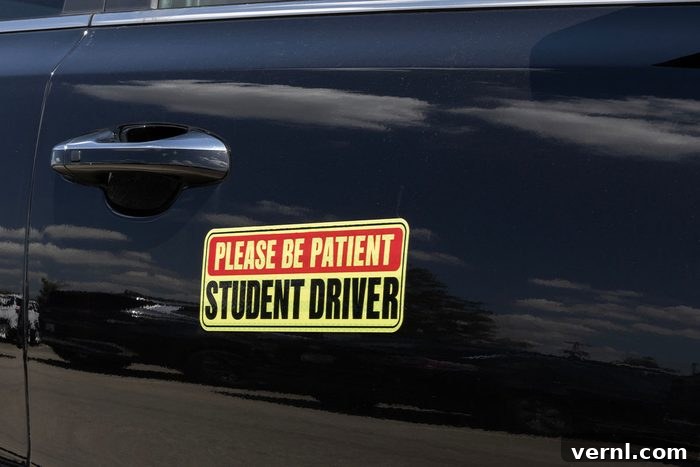
At its core, a student driver sticker is a visual cue, a small but intentional notification to other motorists that the operator of the vehicle is an inexperienced learner. Typically rectangular or triangular, and often featuring bold text or a recognizable symbol, these stickers are usually affixed to the rear bumper, window, or trunk of a car. Their primary function is to communicate a simple message: “Please exercise patience, as the driver inside is still learning the ropes.”
Lucas Waldenback elaborates on this intention: “It’s meant to promote patience and understanding from other road users. The idea is that if someone sees a student driver sticker, they might be more inclined to give that vehicle extra space, avoid aggressive maneuvers, or simply be more forgiving of minor hesitations or mistakes that a new driver might make.” The hope is that this consideration can create a less stressful environment for the learner, allowing them to focus on developing their skills without the added pressure of impatient or aggressive drivers.
However, Waldenback also offers a crucial caveat regarding their actual importance. “While some see value in it, we don’t consider it a crucial part of the learning process. Drivers are still responsible for their actions, and it’s better to focus on building real-world skills rather than relying on a sticker to ‘warn’ others.” This perspective underscores an important point: a sticker, no matter how well-intentioned, cannot substitute for comprehensive driver education, extensive practice, and a deep understanding of road rules and safety principles. It serves as a polite request, not a shield from responsibility or an excuse for negligence. The true foundation of safe driving lies in skill, awareness, and adherence to traffic laws, which must be cultivated through rigorous training and supervised practice.
Are Student Driver Stickers Mandated by Law? The Legal Landscape
The question of whether student driver stickers are legally required is a common one, and the answer, like many things in traffic law, is nuanced and depends significantly on location. In most states across the United States, displaying a student driver sticker is entirely voluntary. Unlike learner’s permits, which are universally mandated for new drivers to operate a vehicle under supervision, these stickers typically fall outside the realm of legal obligation.
However, there’s a notable exception that highlights the unique legal intricacies from state to state. According to Freeway Insurance, New Jersey stands out as the only state where individuals holding a learner’s permit are legally required to display identification stickers on their vehicles. This specific mandate, often referred to as “Kyleigh’s Law,” was enacted to enhance safety and increase the visibility of new drivers, especially those under a provisional license. In New Jersey, these are typically red, reflective decals affixed to both the front and rear license plates, serving as a clear and unmistakable identifier for other motorists and law enforcement. Failure to display these decals can result in fines and other penalties, underscoring their legal importance within that particular state.
Beyond New Jersey, the situation is different. “Anyone who is in the process of learning to drive can use one,” Waldenback confirms, emphasizing the optional nature elsewhere. Yet, he maintains a pragmatic view on their overall necessity. “However, I personally think it’s not necessary. If you’re getting proper driving lessons and practicing under supervision, your skills and awareness on the road will do a lot more to ensure safety than a sticker ever could.” This highlights a core philosophy in driving education: while external aids might offer a psychological comfort, true safety is built from within, through competence and confidence fostered by rigorous training and hands-on experience in diverse driving conditions.
It’s crucial for learner drivers and their supervisors to research their specific state’s Department of Motor Vehicles (DMV) regulations to understand all requirements for learner’s permits, including any potential restrictions on driving hours, passenger limits, or, in rare cases like New Jersey, identification markings. These legal requirements, unlike optional stickers, carry direct consequences for non-compliance and are integral to the responsible and legal operation of a vehicle by a novice driver.
Do Student Driver Stickers Have Any Legal Impact? Beyond a Warning
Despite their intention to signal a driver’s inexperience, student driver stickers carry no direct legal weight or provide any special exemptions under traffic law. This is a critical point that learner drivers and their supervisors must understand to avoid any misconceptions about responsibility on the road.
“While it might encourage others to drive more cautiously, it doesn’t change the fact that learner drivers are still subject to the same road rules as any other driver,” explains Lucas Waldenback. This means that whether a vehicle has a student driver sticker or not, the driver behind the wheel – and often their supervising licensed adult – is fully accountable for adhering to speed limits, traffic signals, road signs, and all other regulations governing vehicle operation.
In practical terms, if a new driver, even one displaying a student sticker, commits a traffic violation such as speeding, running a red light, or failing to yield, they will face the same legal repercussions as any other licensed driver. These consequences can include traffic tickets, fines, points on their driving record (even if provisional), and potentially even suspension of their learner’s permit. The sticker does not grant immunity or a ‘get out of jail free’ card for infractions.
However, there’s a human element to law enforcement that sometimes comes into play. A police officer, upon noticing a student driver sticker, *may* be more inclined to exercise discretion in cases of very minor violations. For instance, a slight hesitation at a stop sign or a minor lane deviation might result in a warning rather than a ticket, especially if the officer perceives the driver is genuinely learning and not driving recklessly. This is purely at the officer’s discretion and should never be relied upon. More serious violations, or those indicating dangerous driving, will almost certainly lead to standard enforcement action, regardless of the sticker’s presence.
Furthermore, it’s important to remember that in many jurisdictions, the supervising licensed adult present in the vehicle with a learner driver also bears legal responsibility. They are expected to be attentive and capable of intervening if necessary. In some cases, if a learner driver causes an accident or commits a serious violation, the supervisor may also face legal consequences, depending on the specific laws of the state. Therefore, the sticker is purely an informational tool, not a legal shield, and proper adherence to all traffic laws remains paramount for both the learner and their supervisor.
Do Student Driver Stickers Have Any Insurance Implications? Myth vs. Reality
One common misconception among new drivers and their families is that displaying a student driver sticker might somehow impact their car insurance rates. The reality, as explained by Lucas Waldenback, is that these stickers have virtually no direct bearing on insurance premiums.
“Student driver stickers don’t directly affect your insurance rates,” Waldenback states unequivocally. “What matters to insurers is how you drive and whether you follow the learner driver requirements (like having a licensed adult with you). A sticker doesn’t change the fundamentals of how your insurance is structured.”
Insurance companies primarily assess risk based on concrete factors. When it comes to a new driver, especially one with a learner’s permit, insurers look at several key elements:
- The addition of a new driver to the policy: This is the most significant factor. Adding a young, inexperienced driver (even with a learner’s permit) to an existing policy almost always leads to an increase in premiums because new drivers are statistically at a higher risk of accidents.
- Age and driving experience: Younger drivers, regardless of a sticker, face higher rates due to their limited experience.
- Driver’s education completion: Some insurance companies offer discounts if a learner driver completes an accredited driver’s education course. This is because formal training is seen as reducing risk, unlike a sticker.
- Driving record of the supervising adult: The driving history of the licensed adult supervising the learner can also play a role, as they are legally responsible during the learning phase.
- Type of vehicle: The make, model, age, and safety features of the car being driven by the student can also influence rates.
- Claims history: Any accidents or traffic violations involving the learner driver (even with a permit) will undoubtedly impact future premiums.
A student driver sticker is simply a passive indicator; it doesn’t provide any data that an insurance company uses to calculate risk. It doesn’t prove that a driver is more careful, nor does it quantify their skill level. Insurers are interested in verifiable facts and statistical probabilities, not anecdotal signals. Therefore, while families should definitely communicate with their insurance provider when a new driver begins to learn or obtains a permit to ensure proper coverage, they can rest assured that the decision to display a student driver sticker will not be a factor in their premium calculations.
Do Student Driver Stickers Even Work? Effectiveness and Driver Psychology
The core question regarding student driver stickers isn’t their legality or insurance implications, but rather their effectiveness in achieving their intended purpose: promoting patience and understanding on the road. The answer, it turns out, is far from straightforward and often depends on individual perception and the behavior of other drivers.
Waldenback notes the anecdotal nature of their perceived success. “He has had some of his driving students tell him anecdotally that they feel more comfortable driving with a student driver sticker when they are starting out, but not all of them.” For some, the sticker acts as a psychological buffer, providing a sense of reassurance that other drivers might be more understanding if they make a mistake or drive more slowly. This can reduce anxiety and allow the student to focus better on the driving task.
However, this perceived benefit isn’t universal. “In some instances,” Waldenback points out, “some feel that they are being subjected to more scrutiny, which makes them even more nervous.” Instead of patience, the sticker can sometimes attract impatience or even aggression from certain drivers who become frustrated by slower speeds or cautious maneuvers. Some aggressive drivers might see it as an invitation to tailgate, honk, or attempt to intimidate the learner, making the learning experience more stressful and potentially dangerous.
Waldenback emphasizes an alternative approach to building confidence and ensuring safety: “We believe it’s much more important to focus on proper driver education and getting experience in varied road conditions, rather than relying on a sticker to manage expectations.” This perspective suggests that true effectiveness comes from developing robust skills and adaptability. Learning to drive in diverse conditions – heavy rain, light snow, nighttime, rush hour traffic, on highways, and in busy urban areas – prepares a student far more comprehensively than any external label could.
Ultimately, the response from other drivers is completely subjective. Some motorists will genuinely take a breath, give extra space, and offer grace to a new driver struggling with parallel parking or navigating a complex intersection. Others might not even notice the sticker, or if they do, their reaction could range from indifference to outright frustration. There’s truly no “right” answer to how a student driver sticker will be perceived or if it will genuinely alter the behavior of other road users consistently. The most reliable approach for any learner driver is to build confidence through skill, practice, and a strong understanding of defensive driving principles.
Pros and Cons of Using a Student Driver Sticker
Deciding whether or not to display a student driver sticker involves weighing potential advantages against possible drawbacks. While not legally required in most places, understanding these factors can help a learner driver and their supervisor make an informed choice.
Potential Advantages (Pros):
- Encourages Patience from Other Drivers: The primary goal of these stickers is to signal inexperience, hopefully prompting other motorists to be more understanding, give more space, and exercise greater patience. This can reduce instances of honking, tailgating, or aggressive overtaking.
- Reduces Stress for the Learner: For some new drivers, knowing that their learner status is openly communicated can alleviate anxiety. This psychological comfort allows them to focus more intently on the mechanics of driving and less on the fear of judgment.
- Early Warning for Sudden Maneuvers: Inexperienced drivers might brake more suddenly, accelerate less smoothly, or take wider turns. A sticker can alert following drivers to anticipate these less predictable actions and react accordingly.
- Promotes General Road Safety Awareness: For all drivers, seeing a “student driver” sticker can serve as a gentle reminder that the roads are shared by individuals of varying skill levels, fostering a more cautious and empathetic driving environment.
Potential Disadvantages (Cons):
- Potential for Increased Scrutiny or Impatience: Paradoxically, some drivers react negatively to student driver stickers, seeing them as a reason to be more critical, impatient, or even aggressive. This added pressure can make the learning experience more stressful and counterproductive.
- Does Not Grant Immunity: As discussed, the sticker offers no legal protection or exemption from traffic laws. Any mistakes or violations are still the full responsibility of the driver and supervisor.
- False Sense of Security: Over-reliance on a sticker can create a false sense of security, leading a learner to believe that their inexperience is excused or that other drivers will always be forgiving. This can detract from the crucial focus on skill development.
- Doesn’t Replace Skill and Training: A sticker is merely a label; it doesn’t teach defensive driving, improve reaction time, or instill road awareness. These vital skills must come from proper education and extensive practice.
- May Attract Unwanted Attention: In some rare cases, a sticker might make a vehicle a target for pranks, harassment, or unnecessary challenges from reckless drivers.
Ultimately, the decision to use a student driver sticker is a personal one. For some, the psychological benefit outweighs the potential drawbacks, while for others, the focus remains solely on building solid driving skills without external cues.
Essential Tips for New Drivers and Their Supervisors
Whether or not a student driver sticker is used, the journey to becoming a safe and confident driver requires dedication, patience, and effective guidance. Here are crucial tips for both new drivers and their supervising adults to ensure a successful learning experience:
For the Student Driver:
- Start Simple, Then Progress: Begin practicing in low-traffic areas like empty parking lots or quiet residential streets. Gradually move to more complex environments like main roads, highways, and different weather conditions as your confidence and skills grow.
- Ask Questions: Don’t hesitate to ask your supervisor for clarification on road rules, tricky maneuvers, or anything you don’t understand. Active learning is key.
- Stay Calm and Focused: Driving can be overwhelming at first. Take deep breaths, avoid distractions (like your phone), and concentrate fully on the road and your vehicle’s controls. It’s okay to make mistakes; learn from them.
- Practice Regularly and Consistently: Short, frequent practice sessions are often more effective than long, infrequent ones. Consistency helps build muscle memory and reinforces learned behaviors. Aim for variety in your practice, including day/night driving and different traffic scenarios.
- Learn Defensive Driving: Always anticipate potential hazards. Look far ahead, check mirrors frequently, maintain ample following distance, and be prepared for other drivers’ errors.
- Understand Your Vehicle: Familiarize yourself with all the controls – lights, wipers, horn, turn signals, mirrors, climate control – before you even start moving. Knowing where everything is will reduce distraction.
For the Supervising Adult:
- Be Patient and Encouraging: Learning to drive is challenging. Avoid yelling or showing frustration, as this can increase the student’s anxiety and hinder their learning. Offer constructive feedback in a calm tone.
- Set Clear Expectations: Discuss the goals for each driving session beforehand. What specific skills will be practiced? Where will you go?
- Provide Clear and Concise Instructions: Give directions well in advance (e.g., “In 200 feet, turn right at the traffic light”). Avoid overwhelming the student with too much information at once.
- Lead by Example: Remember that your student is watching your every move. Practice safe driving habits yourself – no phone use, always wear your seatbelt, and obey all traffic laws.
- Be an Active Coach, Not Just a Passenger: Remain vigilant and attentive. Be prepared to intervene if necessary, whether verbally or by taking control of the steering wheel or brake (if your vehicle has dual controls or you can safely reach them).
- Review and Discuss: After each session, take a few minutes to discuss what went well and areas that need improvement. This reinforces learning and helps build confidence.
- Know the Learner Permit Restrictions: Be fully aware of your state’s specific laws regarding learner permits, including requirements for supervision, passenger limits, and curfews.
The collaborative effort between a motivated student and a dedicated, patient supervisor, bolstered by formal driver education, forms the strongest foundation for safe and responsible driving, far more impactful than any sticker.
Conclusion: Skill Over Symbol
The student driver sticker, a familiar sight on roads worldwide, serves as a polite visual request for patience and understanding. While it can offer a psychological comfort to some new drivers and potentially encourage considerate behavior from a portion of other motorists, its impact is ultimately limited. As Lucas Waldenback of Zutobi aptly points out, these stickers are not a legal mandate in most places, do not confer any special legal immunity, and have no direct bearing on insurance premiums. Their effectiveness is subjective, varying wildly based on the temperament of individual drivers on the road.
The true foundation of safe, confident, and responsible driving lies not in external labels but in comprehensive education, diligent practice, and the development of real-world skills. While a sticker might temporarily signal inexperience, it cannot replace the critical judgment, precise control, and defensive driving techniques that are honed through hours of supervised practice in diverse conditions. For both learner drivers and their supervisors, the emphasis should always be on mastering the rules of the road, understanding vehicle dynamics, and cultivating an acute awareness of their surroundings.
In the dynamic environment of our roads, mutual respect and understanding are always beneficial. However, for new drivers, the most reliable path to safety and proficiency is an unwavering commitment to learning, practicing, and continuously improving their driving capabilities. A sticker can be a small courtesy, but skill, vigilance, and adherence to the law are the true hallmarks of a driver ready to navigate the complexities of the open road.
About the Expert
- Lucas Waldenback, co-founder of Zutobi, a leading driving education platform.
Sources
- Freeway Insurance: Do Student Driver Stickers Work?
- Denver 7: Driving You Crazy: What protections do drivers have when they have a student driver sticker on their vehicle?
Related Articles You Might Find Interesting
- Do You Know What That Little Button on Your Seat Belt Is For?
- What Those Lines on Your Backup Camera Really Tell You
- Here’s What The Small Panel On Your Car’s Front Bumper Is For