
Understanding and Fixing Tripped Circuit Breakers: Your Comprehensive Guide to Home Electrical Safety
Click. Darkness. The sudden silence. We’ve all experienced that unsettling moment when a circuit breaker trips, plunging a part of our home into unexpected darkness. It’s an annoying inconvenience, often happening at the most inopportune times. But more than just a disruption, a tripped circuit breaker is your home’s critical safety mechanism doing its job. As a licensed electrician with years of experience, I’ve seen countless scenarios, from simple overloads to complex, dangerous faults.
Circuit breakers are vigilant guardians of your home’s electrical system. Their primary function is to continuously monitor the flow of electricity through a circuit. If the electrical current exceeds a preset, safe limit, the breaker instantly opens the circuit, interrupting the power flow. This immediate action prevents overheating of wires, potential damage to appliances, and, most importantly, significantly reduces the risk of electrical fires and shocks. While an occasional trip might not be cause for alarm, a circuit breaker that keeps tripping consistently is a clear signal that something is fundamentally wrong and requires your immediate attention.
Ignoring persistent tripping can lead to serious electrical hazards, jeopardizing your property and the safety of your family. This comprehensive guide will arm you with the knowledge to understand why your breakers trip, how to safely troubleshoot common issues, and when it’s absolutely essential to call in a professional electrician. Before we dive into the specifics, it’s worth noting that even appliances on standby can draw power, acting as energy vampires and contributing to your home’s overall electrical load, sometimes unknowingly adding to an already stressed circuit.
How to Identify and Safely Reset a Tripped Circuit Breaker
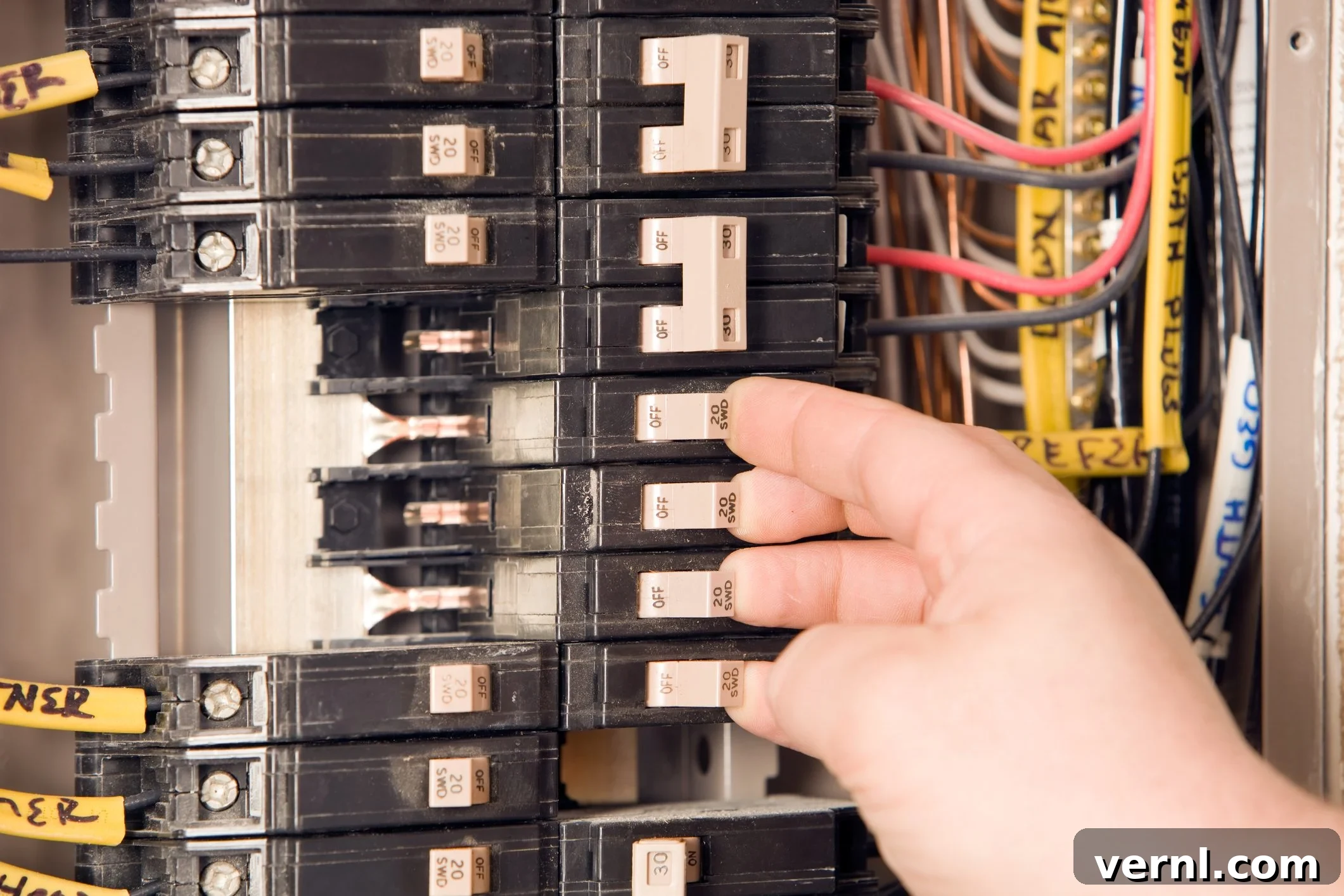
When you lose power to an area of your home, your first course of action should be to inspect your electrical panel. This crucial hub, typically found in a basement, garage, or utility closet, houses all the circuit breakers that protect your home’s various electrical circuits. Upon opening the panel’s front cover, you will usually see two columns of circuit breakers. Ideally, these will be clearly labeled, indicating which parts of your home each breaker controls, making identification much easier.
Locating the Tripped Breaker
Most active circuit breakers will have their handles aligned uniformly in the “On” position. A tripped breaker, however, will visibly stand out. Its handle will typically be in an intermediate or “tripped” position, often resting squarely in the middle, neither fully “On” nor fully “Off.” Sometimes, it might be slightly offset or looser than the other handles. This distinct position is your visual cue that this particular circuit has been interrupted.
Safely Resetting the Breaker
Once you’ve identified the culprit, resetting it is a straightforward, two-step process, but it requires adherence to critical safety protocols. Each circuit breaker has clearly marked “On” and “Off” positions. To reset a tripped breaker, you must first firmly push the handle completely to the “Off” position. You should feel a definite click as it disengages from its tripped state. After it is fully “Off,” then push the handle firmly all the way back to the “On” position. This ensures the internal mechanism resets properly and restores power to the circuit.
A Crucial Safety Warning: When operating an electrical panel, always prioritize your safety. Stand to the side of the panel, not directly in front of it, and turn your face away when flipping breakers. This precaution is vital because, in rare but extremely dangerous instances, an arc flash can occur. An arc flash is a powerful electrical explosion caused by a short circuit, capable of generating intense heat and light that can cause severe burns and eye damage. While modern residential panels are designed to mitigate this risk, taking this simple safety measure can be life-saving. If you observe any sparks, hear unusual buzzing or popping sounds, smell burning odors, or notice any physical damage around the panel, do NOT attempt to reset the breaker. Instead, immediately contact a qualified electrician.
Why Does My Circuit Breaker Keep Tripping? Understanding the Three Main Causes
A circuit breaker trips because it detects an unsafe level of electrical current flowing through the circuit it protects. Each breaker is rated for a specific amperage – for example, a 20-amp breaker is designed to safely handle up to 20 amps. When the electrical demand or an electrical fault causes the current to exceed this rating, the breaker trips to prevent overheating and damage. There are three primary and distinct reasons why a circuit breaker might repeatedly trip:
- Overloads: The circuit is drawing more power than it’s designed to handle.
- Short Circuits: Electricity takes an unintended, low-resistance path, causing a massive surge.
- Ground Faults: A specific type of short circuit where electricity escapes to the earth ground path.
1. What Is a Circuit Overload?
A circuit overload is the most common reason for a tripped breaker. It occurs when too many electrical devices or appliances are operating simultaneously on a single circuit, collectively demanding more current than the circuit’s wiring and breaker are rated for. Think of it like trying to fill a small bucket with a fire hose – eventually, the bucket will overflow because it can’t handle the volume.
Let’s illustrate with a typical kitchen scenario: many kitchen small appliance circuits are rated for 20 amps. If you decide to run a 1,200-watt microwave (drawing approximately 10 amps) and simultaneously use a 1,700-watt air fryer (drawing about 14 amps) on the same circuit, you’re placing a total demand of 24 amps on a circuit designed for only 20 amps. This 4-amp excess is enough to trigger the breaker, causing it to trip almost immediately.
The danger of an overload isn’t just the immediate power loss. When wires carry more current than they’re rated for, they generate excessive heat. Over time, this heat can degrade the wire’s insulation, making it brittle and susceptible to cracking, which significantly increases the risk of a fire. The circuit breaker’s role is to detect this dangerous overheating condition and open the circuit, cutting off power before wires become dangerously hot or catch fire. Overloads are generally the easiest issues to identify and rectify, typically by simply unplugging some devices or redistributing them to different circuits.
2. What Is a Short Circuit?
A short circuit represents a much more serious and immediate electrical hazard compared to an overload. It occurs when a “hot” (live) wire, which carries electricity from your electrical panel to power devices, accidentally comes into direct contact with another hot wire, a neutral wire, or a ground wire. In a normal, functioning circuit, electricity flows from the hot wire, through an appliance or light fixture (the “load”), and then safely returns to the electrical panel via the neutral wire, completing a controlled path.
However, during a short circuit, the electricity bypasses the intended load and takes a “shortcut” back to the panel. This unintended path has extremely low electrical resistance, resulting in an immediate and massive surge of current – often hundreds or even thousands of amps – in a mere fraction of a second. This sudden, uncontrolled surge is far beyond the circuit’s rated capacity, causing the breaker to trip almost instantaneously. The extreme current flow can generate intense heat, sparks, and even flames at the point of contact, posing a severe risk of electrical shock, burns, and potentially devastating fires. Common causes of short circuits include damaged appliance cords, faulty internal wiring within appliances, loose connections in outlets or switches, or even accidental punctures to wires hidden within walls (e.g., from nails or screws).
3. What Is a Ground Fault?
A ground fault is a specific and particularly hazardous type of short circuit. It occurs when a hot wire accidentally makes contact with a non-current-carrying metallic part of the electrical system that is connected to the earth, such as the metal casing of an appliance, a metal electrical box, or even a water pipe. The design of a properly grounded electrical system includes an intentional, low-resistance path for such fault currents to safely return to the main electrical panel and then to the earth via a ground rod, thereby tripping the breaker and preventing harm. This grounding pathway is crucial because it provides a protective route for electricity in the event of a fault, ensuring it doesn’t flow through a person who might touch the faulty equipment.
Without this purposeful path to channel the high current safely, the electricity would seek any available route to the ground, and tragically, that path could be through a human body. This is why ground faults are exceptionally dangerous and can lead to severe electrical shocks, electrocution, and even death. While standard circuit breakers do offer some protection by tripping during a high-current ground fault, Ground-Fault Circuit Interrupters (GFCIs) provide significantly enhanced protection. GFCIs are specifically designed to detect even very minute amounts of current leakage to ground (as little as 5 milliamps) and trip much faster than a standard breaker, making them indispensable in areas prone to moisture, such as bathrooms, kitchens, laundry rooms, and outdoor outlets, where the risk of ground faults is higher.
How to Troubleshoot and Fix a Circuit Breaker That Keeps Tripping
A circuit breaker that consistently trips is a clear indicator of an underlying electrical problem that demands investigation and resolution. Ignoring the issue or merely continuously resetting the breaker without addressing the root cause can escalate minor inconveniences into major safety hazards. Below is a systematic approach to effectively troubleshoot and resolve recurring circuit breaker trips. Always remember: if at any point you feel the problem is beyond your comfort level or expertise, do not hesitate to call a licensed electrician.
Step 1: Checking for a Circuit Overload
Overloads are the most frequent culprits behind tripped breakers and are generally the simplest to diagnose and fix. The objective here is to determine if your circuit is simply being asked to supply more power than it can safely deliver.
- Identify the Affected Area: Pinpoint the specific room or area of your home that has lost power due to the tripped breaker. This helps you narrow down which devices are on that circuit.
- De-energize and Unplug Everything: Go to the affected area and systematically turn off and unplug every single electrical device and appliance connected to that circuit. This includes lights, televisions, computers, chargers, small kitchen appliances, hair dryers – literally everything that draws power.
- Reset the Breaker: Return to your electrical panel and reset the breaker (push firmly to “Off,” then firmly to “On”).
- Observe the Breaker’s Behavior:
- If the breaker trips immediately (within seconds) after resetting, even with absolutely nothing plugged in or turned on: This is a strong indication of a short circuit or ground fault within the circuit’s fixed wiring (inside walls, outlets, or switches), rather than an overload. In this case, proceed directly to Step 3.
- If the breaker holds (does not trip) after being reset: This suggests the problem is indeed an overload caused by one or more appliances, or a faulty device. Continue to the next step.
- Isolate the Overload Source (One by One): Go back to the room and begin plugging in and turning on each device or appliance, one at a time. After plugging in each item and turning it on, pause briefly to observe if the breaker trips. When the breaker trips again, you have successfully identified the last item you connected or activated as the device pushing the circuit over its amperage limit, or a potentially faulty appliance itself.
- Resolve the Overload: Once the culprit is found, the solution is typically to redistribute the electrical load more evenly. This might involve plugging high-wattage appliances into outlets on different circuits, or simply avoiding running multiple heavy-draw items simultaneously on the same circuit. You may need to use extension cords temporarily to reach outlets on separate circuits, ensuring they are rated for the appliance’s power draw.
Step 2: Checking for a Short or Ground Fault in a Specific Appliance or Device
If your troubleshooting in Step 1 pinpointed a specific appliance or device as the cause of the trip, it’s possible that the fault lies within that item itself. This could mean a hot wire inside the appliance is touching its metal casing (a ground fault) or another internal wire (a short circuit).
- Test the Suspect Device on Another Circuit: Take the appliance or device that caused the original circuit to trip and plug it into an outlet that is on a *different* electrical circuit (ensure this new circuit is known to be working correctly and is not overloaded).
- Observe the New Circuit:
- If the breaker for the new circuit also trips immediately when the device is plugged in or turned on: This conclusively confirms that the appliance or device itself is faulty. Unplug it immediately. It is extremely dangerous to continue using a faulty appliance; do not use it again until it has been professionally inspected, repaired, or replaced.
- If the new circuit does NOT trip: This suggests the original circuit might still have been overloaded, or there could be a more complex wiring issue on the original circuit that only manifests under certain conditions. In this scenario, re-evaluate your load distribution on the original circuit and consider consulting an electrician if the problem persists.
Step 3: Call an Electrician for Shorts and Ground Faults in the Wiring
If the breaker trips immediately upon resetting, even when nothing is plugged in or turned on (as determined in Step 1, observation point 4), or if you’ve systematically ruled out appliance faults, then the problem is highly likely to be an electrical fault within your home’s permanent electrical wiring. These types of issues are inherently complex, potentially very dangerous, and almost always necessitate professional intervention.
Common causes for internal wiring faults include:
- Loose Connections: Over time, electrical connections at outlets, switches, light fixtures, or inside junction boxes can loosen. Loose connections can lead to dangerous arcing, which generates heat and can cause shorts or even fires.
- Damaged Wire Insulation: The protective insulation around electrical wires can degrade due to age, prolonged exposure to heat, rodent activity (chewing), or accidental damage (e.g., a nail or screw penetrating a wire inside a wall during renovations). Exposed wires can then come into contact with other wires or conductive surfaces, leading to shorts.
- Faulty Outlets or Switches: Electrical receptacles and switches themselves can wear out or become damaged internally, developing shorts or ground faults within their own mechanisms.
When to Absolutely Call a Professional Licensed Electrician:
- If the circuit breaker trips instantly after you reset it, even with no load connected.
- If you detect any burning plastic or electrical odors (a classic sign of overheating wires).
- If you observe scorch marks, discoloration, or any signs of sparking around outlets, switches, or the electrical panel itself.
- If you frequently experience persistent problems such as flickering lights, buzzing sounds emanating from your electrical system, or warm outlets/switch plates.
- If you lack the necessary electrical experience, tools, or confidence to safely diagnose and repair internal wiring problems. Electrical work is not for novices.
Attempting to diagnose or repair complex wiring issues yourself without adequate knowledge, proper training, and specialized safety equipment can expose you to severe risks including electrical shocks, electrocution, or initiating a house fire. Licensed electricians possess the specialized training, diagnostic tools, and in-depth expertise to safely and accurately locate the exact source and nature of the fault, whether it’s a hidden short within a wall, a faulty component in your electrical panel, or degraded wiring. Their professional intervention not only resolves the immediate problem but also ensures your home’s electrical system is safe, up to code, and provides lasting peace of mind.
Preventing Future Circuit Breaker Trips: Proactive Electrical Safety Tips
While some electrical issues can arise unexpectedly, a significant number of circuit breaker trips are preventable through good habits and proactive maintenance. Taking simple steps can dramatically reduce your risk of electrical hazards, extend the lifespan of your appliances, and improve your home’s overall electrical efficiency and safety.
- Understand Your Home’s Circuits: Take the time to identify which outlets and light fixtures are connected to each circuit breaker. Clearly and accurately label your electrical panel – this is perhaps the single most helpful step for managing your home’s electricity. Knowing your circuits allows you to effectively distribute electrical loads and avoid accidental overloads.
- Avoid Overloading Circuits: Develop a conscious awareness of how many high-wattage appliances (e.g., microwaves, toaster ovens, hair dryers, space heaters, vacuum cleaners, irons) you are running simultaneously on any single circuit. If you have several high-draw devices, make an effort to plug them into outlets on different circuits. Consider using a power strip with surge protection that also features a built-in circuit breaker for additional safety, but remember, these do not increase the circuit’s capacity.
- Use Extension Cords Sparingly and Safely: Extension cords are designed for temporary use, not as permanent wiring solutions. Never “daisy-chain” multiple extension cords together. Always ensure that any extension cord you use is rated for the specific power requirements of the device it’s powering and is in excellent condition, free from fraying, cuts, or exposed wires. Do not run cords under rugs or furniture, as this can cause damage and heat buildup.
- Regularly Inspect Appliances and Cords: Make it a habit to regularly examine appliance cords for any signs of damage, such as frayed insulation, exposed wires, bent or loose prongs, or discoloration indicating overheating. Replace damaged cords immediately. Avoid using any appliance that emits burning smells, shows signs of internal sparking, or behaves erratically.
- Ensure GFCI and AFCI Protection: Verify that you have Ground-Fault Circuit Interrupters (GFCIs) installed in all areas prone to moisture, such as bathrooms, kitchens, laundry rooms, garages, and outdoor outlets. Additionally, ensure your home has Arc-Fault Circuit Interrupters (AFCIs) in bedrooms and other living areas, as mandated by modern electrical codes. These specialized devices offer advanced protection against specific, dangerous types of electrical faults that standard breakers might miss.
- Schedule Regular Electrical Inspections: Especially if your home is older, or if you’ve been experiencing recurring electrical problems, consider having a licensed electrician perform a thorough electrical inspection every few years. A professional inspection can identify hidden issues, outdated or deteriorating wiring, and potential hazards before they escalate into serious problems.
- Consider an Electrical Panel Upgrade: If your home is older and still relies on an outdated electrical panel (e.g., an old fuse box or a panel with insufficient amperage capacity for today’s electrical demands), consider upgrading it. A modern electrical panel can better handle your home’s contemporary power needs and incorporates superior safety features. You can research the cost to replace an electrical panel to help you plan for this important home improvement.
Conclusion: Prioritizing Electrical Safety for Your Home and Family
A tripped circuit breaker should never be dismissed as merely an annoyance. It is a critical warning signal from your home’s electrical system, indicating an underlying issue that requires attention. Whether it’s a simple and common overload caused by too many devices, a dangerous short circuit stemming from damaged wiring, or a potentially life-threatening ground fault, understanding the root cause is paramount for ensuring both your property’s safety and your family’s well-being. While you, as a homeowner, can often troubleshoot and resolve minor overloads, recognizing the unequivocal signs of more serious electrical faults – particularly those involving your home’s fixed wiring – is crucial for knowing when to call in the expertise of a professional.
Never underestimate the inherent dangers associated with electricity. Attempting DIY repairs on complex or unknown wiring issues without proper knowledge, training, and specialized safety equipment can lead to severe personal injury, electrocution, or devastating house fires. By diligently following the troubleshooting steps outlined in this comprehensive guide, practicing safe electrical habits, and, most importantly, knowing precisely when to consult a licensed electrician, you can effectively manage your home’s electrical system, prevent future tripping incidents, and maintain a safe and secure living environment for everyone under your roof.
For further insights into your home’s electrical components, explore our homeowner’s guide to an AC fuse box.