Choosing the Right Security Camera: Essential Features and Types Explained
In today’s fast-paced world, safeguarding your home, property, and loved ones has become a top priority for many. A quick online search for “surveillance cameras” or “home security cameras” reveals an overwhelming array of products, each promising advanced features and varying price points. Navigating this complex market to find the perfect security solution can feel daunting. This comprehensive guide aims to simplify your decision-making process by outlining the most critical features to look for and explaining the distinct types of security cameras available. By understanding these key aspects, you can confidently choose a system that meets your specific security requirements and budget.
Before you even begin browsing products, it’s vital to assess your unique security needs. Consider questions like: Which areas require monitoring, both indoors and outdoors? What level of detail do you need in captured footage? Do you require real-time alerts or simply recorded evidence? Fortunately, modern security technology has made high-quality surveillance remarkably accessible and affordable. Many excellent camera models, packed with advanced capabilities, can be found within a sensible price range of $50 to $200. This affordability means robust home protection is within reach for almost everyone. Let’s delve into the features that truly matter and the various camera types that will help fortify your home.
Essential Security Camera Features You’ll Want to Consider
When you begin comparing security cameras, you’ll notice a common set of features designed to enhance monitoring, convenience, and overall effectiveness. Prioritizing these functionalities based on your specific surveillance goals will guide you toward an optimal camera system. Below, we explore the most impactful features that define a reliable and efficient security solution.
- Pan, Tilt, and Zoom (PTZ) Capabilities: For extensive coverage of large areas, cameras with remote pan, tilt, and zoom (PTZ) functionality are invaluable. These allow you to adjust the camera’s horizontal (pan) and vertical (tilt) viewing angles from your smartphone or computer, providing dynamic control over your surveillance zone. Many PTZ cameras offer a rotation of up to 350 degrees, effectively granting you a near-360-degree view, akin to having eyes in the back of your head. This flexibility is perfect for monitoring expansive living rooms, wide backyards, or checking on pets. When choosing, prioritize cameras with optical zoom over digital zoom, as optical zoom magnifies the image without sacrificing clarity, crucial for identifying distant details.
- Wide-Angle Lenses: If discretion and broad, static coverage are your primary concerns, cameras equipped with wide-angle lenses are an excellent choice. These lenses are designed to capture a much larger field of view compared to standard lenses, enabling a single camera to monitor an entire room, a porch, or a specific outdoor zone without needing to move. Often more compact and less conspicuous than PTZ models, wide-angle cameras are easier to hide or blend seamlessly into their environment, making them ideal for fixed positions where you need to see as much as possible at once without drawing attention.
- High-Definition (HD) Video & Photos: The clarity of your captured footage directly impacts its utility, especially when identifying faces, license plates, or specific events. Modern security cameras offer a spectrum of high-definition resolutions, typically starting at 720p, moving to 1080p (Full HD), and increasingly, 2K or 4K (Ultra HD). Higher resolutions provide sharper images, allowing for greater detail and more effective evidence gathering. Most cameras facilitate capturing and storing this high-quality video and still photos through various methods: an onboard SD card for local storage, secure cloud services (which often involve a subscription fee for remote access and backup), a dedicated Digital Video Recorder (DVR) or Network Video Recorder (NVR) for continuous recording, or direct streaming to your smartphone or tablet.
- Advanced Motion Detection: A cornerstone of smart security, motion detection cameras intelligently conserve storage space and battery life by recording only when activity is detected. When movement occurs within their field of view, these cameras can automatically begin recording, send immediate email alerts or push notifications to your mobile device, and in some cases, even trigger an audible alarm or spotlight. Modern systems often feature advanced algorithms that can differentiate between humans, vehicles, and animals, significantly reducing false alarms. Many allow users to customize specific “motion zones,” focusing surveillance on critical entry points like doors and windows while ignoring benign movements in less sensitive areas.
- Reliable Night Vision Capabilities: Effective security demands round-the-clock monitoring, and threats don’t adhere to daylight hours. Thanks to integrated infrared (IR) LED technology, virtually all contemporary security cameras provide robust night vision, enabling them to capture clear footage even in complete darkness. This feature is indispensable for 24/7 surveillance, ensuring intruders are visible regardless of ambient light. Some cutting-edge cameras now feature “Starlight” or “Low-Light Color” technology, which can capture surprisingly detailed, full-color images in very dim conditions, offering superior context compared to traditional black-and-white infrared footage.
- Intuitive Free Mobile Applications: The true power and convenience of modern security cameras are unlocked through their accompanying mobile applications. Most reputable brands provide user-friendly apps for both iOS and Android devices, allowing you to access live video feeds from anywhere in the world with an internet connection. Beyond real-time streaming, these apps typically enable you to review recorded footage, capture snapshots or video clips, remotely control pan-and-tilt functions, adjust camera settings, and receive instant alerts. This remote accessibility offers unparalleled control and peace of mind, putting your home’s security literally at your fingertips.
- Two-Way Audio Communication: This highly practical feature integrates both a microphone and a speaker directly into the camera, facilitating real-time, two-way communication. You can speak through the camera’s speaker from your mobile app and hear responses from the person on the other end. This transforms security cameras into versatile tools, serving as effective deterrents (e.g., warning off a package thief), convenient intercoms for conversing with delivery drivers, or even sophisticated baby monitors and pet cameras, allowing you to check in and interact with family members or pets while you’re away from home.
- Indoor and/or Outdoor Approved Design: The environment in which your camera will operate dictates its necessary durability and weather resistance. Cameras rated for outdoor use are specifically engineered to withstand various environmental challenges, including rain, snow, dust, and extreme temperatures. When selecting an outdoor camera, look for an IP (Ingress Protection) rating, such as IP65, IP66, or IP67, which indicates its level of resistance to solid particles and liquids. Choosing an appropriately rated camera is critical for ensuring long-term reliability and performance. Outdoor-rated cameras allow you to detect suspicious activity at your property’s perimeter, potentially deterring an incident before it escalates, rather than merely recording events after an intrusion has occurred.
- Smart Home Integration: Many contemporary security cameras are designed for seamless integration with popular smart home ecosystems, including Amazon Alexa, Google Assistant, and Apple HomeKit. This capability enables voice control, allows you to view camera feeds on smart displays, and facilitates the creation of automated routines—for example, having your smart lights illuminate when motion is detected by the camera.
- Versatile Storage Options (Local & Cloud): While cloud storage subscriptions offer remote access and secure off-site backups, the availability of local storage (via an SD card or a connected NVR/DVR) provides a crucial layer of redundancy and often eliminates ongoing fees. Hybrid systems that offer both local and cloud storage are typically the most flexible and provide enhanced peace of mind.
- Built-in Siren and Spotlight: For an immediate and powerful deterrent, some advanced cameras are equipped with a loud siren and/or a bright LED spotlight. These features can be activated manually via the mobile app or automatically triggered upon motion detection, effectively startling intruders and illuminating the scene for clearer video capture at night.
Exploring the Different Types of Security Cameras for Your Home
Beyond individual features, security cameras can be broadly categorized by their power source, data transmission methods, and intended use. Understanding these fundamental distinctions is paramount, as each type offers unique advantages and disadvantages regarding installation complexity, placement flexibility, and overall reliability. Selecting the right type of camera is a critical step in building an effective home surveillance system. Let’s delve into the most common types of security cameras available on the market today.
Wireless Security Cameras: Unmatched Flexibility and Simplified Installation
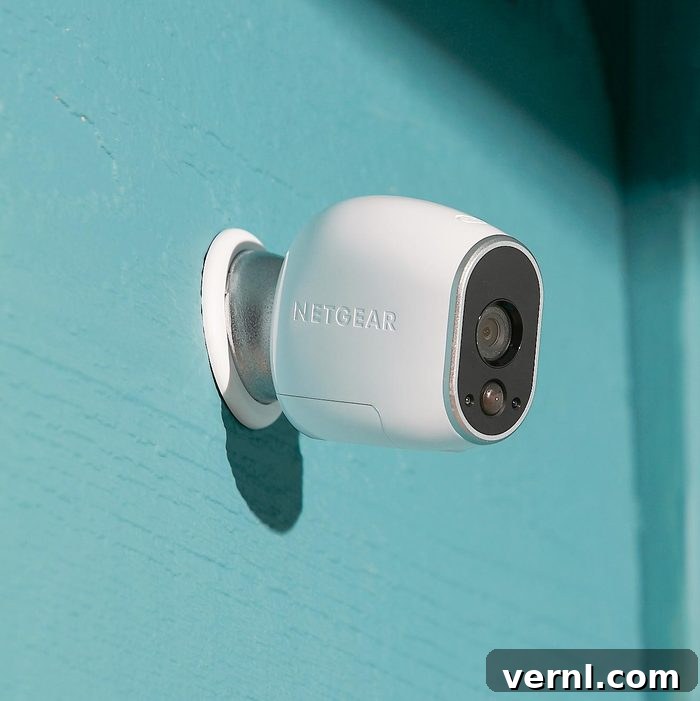
For homeowners who prioritize ease of installation and the ultimate flexibility in camera placement, fully wireless security cameras are an excellent solution. These devices operate entirely without physical wires, drawing power from internal batteries and transmitting video data wirelessly via your home’s Wi-Fi network. This eliminates the need for complex cable routing through walls or ceilings and frees you from the constraints of electrical outlet proximity, making them true “install-it-anywhere” security cameras.
A prime example of a leading wireless system is the Arlo by NETGEAR, renowned for its compact design and robust features. Many wireless cameras, including Arlo models, come with innovative mounting options like built-in magnets for attaching to metal surfaces or versatile ball mounts for optimal positioning. Recordings are typically motion-activated, a smart design choice that conserves battery life and storage space. Footage is often uploaded and stored securely on a cloud server, providing convenient remote access and eliminating the need for a physical DVR. These systems reliably send instant app alerts or emails to your mobile device with links to the recorded video, and you can also stream live video directly to your smartphone, tablet, or computer from virtually anywhere.
Powering these devices typically involves non-rechargeable or rechargeable lithium batteries, offering operational lifespans ranging from several weeks to many months, depending on usage patterns, recording frequency, and customizable settings. Some wireless systems offer optional solar panels that continuously trickle-charge the batteries, significantly extending the time between manual recharges. Many fully wireless cameras utilize a dedicated base station that plugs into your internet modem or router. This base station often serves multiple purposes: it extends the Wi-Fi range for the cameras, improves battery efficiency, and frequently provides local storage options via an SD card or USB drive. Most systems allow for easy expansion by purchasing additional cameras and seamlessly pairing them with your existing base station. High-quality wireless outdoor security cameras from various reputable manufacturers typically range from $80 to $200 per unit, though potential subscription fees for cloud storage should also be factored into the overall cost.
Hardwired Security Cameras: Uncompromised Reliability and Peak Performance
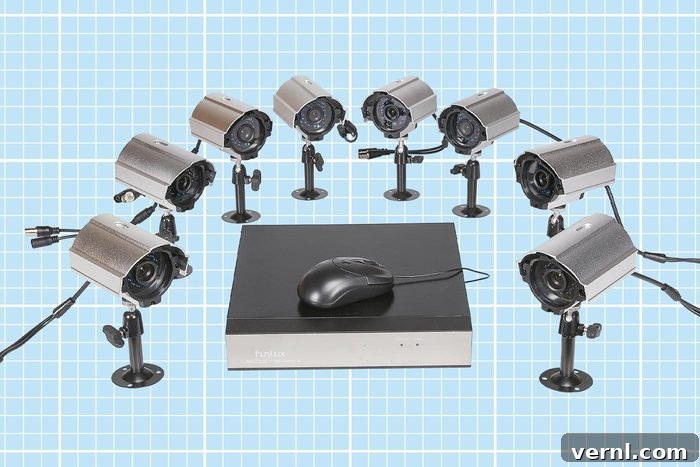
When continuous recording, maximum reliability, and robust performance are paramount for your home security, hardwired security camera systems represent the gold standard. These “set-it-and-forget-it” solutions provide an unparalleled level of consistent surveillance, as they are directly connected to a constant power source and transmit video data via physical cables (typically coaxial cables for analog systems or Ethernet cables for IP-based systems). While their initial setup demands a more involved installation process—often requiring the routing of power and video cables through walls, ceilings, and attics to precisely position each camera—the long-term benefits in terms of stability and performance are substantial.
Hardwired systems are inherently more resilient to interference, eliminate concerns about battery life, and are far less susceptible to Wi-Fi signal dropouts compared to their wireless counterparts. Many comprehensive kits include multiple high-resolution, full-color cameras designed for both indoor and outdoor applications, boasting high weather-resistant ratings to endure harsh environmental conditions. A central component of these systems is a dedicated Digital Video Recorder (DVR) for analog cameras or a Network Video Recorder (NVR) for IP cameras. These recorders are capable of storing several days, weeks, or even months’ worth of continuous video footage, depending on the installed storage capacity, resolution settings, and the number of connected cameras.
With a hardwired system, you can conveniently monitor live video feeds from any or all cameras on a high-definition TV or monitor directly connected to the DVR/NVR unit. Furthermore, most modern hardwired systems are equipped with robust remote viewing capabilities, allowing you to access live streams and review recorded footage through dedicated smartphone or tablet applications from anywhere with an internet connection. Although the initial installation might require more effort, potentially involving professional assistance for optimal cable management, the consistent performance, superior reliability, and typically higher video quality make hardwired security cameras an ideal choice for comprehensive, always-on home security that demands unwavering vigilance.
Partially Wireless (Wi-Fi Powered) Security Cameras: The Convenient Hybrid Solution
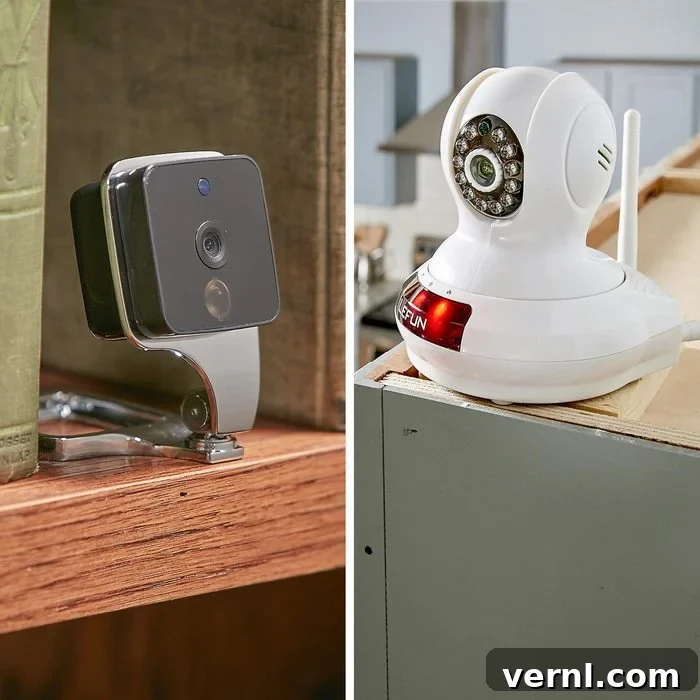
Bridging the gap between fully battery-powered wireless cameras and permanently installed hardwired systems are what we refer to as “partially wireless” security cameras, often commonly known simply as Wi-Fi cameras. These devices offer the convenience of wireless data transmission by connecting to your home’s existing Wi-Fi router, but they still require a physical power cord to be plugged into an electrical outlet for continuous operation. This design makes them significantly easier to install than hardwired systems, as there’s no complex video cabling, but their placement is still limited by the availability of power outlets, making them less flexible than truly battery-powered wireless models.
These cameras are frequently marketed and sold as indoor surveillance solutions, commonly serving as baby monitors, pet cameras, or general indoor security cameras for monitoring specific areas. Because they are typically mains-powered, they offer continuous operation without the need to worry about battery life or frequent recharges. Many models boast advanced features such as remote pan (left-to-right) and tilt (up-and-down) functionality, empowering you to scan an entire room or follow movement directly from your mobile device. Other models feature stationary wide-angle lenses, providing broad, fixed coverage of a specific area without mechanical movement.
Partially wireless cameras are typically feature-rich, often including built-in speakers and microphones for two-way audio communication, robust night vision capabilities using infrared LEDs, and customizable motion detection alerts that send instant notifications to your smartphone. They also commonly offer flexible options for recording and storing video, whether on an onboard SD card for local storage, through a cloud service subscription for remote access and backup, or via a connected NVR in more elaborate setups. Like their fully wireless counterparts, these cameras provide seamless remote access, allowing you to watch both recorded and live video feeds from your smartphone or tablet, thus offering an excellent balance of advanced features, installation convenience, and continuous power for effective indoor monitoring.
Game or Trail Security Cameras: Rugged Surveillance for Remote and Off-Grid Areas
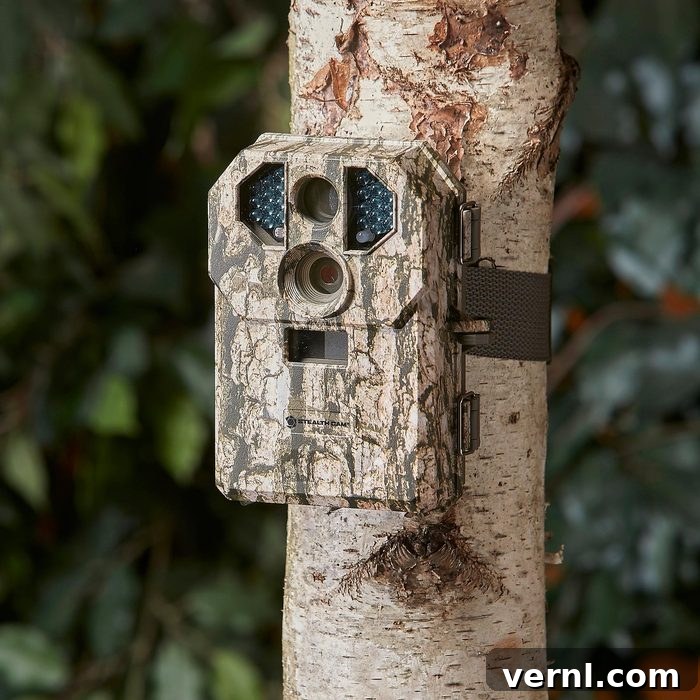
Originally conceived and designed for hunters and wildlife photographers, “game cameras” (also widely known as “trail cameras” or “scouting cameras”) present a highly specialized and robust solution for outdoor surveillance in challenging, remote, and off-grid environments. If your need is to monitor a wooded area, a large rural property, a construction site without utilities, or any location lacking immediate access to electrical outlets or a reliable Wi-Fi signal, a game camera might be the perfect, self-contained solution. These devices are exceptionally rugged, designed to withstand harsh outdoor conditions, and belong to the category of truly easy-to-install security cameras due to their simple strap-to-a-tree mounting method.
Unlike conventional home security cameras, game cameras are not engineered for live video streaming or sending real-time alerts directly to your smartphone. Instead, their primary strength lies in their ability to autonomously capture high-quality photos and video whenever a person or animal triggers their passive infrared (PIR) motion sensor. They excel at operating discreetly, even in complete darkness, thanks to their integrated infrared night vision capabilities. These cameras are typically powered by standard alkaline batteries or an external battery box, offering remarkably extended operational periods—often several months—before requiring a battery change, making them ideal for long-term, unattended monitoring. Images and videos are stored locally on a removable SD card, commonly supporting capacities of 32GB or more.
To review the captured footage, you simply retrieve the SD card and plug it into your computer or a compatible card reader, or connect the camera directly to your computer via a USB cable. While they lack the immediate connectivity and smart home integration of Wi-Fi-enabled cameras, their extreme durability, impressive battery life, and complete independence from power grids or internet connectivity make them invaluable for specific, challenging outdoor surveillance scenarios where conventional cameras simply cannot function. They are excellent for monitoring property boundaries, deterring illegal dumping in remote areas, keeping an eye on isolated sheds, or simply observing wildlife on your land without disturbance.
Do Fake Security Cameras Offer Effective Deterrence?
In the expansive realm of home security, not all deterrents rely on cutting-edge technology. The psychological impact of visible surveillance equipment can often be potent enough to dissuade potential intruders. This is precisely where realistic-looking fake security cameras find their niche. These dummy cameras are meticulously designed to mimic the appearance of genuine surveillance equipment, creating a compelling illusion of a monitored property without requiring any actual functionality or significant investment.
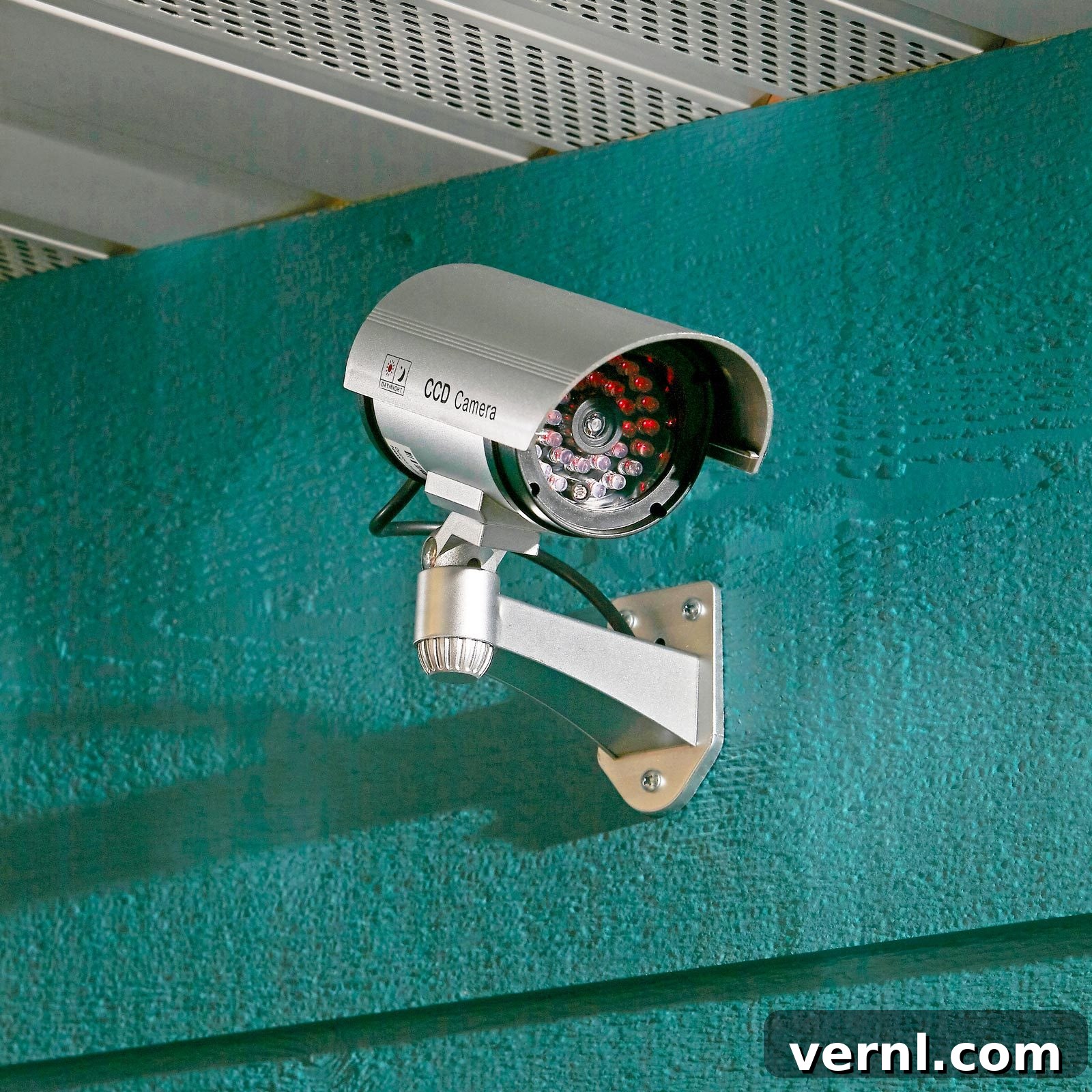
Numerous manufacturers produce highly convincing fake cameras, which are typically available at an incredibly low cost, often ranging from just $10 to $50 for one or multiple units. They can be mounted almost anywhere a real camera would be placed, and many models even incorporate features like flashing red LED lights (simulating recording indicators) or illuminating white LEDs that activate after dark, enhancing their authenticity. For instance, the security camera showcased in the initial imagery of this article could very well be a fake – a testament to how realistic and misleading these products have become in their design and appearance.
While a fake camera will never provide live feeds of suspicious activity around your house or furnish crucial evidence after an incident, its mere presence can be a powerful psychological deterrent, often sufficient to make a would-be burglar think twice and opt for an easier, less risky target. They offer an extremely cost-effective way to enhance the perceived security of your property. However, it is absolutely crucial to understand their inherent limitations: they offer no actual recording, no real-time alerts, and no tangible evidence. For genuine protection and peace of mind, fake cameras should only be considered as a supplementary deterrent, perhaps strategically placed alongside a few functional cameras in key vulnerable spots, or utilized in very low-risk areas where actual surveillance isn’t strictly necessary but a visual deterrent is desired. They are by no means a substitute for a comprehensive, fully functional security system designed to actively protect and monitor your home.