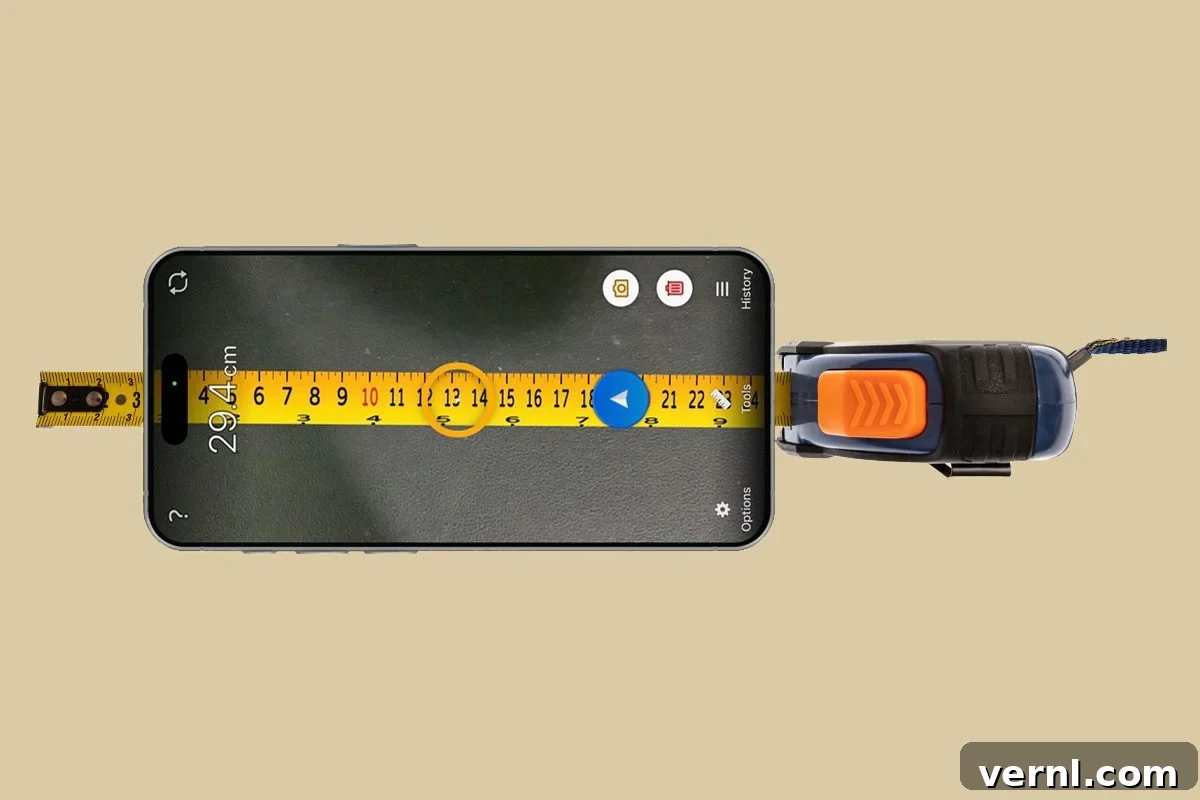
The ubiquity of smartphones has revolutionized how we manage nearly every aspect of our lives. From organizing schedules and communicating globally to entertainment and financial transactions, these pocket-sized supercomputers have become indispensable. It wasn’t long ago that the idea of using a phone for practical tasks like measuring a room or leveling a shelf seemed like science fiction. Yet, today, a quick search on any app store reveals a plethora of “hardware tool apps” promising to replace your traditional toolkit. This raises an intriguing question for DIY enthusiasts, homeowners, and even professionals: Can our smartphones truly serve as an all-in-one solution, effectively replacing a bag full of physical tools, or are they merely convenient novelties?
My own recent experience sparked this inquiry. Attempting to hang a picture, I found myself without a physical level. Rather than making a trip to the hardware store, I instinctively reached for my smartphone, utilizing a built-in leveling app. The picture appeared perfectly straight, leading me to ponder the broader implications. Are these digital tools reliable? Can they offer the same precision and functionality as their analog counterparts? To answer these questions, we embarked on a comprehensive investigation, putting various smartphone hardware apps through their paces in side-by-side comparisons with their traditional tool equivalents. Our findings shed light on their effectiveness, accuracy, and ultimately, their place in your toolkit.
Smartphone Tool Apps vs. The Real Thing: A Detailed Comparison
Ruler Apps: Quick Estimates or Precise Measurements?
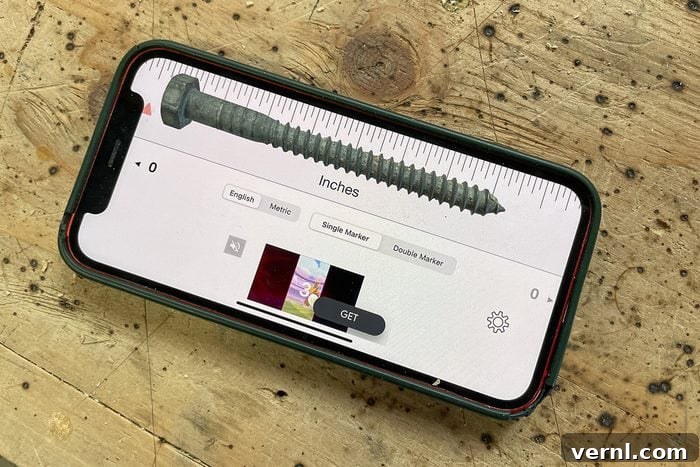
Ruler apps represent some of the most fundamental entries in the hardware and tool app category. Functioning much like a conventional ruler, they overlay a digital scale along the edge of your smartphone screen. The premise is simple: align the screen with the object you wish to measure, and read the displayed length. Most of these applications are freely available, making them an attractive option for a quick, on-the-spot measurement. However, their utility, while convenient, comes with significant caveats.
“Ruler apps inherently have limitations,” explains Hommer Zhao, an electronics manufacturing expert. “The screen size is a major constraint, and even the slightest movement can introduce inaccuracies into the measurement. While they might be acceptable for estimating the size of small items like screws, bolts, or button diameters, they fall short when detailed or critical work demands exactness.”
Our practical tests largely corroborated this assessment. When measuring common items such as bolts, nuts, or small pieces of cabinet hardware, the ruler apps provided mostly accurate results for rough estimations. However, achieving precise measurements, particularly for finer details, proved challenging. The inherent difficulty in aligning the digital scale perfectly with the object’s edges, coupled with the phone’s touch interface, often led to minor discrepancies. Furthermore, the maximum measurement is restricted by the physical dimensions of your phone’s screen, making them unsuitable for anything larger. The rounded edges present on many modern smartphone screens further complicate precise alignment, adding another layer of challenge to accurate readings.
Tape Measure Apps: Augmented Reality’s Promise and Pitfalls
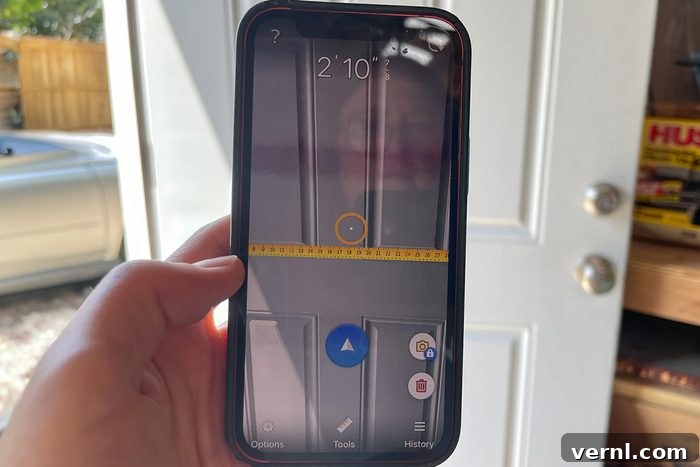
Venturing beyond simple screen-based measurements, tape measure apps often leverage augmented reality (AR) technology. These sophisticated applications utilize your phone’s camera to superimpose a virtual tape measure onto the real world displayed on your screen. Users typically tap to define a starting point and an endpoint, and the app calculates the distance between them, sometimes even offering 3D measurement capabilities. The concept is undeniably appealing, offering the prospect of measuring large objects or spaces without physical contact.
Our evaluation involved testing five distinct AR-based tape measure apps. While some offered intuitive interfaces, making them relatively easy to grasp, the primary concern across the board was their accuracy. This proved to be a significant drawback. My Measure, a particularly popular choice among users, provided a striking example of this inaccuracy. When used to measure a standard 8.5″ x 11″ sheet of office paper, it consistently reported dimensions of 8-5/8″ x 10-1/8″. This considerable deviation was baffling, prompting multiple retests under varying conditions—different angles, lighting levels, and distances—yet the app never managed to register the correct size. A similar test on a shop door, which is genuinely 36″ wide, resulted in a measurement of only 32″ from the app, highlighting a consistent pattern of significant errors.
Beyond accuracy issues, several practical limitations emerged. Many AR measuring apps necessitate a minimum distance, often six feet or more, between the phone and the object being measured. This requirement can be highly impractical or even impossible in confined spaces, such as trying to measure a dishwasher recess in a small kitchen. Adding to these operational challenges, nearly all the AR measuring apps we found restricted advanced functions, and sometimes even basic measurement calculations, behind in-app purchases or subscription models. These subscriptions typically averaged around $30 per year. For serious DIY projects or professional construction work where precision is paramount, and given the observed inaccuracies, this recurring cost felt unjustified, especially when a reliable physical tape measure costs a fraction of that and lasts for years.
Leveling Apps: A Surprising Degree of Practicality
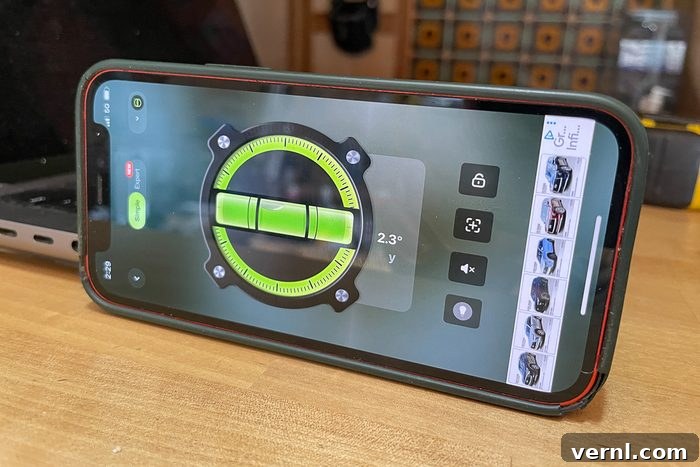
In contrast to the mixed results of measuring apps, leveling apps often deliver a more positive user experience. Available in both traditional bubble level and digital laser formats, these apps cleverly utilize the internal gyroscope and accelerometer sensors within your smartphone to determine if a surface is perfectly horizontal or vertical. The majority of these apps are free, though some may offer premium features for a fee.
“For everyday tasks like hanging a picture frame, mounting a shelf, or simply checking if a surface is level, some leveling apps can achieve impressive precision,” states Nikolay Petrov, an expert in apps and electronics. “I’ve conducted numerous comparison tests, pitting these apps against professional digital spirit levels on actual job sites, and the difference in readings is often less than 1 degree. This level of accuracy is more than sufficient for most DIYers and homeowners.”
Our own testing corroborated Petrov’s assessment. The smartphone leveling apps consistently provided results that closely mirrored those from our physical bubble and laser levels. However, a minor practical “hiccup” arose with my iPhone 12. Its design, featuring control buttons on both sides, prevents it from lying perfectly flat on a surface. This meant I often had to position the phone vertically, which, surprisingly, yielded similar readings to horizontal placement despite the uneven contact points. Another observation was a slight drift in the angle meter of the bubble app, shifting by a few tenths of a degree even when the phone remained undisturbed on a surface. The conclusion for these tools is clear: they are highly effective and convenient for smaller DIY tasks and quick checks around the house. However, for large-scale construction or projects demanding absolute structural integrity, relying solely on a phone app would be ill-advised.
Caliper Apps: Precision Challenged by the Digital Interface
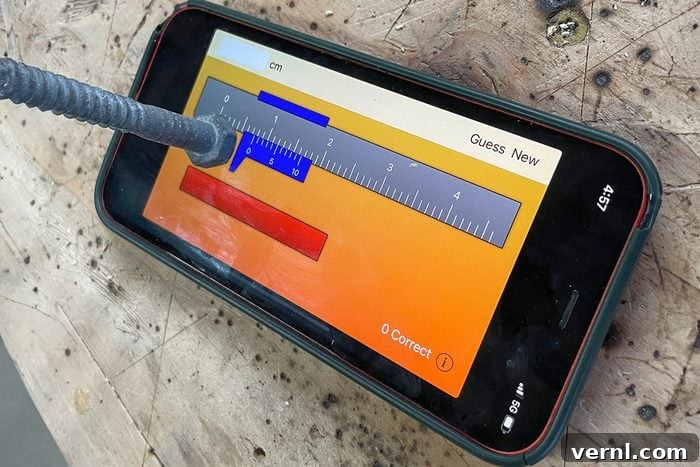
Caliper apps aim to bridge the gap between simple ruler apps and the precise world of physical calipers. Unlike ruler apps that position the scale at the screen’s edge, caliper apps place a virtual, slidable caliper directly in the center of the display. This design is theoretically intended to facilitate more accurate measurements for very small items, such as the heads of screws, small components, or intricate jewelry pieces, where even minor variations are significant.
“Despite the innovative approach, practical limitations persist,” Petrov cautions. “I once attempted to use a caliper app during the restoration of a vintage amplifier, a task that demanded exceptional precision for tiny components. Even with a high-resolution smartphone screen and a stylus for finer control, the app couldn’t come close to the ease of use and the granular precision offered by my analog dial calipers. A recurring frustration was the need for frequent recalibration of the app, and the phenomenon of screen parallax—where the perceived position of an object shifts depending on the viewing angle—made achieving truly fine and consistent measurements nearly impossible.”
Furthermore, the absence of physical barriers, which are integral to how traditional calipers “grip” an object, makes it exceedingly difficult to perfectly align the digital edges with the item being measured. This lack of tactile feedback and physical constraint significantly diminishes the app’s practical precision for tasks where mechanical exactness is non-negotiable.
Protractor Apps: Angular Measurements with a Steady Hand
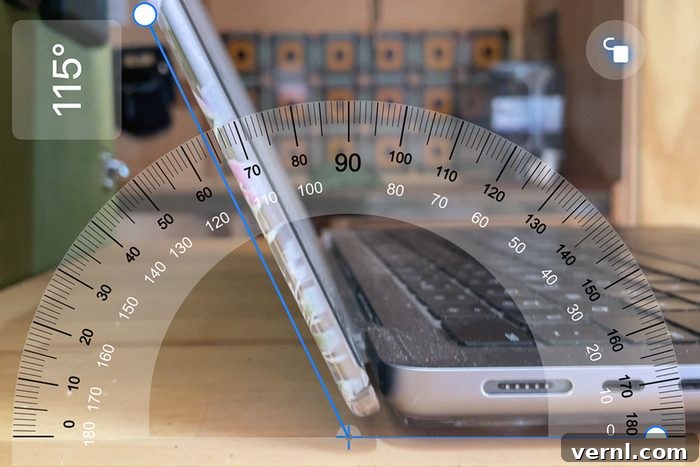
Much like their handheld counterparts, protractor apps are designed to assist users in accurately measuring angles. In our series of tests, these applications generally proved to be reasonably accurate for their intended purpose of determining existing angles. The underlying technology typically leverages the phone’s accelerometer to sense its orientation and, by extension, the angle of the surface or object it’s placed against or aligned with. This makes them a convenient option for quick checks, such as verifying the angle of a miter cut or the incline of a slope.
However, a noticeable challenge emerged under certain circumstances: maintaining the phone steady enough to precisely align the digital angle guides. For static measurements, this might be manageable, but for tasks requiring dynamic adjustments or very fine angular discrimination, a slight tremble of the hand could introduce error. More significantly, one task where protractor apps offer little assistance is the active drawing of a specific angle. While they can *measure* an angle, they don’t provide the physical edge or guide needed to *create* one on a workpiece. For such applications, there remains no viable digital substitute for an actual physical protractor or a carpenter’s speed square, which offer both measurement and a physical reference for marking lines.
Magnifying Glass Alternative: Where Digital Tools Truly Shine
In a notable reversal of fortunes for digital tools, using your smartphone camera as a magnifying glass offers a performance that can genuinely surpass the capabilities of traditional, physical magnifying lenses. This particular application is incredibly effective, especially if you possess a decent-quality smartphone camera, and even more so if your device includes a dedicated macro lens designed for extreme close-up photography. The ability of modern smartphone cameras to zoom in digitally or optically, combined with powerful image processing, allows for incredible magnification.
This digital magnifying glass proves immensely handy in a variety of situations. It can be invaluable for reading minuscule print on product labels, ingredient lists, or complex schematics that are otherwise illegible. Beyond simple text, it becomes an essential tool for intricate tasks such as inspecting tiny electronic components for defects, observing delicate biological specimens, or aiding in precision soldering of micro-items where every detail matters. The effectiveness of this digital tool is further amplified by good lighting conditions; the better illuminated the area, the clearer and sharper the magnified image will be, allowing for unparalleled detail and clarity in close-up inspection.
Thermal Camera Apps: A Home Inspection Game Changer
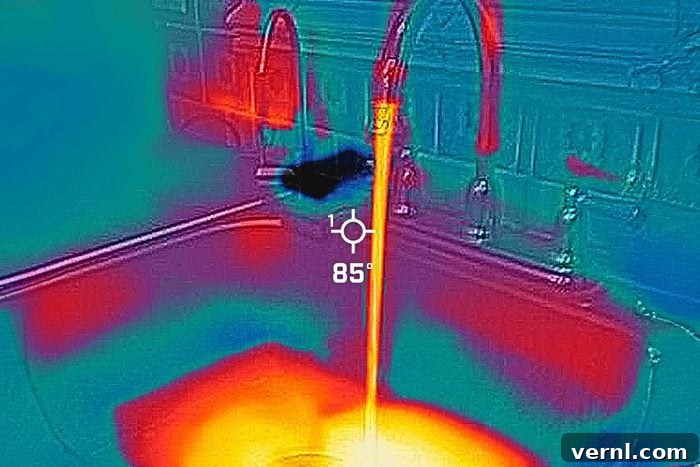
Thermal cameras and their associated smartphone apps represent perhaps the most impactful and transformative digital tools in our evaluation. These devices, utilizing infrared radiation, detect and display differences in temperature across surfaces and objects. This capability makes them genuine game-changers for a wide range of applications, particularly in home inspection, maintenance, and energy efficiency audits. They can effortlessly help locate hidden issues, from identifying faulty wiring behind walls, pinpointing plumbing leaks that might otherwise go unnoticed, to detecting drafts from windows and doors, or revealing areas with insufficient insulation. Beyond practical home applications, they even offer a novel and entertaining way to observe nocturnal wildlife in your garden, revealing creatures otherwise hidden in the dark.
We conducted a rigorous comparison between our handheld Ampbank H128 thermal camera and the Flir One Edge Pro, which is designed to connect directly to a smartphone. Both devices delivered virtually identical temperature readings across multiple testing scenarios, confirming their accuracy in detecting thermal variations. Furthermore, both offered a comprehensive array of light spectrum options, allowing for varied visual interpretations of the thermal data. The app-based Flir camera exhibited a slightly longer activation time, but compensated with superior resolution, primarily due to leveraging the larger and higher-quality display of the smartphone itself. A notable feature of the Flir app was its ability to outline detected objects on the screen, making temperature gradations and anomalies much more obvious and easier to interpret (though it’s worth noting this particular Flir model is higher-end, and other handheld models might offer similar advanced features). Conversely, the dedicated handheld unit felt significantly more rugged and robust, better suited for demanding job site conditions, and generally offered a longer battery life, making it more reliable for extended use without needing a recharge.
Are Smartphone Hardware Tool Apps as Good as the Real Thing? The Verdict
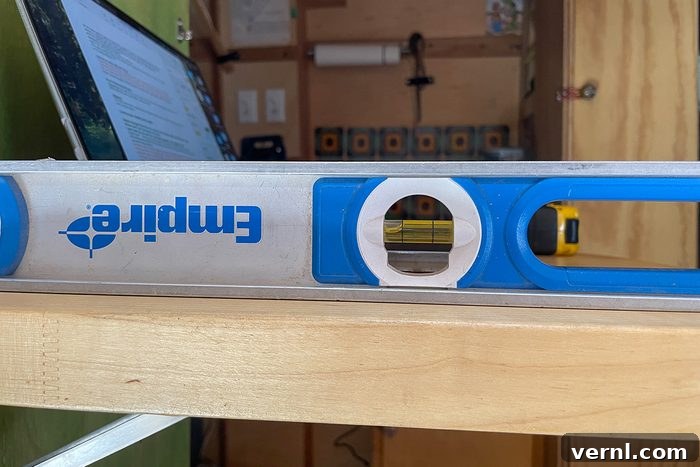
After our extensive testing and analysis, the overarching conclusion is clear: generally, no, smartphone tool apps are not a complete replacement for physical tools. While the convenience factor is undeniable—for a swift level check when hanging a picture or a rough estimate of a small object’s size, an app on your phone is far more accessible than rummaging through a toolbox or making an unplanned trip to the hardware store. They also serve admirably as handy backups in the field when your primary tools aren’t immediately available. However, when precision, accuracy, and durability are paramount, the tactile feedback and engineered reliability of an actual physical tool in your hand remain unsurpassed.
“My key takeaway from this exploration is that while apps excel for quick approximations and on-the-go utility, they simply cannot replicate the tactile feedback and the application-specific engineering inherent in professional-grade tools,” emphasizes Nikolay Petrov. “For tasks demanding genuine precision, such as intricate electronics work, fine woodworking, or critical mechanical assembly, it is essential to equip your toolkit with dedicated, high-quality instruments. The reliability and consistency offered by these specialized tools are indispensable for achieving professional results.”
Hommer Zhao concurs with this perspective, adding, “There’s no doubt that these apps are continually improving, and they are incredibly useful in a pinch, especially when the traditional tool isn’t at hand. However, I would not place my full trust in them as a comprehensive or reliable replacement for a well-stocked physical toolkit. For any task where accuracy directly impacts the quality, safety, or functionality of the outcome, always opt for the real thing.” In essence, smartphone tool apps are excellent companions for casual users and for emergencies, but they are not yet ready to fully usurp the traditional tools that have served craftsmen and DIYers for generations.
About the Experts
- Hommer Zhao is a highly respected electronics manufacturing expert and a director at OurPCB. In his role, he works extensively with cutting-edge digital tools and smart devices within real-world manufacturing environments, offering unique insights into their practical applications and limitations.
- Nikolay Petrov is the visionary founder and Chief Technology Officer at ZontSound. With over a decade of profound expertise in both apps and electronics, Petrov has a proven track record of rigorously comparing app-based tools with their traditional hardware counterparts, providing authoritative evaluations on their performance.
Related Articles for Further Reading
- See a Green Dot on Your Android Phone? Here’s What It Means
- If You Get a USPS Scam Text, You Need To Do This Immediately
- This Is How Often You Should Restart Your Phone