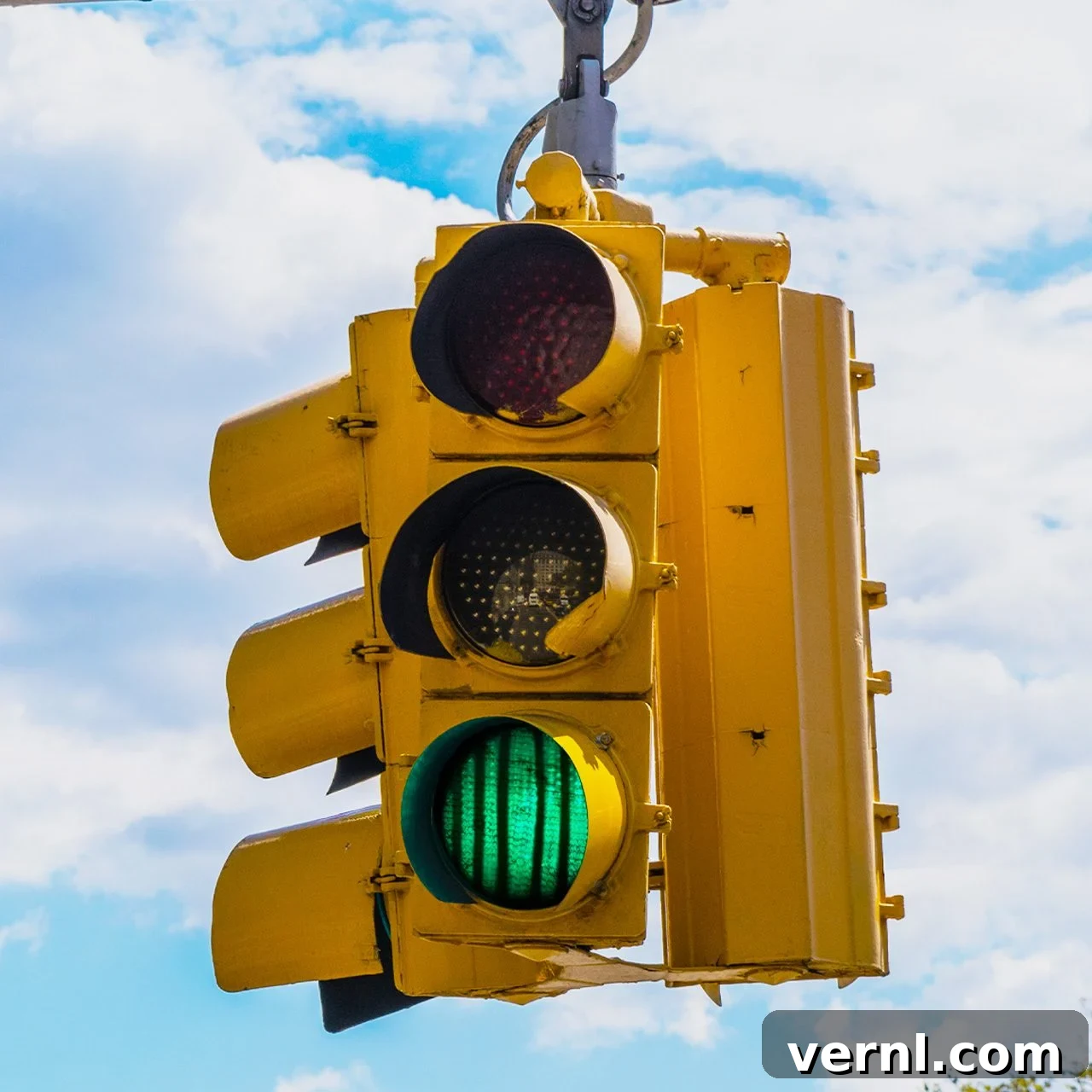
Most drivers rarely think about traffic lights beyond noting when they cycle from green to yellow to red and back. But a closer look reveals intentional design choices that serve a specific purpose. One example is the presence of narrow black lines across some traffic signal lenses. These are not cracks, shadows, or burned-out lights—they are louvers.
Louvers are deliberate features used on certain traffic signals, often associated with the Dallas Display. They influence how a signal appears depending on a driver’s position, helping to prevent confusion between lanes that have different signal indications.
What Do Dallas Display Lines on Traffic Lights Mean?
The black lines are louvers mounted across the face of particular signal lenses. Functionally similar to window blinds, the louvers limit the viewing angle so that drivers in some lanes can see a light while drivers in adjacent lanes cannot. In practice, that means a left-turn signal can be visible to drivers in the left-turn lane but obscured or appear dark to drivers in a through lane beside it.
This arrangement was used on traditional Dallas Displays where circle green or yellow aspects for left turns needed to be visible only to left-turning drivers. The louvers ensured that drivers going straight would not mistake a left-turn indication for a signal that applied to their lane.
Louvers also helped address the so-called “yellow trap.” That situation can occur when a driver waiting to turn left sees their signal change to yellow or green and assumes oncoming traffic has stopped, even though through traffic still has a green light. By restricting the view of left-turn indications to only the intended lane, the Dallas Display reduced the chance of such misinterpretation.
The term “Dallas Display” originates from Dallas County, Texas, where engineers developed the approach for intersections that allowed both protected and permissive left turns. For drivers, spotting the louvers should not change how they drive: they should continue to follow the signal that controls their lane. If a nearby signal looks striped, dark, or difficult to see, it is likely intended for a different lane and not for them.
Why Aren’t Dallas Display Traffic Lights Used Everywhere?
The Dallas Display makes practical sense in certain situations, but it is not the only solution and has become less common as signal design has evolved. One major alternative that many drivers now encounter is the flashing yellow arrow for permissive left turns. Flashing yellow arrows communicate that drivers may turn left after yielding to oncoming traffic and pedestrians, and studies cited by transportation authorities indicate drivers generally understand these displays well.
Louvers have some drawbacks. Because they restrict the viewing angle, they also reduce the amount of light emitted from the signal as seen from some positions. The Manual on Uniform Traffic Control Devices allows limiting a signal’s visibility when necessary, but it also notes that other equipment or signal designs can often direct light without blocking so much of it. As a result, traffic engineers frequently choose alternatives such as directional signal housings, signal placement changes, or arrow-based displays that convey left-turn permissions more clearly to all road users.
In short, the black lines you sometimes see on traffic lights are intentional louvers designed to control which drivers can see a particular indication. They are not damage or an artifact of manufacturing; they are a targeted traffic engineering solution to help reduce confusion and improve intersection safety.
Sources
Federal Highway Administration, Signalized Intersections: Informational Guide
Federal Highway Administration, Traffic Signal Timing Manual
Federal Highway Administration, Manual on Uniform Traffic Control Devices, 11th Edition
Transportation Research Board, Evaluation of Traffic Signal Displays for Protected/Permissive Left-Turn Control