
Understanding and Managing June Bugs: A Comprehensive Guide
As summer evenings arrive, you might notice clumsy, brown beetles fluttering around your porch lights, bumping against windows, and occasionally burrowing into your lawn. These are commonly known as June bugs, or June beetles, named for the month when their mating season peaks. While often seen as mere nuisances, these fascinating insects play a unique role in our ecosystem and can sometimes become a significant challenge for gardeners and homeowners.
To help us delve deeper into the world of these pervasive warm-weather insects, we’ve consulted Scott Green, a board-certified entomologist with Ehrlich Pest Control. His expert insights will guide us through understanding their biology, identifying their presence, and implementing effective management strategies.
What Exactly Is a June Bug? Unraveling the Mystery
Despite their common name, June bugs are not just any bug; they are a specific type of beetle. According to Green, June bugs belong to the expansive family Scarabaeidae and the order Coleoptera. “They’re closely related to Scarab beetles and are part of a vast order comprising around 1,100 related beetle species,” he explains. This makes them cousins to many other well-known beetles, including dung beetles and even the problematic Japanese beetles, though they have distinct characteristics and behaviors.
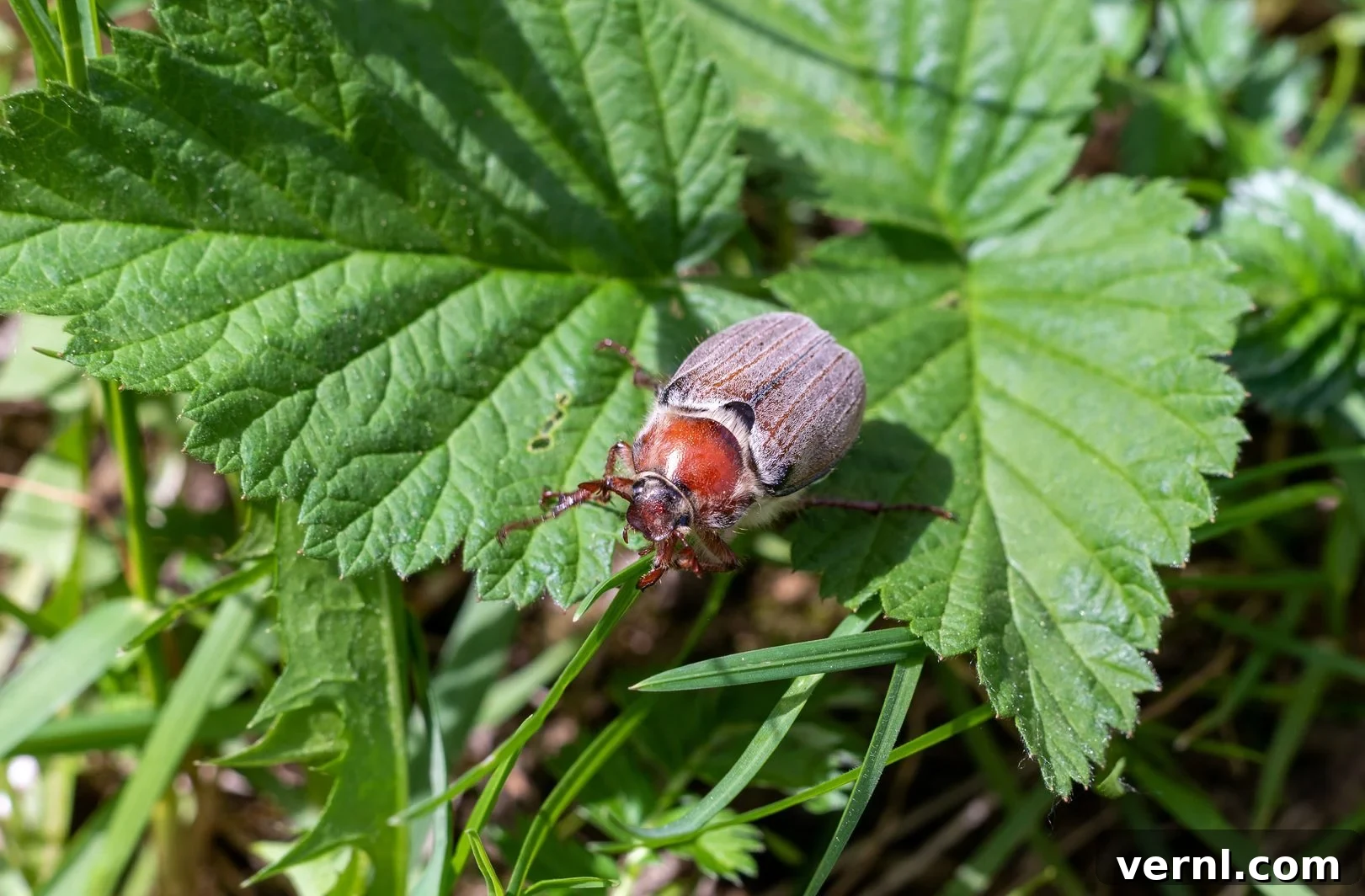
June bugs are indigenous to North America and are frequently encountered across the Northern Hemisphere, with particularly dense populations along the East Coast and throughout the Southern United States. These beetles typically measure between 1/2 and one inch in length, displaying a spectrum of colors from deep black and various shades of brown to coppery hues and even striking metallic emerald green. Their bodies are characteristically oval-shaped, equipped with six sturdy legs and two sets of wings – hard outer wings (elytra) protecting the delicate flying wings underneath. A distinctive feature is their segmented antennae, which fan out delicately at the ends, aiding them in sensing their environment.
“June bugs are primarily nocturnal creatures, irresistibly drawn to light sources,” Green notes. “It’s common to observe them clumsily navigating around your landscape lighting at night. Despite their aerial activity, they are not considered strong or graceful fliers, often appearing erratic and bumping into obstacles.”
Beyond their physical attributes and nocturnal habits, June bugs are remarkable for their impressive evolutionary resilience. As a species, they boast an astounding survival record, having thrived for approximately 250 million years. This means they predate the dinosaurs, showcasing an incredible adaptability and staying power that underscores their enduring presence in our natural world.
The Intriguing Life Cycle of the June Bug: From Egg to Adult
Understanding the life cycle of the June bug is crucial for effective management, as different stages present different challenges and vulnerabilities. This multi-year transformation is a fascinating journey:
- Egg Stage: The life cycle begins when adult female June bugs lay their tiny, pearly white eggs deep within the soil, typically in lush, grassy areas like lawns and pastures. Each female can lay up to 75 eggs over several weeks. These eggs are quite small, about the size of a pinhead, and hatch relatively quickly, usually within 30 days, given suitable soil moisture and temperature conditions.
- Larval Stage (White Grubs): “June bug larvae, commonly known as white grubs, represent the most destructive stage of their life cycle,” Green explains. These C-shaped, creamy-white grubs live entirely underground for an extended period, often up to three years, before they mature. They possess three pairs of legs near their distinctive orange-brown heads and have a soft, wormlike body. During these years, they feed voraciously on the roots of grasses, crops, and various low-lying plants. This continuous feeding can severely damage lawns, leading to patches of dead grass and creating an environment ripe for further issues. The grubs also undergo several molts (instars) as they grow, increasing in size with each stage.
- Pupal Stage: In the late spring and early summer of their final year, after growing to their full larval size, the white grubs enter the pupal stage. They burrow three to six inches deep into the soil and transform into pupae. This quiescent stage, where the grub undergoes metamorphosis, typically lasts about three weeks. During this time, they do not feed but undergo a remarkable transformation, developing adult structures such as wings and antennae.
- Adult Stage: “Adult June bugs emerge from the soil in the late spring and early summer months, usually around May or June, hence their name,” says Green. They typically live for approximately one year, though their active surface life is concentrated during the summer. Adults are nocturnal, emerging at night to feed on tree and shrub foliage, mate, and lay eggs, thus continuing the cycle. As temperatures drop in early winter, adult June bugs burrow back into the ground, where they overwinter and eventually die, unless they re-emerge briefly in late spring to complete any remaining egg-laying or feeding before their natural lifespan ends.
The white grubs are an important, albeit problematic, food source in the ecosystem. They are a primary diet component for various wildlife, including birds, moles, skunks, and raccoons. While this may seem like a natural control mechanism, the foraging activities of these animals, digging aggressively to access the grubs, can inflict considerable collateral damage on your backyard and garden, turning a grub problem into a much larger landscape nightmare.
Are June Bugs Harmful? Do They Bite Humans or Pets?
One of the most common concerns regarding any insect is whether it poses a direct threat to humans or pets. Fortunately, with June bugs, you can breathe a sigh of relief. The straightforward answer is no: June bugs do not bite humans or pets. Their mouthparts are designed for chewing plant material, not for piercing skin or drawing blood. This means they are completely safe to handle and observe up close, making them fascinating subjects for curious children or nature enthusiasts.
Strictly vegetarian, adult June bugs have a diet centered around leafy plants. They are known to munch on the foliage of various trees, shrubs, and garden plants. Their preferred menu includes corn, raspberry leaves, oak leaves, rose petals, and a wide array of other deciduous tree leaves and flowers. While they don’t bite, their collective feeding habits can, in cases of severe infestation, lead to defoliation and aesthetic damage to garden plants and ornamental shrubs.
The primary harm associated with June bugs is indirect and occurs during their larval stage. As white grubs, they relentlessly chew on the roots of grasses and plants underground. This root damage can be devastating to lawns, leading to yellowing, wilting, and ultimately, the death of large sections of turf. Furthermore, the presence of these grubs attracts larger predators like raccoons and skunks, whose vigorous digging for this food source can cause even more extensive and unsightly damage to your meticulously maintained lawn and garden beds.
Effective Strategies: How To Get Rid of June Bugs and Protect Your Landscape
Once fully mature and active above ground, adult June bugs are notorious leaf-eaters. However, the most significant damage to your landscape comes from their larval stage – the white grubs – which wreak havoc on plant roots. Identifying and addressing a June bug problem requires a keen eye and a strategic approach.
Recognizing the Signs of June Bug Damage
The symptoms of a June bug grub infestation can often mimic other lawn issues, so careful observation is key. Look for these tell-tale signs that June bugs may have compromised your plant’s root systems:
- Lawn Discoloration: Observe thin, yellow, or random and irregularly shaped brown patches appearing on your lawn. These areas often start small and expand over time.
- Wilting Foliage: Even with adequate watering, plants and grass may exhibit wilting, indicating that their root systems are too damaged to absorb sufficient moisture and nutrients.
- Spongy Turf: Walk across your lawn. Areas with significant grub activity may feel unusually spongy or soft underfoot, as the roots holding the turf together have been eaten away.
- Easy Turf Removal: If you can easily pull up sections of grass, or if the turf rolls back like a carpet, it’s a strong indicator of extensive root damage from grubs.
- Nocturnal Wildlife Activity: The presence of raccoons, skunks, moles, and birds vigorously digging and tearing up your lawn at night is a primary sign of a grub infestation, as these animals are foraging for their preferred food source.
Confirming the Culprit: Identification is Key
Before embarking on any elimination efforts, it’s imperative to confirm that June bugs are indeed the cause of your problems. Many different types of grubs exist, and treatments vary. As Green advises, “Dig up a small section of affected turf and examine the grubs closely to determine if it’s a June bug or a similar-looking pest, like a Japanese beetle grub.” You can identify a June bug grub by its distinct characteristics: a white, C-shaped body, three prominent sets of legs located near its head, an orange-colored head capsule, and a general wormlike appearance.
Integrated Pest Management (IPM) for June Bugs
Once you’ve confirmed a June bug problem, an integrated pest management approach that combines cultural, biological, and, if necessary, chemical controls is most effective. The focus should primarily be on targeting the grubs in the soil.
Non-Chemical and Cultural Control Methods (DIY Approaches)
These methods focus on creating an environment that is less hospitable to June bugs and more resilient to their damage, often reducing or eliminating the need for pesticides:
- Superior Lawn Upkeep: “A healthy, vibrant lawn is unequivocally the greatest protection against damage from June bug grubs,” Green emphasizes. Robust grass with strong root systems can tolerate some grub feeding without showing significant signs of distress. Areas already damaged by grubs should be overseeded in the fall. This promotes new growth and creates a dense turf that can outcompete weeds and naturally suppress grub populations.
- Appropriate Watering Practices: “Overwatering, characterized by shallow, frequent sprinkling, actually predisposes turf to diseases, hinders deep root growth, and significantly increases a lawn’s susceptibility to stress, including pest damage,” Green warns. He strongly recommends irrigating lawns deeply but less frequently, ideally no more than twice a week. Deep watering encourages roots to grow deeper, making them more resilient to grub feeding.
- Strategic Fertilization: “Appropriate fertilization encourages a dense, thick lawn that is better equipped to tolerate some insect feeding without showing severe damage,” Green states. Use a balanced fertilizer suitable for your grass type and apply it according to soil test recommendations. Healthy grass can recover more quickly from stress.
- Regular Mowing: Cut your turf to the appropriate height for its specific type of grass. Mowing too short stresses the grass, depletes its food reserves, and weakens its ability to withstand pest pressure. Taller grass often encourages deeper root growth, enhancing resilience.
- Lawn Aeration: Lawns also greatly benefit from aeration. “To significantly increase water penetration, improve nutrient absorption, and reduce soil compaction, periodically remove soil plugs using a core aerator,” Green advises. This practice also improves air circulation to the roots, fostering a healthier turf environment.
- Beneficial Nematodes: Introduce naturally occurring, microscopic parasitic nematodes (e.g., Heterorhabditis bacteriophora) to your lawn. These specific species of nematodes are natural enemies of grubs and will infect and kill them without harming plants, pets, or humans. They are best applied when grubs are actively feeding and soil temperatures are warm.
Chemical Control Methods (Pesticides)
If non-chemical methods prove insufficient for a severe infestation, targeted pesticide application may be considered. However, this should be approached with caution and knowledge:
- Targeted Application: If you determine you do have a June bug grub problem that warrants chemical intervention, treat the larvae in the soil with pesticides specifically labeled for application in grasses and for controlling beetle larvae. “Many products are not intended for use in garden settings where edible plants are grown, so always check the label carefully,” warns Green.
- Timing is Crucial: The most effective time to apply grub control products is in late summer or early fall when grubs are small, actively feeding close to the surface, and most vulnerable to insecticides. Preventative products can be applied in late spring.
- Environmental Considerations: Green cautions against the indiscriminate use of pesticides. Applying pesticides risks killing non-targeted species, including beneficial insects like pollinators and earthworms, which are vital for a healthy ecosystem. He suggests contacting your nearest university extension office to inquire about the safest and most effective treatment options for your specific area.
Professional Assistance
“If chemical treatment is deemed necessary, pesticide applications are most safely and effectively performed by professionals who are licensed for this type of pest management in your area,” Green advises. These experts have the knowledge, equipment, and training to apply products correctly, minimizing risks. “Care and attention must be taken to avoid run-off of pesticides from lawns, yards, and foundations into storm drains, because they lead directly into natural bodies of water, potentially harming aquatic life and water quality.”
Conclusion: Living Harmoniously with June Bugs
June bugs, with their distinctive evening flights and the hidden impact of their larval stage, are a common and intriguing part of the North American summer landscape. While their presence can sometimes be a cause for concern due to grub damage to lawns, understanding their life cycle and habits empowers homeowners to manage them effectively and responsibly. By prioritizing robust lawn health through proper cultural practices – careful watering, appropriate fertilization, correct mowing, and aeration – you can significantly bolster your landscape’s natural defenses against these beetles.
As Scott Green aptly summarizes, a healthy lawn often negates the need for chemical interventions, which carry inherent risks to non-target species and the environment. When issues arise, accurate identification and a thoughtful, integrated approach combining preventative measures with targeted, environmentally conscious solutions are key. Embracing these strategies allows for a more harmonious coexistence with June bugs, ensuring both a thriving garden and a healthy ecosystem.