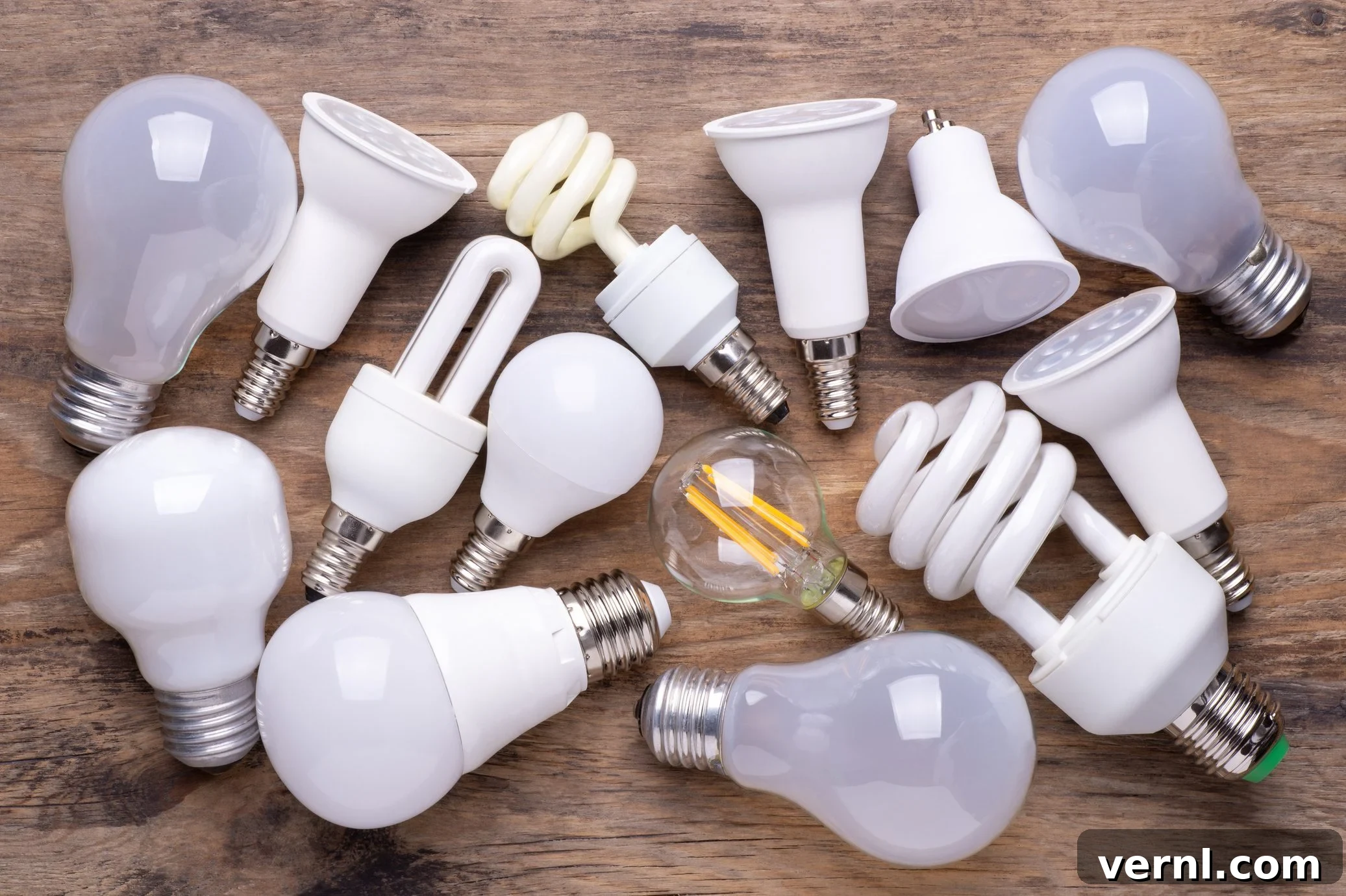
The journey of artificial illumination began long before the titans of electricity, Nikola Tesla and Thomas Edison, graced the world. Early electric arc light bulbs emerged as revolutionary devices in the 1830s, sparking an innovation that would forever transform human society. While these early inventions laid the groundwork, it took considerable time for light bulbs to transition from nascent experiments to indispensable fixtures in everyday life. A mere century ago, as recently as the 1920s, a staggering half of all homes in the United States still lacked electrical access, highlighting the slow but steady adoption of this game-changing technology. For decades that followed, spanning from the advent of widespread electricity to the 1980s, the choice for consumers was remarkably straightforward: the ubiquitous traditional incandescent bulb reigned supreme. This era of simplicity, however, has drawn to a close. Today, as the venerable incandescent bulb is systematically phased out, homeowners are faced with a diverse and sometimes bewildering array of options, making the decision of selecting the right light bulb type a far more complex endeavor.
Navigating the modern landscape of home lighting doesn’t have to be a source of frustration. We’re here to demystify the choices and provide a comprehensive guide to help you illuminate your home efficiently and effectively.
The Illuminating Evolution of Light Bulbs
Despite being increasingly eclipsed by more advanced alternatives, incandescent bulbs surprisingly still account for approximately one-third of all light bulb sales in the U.S. However, this traditional technology is steadily being phased out in favor of significantly more energy-efficient and environmentally friendly options. The shift is not just driven by regulations but by consumer preference and technological advancements.
“It is rare that clients request incandescent bulbs now because the LED bulbs have become more affordable, higher quality and we have adapted to seeing them in most places,” observes Jennifer Johnson, owner of The Light Center in Fort Collins, Colorado. This sentiment echoes across the lighting industry, underscoring a fundamental change in how we perceive and purchase lighting solutions.
The primary driver behind this paradigm shift is efficiency. According to the U.S. Environmental Protection Agency (EPA), a startling 90 percent of the energy consumed by most incandescent bulbs is lost as heat, leaving a mere 10 percent to produce actual visible light. “We were essentially lighting homes with small heaters,” quips Enesta Jones of the EPA, highlighting the inherent inefficiency of this outdated technology. This vast energy waste not only contributed to higher electricity bills but also placed an unnecessary burden on the power grid and the environment.
The advent and rapid progression of LED (Light Emitting Diode) technology have fundamentally altered this narrative. LEDs boast an impressive efficiency rate of about 90 percent, meaning the vast majority of consumed energy is converted into light, not wasted heat. Furthermore, the economic accessibility of LEDs has dramatically improved; over the last decade, their price has plummeted by nearly 90 percent, making high-quality bulbs available for around $5. This dramatic cost reduction means that each LED bulb effectively pays for itself in energy savings within a few months of use, offering an undeniable return on investment for homeowners.
Beyond mere efficiency, LED technology is evolving at an astonishing pace, opening up new frontiers in home lighting. Smart bulbs, for instance, allow users to precisely control lighting to create specific moods and ambiances within a room, transforming spaces with a tap of a finger or a voice command. The ability for color customization throughout the day, often syncing with natural circadian rhythms, offers potential health benefits by supporting natural sleep-wake cycles. Moreover, the compact size and flexibility of LED technology have enabled innovative fixture designs that can be seamlessly integrated into cabinets, furniture, and architectural elements, offering discreet yet powerful illumination. For homeowners seeking practical ways to reduce energy use and their carbon footprint, switching to LEDs remains one of the simplest and most impactful steps.
“The bottom line is that LED technology is the better option for lighting, no matter your choices at the store,” states Jones unequivocally. The cumulative impact of this shift is profound. She adds, “If every American home replaced their five most frequently used light fixtures or the bulbs in them with ones that have earned the Energy Star, we would save more than $5 billion each year in energy costs and prevent greenhouse gases equivalent to the emissions from more than six million cars.” This highlights not just personal savings but a monumental collective impact on environmental sustainability.
While LEDs are undoubtedly today’s shining stars in the lighting world, it’s essential to understand the full spectrum of options still available on the shelves. This comprehensive guide will equip you with the knowledge to find the ideal light bulbs to fulfill all your home lighting needs, ensuring both functionality and aesthetic appeal.
Understanding the Main Light Bulb Types for Residential Use
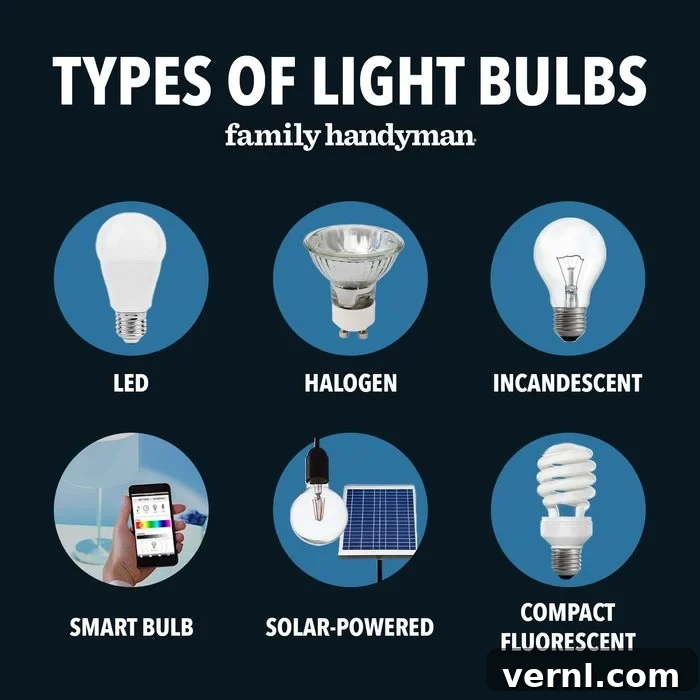
The modern lighting market offers a diverse array of light bulb technologies, each with its unique characteristics, pros, and cons. While LED has become the dominant player, understanding the other types can still be valuable, especially when dealing with older fixtures or specific aesthetic preferences. Here are the four primary types of light bulbs you’ll encounter for home lighting applications:
- Incandescent: The Traditional Glow
Though rapidly receding from mainstream use due to efficiency concerns, incandescent bulbs still maintain a niche, particularly in specialty products like decorative Edison-style filament bulbs. These bulbs operate by heating a tungsten filament until it glows, producing a warm, comforting light that many consumers still appreciate for its color rendition and nostalgic appeal. However, their significant energy waste (90% as heat) makes them costly to operate and environmentally inefficient. While LEDs with appropriate color temperatures can now closely mimic the incandescent glow, the traditional bulb’s unique aesthetic still finds favor in specific decorative contexts, rather than as a primary lighting source for renovations or new constructions.
- Halogen: The Brighter Incandescent Variant
Halogen bulbs are essentially an advanced form of incandescent technology. They contain a small amount of halogen gas within the bulb, which reacts with the tungsten filament to reduce evaporation and redeposit tungsten back onto the filament. This allows halogen bulbs to burn hotter, longer, and brighter than traditional incandescents, increasing their efficiency by approximately 30 percent. Halogens typically produce a slightly whiter, crisper light, making them suitable for task lighting or applications where a clearer, more focused beam is desired. However, they still generate considerable heat, are pricier than standard incandescents, and their improved efficiency is still far outmatched by LEDs.
- Compact Fluorescent Lamps (CFL): The Early Energy Saver
CFL bulbs were once hailed as the next generation of energy-efficient lighting, offering about 75 percent more efficiency than incandescent bulbs. They operate by passing an electric current through a tube containing argon and a small amount of mercury vapor, exciting the mercury atoms to produce ultraviolet light, which then illuminates a phosphor coating on the inside of the tube. While efficient, CFLs come with several drawbacks. They contain mercury, a hazardous substance that requires special disposal, and their performance can be sensitive to temperature fluctuations, making them less ideal for outdoor or cold environments. Furthermore, CFLs often require a warm-up period to reach full brightness and can produce a somewhat “cooler” or less natural light. “Fluorescent in general are not preferred in most residential projects,” states Doreen Le May Madden, owner of Lux Lighting Design in Belmont, Massachusetts, and chair of the Residential Environments Lighting Committee and a Certified Lighting Architect. She emphasizes, “LED offers better light quality and energy savings now,” clearly indicating the industry’s shift away from CFLs.
- LED (Light Emitting Diode): The Modern Standard
LEDs have emerged as the undisputed standard for modern lighting, offering a host of benefits that far surpass other technologies. Beyond their exceptional energy efficiency and impressive lumen ratings, LEDs are lauded for their versatility, superior light quality, precise dimming response, and excellent color rendering. They work by passing an electric current through a semiconductor, which then emits light. This solid-state technology means no filaments to burn out and no gases to heat, leading to incredibly long lifespans (often 25,000 to 50,000 hours or more). “LED is the standard now for general lighting,” affirms Melissa Thomas, owner of Mr. Electric in Land O’ Lakes, Florida. “For existing homes looking for an upgrade, we typically recommend changing to recessed LED fixtures. This gives a clean appearance over the old surface fixtures. For just bulbs, we go with the new standard LED bulbs.” The remarkable adaptability of LED technology allows it to replace most incandescents in existing fixtures, offering an immediate and significant upgrade in efficiency and light quality.
Within the world of LEDs, innovation continues, giving rise to specialized products that enhance convenience and functionality:
- Smart Bulbs: The Connected Home Experience
Also known as intelligent bulbs, these are advanced programmable LEDs equipped with microchips that enable a vast array of functionalities. Smart bulbs can be remotely turned off and on, precisely dimmed, and have their color adjusted (from warm whites to a full spectrum of colors) from a laptop, tablet, or smartphone. They integrate seamlessly into smart home ecosystems, allowing for scheduling, voice control, grouping of lights, and even geofencing (turning lights on/off based on your location), offering unprecedented levels of convenience, ambiance control, and even security.
- Solar- and Battery-Powered Bulbs: Off-Grid and Accent Lighting
These specialized LEDs offer solutions for areas without easy access to electrical wiring or for enhanced security. Commonly used in step lighting, landscape accents, and outdoor flood lighting, they often incorporate motion and light-sensors. Solar-powered versions harvest energy from the sun during the day, storing it in a battery to power the LEDs at night, making them an eco-friendly and autonomous lighting solution for outdoor spaces. Battery-powered options provide flexible, portable lighting for temporary needs or emergencies.
Key Features to Consider When Choosing Light Bulbs
Selecting the ideal light bulb involves more than just picking a type; it requires understanding several key features that dictate performance, aesthetics, and user experience. Here are the crucial factors to keep in mind when making your choice:
- Brightness: Lumens vs. Watts
Traditionally, people associated brightness with wattage. However, wattage merely indicates the amount of power a bulb consumes, not how much light it emits. Lumens (lm) are the true measure of a bulb’s brightness. A higher lumen rating means a brighter light. Understanding both is key to gauging efficiency: a bulb that produces high lumens with low wattage is highly efficient. For example, if a chandelier is rated to hold up to 100 watts per incandescent socket, using a 1,600-lumen LED bulb that only consumes 13 watts will yield the same, if not greater, perceived brightness as the 100-watt incandescent. When in doubt, “I always recommend to go brighter [more lumens] and put in a dimmer if it is too bright,” advises Melissa Thomas. “When changing from old incandescent to new LED bulbs, the light will appear brighter initially, but [people] get used to it quickly and enjoy the brightness.” This flexibility ensures you always have adequate light, adjustable to your preference.
General Lumen Guidelines:
- Accent Lighting: 100-250 lumens (e.g., nightlights)
- Task Lighting: 450-800 lumens (e.g., reading lamps, under-cabinet)
- General Room Lighting: 800-1600+ lumens (e.g., living rooms, kitchens, bedrooms)
Always consider the room size and specific activities when determining lumen requirements. Dimmer compatibility is also crucial for LEDs; ensure your dimmer switch is compatible with LED technology to avoid flickering or poor performance.
- Color Temperature: Setting the Mood with Kelvin (K)
LED bulbs offer a vast range of light colors, from the warm, inviting glow of a traditional incandescent to the crisp, invigorating feel of natural daylight. Light colors are precisely measured on the Kelvin (K) temperature scale. Lower Kelvin values indicate warmer, yellower light, while higher values signify cooler, bluer light. Many newer LED fixtures even offer adjustable color ranges, allowing users to switch between different temperatures.
The choice of color temperature largely comes down to personal preference and the intended ambiance of a room. Jennifer Johnson notes she predominantly sells 3,000K bulbs, which “is warm enough to not feel stark, but is crisp enough to not muddy whites. Occasionally people will strongly prefer 2,700 K, and because males tend to prefer cooler temperatures in lighting, they may request 3,500 K.” Doreen Le May Madden specifies her common residential ranges as 2,400 K to 2,700 K, “since they give the effect of incandescent bulbs. However, these may not be the best option in a room with all cool colors. Some prefer a whiter light of 3,000 K, since this highlights both warm and cool colors equally.”
Typical Kelvin Ranges and Their Applications:
- 2200K – 2700K (Warm White/Soft White): Mimics incandescent bulbs. Ideal for bedrooms, living rooms, and dining areas where a cozy, relaxing, and intimate atmosphere is desired.
- 3000K – 3500K (Neutral White/Bright White): A balanced white light, neither too yellow nor too blue. Excellent for kitchens, bathrooms, offices, and hallways where a clean, inviting, yet functional light is needed. It helps colors appear truer.
- 4000K – 5000K (Cool White/Daylight): Closely resembles natural daylight. Best for task-oriented areas like workshops, garages, home offices, and laundries where alertness, focus, and accurate color perception are important. Can feel too stark for relaxing spaces.
- Color Rendering Index (CRI): How True Colors Appear
Beyond color temperature, CRI measures how accurately a light source reveals the true colors of objects compared to natural sunlight. A CRI of 100 is perfect, representing natural daylight. Most quality LEDs have a CRI of 80 or higher, which is generally good for residential use. For areas where color accuracy is critical, like art studios, makeup vanities, or kitchens where food presentation matters, look for bulbs with a CRI of 90+.
- Aesthetics: Form and Function
The visual appeal of a light bulb, both unlit and illuminated, plays a significant role in interior design. Consider the bulb’s shape (e.g., A-shape, globe, candle, floodlight), its glass or lens color, and how it complements the fixture and overall room decor. “Not all bulbs are created equal and until you see them on, you may not be able to tell the difference,” advises Johnson. Some fixtures leave the bulb exposed, making its aesthetic crucial. Modern LEDs come in a myriad of decorative forms, including filament styles that mimic traditional incandescents without the energy waste.
- Lifespan and Durability: A Long-Term Investment
One of the most compelling advantages of LED bulbs is their exceptionally long lifespan, often rated for 25,000 to 50,000 hours of use. This drastically reduces the frequency of bulb replacement, saving both time and maintenance costs, especially in hard-to-reach fixtures. Compared to incandescents (around 1,000 hours) or CFLs (around 8,000 hours), LEDs represent a significant long-term investment. They are also generally more durable, as they lack fragile filaments or glass tubes susceptible to breakage.
The EPA has thoughtfully compiled an interactive guide to choosing bulbs, which can further assist in understanding lumen requirements and preferred color temperatures for various applications.
Deciphering Light Bulb Sizes and Bases
While the internal technology of light bulbs has seen revolutionary changes, the physical interface with light fixtures has remained somewhat standardized, albeit with numerous variations. There is no single, universally adopted industry standard for light bulb sizes and bases, leading to hundreds of combinations. Bulb sizes are typically indicated by an alphanumeric designation, such as A19, T10, B10, MR16, G9, GU10, and so forth.
For most common table and floor lamps, the familiar “A-lamps” are used, characterized by their pear-like shape and an Edison (E26) screw-in base, named after its inventor, suitable for 120V household current in North America. Smaller, candelabra-style fixtures, common in decorative chandeliers, often use E12 bases. Other common bases include:
- E26/E27: Standard household screw-in base (Edison Screw). E26 for North America, E27 for Europe (though often interchangeable due to minor voltage differences).
- E12/E14: Candelabra screw-in base. E12 for North America, E14 for Europe.
- GU10: A two-pin twist-and-lock base, commonly found in recessed lighting and track lighting, especially for spotlighting.
- MR16: A bi-pin base with a multifaceted reflector, typically used in low-voltage landscape lighting or track lighting.
- G9/G4: Small bi-pin bases often found in decorative fixtures, under-cabinet lighting, or compact halogen lamps.
To ensure you select the correct bulb, the simplest and most reliable method is to examine your existing light fixture or the old bulb itself. Most bulbs will have their size and base type printed on the glass or base. If you have an old bulb, bring it with you to the store to ensure an exact match for both size and base type. For fixtures without a bulb, consult the fixture’s manual or look for markings on the socket itself.
Making the Smart Choice: Best Standard Residential Light Bulbs
Ultimately, the “best bulb” is subjective and dependent on individual preferences, specific room requirements, and aesthetic considerations. However, for the vast majority of residential applications, our experts overwhelmingly recommend a high-quality LED bulb. These should be chosen with your preferred color temperature, desired lumen output, and sourced from a reputable company known for its reliability and product consistency.
The single most critical piece of advice when shopping for any lighting product is to “first look for the Energy Star label,” emphasizes Enesta Jones of the EPA. Energy Star certification is not just a marketing gimmick; it is a rigorous program that guarantees a product meets strict energy efficiency guidelines set by the U.S. Environmental Protection Agency. Energy Star certified bulbs are independently tested and verified to ensure they perform as promised, delivering on their claims of brightness, lifespan, and energy savings.
As Jones explains, “[It] works as a seal of approval for LED bulbs, to indicate they save energy, deliver on brightness, and work the way you expect light bulbs should.” Opting for Energy Star certified LEDs not only ensures you receive a high-performing product but also contributes to significant reductions in household energy consumption, lower utility bills, and a smaller environmental footprint. It’s a simple, reliable way to make an informed and responsible choice for your home’s lighting needs, providing peace of mind alongside superior illumination.