Mastering Vehicle Inspection Stickers: Your Guide to State Compliance and Road Safety
Navigating the world of vehicle ownership comes with a specific set of responsibilities, from routine maintenance to understanding the legal framework governing your car’s presence on public roads. Among these duties, the process of renewing your vehicle registration is a regular administrative hurdle that can vary significantly from state to state. It typically involves a myriad of paperwork, fluctuating renewal fees based on your location and vehicle type, and diverse inspection requirements that ensure your car meets specific operational and environmental standards. While you’re likely familiar with the registration tags that grace your license plate—often color-coded to denote the year and positioned near a sticker indicating your renewal month—there’s another crucial piece of adhesive proof that often demands attention: the vehicle inspection sticker.
This unassuming sticker, commonly affixed to your windshield, is far more than just a date marker. It serves as official evidence that your vehicle has undergone and successfully passed the necessary safety and/or emissions inspections mandated by your state. These checks are fundamental to maintaining road safety, reducing environmental pollution, and ensuring that every vehicle on the highway meets a minimum standard of operational integrity. The landscape of vehicle inspections is intricate, with some states requiring separate stickers for inspections, others integrating the proof into the registration tag, and a select few having no mandatory regular inspection program at all. Understanding these regional differences and the profound implications of these small decals is essential for every responsible driver. Let’s embark on a detailed exploration to decode the vehicle inspection sticker, shedding light on its significance, variations, and what it truly means for your driving experience.
What Are Vehicle Inspection Stickers? Unpacking Their Purpose and Importance
Fundamentally, a vehicle inspection sticker acts as tangible proof that your automobile has undergone and cleared the mandatory safety and/or emissions assessments prescribed by your state’s Department of Motor Vehicles (DMV) or equivalent authority. It’s important to distinguish these from your registration tags. Registration tags typically reside on your license plate, often in an upper corner, displaying year and month indicators (frequently color-coded for easy visual identification). Inspection stickers, on the other hand, are generally placed prominently on your windshield, making them easily verifiable by law enforcement and inspection stations alike.
The core philosophy behind requiring these inspections, and subsequently the stickers that validate them, revolves around two critical pillars: public safety and environmental stewardship. Safety inspections are meticulously designed to pinpoint and necessitate the repair of mechanical deficiencies that could compromise safe operation, such as compromised braking systems, excessively worn tires, or malfunctioning lights. Concurrently, emissions inspections target vehicles that release pollutants beyond permissible limits, thereby contributing to cleaner air and mitigating the broader environmental impact of vehicular exhaust. Without these vital regulatory checks, the roads would be populated by potentially unsafe vehicles, increasing accident risks, while unchecked emissions would drastically worsen air quality, posing significant health hazards.
The Evolution of Compliance: States Consolidating Proof
While the traditional model of separate registration and inspection stickers persists in many jurisdictions, there’s a growing trend among states and counties to streamline this process. This often involves consolidating the proof of inspection directly into the vehicle’s registration tag, adopting a “two steps, one sticker” approach. This modern methodology aims to enhance convenience for motorists and boost administrative efficiency for state agencies. A prime example of this integration is Tarrant County, Texas, which pioneered this system in March 2015. Under this updated framework, vehicles still require inspection; however, upon successful completion, the registration sticker itself serves as a combined certification of both current registration and a passed inspection. This means fewer stickers to apply and potentially a more straightforward compliance routine, provided drivers remain aware that the inspection remains a prerequisite for registration.
California also employs a consolidated proof system, albeit with a distinct emphasis on environmental regulations. The Golden State does not issue a general inspection sticker for overall vehicle condition. Instead, its focus is primarily on emissions, mandating regular smog tests for most vehicles. There are specific exemptions for certain vehicle types, such as electric cars, very new models, or certified older classics. Crucially, proof of a clean smog test is an indispensable component of the vehicle registration process in California. Your registration cannot be finalized until this emissions requirement is satisfactorily met. Once validated, the state issues your standard registration sticker, which implicitly confirms that your vehicle has successfully cleared the necessary environmental checks. This system underscores California’s pioneering commitment to air quality and environmental protection, directly linking clean emissions to legal vehicle operation.
Jurisdictions Upholding Separate Inspection Stickers
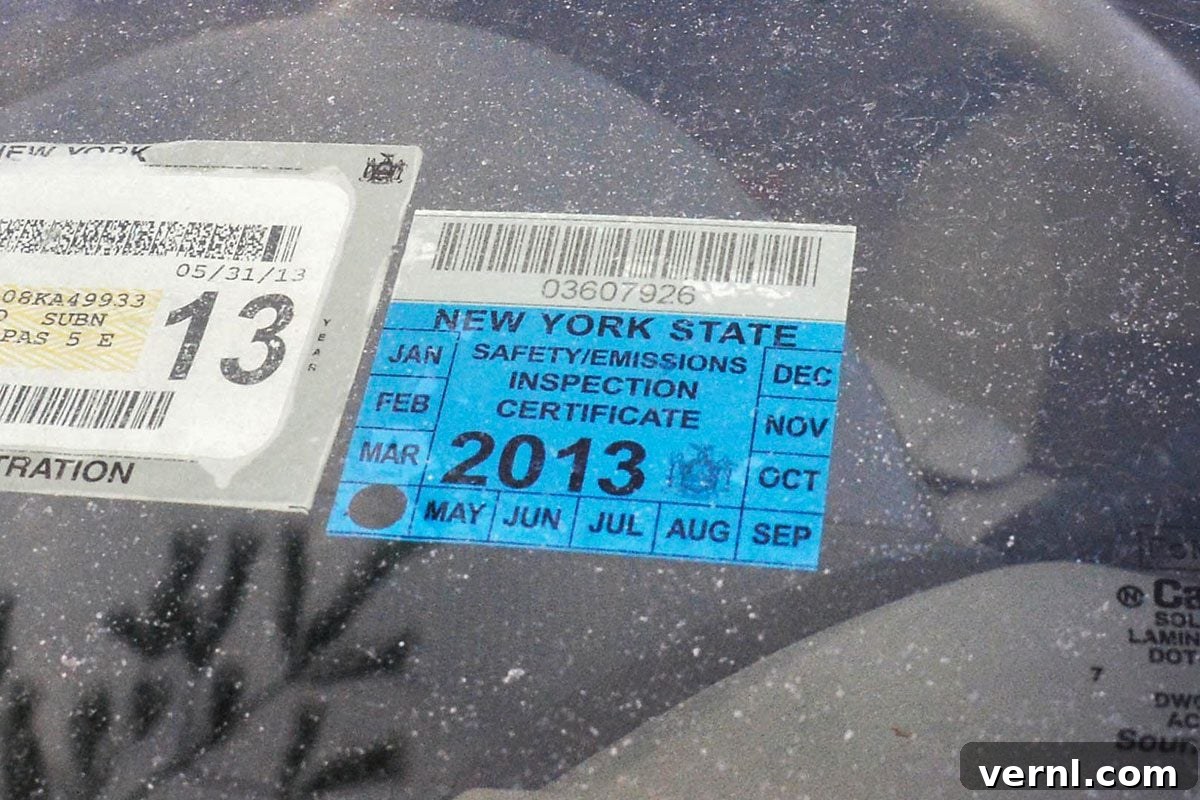
Despite the movement towards integrated systems, a significant number of states continue to issue separate vehicle inspection stickers alongside registration tags, highlighting specific regulatory priorities. New York, for example, strictly requires most vehicles to undergo an inspection as an integral part of the registration renewal process. While the state’s DMV outlines certain exceptions, the general mandate is clear: a valid inspection is non-negotiable for legal vehicle operation. Following a successful inspection, the New York DMV issues both a distinct registration sticker and a separate, dedicated inspection sticker. These inspection stickers typically bear crucial information such as the expiration month and year, and often an identification number for the inspection station that performed the check, providing clear and immediate proof of compliance.
Massachusetts similarly adheres to a protocol requiring annual vehicle inspections, with a separate inspection sticker serving as definitive proof. In a move to modernize and simplify, Massachusetts ceased issuing paper certificates in 2022, making the physical sticker on the windshield the sole official evidence of a passed inspection. This reliance on the visible sticker underscores its critical role for law enforcement officials and ensures that drivers have an unambiguous, readily accessible indicator of their vehicle’s current compliant status, reflecting the state’s commitment to consistent oversight of vehicle roadworthiness.
Decoding Your Inspection Sticker: What It Covers and What It Tells You
At its essence, your vehicle inspection sticker is a compact certificate of your vehicle’s health and legal compliance, signifying that it has successfully navigated state-mandated tests and is deemed safe and environmentally sound for the forthcoming period. The scope and specificity of these inspections are highly state-dependent, which directly impacts what your sticker ultimately represents. Generally, as highlighted by Thompson Law, vehicle inspections fall into two overarching categories: comprehensive safety inspections and targeted emissions inspections.
Safety Inspections: A Deep Dive into Roadworthiness
Safety inspections are meticulously designed to guarantee that every critical component of your vehicle is in optimal working condition, thereby proactively preventing mechanical failures that could precipitate accidents. These rigorous evaluations typically encompass a broad spectrum of essential systems and components, including:
- Braking System: Thorough checks on brake pads, rotors, calipers, hydraulic fluid levels, and overall braking efficacy to ensure reliable stopping power.
- Tires and Wheels: Assessment of tread depth, tire pressure, signs of uneven wear, and overall tire condition to guarantee adequate road grip and minimize blowout risks.
- Lighting System: Verification of the proper functionality of all exterior lights, including low and high beam headlights, taillights, brake lights, turn signals, hazard lights, and often license plate illumination.
- Steering and Suspension: Examination of components for any signs of wear, looseness, or damage that could compromise the vehicle’s handling, stability, and control.
- Windshield and Wipers: Ensuring a clear, unobstructed field of vision, free from significant cracks or damage, and confirming that windshield wipers operate effectively to clear precipitation.
- Horn: Checking for proper operation, essential for alerting other drivers and pedestrians to potential hazards.
- Seatbelts: Verification that all seatbelts are fully functional, free from tears or damage, and securely latching.
- Mirrors: Inspection of rearview and side mirrors for proper placement, secure mounting, and an unobstructed view.
- Exhaust System: A visual and auditory check for leaks, damage, or modifications that could allow dangerous fumes into the cabin or produce excessive noise.
- Fluid Levels and Leaks: Basic checks of essential fluids such as engine oil, coolant, power steering fluid, and transmission fluid, along with an inspection for any active leaks.
By identifying and mandating the repair of deficiencies in these critical areas, safety inspections are a cornerstone of accident prevention, safeguarding every individual on the road. A valid inspection sticker unequivocally confirms that your vehicle meets these fundamental safety benchmarks, assuring responsible operation.
Emissions Inspections: Safeguarding Our Environment
Emissions inspections are specifically focused on controlling and monitoring the level of pollutants emitted by your vehicle into the atmosphere. These tests are particularly crucial in densely populated urban centers and regions with heightened environmental concerns regarding air quality. The typical emissions inspection protocol often includes:
- On-Board Diagnostics (OBD-II) Test: For most vehicles manufactured from 1996 onwards, technicians connect diagnostic equipment to the vehicle’s computer system. This system continuously monitors emission control components and retrieves any stored diagnostic trouble codes (DTCs) that indicate a malfunction contributing to increased pollution.
- Tailpipe Emissions Test: For older vehicles, or in some cases, specific heavy-duty vehicles, a traditional “sniffer” test is performed. A probe inserted into the tailpipe measures the actual concentration of various harmful pollutants, such as hydrocarbons (HC), carbon monoxide (CO), and nitrogen oxides (NOx), in the exhaust gases.
- Visual Inspection of Emissions Components: Technicians may also conduct a visual check of key emissions control components, including the catalytic converter, oxygen sensors, exhaust gas recirculation (EGR) valve, and fuel cap, to ensure they are present, intact, and free from tampering or damage.
A successful emissions inspection, corroborated by your sticker, confirms that your vehicle’s pollution control systems are operating as designed, thereby playing a crucial role in mitigating smog, acid rain, and other detrimental atmospheric contaminants, contributing directly to healthier air quality for all.
Interpreting Your Sticker: Key Information at a Glance
While the precise graphic design and layout can differ between states, most inspection stickers are designed to display critical information prominently and clearly:
- Expiration Date: This is typically the most conspicuous feature, indicating the month and year by which your next inspection is required. It’s vital for drivers to note this date to avoid lapse in compliance.
- Inspection Station Identifier: A unique code or number that identifies the specific facility or mechanic that performed the inspection, allowing for accountability.
- Vehicle Information: Some stickers may include a partial Vehicle Identification Number (VIN) or the vehicle’s license plate number as an added layer of verification, linking the sticker directly to the specific vehicle.
- State Seal or Logo: The official emblem or branding of the issuing state, signifying its governmental authority.
Proficiently understanding how to read and interpret your inspection sticker ensures you are perpetually aware of your vehicle’s current compliance status and can proactively schedule your subsequent mandatory checks, preventing potential penalties.
States Without Mandatory Regular Vehicle Inspections: A Different Approach
While the concept of mandatory, regular vehicle inspections is broadly adopted across the United States, it is not universally implemented. A distinct group of states has opted against statewide, routine inspection programs. The reasons for this can vary, encompassing considerations of cost-effectiveness, a reliance on stringent federal manufacturing standards for new vehicles, or a fundamental belief that the primary responsibility for ongoing vehicle maintenance rests solely with the individual owner. According to Thompson Law, the following states generally do not mandate regular vehicle inspections for passenger cars:
- Alaska
- Arkansas
- Florida
- Iowa
- Michigan
- Minnesota
- Mississippi
- Montana
- North Dakota
- South Carolina
- South Dakota
- Washington
- Wyoming
In these particular states, if an inspection sticker is issued at all, it might pertain to specific, non-annual circumstances, such as commercial vehicles, salvage title vehicles, or vehicles crossing state lines. Such a sticker would signify that the vehicle passed an inspection at a particular point in time, rather than denoting an ongoing annual requirement. Crucially, even in the absence of a mandatory inspection program, vehicle owners in these states are still legally obligated to operate safe vehicles. They remain subject to traffic citations or penalties if their vehicle is found to be unsafe, poorly maintained, or emitting excessive pollutants during a routine traffic stop or accident investigation. Consequently, the onus of proactive maintenance and ensuring ongoing roadworthiness falls entirely on the individual driver in these jurisdictions.
The Broader Importance of Regular Vehicle Inspections Beyond Legal Compliance
While adhering to state laws is a primary driver for vehicle inspections, their benefits extend far beyond mere legal compliance, offering substantial advantages to drivers, passengers, and the broader community:
- Enhanced Safety for All: Inspections serve as a vital preventative mechanism, enabling the early detection and remediation of potential mechanical failures—such as severely worn brakes, compromised steering components, or failing suspension—before they escalate into hazardous situations on the road. This proactive identification significantly reduces the likelihood of accidents and protects everyone.
- Critical Environmental Protection: By verifying that vehicle emissions control systems are functioning correctly and efficiently, inspections play an indispensable role in mitigating the release of harmful pollutants into the atmosphere. This directly contributes to reducing smog, decreasing respiratory illnesses, and combating the adverse effects of climate change, fostering healthier ecosystems.
- Significant Long-Term Cost Savings: Regular inspections are instrumental in identifying minor issues, such as uneven tire wear, a slight fluid leak, or a failing sensor, before they can develop into major, prohibitively expensive repairs. Furthermore, proper vehicle maintenance, frequently prompted by inspection schedules, also optimizes fuel efficiency, leading to tangible savings at the gas pump.
- Increased Vehicle Longevity and Resale Value: A vehicle that is consistently well-maintained and regularly checked for safety and performance indicators is inherently more durable, enjoys a longer operational lifespan, and typically retains a higher resale value. A demonstrable history of passed inspections can be a compelling asset when it comes time to sell or trade your vehicle.
- Invaluable Peace of Mind: Knowing that your vehicle has undergone professional scrutiny and meets all pertinent safety and environmental standards instills a profound sense of confidence and peace of mind for drivers on every journey. This assurance allows you to focus on the road ahead, free from undue concern about unforeseen mechanical failures.
Irrespective of whether your state opts for a dedicated windshield inspection sticker or integrates proof directly into your registration, the fundamental principle remains steadfast: consistent and thorough vehicle checks are an indispensable facet of responsible car ownership. They represent a crucial investment in your personal safety, the well-being of your passengers and fellow road users, and the sustained health of our shared environment.
Conclusion: Stay Informed, Stay Compliant, Stay Safe
Vehicle inspection stickers, in their myriad forms and regulatory contexts, stand as a crucial cornerstone of both road safety and environmental stewardship across the nation. From the distinctive windshield decals mandated in states like New York to the integrated proof within registration tags in California and Texas, these requirements collectively underscore a nationwide commitment to maintaining safe roadways and preserving clean air. For every driver, understanding your specific state’s inspection laws, correctly interpreting what your inspection sticker signifies, and diligently prioritizing your vehicle’s maintenance are not merely legal obligations, but essential responsibilities that contribute to a safer, healthier driving ecosystem.
Proactive engagement is key: do not defer this critical aspect of vehicle ownership until the eleventh hour. Take the initiative to familiarize yourself with your local Department of Motor Vehicles (DMV) regulations, schedule your vehicle inspections well in advance of their expiration dates, and consistently prioritize the optimal health and operational integrity of your vehicle. A valid inspection sticker is more than just a bureaucratic formality; it is a tangible testament to your unwavering commitment to safety, your dedication to environmental protection, and your embrace of responsible vehicle ownership. Drive safely, drive intelligently, and above all, stay thoroughly informed.
Sources
- Two Steps, One Sticker, Tarrant County Texas.
- Smog Inspections, California Department of Motor Vehicles.
- About New York State Inspections, New York Department of Motor Vehicles.
- Motor Vehicle Inspection Stickers, Mass.gov.
- Vehicle Inspection Laws by State, Thompson Law.