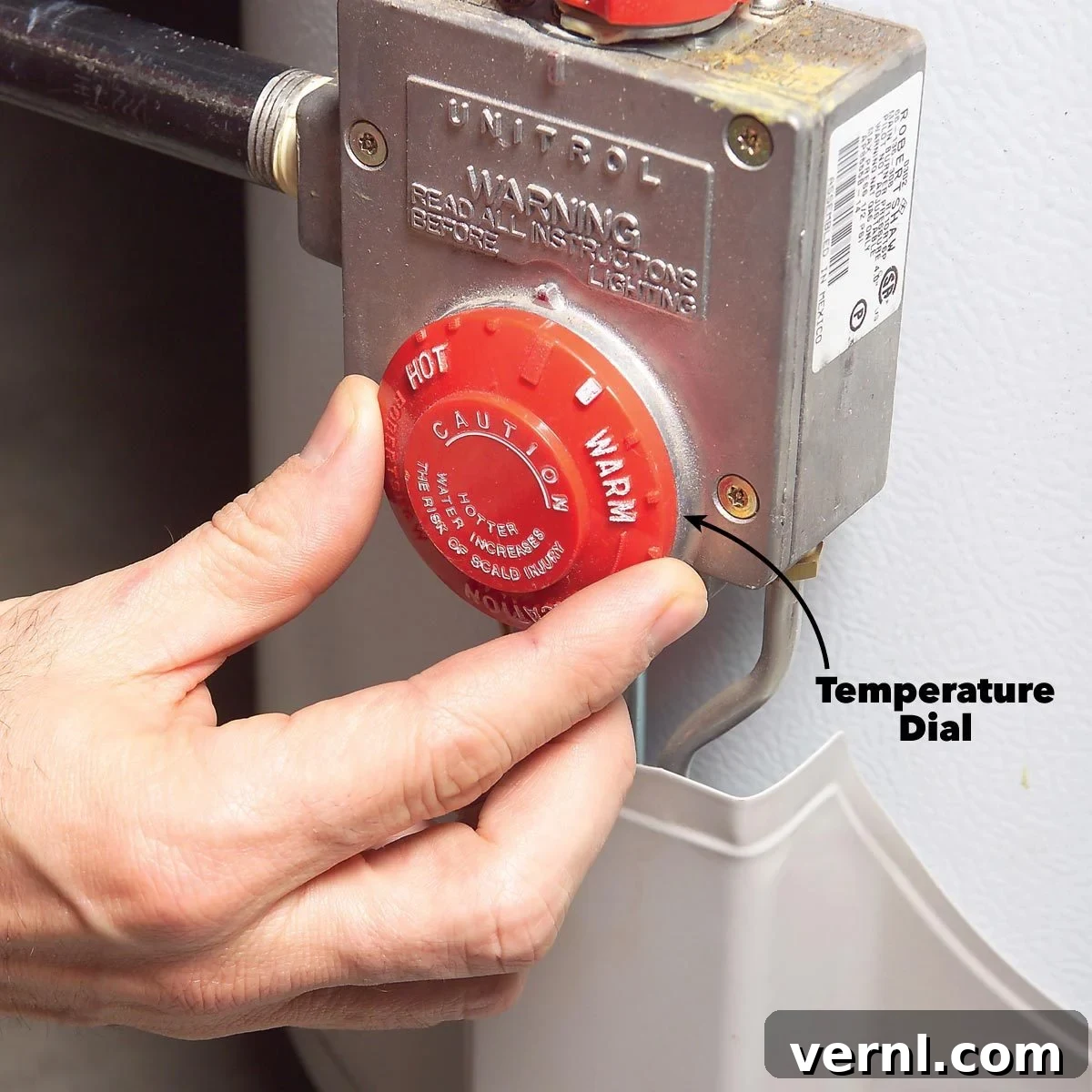
Every year, countless individuals visit hospital emergency rooms suffering from burns caused by dangerously hot tap water. This unfortunate reality often stems from a single preventable cause: their hot water heater is set to an excessively high temperature. While hot water is an indispensable convenience in modern life – whether for rigorous cleaning tasks or a soothing shower after a demanding day – understanding its safe and efficient temperature threshold is paramount. What exactly is the reasonable and safe upper limit for the hot water heater in your home?
Beyond setting the correct temperature, you might also be interested in enhancing your system’s safety and efficiency. For those looking to install additional safety features, here’s how to install a hot water regulator, which can provide an extra layer of protection.
What Temperature Should Your Water Heater Be Set At for Optimal Safety and Efficiency?
The Department of Energy emphatically recommends a hot water temperature setting of 120 degrees Fahrenheit. This specific temperature isn’t an arbitrary figure; it’s a carefully calculated sweet spot designed to achieve two critical objectives: paramount safety for all household members and significant energy savings for homeowners. Adhering to this recommendation is one of the simplest yet most impactful ways to improve your home’s overall safety and reduce its environmental footprint.
“This temperature is hot enough to prevent the growth of harmful bacteria, such as Legionella, while simultaneously being safe enough to avoid scalding, especially for vulnerable individuals like children or the elderly,” explains Lisa Purvins, a seasoned expert in the HVAC field. She emphasizes, “Setting the temperature higher can dramatically increase the risk of severe burns and needlessly inflate energy costs. Maintaining this optimal temperature strikes a perfect balance between safety, comfort, and remarkable efficiency.”
It’s a surprising fact for many homeowners that most hot water heaters leave the factory with a default temperature setting of 140 degrees Fahrenheit. This level is considerably higher than what is typically required for household use and presents a dual threat: it significantly elevates the risk of scalding and drives up utility expenses. A hot water heater can, astonishingly, account for as much as 18 percent of the average household’s total utility bill. Simply turning down the thermostat to the recommended 120-degree setting can lead to substantial financial savings, potentially reducing your energy costs by as much as $400 per year. Imagine the positive impact on your budget and the environment!
The inherent danger of a 140-degree default setting cannot be overstated. Water at this temperature poses a serious risk of severe scalding. According to the Consumer Product and Safety Commission, burns can occur with as little as six seconds of exposure to water heated to 140 degrees. This risk is amplified for young children and the elderly, whose skin is thinner and more susceptible to rapid, severe injury. Such burns can lead to excruciating pain, permanent scarring, and even life-threatening complications, making the seemingly minor act of adjusting your water heater’s temperature a critical safety measure.
Understanding the Benefits of 120°F Beyond Just Savings
The 120°F recommendation isn’t just about preventing immediate burns or cutting costs; it’s a holistic approach to home comfort and health. At this temperature, the water is hot enough for effective cleaning and comfortable showering without causing discomfort or irritation. Furthermore, while there is a minimal, theoretical risk for Legionellae bacteria at 120 degrees, the level is still considered entirely safe for the vast majority of the population. This bacterium, which can cause Legionnaires’ disease, thrives in stagnant warm water between 77°F and 113°F. A constant temperature of 120°F in the tank effectively inhibits its growth, offering a robust defense against potential health hazards.
Special Considerations for Higher Temperatures
While 120°F is the general rule, there are very specific circumstances where a slightly higher temperature, typically in the range of 130 to 140 degrees, might be considered. One primary instance is if you own a dishwasher that lacks an internal booster heater. Many modern dishwashers are designed to operate optimally with hotter water to thoroughly sanitize dishes, and if yours doesn’t heat the water itself, a higher tank setting might be necessary for this appliance’s performance. However, this is usually confined to the dishwasher’s supply line, and a thermostatic mixing valve (TMV) can be installed at other fixtures to ensure safe tap temperatures.
Another rare exception involves households where individuals have severely compromised immune systems or chronic respiratory diseases. In such cases, a medical professional might advise a slightly higher water heater temperature to further minimize any lingering risk of bacterial growth. This decision should always be made in consultation with healthcare providers and potentially a plumbing expert, considering the heightened scalding risks involved. For these specific scenarios, integrating a thermostatic mixing valve at all points of use (showers, sinks) is highly recommended. A TMV mixes hot water from the tank with cold water before it reaches the faucet, allowing the water heater to maintain a higher temperature (e.g., 130-140°F) for bacterial control, while ensuring a safe, consistent 120°F (or lower) at the tap.
How to Safely and Accurately Adjust the Temperature on Your Hot Water Heater
Adjusting the temperature on your water heater can sometimes be a perplexing task, primarily because many temperature dials are not clearly labeled with specific numerical settings. Instead, they might feature vague markings like “Hot,” “Warm,” or simple increment lines. The location and appearance of the temperature control device can also vary significantly. For example, under-sink hot water heaters and tankless hot water heaters often have different interfaces, ranging from simple dials to digital displays. In such cases, your owner’s manual is an invaluable resource for precise instructions on how to adjust the temperature for your specific model.
If the external stickers on your water heater offer no guidance and the owner’s manual has mysteriously disappeared, don’t despair. You can still accurately set your water heater to the optimal 120°F by following this methodical, step-by-step process. Remember, safety first: always consult your water heater’s manual for specific safety precautions, which typically include turning off the power to electric water heaters at the circuit breaker or shutting off the gas supply for gas models before making any adjustments.
- Prepare for Measurement: Begin by running hot water at the tap closest to your water heater. Let it run for at least three minutes. This step is crucial because it purges any cold water lingering in the pipes, ensuring you’re measuring the actual temperature of the water coming directly from the heater. Use a reliable thermometer to take a precise reading of the water temperature as it fills a glass.
- Locate and Adjust the Thermostat: Once you have your initial reading, locate the temperature dial or control on your water heater. For electric models, there might be two thermostats, typically located behind access panels (often secured with screws), one for the upper heating element and one for the lower. For gas models, the control is usually a single dial on the gas valve assembly. If your initial reading is above 120 degrees, carefully adjust the dial downwards in small increments. For example, if it’s set to “Hot,” try moving it slightly towards “Warm.”
- Allow for Re-Stabilization: After making an adjustment, it’s critical to wait. Water heaters need time to reheat the entire tank of water to the new setting and for the temperature to stabilize. Wait approximately three hours before retesting the water temperature at the same tap, again running it for three minutes. This waiting period is essential for an accurate reading of the new setting.
- Repeat Until Optimal: If your water temperature still reads above or below 120 degrees after the waiting period, repeat the adjustment process, making further small tweaks to the dial. Continue this cycle of adjusting, waiting, and retesting until your thermometer consistently reads 120 degrees Fahrenheit. Patience during this process will ensure accuracy and prevent unnecessary over-adjustments.
For a final verification, perform one last check of the water heater temperature the following morning, ideally before anyone in the household uses any hot water. This ensures that the temperature remains stable and accurate under normal household conditions. Once you’ve successfully identified the perfect 120-degree setting, take a moment to make a permanent mark on the dial with a waterproof marker. This simple act will save you from repeating this testing process in the future, providing a clear reference point for your optimal setting.
Finally, integrating this check into your routine hot water heater maintenance is a smart practice. Whenever you flush your tank or inspect connections, take a quick moment to verify that the temperature setting is still precisely where it should be. Accidental bumps or curious hands can sometimes alter settings, so a regular check ensures ongoing safety and efficiency.
Expert Insight from Lisa Purvins
Our invaluable insights on water heater safety and efficiency come from Lisa Purvins, the accomplished CFO and Vice President of Pro-Tech Heating & Cooling. With an impressive career spanning over 20 years in the dynamic HVAC field, Lisa brings a wealth of practical knowledge and leadership to the discussion. Pro-Tech Heating & Cooling, a proud family-owned and operated business headquartered in Michigan, is dedicated to delivering exceptional service. Their core mission revolves around ensuring that heating and cooling systems operate seamlessly and efficiently, achieved through friendly, reliable service provided by their team of highly trained and certified HVAC technicians. Lisa’s expertise underscores the critical balance between safety, comfort, and sustainable energy practices in home heating.