
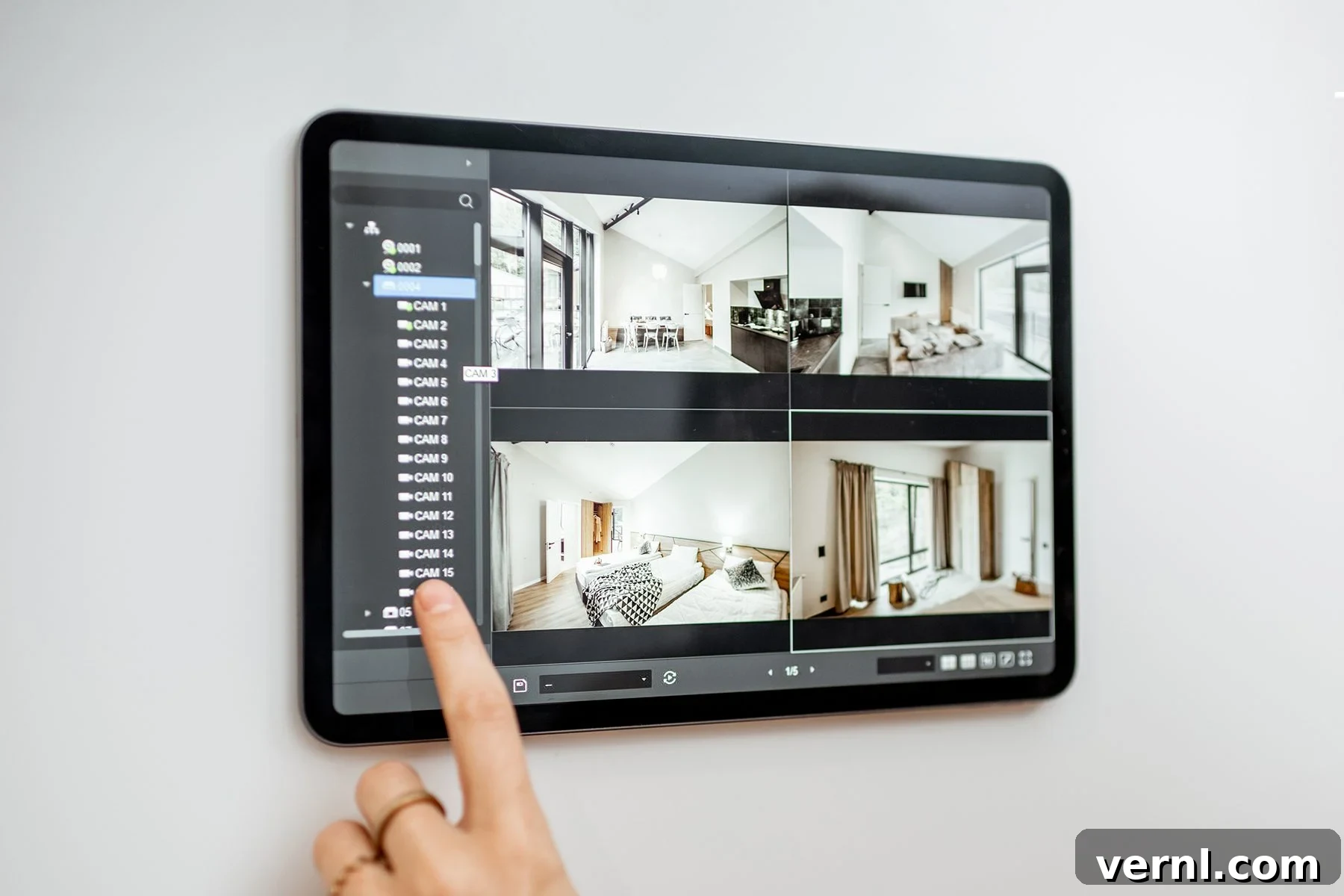
In an age where personal safety and home security are paramount, homeowners face a crucial decision: how to best protect their property and loved ones. This choice often boils down to selecting between a home security system with a professional monitoring subscription and a self-monitored, no-subscription alternative. Each option presents a unique set of benefits and drawbacks, impacting everything from monthly expenses to the level of protection and peace of mind you experience.
I recently assisted a friend in a bustling yet relatively safe neighborhood with setting up a basic Ring home system. Her primary goal was straightforward: to identify callers at her front door and keep an eye on her back entrance without incurring ongoing costs. She opted for a hardwired front doorbell and a single battery-powered camera for the back, utilizing the free Ring app for self-monitoring. This cost-effective, no-subscription setup perfectly met her immediate need to screen visitors before opening her door, proving that comprehensive, high-cost solutions aren’t always necessary for effective home security.
Of course, a robust security system is capable of much more than simply identifying callers. A fully-featured, professionally monitored system can cover every corner of a property, integrating advanced sensors for intrusion detection, fire, carbon monoxide, and other emergencies. Such systems are designed to instantly alert a monitoring center, which then dispatches appropriate authorities like police, fire departments, or paramedics. However, this premium level of protection comes with a recurring monthly fee, a commitment not every homeowner needs or desires. Furthermore, professionally monitored systems, while highly effective, can sometimes generate false alarms, potentially leading to unnecessary responses from emergency services and even fines or strained relationships with neighbors.
To shed more light on this critical decision, we consulted with Hooman Shahidi, the Chief Product Officer at SimpliSafe, a prominent name in home security. His insights offer a valuable perspective on the distinctions between subscription and no-subscription systems. If you’re currently weighing your options for a new home security setup and are unsure whether professional monitoring is a worthwhile investment for your situation, this comprehensive guide is designed to help you make an informed choice.
Understanding Home Security Systems: The Subscription Model Explained
The core philosophy behind most traditional home security systems revolves around a subscription service, transforming your security hardware from a mere alert system into a proactive protection network. As Shahidi explains, “The subscription service brings your security hardware to the next level. If one of your sensors trips — whether a smoke alarm or burglary sensor — a professional monitoring service will jump into action and ensure appropriate help is sent to mitigate any damage.” This professional oversight means that in the event of an emergency, trained operators are on standby 24/7 to assess the situation, verify alarms, and dispatch the necessary emergency services to your home, even if you’re unreachable or unable to respond.
Without a subscription, the responsibility for monitoring and responding falls entirely on your shoulders. Shahidi warns, “Without a subscription, you’re on your own, which can be challenging during a scary situation or impossible if you’re away from your phone and don’t see the alarm notification on your home security app.” This highlights a significant advantage of professional monitoring: the elimination of personal oversight burdens, ensuring that critical events are always addressed promptly.
Beyond immediate emergency response, most subscription services include crucial supplementary features, with cloud storage of video footage being a prime example. This feature automatically backs up recordings from your security cameras to a secure cloud server, making them accessible anytime, anywhere. This digital archive is invaluable for various reasons: it can help investigators determine the causes of damage, provide critical evidence to identify intruders, and offer peace of mind knowing that important moments are safely stored away from potential tampering or physical damage to local devices.
The cost of these subscription services can vary widely based on the provider, the level of monitoring, and the specific features included. According to Ackerman Security Systems of Atlanta, homeowners should anticipate monthly fees generally ranging between $30 to $60. However, the market offers a spectrum of plans; some companies provide more basic monitoring for as little as $20 per month, while premium, feature-rich packages can ascend to $100 or more per month, especially when bundled with extensive smart home integration or specialized services.
The Rise of Self-Monitored Home Security Systems: No Monthly Fees, More Control
For those seeking security without the ongoing financial commitment, self-monitored systems offer an increasingly popular alternative. “Professional monitoring subscriptions are often optional when purchasing a home security system,” confirms Shahidi. This means that when you invest in security hardware like smart doorbells, cameras, and various sensors, you typically gain access to a free accompanying mobile application. This app transforms your smartphone or tablet into a personal monitoring hub, allowing you to self-monitor your property without paying a monthly fee.
Self-monitoring involves receiving real-time alerts directly on your mobile device when a sensor is triggered or motion is detected. Through the app, you can often view live camera feeds, engage in two-way audio communication with visitors, review recorded events (though local storage might be the primary option without a cloud subscription), and arm or disarm your system remotely. Shahidi affirms that this self-monitoring capability is true for SimpliSafe systems, just as my friend now efficiently monitors her Ring setup from her mobile device. This level of direct control and flexibility appeals to many homeowners who prefer to manage their security independently.
The market for no-subscription home security is robust and growing, with many leading brands offering the flexibility to use their equipment without a recurring fee. While some of these brands also provide subscription tiers for professional monitoring or extended features, their base functionality remains accessible to self-monitors. Besides prominent names like SimpliSafe and Ring, several other reputable brands provide free apps that empower users to manage their equipment independently, including:
- Arlo
- Wyze
- Eufy
- Google Nest (with some feature limitations without Nest Aware)
- Lorex
- EZVIZ
- Reolink
- TP-Link Tapo
This wide availability means that consumers have numerous choices when it comes to building a custom, no-subscription security setup tailored to their specific needs and budget.
Benefits of a No-Subscription Home Security System: Freedom and Flexibility
While Hooman Shahidi often recommends subscribing to a professional monitoring plan for maximum protection, he acknowledges that opting for a self-monitored system comes with its own compelling advantages. For many, these benefits significantly outweigh the perceived drawbacks.
- No Recurring Fees: This is arguably the most significant motivator for budget-conscious homeowners. Eliminating monthly subscription fees translates into substantial long-term savings. Over several years, these savings can amount to hundreds, if not thousands, of dollars, allowing homeowners to allocate those funds elsewhere or reinvest them into additional security hardware as needed. This financial freedom is a major draw for individuals and families looking to control their household expenses without compromising on basic safety measures.
- No False Alarm Penalties: False alarms are an unfortunate reality of any security system. Whether triggered by a mischievous pet, a faulty sensor, or an accidental user error, false alarms can be costly. Many communities impose fines for repeated false alarms, as they divert valuable emergency response resources. With a self-monitored system, the responsibility for verifying an alarm rests solely with you. This means you can often quickly check a live camera feed or a notification to determine if an actual emergency is occurring before deciding whether to contact authorities, thereby avoiding potential penalties and minimizing inconvenience to first responders and neighbors.
- Put Equipment Where You Want It & Portability: Self-monitored systems offer unparalleled flexibility in terms of equipment placement. You have complete autonomy to move cameras, sensors, and other devices around your property as your security needs evolve or as you wish to experiment with optimal coverage. There’s no need to consult with a monitoring company or pay for professional adjustments. Furthermore, this independence makes the system highly portable. If you’re a renter, or if you plan to move to another property in the future, you can simply pack up your security equipment and take it with you. This saves you the cost and hassle of installing a new system at a new location, making it a valuable asset for those with transient living situations.
- Enhanced Privacy Control: For some homeowners, the idea of a third-party monitoring center having access to their camera feeds or data raises privacy concerns. With a no-subscription system, you maintain greater control over your data. Video footage is often stored locally on an SD card or a personal network video recorder (NVR), meaning it stays within your direct control. While many self-monitored systems also offer optional cloud storage (often for a fee), the fundamental control over who views and accesses your security footage rests squarely with you, offering an additional layer of privacy.
- Customization and Scalability: Self-monitored systems often allow for greater customization. You can start with a basic setup – perhaps just a doorbell camera – and gradually add more sensors, cameras, or smart home devices as your needs or budget allow. There’s no pressure to commit to a pre-defined package or pay for features you don’t use. This modular approach makes it easy to tailor the system precisely to your home’s unique layout and your specific security priorities.
The Trade-offs: Drawbacks of Self-Monitored Home Security Systems
While the benefits of a no-subscription system are compelling, it’s crucial to acknowledge the trade-offs. Skipping the professional monitoring subscription means foregoing a significant level of protection and convenience that a dedicated security company provides.
- No Help with Equipment or Installation: One of the primary advantages of professional services is the expert support for setup and maintenance. With a no-subscription system, you are entirely on your own for installation, configuration, and troubleshooting. If you encounter difficulties understanding how a piece of equipment works, determining its optimal placement, or resolving technical glitches, you’ll need to rely on product manuals, online forums, YouTube tutorials, or your own technical aptitude. This can be a significant hurdle for those who are not tech-savvy or prefer a hands-off approach to home maintenance.
- No Backup Protection and More Stress: This is perhaps the most critical drawback. Without professional monitoring, there’s no backup when you’re unable to respond to an alert. If an emergency occurs while you’re asleep, away on vacation, in a meeting, or simply out of cellular range, you might miss a crucial notification. The burden of constant vigilance falls entirely on the homeowner. “Without professional monitoring, you have to check your device to find out if something is happening that you need to know about,” says Shahidi, highlighting the increased cognitive load and potential stress. In a genuine emergency, this sole responsibility can be overwhelming and lead to delayed responses, potentially exacerbating damage or danger.
- Limited Connection to Emergency Services: In the event of a verified emergency, a professionally monitored system automatically contacts and dispatches the appropriate emergency services on your behalf. With a self-monitored system, this critical step falls to you. You must manually contact 911 or your local emergency number, explain the situation, and provide your address. This process introduces valuable time delays, which can be critical during a fire, break-in, or medical emergency. “Professional support,” Shahidi emphasizes, “ensures that the right emergency help will be sent to the home quickly to address the problem at hand.” This direct, immediate link to emergency responders is a safety net that self-monitoring simply cannot replicate.
- Limited Cloud Storage and Advanced Features: While many no-subscription cameras offer local storage (e.g., via SD card), continuous cloud storage, especially for extended periods, often comes with a separate, usually optional, subscription fee. This means that without a subscription, you might have limited access to past footage or risk losing recordings if local storage is damaged or stolen. Furthermore, advanced features like AI-powered person/vehicle detection, pet monitoring, or seamless integration with a broader smart home ecosystem are frequently exclusive to subscription tiers or proprietary ecosystems that come with their own costs.
- Potential for Data Overload: Depending on the number of devices and the sensitivity settings, a self-monitored system can generate a significant volume of alerts. Constantly receiving notifications for every motion detected by a tree branch swaying or a car passing by can lead to “alert fatigue,” where the homeowner starts to ignore notifications, potentially missing a legitimate threat. A professional monitoring service typically employs methods for alarm verification, reducing the likelihood of dispatching for non-emergencies and ensuring only critical alerts reach you, if desired.
Subscription vs. No-Subscription: A Detailed Comparison Table
To help you visualize the key differences, here’s a detailed comparison:
| FEATURE / CATEGORY | PROFESSIONAL MONITORING (Subscription) | SELF-MONITORING (No Subscription) |
| Monthly Cost |
|
|
| Emergency Response |
|
|
| Alarm Verification |
|
|
| Cloud Video Storage |
|
|
| Installation & Support |
|
|
| System Portability |
|
|
| Peace of Mind |
|
|
Which Home Security System is Right for You? Making an Informed Decision
The choice between a subscription-based, professionally monitored home security system and a self-monitored, no-subscription alternative is highly personal. It hinges on a multitude of factors, including your budget, your technical comfort level, the perceived safety of your neighborhood, and ultimately, the level of protection and peace of mind you desire. There’s no universal “best” option; instead, it’s about finding the system that perfectly aligns with your specific circumstances and priorities.
You might find that professional monitoring is an unnecessary expense if, like the friend for whom I recently set up a system, you reside in a relatively safe neighborhood and your primary security concern is simply identifying who is at your door or keeping a casual eye on an entry point. For such minimal protection needs, the required skill for installing security hardware is often low, making DIY setup perfectly feasible. Moreover, self-monitoring software is typically user-friendly and readily accessible through free mobile applications. This scenario perfectly illustrates how a no-subscription system can provide adequate security without breaking the bank.
However, the calculus changes significantly if you live in an area where crime rates are a genuine concern, or if you frequently travel and leave your home vacant. In such situations, professional monitoring can be the crucial difference between a minor incident and a catastrophic loss, or between a quick resolution and prolonged distress. Consider the experience of my brother-in-law, who once lived in a dangerous neighborhood. He was asleep when arsonists set fire to his garage. While camera footage eventually helped police identify and catch the perpetrators, substantial damage had already occurred. A professionally monitored system could have detected the smoke or heat early on, dispatched the fire department immediately, and potentially prevented the significant destruction before it escalated. This illustrates the irreplaceable value of a rapid, external response when every second counts.
To help you make an informed decision, ask yourself the following questions:
- What is my budget for security? Can I comfortably afford a monthly subscription, or am I prioritizing upfront equipment costs only?
- How comfortable am I with technology and DIY tasks? Am I willing and able to install, troubleshoot, and maintain the system myself, or do I prefer professional assistance?
- What is the crime rate and general safety level of my neighborhood? Does my location warrant constant professional vigilance, or are basic alerts sufficient?
- How frequently am I away from home or unreachable? If I travel often or have periods where I can’t check my phone, who will monitor my home?
- What kind of emergencies am I most concerned about? Is it just intrusion, or also fire, flood, or medical alerts that require immediate professional dispatch?
- What level of peace of mind do I truly need? Will self-monitoring suffice, or do I require the absolute assurance that someone is always watching?
By thoughtfully addressing these questions, you can weigh the benefits and drawbacks of each system type against your personal risk tolerance, financial situation, and lifestyle. The goal is to choose a home security solution that provides optimal protection while aligning with your practical needs and preferences.
Frequently Asked Questions (FAQ)
Is no-subscription home security system equipment cheaper?
Not necessarily. Hooman Shahidi clarifies, “Today, a wide variety of home security systems are available depending on your specific budget and home security needs.” The upfront cost of equipment for both subscription-ready and no-subscription systems can vary significantly, ranging from affordable entry-level cameras to high-end, multi-component setups. The main financial distinction between a subscription and a no-subscription home security system isn’t typically the initial hardware price, but rather the presence or absence of a recurring monthly cost for professional monitoring and associated premium features like extensive cloud storage or advanced AI detection. You might even find some advanced no-subscription camera systems have a higher upfront cost than basic subscription-ready equipment.
Do I still get alerts with a no-subscription system?
Yes, absolutely. With a no-subscription system, you receive real-time alerts directly on your smartphone or other linked mobile devices via the system’s dedicated free app. These alerts typically include notifications for motion detection, door/window sensor triggers, or other events detected by your security hardware. The key difference is that these alerts go directly to you, the homeowner, rather than to a professional monitoring center that would then contact emergency services on your behalf. You are responsible for monitoring and responding to these alerts yourself.
Can I upgrade a no-subscription system to a subscription later?
In many cases, yes. Most reputable home security brands that offer self-monitoring also provide optional professional monitoring plans. If you initially purchase hardware for self-monitoring and later decide you want the added benefits of professional monitoring, you can often subscribe to a plan through the same company. It’s always a good idea to confirm this flexibility with the specific brand you are considering before making a purchase, as policies can vary.
Do professional monitoring systems offer insurance discounts?
Yes, many homeowners insurance providers offer discounts if you have a professionally monitored home security system. Insurers view these systems as a significant deterrent to theft and a way to mitigate damage from other perils like fire, thereby reducing their risk. The exact discount percentage can vary by provider and policy, so it’s advisable to check with your insurance agent to see if your chosen professional monitoring service qualifies for a reduction in your premiums. Self-monitored systems typically do not qualify for such discounts.
Meet Our Expert
- Hooman Shahidi is the Chief Product Officer at SimpliSafe, a leading provider of home security systems.
Sources
- Ackerman Security Systems: How Much Do Home Security Systems Cost Per Month?; 2024.