
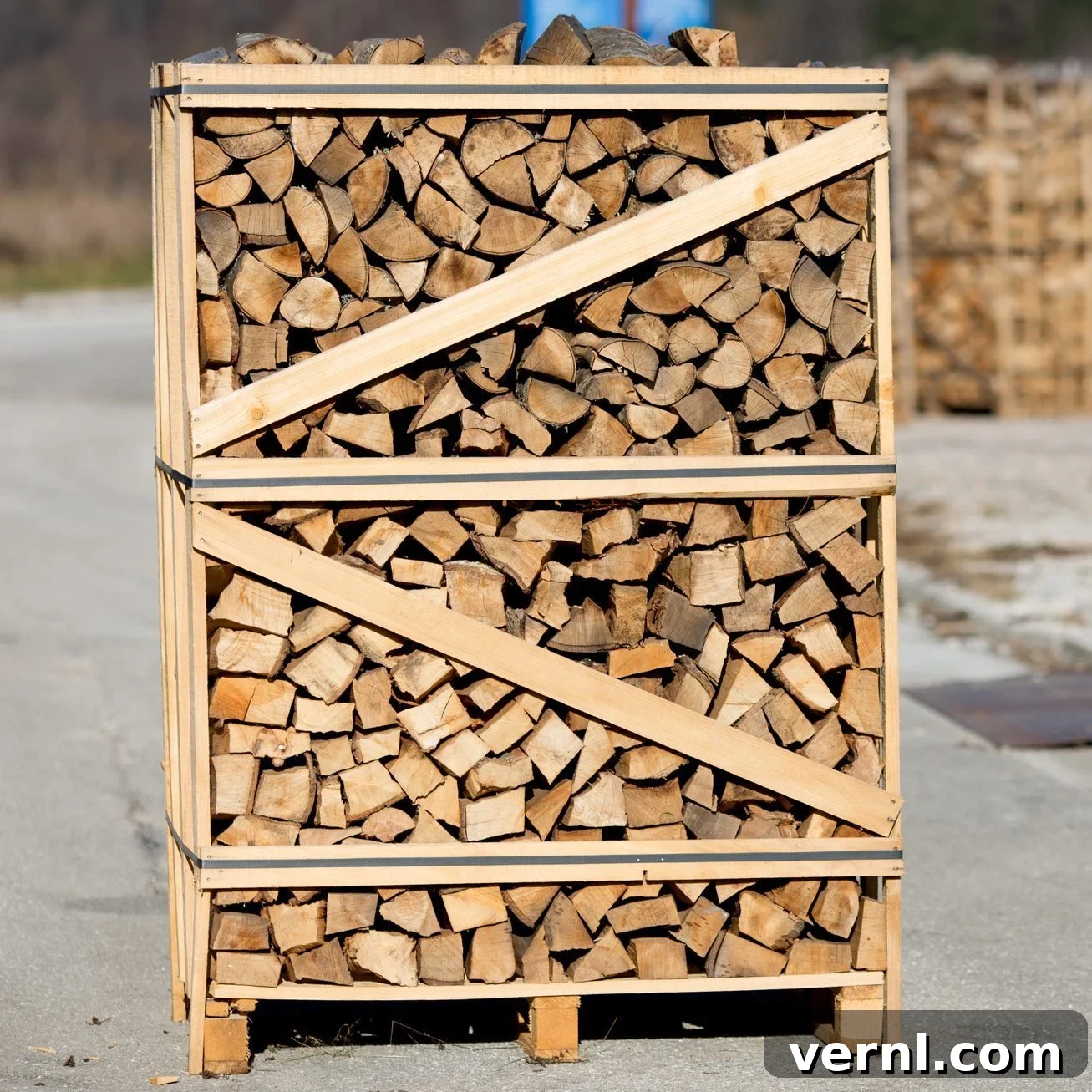
If you’re looking for firewood in the U.S., understanding the various measurement units is crucial. The primary unit you’ll encounter when buying firewood in bulk is the cord, or a fraction thereof. This term, which originated around the 16th century, historically referred to the length of the cord used to bundle wood together. While not universally common, it is also used in countries like New Zealand and Canada, reflecting its historical ties to Imperial measurement systems.
The distinction between Imperial and metric measurements becomes apparent when discussing firewood. Because the cord originated when the Imperial system was prevalent, it is defined by feet. Conversely, many countries that adopted the metric system, including Canada for some measurements, quantify firewood in multiples of a stere, a unit based on meters. It’s important to note that a stere is significantly smaller than a cord, which can be a point of confusion for international buyers or sellers.
A full cord represents a substantial amount of firewood, often more than what an average homeowner or occasional burner needs. To accommodate varying demands and storage capacities, sellers commonly use several smaller units for quantifying firewood. These include the face cord, rick, pallet, and bundle. Before making any purchase, it’s always wise to carefully consider how much firewood you realistically need for the season or specific occasion.
Understanding the Cord: The Benchmark of Bulk Firewood
When dealing with firewood, the measurement is fundamentally based on volume, not weight. This simplifies matters considerably, as different wood species possess varying densities and moisture content significantly impacts weight. A seasoned oak log, for example, will weigh substantially more than a freshly cut pine log of the same volume. For an accurate volume measurement, it is imperative that the wood be neatly stacked with minimal space between logs. A haphazard pile will invariably contain more air and less actual wood.
In the United States, a standard cord of firewood is defined as a meticulously stacked rectangular pile measuring four feet high, eight feet long, and four feet deep. This equates to a total volume of 128 cubic feet. This specific dimension is the universally accepted standard Imperial measurement unit for bulk firewood. To put this into perspective, transporting a full cord of firewood typically requires more than one trip, even with a full-sized pickup truck. The exact number of trips will depend heavily on the truck’s payload capacity and the specific weight of the wood species being hauled.
While the standard cord dimension assumes logs that are four feet long, these lengthy pieces are generally impractical for most residential fireplaces, wood stoves, or outdoor fire pits. Consequently, it is common practice for sellers to cut these logs shorter, often to 16-inch or 24-inch lengths. Even when logs are cut into halves or thirds, if you stack them four feet high and eight feet long, with multiple rows behind the visible stack to achieve the four-foot depth, you still end up with a full cord of firewood. The key is to ensure the total cubic volume of stacked wood amounts to 128 cubic feet, regardless of individual log length.
Smaller Units: The Face Cord and Rick for More Manageable Quantities
For many homeowners, a full cord of firewood is simply too much to store or use in a single season. This is where smaller, more manageable units like the face cord and the rick come into play. However, these units often come with their own set of ambiguities, primarily due to regional variations and seller interpretations.
If you stand before a neatly stacked pile of firewood that measures eight feet long by four feet high, you might instinctively assume you’re looking at a full cord. However, this is not always the case. The crucial factor distinguishing a face cord from a full cord is the depth of the stack and the length of the individual logs. If there is only a single stack and the logs are uniformly 16 inches long, then you are indeed looking at a face cord. A face cord, with dimensions of 8 feet long x 4 feet high x 16 inches (1.33 feet) deep, represents approximately one-third of a full cord, totaling around 42.7 cubic feet.
The term rick is often used interchangeably with face cord, particularly in certain regions, but it can also signify a different volume. Like a face cord, a rick is typically a stack measuring four feet high by eight feet long, but its depth is shorter than the four feet required for a full cord. If the depth is 16 inches, then the rick is essentially equivalent to a face cord. However, the lengths of logs in a rick, and therefore its total volume, can vary significantly depending on the seller and geographical location. For instance, if the depth of the pile is two feet (24 inches), the rick would represent approximately half a cord (8 ft x 4 ft x 2 ft = 64 cubic feet). If the depth is only 12 inches, which is often ideal for most wood stoves and smaller fireplaces, then the rick would only be a quarter of a cord (8 ft x 4 ft x 1 ft = 32 cubic feet). To further complicate matters, some sellers might market a 12-inch deep rick as a “face cord,” despite its significantly smaller volume compared to the standard 16-inch face cord. Always clarify the exact dimensions and log lengths when purchasing a face cord or rick to ensure you’re getting the expected amount of firewood.
Even Smaller Units: Pallet and Bundle for Convenience
Even a face cord or rick can be a substantial quantity of firewood for those who only use their fireplace or wood stove occasionally. For such users, or those with limited storage space, even smaller units like pallets and bundles offer more convenient options.
Some wood suppliers sell firewood by the pallet. This unit typically refers to a cubic stack of wood measuring approximately 3.5 feet by 3.5 feet by 3.5 feet. The total volume of a standard firewood pallet is around 42.9 cubic feet, which is roughly equivalent to the volume of a face cord. For individuals who need more than just a few logs but less than a full face cord, a half pallet might be a perfect solution, offering enough wood for several evenings without demanding excessive storage space.
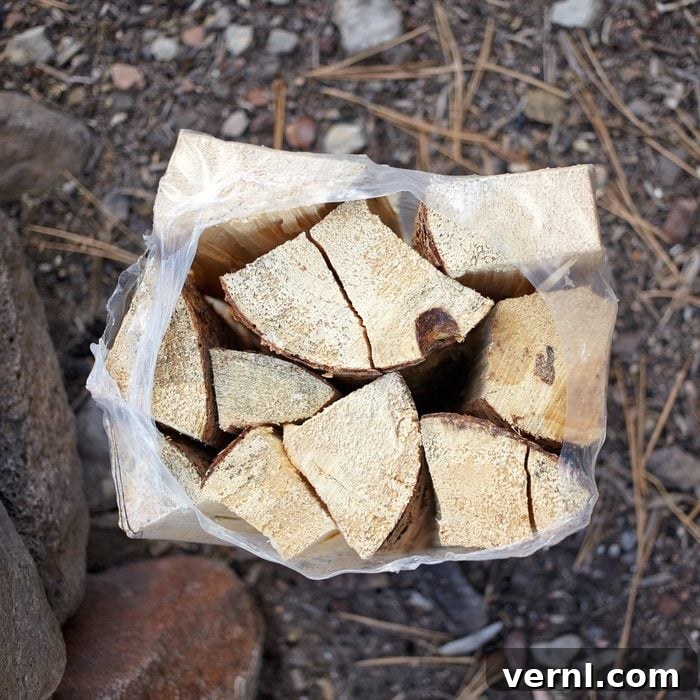
The most convenient and readily available way to buy firewood is by the bundle. These small, wrapped packages are the standard unit sold at grocery stores, big box retailers, gas stations, and campgrounds. Bundles are ideal for people who enjoy an occasional fire for ambiance, a camping trip, or a special event. However, for those who rely on wood burning for daily heating, purchasing bundles becomes an incredibly costly endeavor due to the significant markup. If you require a larger, more economical amount, you will need to conduct some research into where to buy firewood in bulk from local suppliers in your area.
The exact volume of store-bought bundles can vary, but it’s typically around 3/4 to 1 cubic foot. While the convenience is undeniable, the cost disparity is stark. With each bundle commonly priced between $5 to $7, acquiring the equivalent of a full cord through bundles could cost you as much as $600 to $900. This is a dramatic increase compared to the $200 to $400 you might pay for a full cord when purchased directly from a reputable firewood supplier. For regular burners, the savings of buying in bulk are undeniable.
Buying Firewood in Metric Countries: Understanding the Stere and Beyond
The United States stands as one of only a few countries that continue to predominantly use the Imperial measurement system. This means that travelers or those relocating to metric-system countries will need to familiarize themselves with different firewood measurement units, most notably the stere.
Metric units, such as the liter for volume or the kilogram for weight, require a mental shift. The same applies to the unit for firewood, the stere (pronounced “stair”). A stere is defined as a stack of firewood that measures one meter by one meter by one meter (1m x 1m x 1m). While this sounds like a cubic meter, there’s a crucial distinction: the stere includes the spaces between the logs. Because of these inherent air gaps, a stere contains slightly less actual wood than a solid cubic meter. In practical terms, one stere is approximately equivalent to about a quarter of a standard U.S. cord, making it a considerably smaller unit.
It’s also important to understand that the stere is not the only metric measurement unit used globally. Different countries or regions may employ their own specific terms, even if the underlying volume is similar. For example, in the Netherlands, firewood is often measured by the kuub; Germans might refer to the kubikmeter; and the Finnish use the term motti. These units often (but not always) refer to a solid cubic meter of wood, or at least a stack that is expected to yield approximately one cubic meter of solid wood, implying that the air spaces are either accounted for differently or are assumed to be less significant. This means units like the kuub, kubikmeter, or motti, when referring to a full cubic meter of *solid* wood, would actually be slightly larger than a stere because they imply less air space. When buying firewood in metric countries, always clarify whether the quoted price is for a stere (including air spaces) or a unit that represents a more compact cubic meter of wood.
Essential Tips for Smart Firewood Purchases
Regardless of whether you’re buying a full cord or a small bundle, being an informed consumer will save you money, time, and frustration. Here are some key tips for making smart firewood purchases:
- Verify Measurements: Never take a seller’s word for it alone. Visually inspect the stack. If buying a cord, ask to see it stacked to the correct 4x8x4 dimensions. For face cords or ricks, confirm the depth and log length. A poorly stacked pile can easily shortchange you.
- Ask About Moisture Content (Seasoning): This is arguably the most critical factor. Green (freshly cut) wood contains a high percentage of water, making it difficult to light, produce excessive smoke, and burn inefficiently. Look for “seasoned” firewood, which has been cut, split, and dried for at least 6-12 months (or longer for hardwoods) until its moisture content is below 20%. Seasoned wood will typically be darker, lighter in weight, have cracks on the ends, and make a hollow sound when two pieces are knocked together.
- Know Your Wood Type: Hardwoods (oak, maple, hickory, ash) burn longer and hotter, making them ideal for heating. Softwoods (pine, spruce, fir) ignite quickly and are good for kindling or short, intense fires, but they burn faster and produce more creosote build-up in chimneys. Consider your burning habits and needs.
- Calculate Your Needs: How often do you plan to burn? Do you use it for primary heating or occasional ambiance? A typical full-time wood burner in a colder climate might use 3-5 cords per winter, while an occasional burner might only need a face cord or two. Don’t overbuy if you lack proper storage.
- Inspect for Pests and Disease: Be wary of firewood that shows signs of insect infestation or disease. Transporting such wood can spread destructive pests to new areas, potentially harming local ecosystems. Some regions have strict regulations on moving firewood across state or county lines.
- Consider Delivery and Stacking: Factor in the logistics. Do you have a vehicle capable of hauling large quantities? Will the seller deliver, and is there an extra charge? Do you have a suitable, dry, well-ventilated space to stack and store the wood, away from your home’s foundation?
- Shop Around and Compare Prices: Prices can vary significantly based on location, wood type, and seller. Get quotes from several suppliers and compare their definitions of a “cord” or “face cord” to ensure you’re comparing apples to apples.
Understanding the intricacies of firewood measurements, from the robust cord to the convenient bundle, empowers you to make informed decisions. By clarifying terms with sellers, inspecting your purchases, and considering your specific needs, you can ensure a warm and efficient fire experience while getting the best value for your money.