
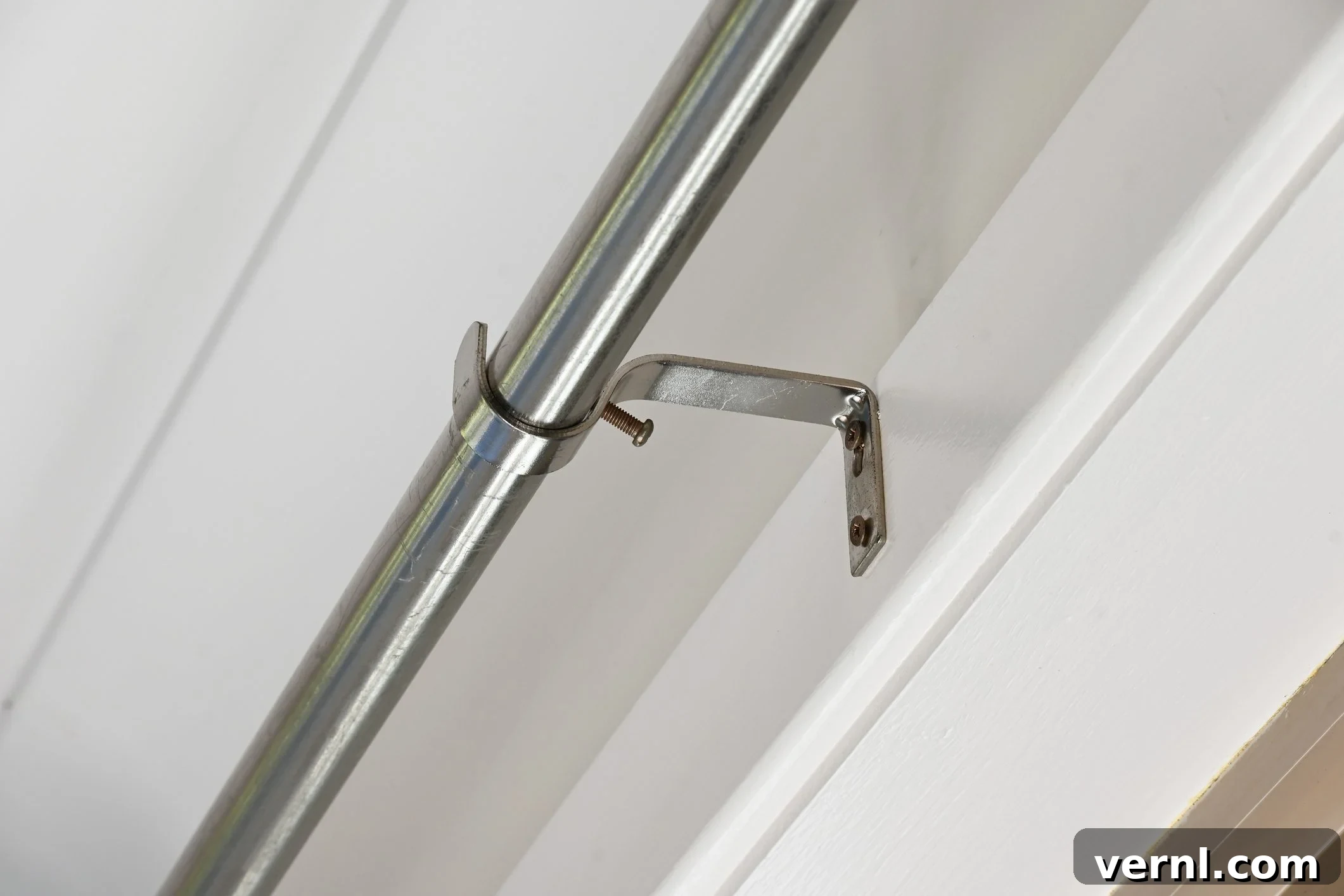
Installing conventional curtain rods that attach to drywall can be a surprisingly challenging endeavor, despite their simple appearance. Anyone who has wrestled with drills, anchors, and spirit levels can attest to the frustrations involved. From trying to locate wall studs to patching unwanted holes when relocating or redecorating, the traditional method often consumes more time and effort than anticipated. This is where no-drill curtain rod brackets emerge as a potentially game-changing solution. These innovative brackets offer a significant labor-saving alternative, effectively eliminating the need for drilling into drywall and, consequently, the hassle of repairing holes – a major boon for renters or anyone frequently updating their window coverings.
But the burning question remains: do these no-drill solutions genuinely deliver on their promise of convenience and stability?
According to interior design expert Jodi Peterman, the answer is a resounding yes, particularly for lighter window treatments. “They are an excellent solution for lightweight to medium-weight curtains, providing a hassle-free installation experience,” she notes. Real estate investor Robert Shepard concurs but stresses the importance of making an informed choice. The market offers several distinct types of no-drill brackets, each designed to handle varying weight capacities. For heavier options, such as super-heavy soundproofing or blackout curtains, conventional drilled brackets often remain the more reliable option due to their superior load-bearing capabilities.
Understanding the different types of no-drill curtain rod brackets available and their specific applications is crucial for selecting the best fit for your home. Let’s explore the options.
What Are No-Drill Curtain Rod Brackets?
As their name explicitly suggests, no-drill curtain rod brackets are innovative hardware designed to support curtains without requiring any holes to be drilled into your walls or window frames. They represent a significant departure from traditional installation methods, which typically involve measuring, drilling pilot holes, inserting drywall anchors, and meticulously screwing brackets into place. These modern alternatives achieve their purpose through various ingenious mechanisms, each tailored to different window types and curtain weights. Their primary appeal lies in their ease of installation and removal, offering flexibility and preserving the integrity of your walls. If you’re also exploring DIY curtain rod ideas, these brackets can complement many homemade designs.
Types of No-Drill Curtain Rod Brackets
The ingenuity of no-drill curtain rod hangers lies in their diverse attachment methods. Some variations ingeniously hook onto existing window casings or blinds, leveraging pre-existing structures for support. Others employ advanced adhesive technologies to securely bond to drywall or window frames. Yet another category utilizes tension-based systems, anchoring themselves firmly within the window frame. Each type offers unique advantages, catering to specific needs and preferences.
Tap Brackets
Tap brackets are robust metal brackets engineered to fit snugly around the corners of your window casing. Their unique design incorporates small, sharp support pins that are gently tapped into the wood casing with a hammer, creating a secure hold without the need for drilling large holes. For wider windows, a center bracket with pinned wings provides additional support, preventing the rod from sagging. The most prominent (and often singular) brand in this category is Kwik-Hang, renowned for its efficiency and strength.
“Kwik-Hang brackets are incredibly versatile, working seamlessly with any wooden window frame that measures at least 1/2 inch in width,” explains Jodi Peterman. “They boast an impressive weight capacity of up to 20 lbs, making them a sturdy and exceptionally renter-friendly solution for a wide range of curtain styles.” Their minimal impact on the window casing makes them an ideal choice for temporary installations or situations where preserving the original structure is paramount.
- How they work: Installation is remarkably straightforward and requires minimal tools. You simply position the bracket onto the corner or the center of the wooden window casing and use a hammer to gently tap the integrated pins into the wood. The entire process typically takes mere minutes. When it’s time for removal, a flathead screwdriver can be used to carefully pry the brackets up, leaving behind only tiny, easily concealable pinholes that often require no patching. This ease of installation and removal makes them a favorite among those seeking quick, yet reliable, curtain hanging solutions.
Self-Adhesive Hangers
Self-adhesive hangers are designed for ultimate simplicity, featuring a strong adhesive backing that creates an instant, firm bond with any clean, flat surface. Command is a leading brand in this segment, though numerous other manufacturers offer similar products. Robert Shepherd highlights their utility: “These hangers are perfectly suited for lightweight curtain rods and are particularly popular among renters who prioritize avoiding any form of wall damage.” Their appeal lies in their unobtrusive nature and the promise of a damage-free removal, provided instructions are followed carefully.
- How they work: The installation process is exceptionally user-friendly. Begin by thoroughly cleaning and drying the intended surface to ensure optimal adhesion. Next, peel away the protective backing from the hanger, position it firmly on the clean, flat surface, and apply consistent pressure for several seconds. The powerful adhesive will bond almost instantly, holding the hanger in place. When removal is desired, specific adhesive strips often feature a pull-tab mechanism that allows the hanger to be stretched off the surface without leaving residue or damaging the paint, making them a true temporary solution.
Magnetic Hangers
For homes featuring metal windows or window casings, magnetic hangers present a unique and highly convenient no-drill solution. These innovative hangers are equipped with powerful magnets that cling securely to metallic surfaces, providing robust support for curtains without any mechanical fasteners. “Magnetic hangers are often extendable, offering the flexibility to be adjusted and adapted to fit a variety of window sizes and configurations,” notes Robert Shepherd, emphasizing their versatility.
- How they work: The mechanism is as simple as it is effective. Magnetic hangers automatically attach themselves to any ferrous metal surface, such as steel window frames. The strength of the magnetic attraction is specifically engineered to be sufficient for supporting lightweight curtains, ensuring they remain securely in place. Their ease of repositioning and complete lack of surface alteration makes them an ideal choice for metal-framed windows, offering instant and damage-free curtain hanging.
Tension Rods
Tension rods are perhaps one of the most widely recognized no-drill solutions, commonly found supporting shower curtains in bathrooms. However, their versatility extends far beyond the shower, making them an excellent option for hanging curtains within window frames. Their simple, yet effective, spring-loaded mechanism allows for quick installation and removal, offering immediate privacy and aesthetic enhancement without any permanent alterations.
- How they work: A tension rod typically comprises two telescoping rods, one nested within the other, connected by an internal spring mechanism. To install, you adjust the rod to a length slightly longer than the width of your window frame opening. You then compress the rod by pushing the two sections together, fit it into the window frame, and release it. The internal spring exerts outward pressure, causing the rod ends to lock firmly against the opposing sides of the frame, holding it securely in place. This tension provides sufficient support for lightweight to medium-weight curtains.
Mini-Blind Curtain Rods
For windows already equipped with mini-blinds, specialized mini-blind curtain rod brackets offer a clever and unobtrusive way to hang curtains. These brackets leverage the existing structure of your blinds, eliminating the need to drill into the wall or window frame. Nono Brackets is a leading brand in this innovative category, known for its practical design and ease of use.
- How they work: The installation involves attaching a U-shaped clamp, typically made of metal, onto the header of your existing mini-blind. This clamp securely affixes to the top rail of the blind assembly. Once these brackets are firmly in place, you simply rest your curtain rod within their designated slots. The entire curtain assembly is then supported by the robust header of the mini-blind, providing a stable and seamless look. This method is particularly appealing to renters who want to add curtains without affecting the underlying wall or window trim.
No-Drill Curtain Rod Bracket Pros and Cons
While no-drill curtain rod brackets offer undeniable advantages, it’s essential to consider both their benefits and their limitations to determine if they are the right choice for your specific project. A balanced understanding ensures you select a solution that meets your expectations for convenience, stability, and aesthetic appeal.
Pros
- Significant Time-Saving: One of the most compelling advantages is the drastically reduced installation time. Conventional curtain rod brackets, especially when dealing with drywall and the complexities of locating studs or installing anchors, can easily take 30 minutes or more per window. In stark contrast, most no-drill brackets can be installed in under five minutes, making them incredibly efficient for multiple windows or quick decor changes.
- Reduced Labor and Effort: Beyond just time, no-drill solutions eliminate the physical effort and specialized tools typically associated with curtain installation. There’s no need for drills, levels, measuring tapes, or the frustration of finding studs or struggling with screw anchors in awkward spots. This makes curtain hanging accessible to everyone, regardless of DIY skill level.
- Cost-Effective Solutions: Generally, no-drill curtain rod brackets are a highly affordable option. You can typically equip a single window for around $20 or less, which compares favorably to the cost of traditional hardware, especially when factoring in the potential expense of tools or professional installation services. Their budget-friendly nature makes them an attractive choice for temporary living situations or those decorating on a tight budget.
- Leave No Trace (Mostly): A primary draw for renters and those who frequently redecorate is the ability to remove these brackets without leaving lasting damage. In most cases, if installed and removed correctly, no-drill curtain rods can be taken down without requiring any patching, painting, or extensive repairs to the wall or window frame, preserving your security deposit and peace of mind.
Cons
- Limited Weight Capacity: The most significant drawback of no-drill curtain rods is their inherent weight limitation. While tap brackets offer the highest capacity among no-drill options, typically up to 20 lbs, they still rely on the stability and condition of the window casing. Most other types are best suited for lightweight to medium-weight curtains. Heavy fabrics, multiple layers, or blackout curtains often exceed the capacity of these brackets, making conventional, drilled-in solutions more appropriate for substantial window treatments.
- Potential for Failure Over Time: Certain no-drill options, such as adhesive and magnetic rods, as well as tension rods, are not entirely immune to failure. Over extended periods, adhesive bonds can weaken, magnetic attractions can lessen due to movement or vibration, and tension rods can slowly slip if not perfectly seated or if subjected to jarring. This can lead to curtains unexpectedly falling, which can be frustrating and potentially damaging to the curtains or anything below. Environmental factors like humidity can also impact adhesive strength.
- Risk of Minor Wall Damage: While marketed as “no-damage,” some no-drill brackets carry a slight risk. When removing adhesive brackets, particularly if the paint underneath is old or poorly applied, they can sometimes peel off paint or leave behind sticky residue. Similarly, tension rods, when exerting continuous pressure within a drywall-framed window frame, can, over time, create subtle indentations or even crack the drywall if not adequately protected with cushioning. Careful installation and removal are key to minimizing these potential issues.
Do No-Drill Curtain Rod Brackets Really Work?
Yes, unequivocally, no-drill curtain rod brackets do work effectively for many applications, offering a genuine alternative to traditional installation. However, as Robert Shepherd wisely cautions, their true effectiveness can vary significantly based on several critical factors, including the specific type of wall or window frame you have, and crucially, the weight of the curtains you intend to hang. Tap brackets, for instance, generally offer the highest weight support among the no-drill options, but their utility is strictly confined to windows framed with sturdy wood casing.
- Pro Tip: When considering tap brackets, it’s vital to assess the levelness of your window casing. Because these brackets attach directly to the casing, any tilt or unevenness in the wood will directly translate to an unlevel curtain rod. This can result in a noticeable, aesthetically displeasing difference in the gap between the bottom of your curtains and the floor. Always check the casing with a level beforehand to avoid this common issue.
Are No-Drill Curtain Rod Brackets Right for My Project?
Determining if no-drill curtain rod brackets are the ideal solution for your project requires a thoughtful assessment of your specific needs and circumstances. The convenience and versatility they offer are undeniable, but their suitability hinges on several key factors.
If your curtains are relatively lightweight, weighing less than 20 pounds, and your windows are framed with solid wood casing, then tap brackets are an absolute “no-brainer.” They are remarkably easy to install, provide a stable hold, and are practically painless to remove, leaving minimal trace. For windows without casing but with existing mini-blinds, mini-blind curtain rod brackets offer another excellent, fixed-bracket alternative that leverages existing hardware. On a scale of 1 to 10 for ease of use, reliability, and minimal impact, I would confidently rate these two options at a 9 or 10.
On the other hand, adhesive brackets and tension rods, while incredibly convenient for certain scenarios, might not rate as highly in terms of long-term reliability or robustness, probably landing around a 6 or 7. These hangers certainly work and are excellent for very temporary or lightweight applications. However, they are generally less forgiving. A playful tug from a child or a curious pet could potentially dislodge your curtains, sending them crashing down. Moreover, while designed for damage-free removal, the possibility of having to touch up paint after removing adhesive brackets is approximately fifty-fifty, especially if not executed with extreme care and patience. They are best suited for very light sheers or decorative elements where security isn’t a primary concern.
Ultimately, the best choice depends on balancing convenience with the weight of your curtains, the type of window you have, and your tolerance for potential, albeit minor, issues. Always prioritize the longevity and stability of your curtain setup.
No-Drill Curtain Rod Bracket Tips & Tricks
Maximizing the effectiveness and longevity of your no-drill curtain rod brackets involves a few simple tips and tricks. These best practices can help ensure a secure installation, prevent common issues, and maintain the aesthetic appeal of your window treatments.
- Secure Window Casing for Tap Brackets: Before installing tap brackets, particularly if your curtains are on the heavier side (though within the weight limit), inspect your window casing. If it feels loose or appears to have weak points, consider reinforcing it. Adding a few extra nails or, for superior strength, trim screws to the casing can significantly enhance its stability, providing a more reliable foundation for your curtains.
- Check Casing Levelness: As previously noted, the level of your top window casing directly impacts the levelness of your curtain rod when using tap brackets. Always use a spirit level to check the casing beforehand. If you find it’s slightly tilted, you can discreetly shim up the bracket on the lower side with a small piece of cardboard or a plastic shim. This simple adjustment ensures your curtain rod is perfectly horizontal, leading to a much more polished and professional appearance.
- Prevent Dents with Tension Rods: When utilizing a tension rod in a window frame constructed from drywall, there’s a risk of the continuous pressure creating indentations or even minor damage to the softer drywall surface. To mitigate this, insert small, flat squares of cardboard, felt, or even adhesive furniture pads between the ends of the tension rod and the drywall frame. This provides a cushioning buffer, distributing the pressure more evenly and protecting your walls.
- Clean Surfaces for Adhesive Brackets: For self-adhesive hangers to perform optimally, a pristine surface is essential. Before affixing adhesive brackets to any wall or window frame, thoroughly clean the area with rubbing alcohol. This crucial step removes any oils, dirt, dust, or residue that could compromise the adhesive bond, ensuring the brackets adhere as strongly as possible and maintain their hold over time. Allow the surface to dry completely before application.
- Avoid Textured Drywall for Adhesives: Self-adhesive brackets are designed for smooth, flat surfaces. Their adhesive cannot create a strong, consistent bond on textured drywall, such as popcorn or orange peel finishes. The uneven surface reduces the contact area for the adhesive, significantly increasing the likelihood of the hangers failing and your curtains falling. Always choose adhesive brackets for flat, painted walls or smooth window frames.
About the Experts
- Robert Shepherd is the accomplished founder of Peak & Home Partners, a distinguished real estate investment company based in Maryland, bringing invaluable insights into home maintenance and improvements.
- Jodi Peterman serves as the CEO of Elizabeth Erin Designs, a premier full-service interior design firm specializing in residential, commercial, and vacation rental properties, offering expert advice on aesthetic and functional design solutions.