Every vehicle, no matter how mass-produced, possesses a unique identity – its Vehicle Identification Number, or VIN. This sophisticated 17-character code is far more than just a random serial number; it’s a detailed fingerprint, embedding crucial information about your car, truck, or motorcycle. From its birth on the assembly line to its journey on the road, the VIN acts as an immutable record, essential for everything from routine maintenance to uncovering its complete history.
While your car might resemble thousands of others, its VIN ensures it stands alone. This number holds the key to its specific year of manufacture, model, engine type, and even the unique options it was equipped with from the factory. Understanding your VIN is paramount for sourcing the correct parts for repairs, navigating insurance claims, and even making informed decisions when buying or selling a used vehicle. As someone with extensive experience in both car factories and repair shops, I can confidently say that the VIN truly is the fundamental identifier for every aspect of a vehicle’s life.
About Our Automotive Expert
Chris Tonn is a highly respected freelance automotive journalist based in Columbus, Ohio. His comprehensive writing covers the latest auto news and technology, in-depth new car reviews, and fascinating automotive history. With practical experience as a service writer at a major repair shop chain, coupled with his hands-on approach to performing most of his own auto repair work at home, Chris offers a unique blend of theoretical knowledge and real-world insight into the automotive industry. His expertise ensures that our understanding of complex topics like the VIN is grounded in practical application.
What Exactly is a VIN Number?
The Vehicle Identification Number (VIN) is a globally recognized, government-mandated serial numbering system that adheres to rigorous standards set by the International Organization for Standardization (ISO) and specific requirements from national bodies like the National Highway Traffic Safety Administration (NHTSA) in the United States. This standardized 17-character alphanumeric code, a mandatory feature on all vehicles manufactured since 1981, serves as the definitive identifier for cars, trucks, motorcycles, and other motor vehicles worldwide.
Before 1981, VINs varied widely among manufacturers, making it challenging to track vehicle information consistently. The introduction of the standardized 17-character VIN revolutionized the automotive industry by providing a uniform method to precisely identify when and where a vehicle was made, by which manufacturer, and often detailing its specific features and optional equipment. This robust system helps prevent fraud, aids in vehicle recalls, and ensures that critical information is readily accessible.
While many vehicle owners typically encounter their VIN only during routine administrative tasks such as renewing vehicle registration, processing insurance claims, or obtaining a vehicle history report, the intricate sequence of letters and numbers within a VIN tells a much richer story. Deciphering this code empowers car owners, mechanics, and enthusiasts alike to understand their vehicle’s origins, verify its specifications, and ultimately ensure they acquire the correct replacement parts for any repair or upgrade.
Where to Find Your Car’s VIN Number
Manufacturers strategically place the VIN in several conspicuous and critical locations throughout your vehicle, ensuring its accessibility and aiding in anti-theft measures. Knowing where to quickly locate your VIN is incredibly useful, whether you’re performing maintenance, checking a vehicle’s history, or dealing with an insurance claim.
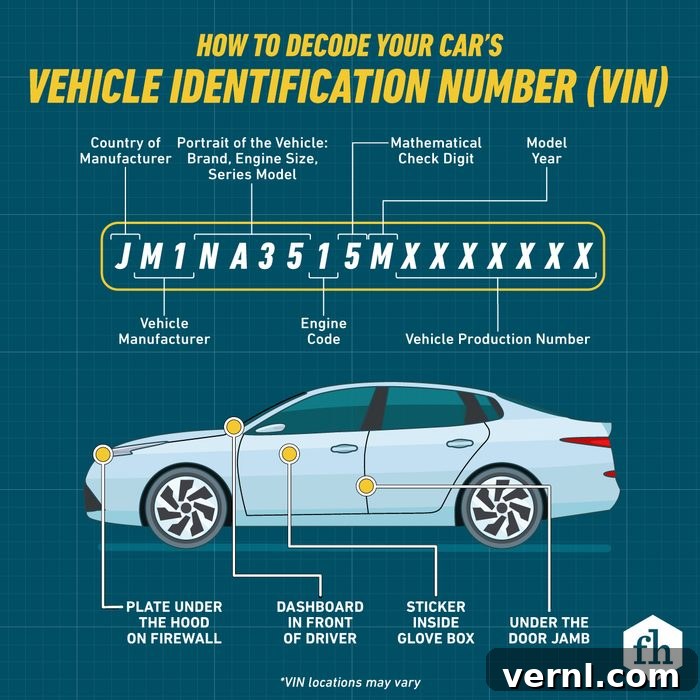
The most common and easily visible location for the VIN is on a small plate or sticker situated on the dashboard. This plate is positioned on the driver’s side, visible through the windshield when looking from outside the car. Modern vehicles often feature a barcode alongside the alphanumeric VIN in this spot, which technicians frequently scan during services like oil changes to quickly retrieve vehicle information, streamlining the process and minimizing errors.
Beyond the dashboard, you’ll find the VIN in several other key areas. Another prominent spot is typically on the driver’s side door jamb, often on a sticker that also contains tire pressure recommendations and other manufacturing details. It can also be found on a plate under the hood, usually on the firewall (the partition between the engine bay and the passenger compartment), or a sticker inside the glove compartment. For added security and traceability, some vehicles even have the VIN stamped directly onto the chassis underneath the carpet or seats, requiring a bit more effort to locate. Many dealerships offer VIN etching services, where the VIN is etched onto all glass windows of the vehicle, serving as a powerful deterrent against theft and making it harder for criminals to resell stolen car parts.
The redundancy of VIN placement isn’t accidental. This strategic distribution makes it significantly more challenging for criminals to obscure a vehicle’s identity, especially when attempting to re-sell stolen parts or entire vehicles. Each placement serves a purpose, from quick visual checks by law enforcement to detailed verification during vehicle inspections or salvage operations.
Deciphering Each Character in Your VIN
At first glance, a 17-character VIN can appear to be a jumbled string of letters and numbers, almost as if someone randomly struck a keyboard. However, this complex code is meticulously structured, with each character and position holding a specific, vital piece of information about your vehicle. Let’s break down this unique identifier to reveal its hidden meanings. To illustrate, I’ll use a portion of the VIN from my beloved classic, a 1991 Mazda Miata, which I’ve proudly owned for over two decades. For security purposes, I’ve replaced some key characters with ‘X’s:
Example VIN Segment: JM1NA3515MXXXXXXX
Characters 1-3: World Manufacturer Identifier (WMI)
The first three characters of the VIN form the World Manufacturer Identifier (WMI). This segment precisely identifies the country where the vehicle was manufactured and the company that built it. It’s the global stamp of origin for your car.
- First Character (Country of Origin): This digit or letter indicates the geographical region or country where the vehicle was assembled. Common examples include:
- 1, 4, 5: United States
- 2: Canada
- 3: Mexico
- J: Japan
- K: South Korea
- S: United Kingdom or Germany (Older East Germany)
- W: Germany (Most common for modern German vehicles)
- Z: Italy or Slovenia
There are many more, covering virtually every vehicle-producing nation.
- Second Character (Manufacturer): This character, in conjunction with the first, specifies the actual manufacturer. For instance, ‘1F’ indicates a U.S.-manufactured Ford, ‘JN’ points to a Japan-manufactured Nissan, and ‘WF’ identifies a Germany-manufactured Volkswagen. This combination is unique to each automaker.
- Third Character (Vehicle Type/Division): The third character often distinguishes between different divisions of a manufacturer or the specific type of vehicle (e.g., car, truck, bus). In my Miata’s VIN, ‘JM1’, ‘J’ signifies Japan, ‘M’ denotes Mazda, and ‘1’ indicates it’s a Mazda passenger car. If it were a Mazda truck, this character might be a ‘2’ or another designated code. Extensive tables for World Manufacturer Identifiers are readily available online, including the comprehensive NHTSA VIN Decoder website, which is an excellent resource for verification.
Characters 4-9: Vehicle Descriptor Section (VDS)
The next six characters (positions 4 through 9) constitute the Vehicle Descriptor Section (VDS). This section, while standardized in its position, is highly customized by each manufacturer to encode specific details about the vehicle itself. The information here varies greatly depending on the automaker, but it typically includes critical specifications:
- Body Type: Such as sedan, coupe, SUV, convertible, or hatchback.
- Series/Line: The specific model series or trim level.
- Restraint System Type: Details about airbags and seatbelt types.
- Gross Vehicle Weight Rating (GVWR): Particularly important for trucks and commercial vehicles, indicating their maximum operating weight.
- Engine Type: (Often, but not always, specifically in position 8).
- Brake System Type: ABS, standard, etc.
- Chassis Type: Information relevant for vehicles offered in different configurations, like various wheelbases for trucks or specific frame designs for performance cars.
For enthusiasts, understanding this section can be incredibly valuable. For example, in the case of my Miata, the fourth and fifth characters of the VIN are ‘NA’. A quick search on any number of enthusiast forums or social media platforms for “NA Miata” will instantly connect you with millions of results and discussions among fans passionately debating the various merits and modifications of this specific generation of the vehicle. This information is invaluable when trying to determine compatibility for aftermarket parts or troubleshooting common issues.
Character 9: The Check Digit
A unique and critical component of the VIN system is the ninth character, which serves as a “check digit.” This is a security feature mandated by NHTSA to verify the authenticity of a VIN and detect potential errors or fraudulent VINs. The check digit is derived from a mathematical formula that processes all other characters in the VIN. If a VIN has been tampered with or transcribed incorrectly, a calculation using this formula will not match the ninth character, thus flagging it as invalid. This ingenious system adds an extra layer of protection against VIN cloning and other illicit activities, making it harder for nefarious actors to re-sell stolen vehicles or parts.
What Digit of the VIN is the Engine Code? (Often Character 8)
While the Vehicle Descriptor Section covers many details, the eighth character of the VIN is frequently designated by many automakers as the engine code. This is an exceptionally important piece of information, especially for models that are offered with multiple engine options, as it directly impacts parts compatibility and performance characteristics.
For instance, my 1991 Mazda Miata was produced with only a single engine type in that model year, so the eighth character might not directly correspond to a distinct engine code in the same way. However, I also own a 2006 Chevrolet Trailblazer, a vehicle that came with two different engine choices. In the Trailblazer’s VIN, the eighth character is an ‘S’, which identifies it as having the 4.2-liter inline six-cylinder engine. Had my Trailblazer been equipped with the alternative 5.3-liter V-8 engine offered that year, its VIN would feature a ‘P’ in the eighth position. Knowing this specific engine code is vital for mechanics to order the correct spark plugs, filters, belts, and other engine-specific components, preventing costly errors and ensuring proper vehicle function.
Character 10: Model Year Indicator
The tenth digit of the VIN is arguably one of the most straightforward and important for general identification: it indicates the vehicle’s model year. This character uses an alternating sequence of letters and numbers to denote the year of manufacture, allowing for quick and accurate identification of a vehicle’s age.
- The system began with the letter ‘A’ for the 1980 model year, then progressed alphabetically (B for 1981, C for 1982, and so on).
- Certain letters are deliberately excluded from this sequence to prevent confusion with numbers or other letters. These include ‘O’, ‘I’, ‘Q’, and the number ‘0’ (zero). For example, ‘O’ could be mistaken for a zero, and ‘I’ for a one.
- For my 1991 Mazda Miata, the model year indicator is ‘M’, confirming its production in the 1991 model year.
- In 2001, the system switched from letters back to numbers, so a vehicle from the 2001 model year would have a ‘1’ in the tenth position. This cycle continued until 2009 (which would be ‘9’).
- In 2010, the system reverted to using letters again, starting with ‘A’ for the 2010 model year. This restart was deemed safe as it’s highly unlikely anyone would confuse a 2010 model year car with one built in 1980. This cyclical pattern ensures a unique model year identifier for every decade.
Character 11: Assembly Plant Code
Following the model year, the eleventh character of the VIN often provides highly specific information about the vehicle’s origin: the assembly plant code. While not universally standardized across all manufacturers, many automakers use this position to denote the specific factory or assembly plant where the vehicle was manufactured. This detail can be incredibly useful for tracking recalls, understanding minor variations between vehicles produced at different facilities, or even for enthusiasts who are curious about the precise birthplace of their cherished ride. For example, some manufacturers might have multiple plants producing the same model, and this code clarifies which one.
Characters 12-17: Sequential Production Number
The final six characters (positions 12 through 17) form the Sequential Production Number. These digits are unique to each individual vehicle and represent its place in the production sequence at the specific assembly plant. Essentially, these are the serial numbers that advance one by one as each vehicle rolls off the production line. This unique sequence ensures that no two vehicles ever share the exact same VIN. This sequential numbering is crucial for manufacturers to track individual units for quality control, warranty claims, and recall campaigns. It’s the ultimate identifier that distinguishes your particular car from every other car ever made.
The Indispensable Role of Your Vehicle’s VIN
The Vehicle Identification Number is far more than just a bureaucratic requirement; it serves as the indelible DNA of your automobile, playing an indispensable role throughout its entire lifecycle. Understanding and utilizing the VIN offers a wealth of benefits for vehicle owners, prospective buyers, mechanics, law enforcement, and insurance companies alike.
- Accurate Parts Ordering and Maintenance: As highlighted by our expert, the VIN is the “key to everything.” When performing repairs or routine maintenance, providing your VIN ensures that you receive the exact correct parts tailored to your vehicle’s specific model, year, engine, and trim level. This prevents costly mistakes, ensures compatibility, and guarantees optimal performance and safety.
- Verifying Vehicle History: For anyone considering purchasing a used car, a VIN check is non-negotiable. Services like CarFax or AutoCheck use the VIN to generate comprehensive vehicle history reports that can reveal critical information such as past accidents, salvage titles, odometer fraud, flood damage, repair records, and even previous ownership details. This transparency is vital for making an informed buying decision and avoiding potentially problematic vehicles.
- Recall Management and Safety: Manufacturers rely heavily on VINs to identify and notify owners of safety recalls or service campaigns. If a specific batch of vehicles produced within a certain timeframe or at a particular plant is found to have a defect, the VIN allows automakers to pinpoint exactly which cars are affected, ensuring owners can get necessary repairs free of charge and preventing potential hazards.
- Anti-Theft and Recovery: The multiple, often hidden, placements of the VIN make it a powerful tool in combating vehicle theft. Law enforcement agencies use VINs to identify stolen vehicles and parts, and the unique identifier makes it incredibly difficult for thieves to mask a vehicle’s true identity for resale. VIN etching on windows further deters theft, as replacing all etched glass is a significant cost and effort for criminals.
- Insurance and Registration: Your VIN is a fundamental piece of information for insurance companies to accurately assess your vehicle and process claims. Similarly, government motor vehicle departments use the VIN for official registration, titling, and taxation purposes, ensuring each vehicle on the road is legally accounted for.
Conclusion: Your Car’s Unique Story in 17 Characters
In conclusion, the Vehicle Identification Number is an extraordinary piece of engineering and regulation that transforms a mass-produced item into a uniquely identifiable asset. Each of its 17 characters tells a part of your vehicle’s story – from its country of origin and the company that built it, to its specific features, model year, and even its exact place in the production line. Far from being a mere serial number, the VIN is an indispensable tool for car owners, mechanics, and professionals across the automotive industry.
By understanding how to locate and decipher this powerful code, you gain a deeper insight into your vehicle’s past, ensure its proper maintenance in the present, and protect its value for the future. The VIN truly is the ultimate identifier, a testament to the individual identity of every car on the road, making each one, in its own way, truly unique.
[cf]skyword_tracking_tag[/cf]