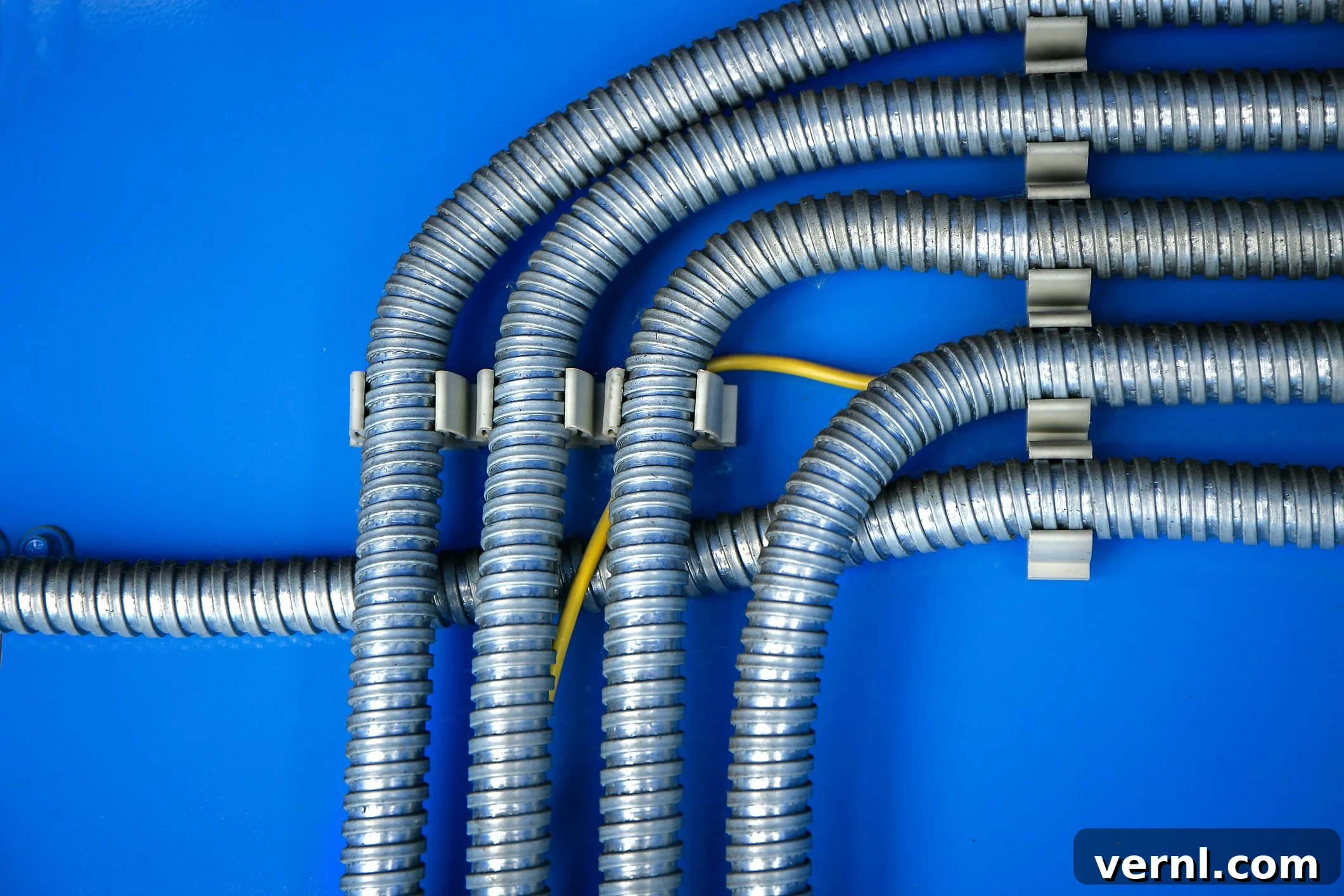
As a seasoned master electrician, I’ve observed a common fascination among those in my profession: an undeniable curiosity about the intricate web of electrical wiring that surrounds us daily. Whether I’m enjoying a meal at a restaurant or grabbing a coffee, if the structural ceiling is exposed, my gaze inevitably drifts upwards, admiring the meticulous runs of conduit and cable trays.
It’s not just an occupational quirk; it’s an appreciation for well-executed craftsmanship. Of course, this often results in a gentle nudge from my wife, reminding me to keep my eyes on the conversation, not the ceiling!
For homeowners, understanding electrical conduit might seem like a niche interest, but there are numerous situations where this knowledge becomes invaluable. Perhaps you’re embarking on an outdoor electrical project, needing robust protection for buried cables. Or maybe you’re looking to safeguard Type NM-B cabling in a high-traffic area of your garage or along basement walls. Even making a flexible connection to an appliance often calls for a specific type of conduit.
The National Electrical Code (NEC), the authoritative standard for electrical installations in the U.S., lists over twenty types of conduit, tubing, and raceways. For the scope of this guide, we’ll focus on the “Top Ten” most commonly found at home centers and hardware stores, empowering you to confidently tackle your home electrical projects.
What Is Electrical Conduit? Understanding the Basics
Electrical conduit is essentially a protective passageway for electrical wires and cables. Best described as a raceway with a circular cross-section, its primary purpose is to shield conductors from physical damage, moisture, and corrosive elements, while also providing a neat and organized pathway for electrical distribution.
The broader term “raceway” encompasses any enclosed channel of any shape designed to hold wires and cables. This includes various forms of conduit and tubing. Tubing, often referred to as “thinwall” raceway, also has a circular cross-section but generally offers less robust protection than its conduit counterparts. Unlike pre-wired cables like Romex (NM-B), conduit systems are installed first, and then individual insulated wires are pulled through them. This modularity provides superior protection, allows for easier wire replacement or upgrades, and ensures compliance with critical safety standards.
Exploring the Diverse World of Electrical Conduits
Electrical conduits and tubing come in a wide range of materials, sizes, and flexibilities, each suited for specific applications and environments. Standard rigid and semi-rigid conduits are typically sold in straight 10-foot lengths, with common trade sizes ranging from 1/2-inch up to two inches for residential use. Larger sizes, up to six inches, are primarily reserved for commercial and industrial installations where greater wire capacity is required.
Flexible conduit, on the other hand, is usually available in convenient coiled lengths, often wrapped in plastic packaging. Common flexible conduit sizes for homeowners include 1/2-inch, 3/4-inch, and one inch. While many conduits are made from various metals, there are also numerous nonmetallic (PVC) versions that offer corrosion resistance and ease of installation, making them popular choices for specific tasks. The choice between metallic and nonmetallic, rigid or flexible, depends heavily on the installation environment, the level of physical protection required, and local electrical codes.
Critical Reminders for Safe and Effective Conduit Installation:
- Matching Connectors and Fittings: It is absolutely paramount to use the appropriate connectors, couplings, and fittings specifically designed for the type of conduit or tubing you are installing. Mismatched components can compromise the integrity of the system, leading to loose connections, moisture intrusion, and potential safety hazards. Always ensure a secure, code-compliant connection.
- Electrical vs. Plumbing Materials: Never mix electrical conduit and fittings with plumbing pipes and fittings. Although they may sometimes appear similar or even seem to fit together, their design specifications, material properties, and intended uses are fundamentally different. Using plumbing components in an electrical system is a serious code violation and a significant safety risk.
- Wire Installation Post-Conduit: Unlike factory-assembled electrical cables where insulated wires are pre-installed within a protective jacket, conduit systems are installed empty. Once your conduit run is complete, you must then pull or push your own insulated wires through the conduit. A fish tape is an indispensable tool for this task, especially on longer runs or those with bends. For very long or complex runs, a pull string or wire lubricant can significantly ease the process and prevent wire insulation damage.
- Conduit Fill Capacity: To prevent overheating, ensure proper air circulation, and allow for future wire additions, conduit, tubing, and raceways should generally not be filled to more than 40% of their cross-sectional area. Overcrowding wires in conduit can lead to heat buildup, insulation degradation, and increased risk of fire or electrical shock. Always consult NEC tables for precise fill capacities.
- Limiting Bends: The total degrees of bends in any single conduit run must not exceed 360 degrees between pull points (e.g., from one junction box to another). Excessive bends make wire pulling extremely difficult, increasing the likelihood of damaging wire insulation. If your run requires more than 360 degrees of bends, strategically add a junction box or a conduit fitting with a removable cover to create an intermediate pull point.
- Securement and Support: Every type of conduit, tubing, or raceway has specific rules for securement and support outlined in the NEC. Proper support is crucial for the stability, safety, and longevity of the installation. Inexpensive conduit straps are available in various styles to match different conduit types and sizes. As a general guideline: metal conduits typically need to be secured within 36 inches of an electrical box and then at seven-to-10-foot intervals; PVC conduit requires more frequent support, usually every three to five feet depending on its size, due to its susceptibility to expansion and contraction; and flexible conduits should be secured within 12 inches of boxes and every 4-1/2 feet thereafter. When in doubt, adding more straps for a secure and professional-looking installation is always a good practice.
- Equipment Grounding Conductor: While some continuous metallic conduit systems can technically serve as an equipment grounding conductor (EGC) if properly installed with approved connectors and fittings, it is always recommended, especially for DIYers, to pull a dedicated green-insulated equipment grounding wire along with the other hot and neutral wires. This provides an independent, robust grounding path, ensuring maximum safety and simplifying troubleshooting. The added cost is minimal compared to the enhanced safety it provides.
Rigid Metal Conduit (RMC)
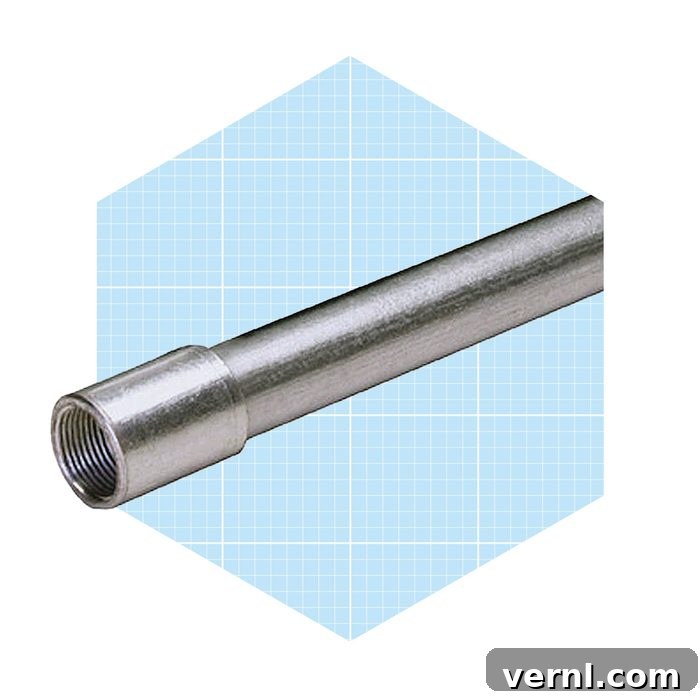
Rigid Metal Conduit (RMC) is the heavyweight champion of electrical protection. Made from galvanized steel, it’s a threaded conduit that offers unparalleled physical protection for wires and cables, making it ideal for the most demanding environments, including underground wiring, industrial settings, and locations prone to severe physical impact. Its robust nature, however, comes with a trade-off in installation difficulty. RMC is heavy, challenging to cut, and requires specialized threading tools for connecting sections (unless threadless connectors and couplings are used). Bending RMC also demands significant effort and specialized conduit benders. While it’s the most expensive option, its superior durability and protection make it indispensable where maximum integrity is required.
Flexible Metal Conduit (FMC)
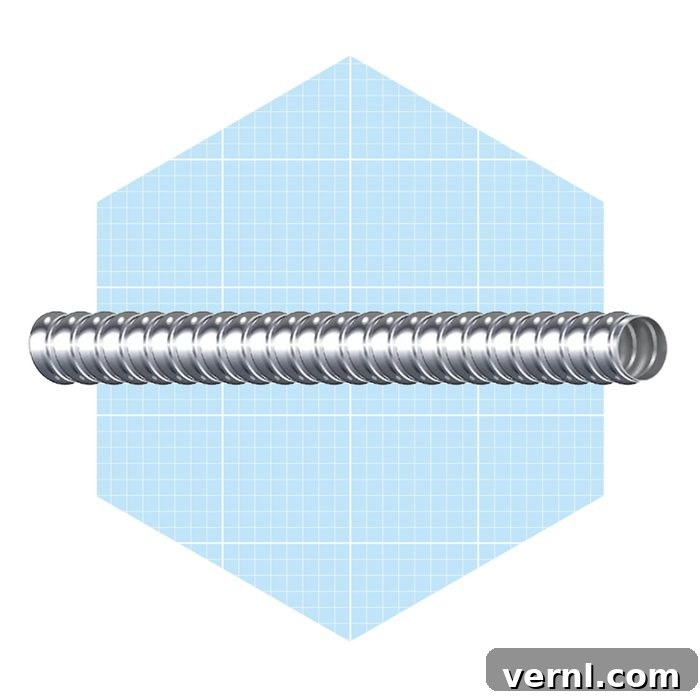
Flexible Metal Conduit (FMC), often referred to as “Greenfield,” is constructed from helically wound, interlocking galvanized steel or aluminum strips. This design gives it exceptional flexibility, making it incredibly useful for connecting stationary appliances that might require occasional movement for cleaning, repair, or replacement. Think electric ranges, dishwashers, or electric water heaters. FMC is also an excellent choice for the final connection to equipment that vibrates, such as large air compressors in a workshop, as it helps absorb vibrations and prevent damage to rigid wiring. Furthermore, its flexibility allows it to easily snake through tight spaces, making it suitable for protecting wiring inside cabinets or other enclosed areas where rigid conduit would be impractical.
Liquidtight Flexible Metal Conduit (LFMC)
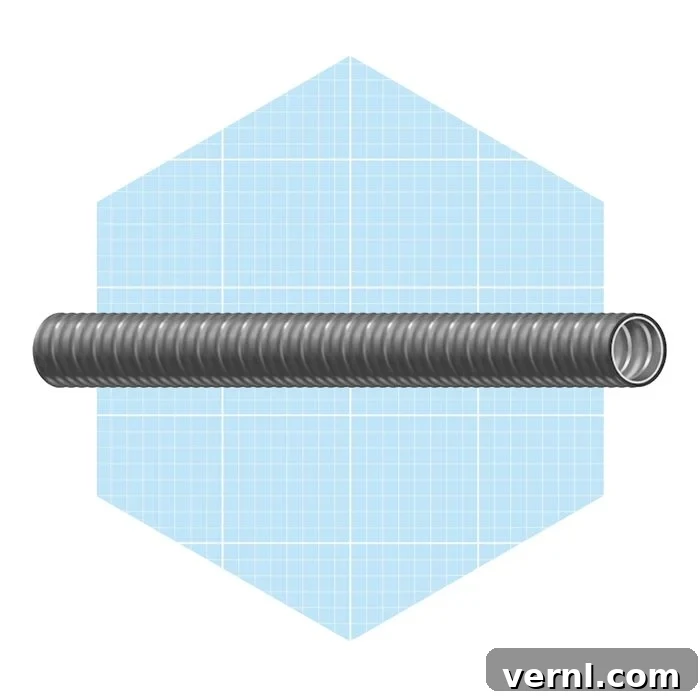
Liquidtight Flexible Metal Conduit (LFMC) is essentially an enhanced version of FMC. It features a flexible metal core enveloped by an outer liquid-tight, sunlight-resistant, nonmetallic jacket. This protective jacket makes LFMC ideal for use in wet, damp, or outdoor locations where standard FMC would not be suitable. It provides excellent protection against moisture, oils, and corrosive elements, while retaining the flexibility of FMC. Common applications include connecting outdoor HVAC units, motors, pumps, or other equipment exposed to the elements or requiring a sealed connection. Its ease of installation, combined with superior environmental protection, makes it a popular choice for challenging outdoor or industrial connections.
Rigid Polyvinyl Chloride Conduit (PVC)
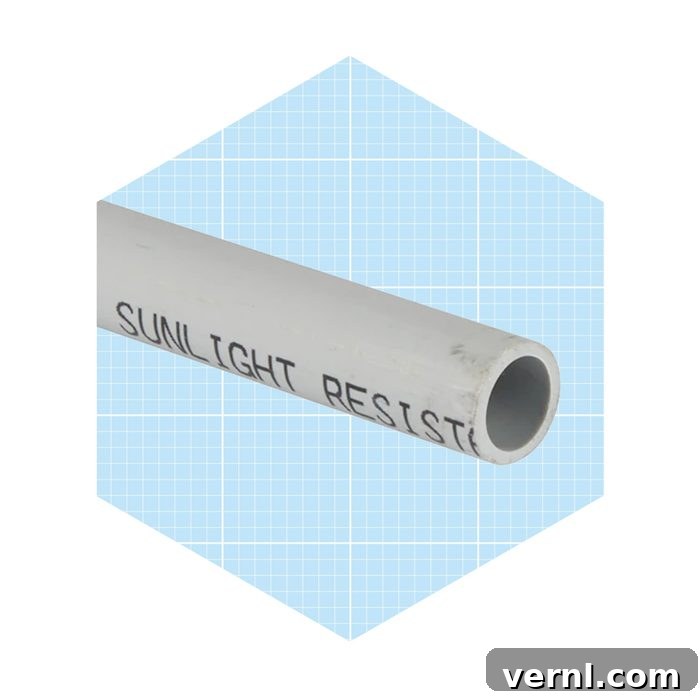
Rigid Polyvinyl Chloride (PVC) conduit is the nonmetallic equivalent to RMC, offering robust protection without the weight and cost of metal. One of its greatest advantages is its ease of installation: it can be readily cut with a hacksaw or PVC cutter and joined together using specialized solvent cement, creating a strong, watertight bond. Installing PVC conduit is straightforward for DIYers.
PVC conduit is widely used for the installation of underground wiring, such as supplying power to a detached garage, shed, or outdoor lighting, as it is highly resistant to corrosion and moisture. It can also be effectively used indoors in areas like garages or utility rooms. The NEC specifies different schedules for PVC conduit: Schedule 40 PVC is commonly used for most applications, including direct burial. However, for transitions from below ground to above ground on the side of a building, the NEC often mandates heavy-duty Schedule 80 PVC. This thicker-walled conduit provides enhanced physical protection against incidental damage from lawnmowers, weed trimmers, or other impacts. Despite the difference in wall thickness, the external diameter of Schedule 40 and Schedule 80 PVC is identical, meaning all standard PVC connectors and couplings are interchangeable, simplifying procurement and installation.
Liquidtight Flexible Nonmetallic Conduit (LFNC)
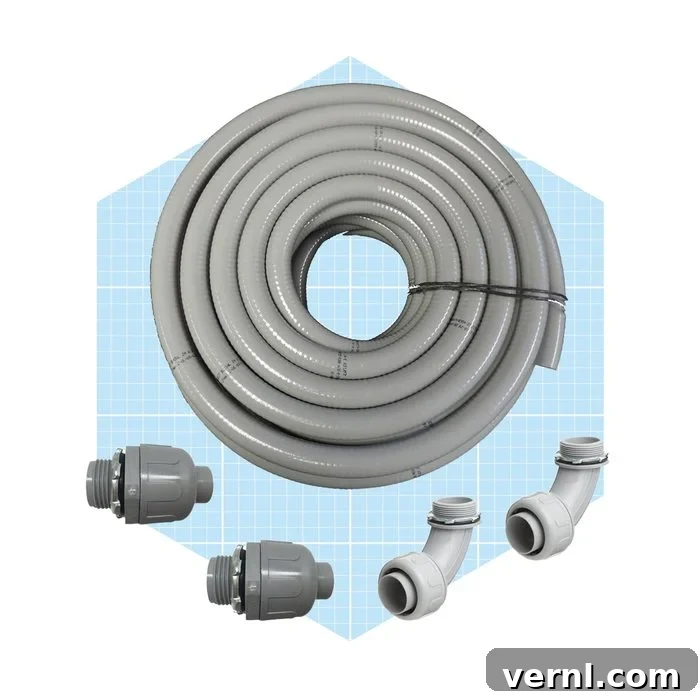
Similar to rigid PVC conduit in its material composition, Liquidtight Flexible Nonmetallic Conduit (LFNC) is celebrated for its ease of use and flexibility. It serves as the nonmetallic counterpart to LFMC, but without the flexible metal core. Visually, it often resembles a gray garden hose, identifiable by its corrugated, pliable structure. LFNC is specifically designed for use in wet or damp locations where flexibility is required, offering excellent resistance to corrosion, moisture, and oils. It’s often found in applications such as connecting outdoor lighting, pool pumps, or other motors where a flexible, liquid-tight connection is necessary. A wide array of compatible connectors and fittings are readily available, making installation straightforward and reliable for various environmental conditions.
Electrical Metallic Tubing (EMT)
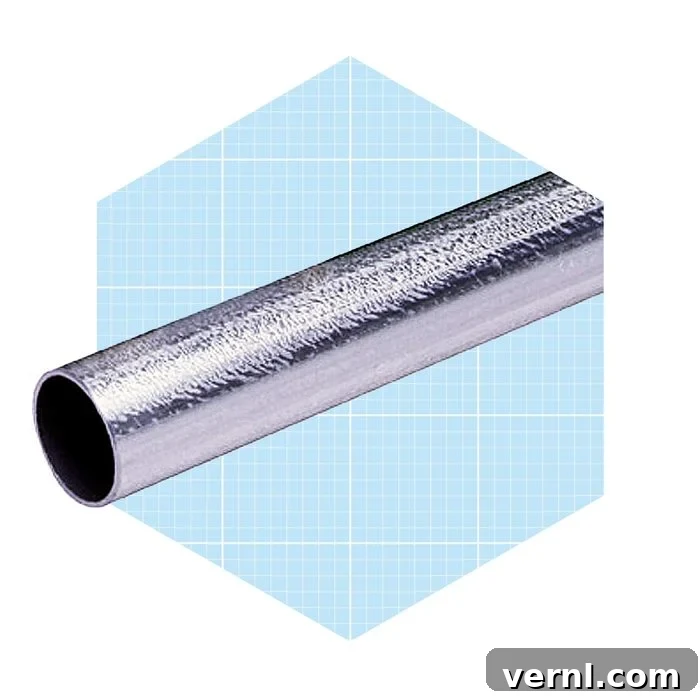
Electrical Metallic Tubing (EMT) is an unthreaded, thin-wall raceway with a circular cross-section, widely favored for its versatility and ease of installation in residential and light commercial applications. Unlike RMC, EMT does not require threading; sections are joined using simple set-screw or compression-type connectors and couplings. This makes it significantly easier and faster to install. EMT is also relatively light and can be easily cut with a hacksaw or specific EMT cutters. One of its major advantages is its malleability, allowing skilled installers to create precise 90-degree bends, offsets, and saddles using a conduit bender, thereby minimizing the need for additional fittings and creating a clean, professional look. Pre-bent factory elbows are also readily available, further simplifying complex runs. Its affordability and relative ease of handling make it a popular choice for exposed interior wiring installations where moderate physical protection is required. A wide range of connectors, couplings, and fittings are designed specifically for EMT, ensuring secure and code-compliant installations.
Electrical Nonmetallic Tubing (ENT)
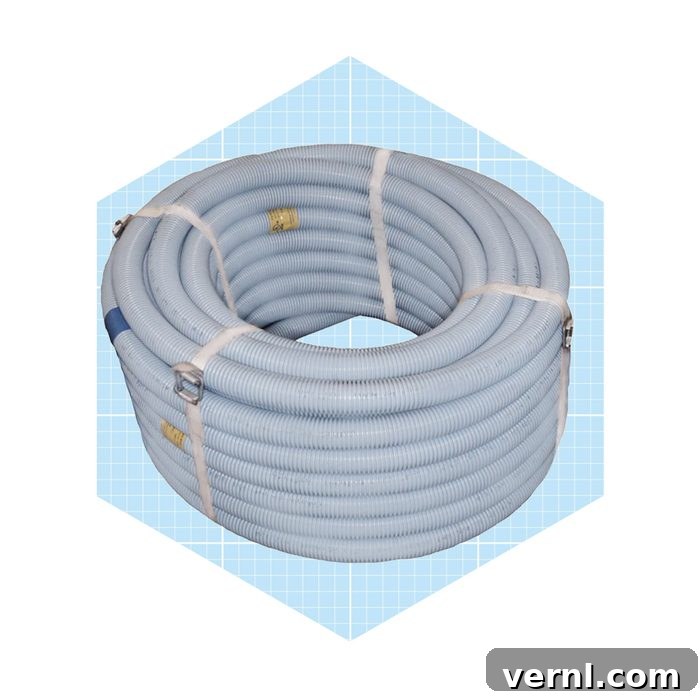
Electrical Nonmetallic Tubing (ENT) is a pliable, corrugated raceway of circular cross-section, often informally referred to as “Smurf Tube” due to its common blue color. It is essentially the nonmetallic, flexible cousin to FMC, offering a lightweight and extremely flexible option for specific wiring applications. ENT is particularly useful for installations within walls, ceilings, and concrete slabs, especially in concealed locations, as it can be easily snaked around obstacles. Its corrugated design allows it to bend without kinking, making it an excellent choice for complex wire runs within building structures. While it doesn’t offer the same level of impact protection as rigid conduits, it provides sufficient mechanical protection for general wiring in accessible areas. It is designed for ease of installation and is compatible with a range of nonmetallic fittings and connectors.
Surface Raceways (Metal and Nonmetallic)
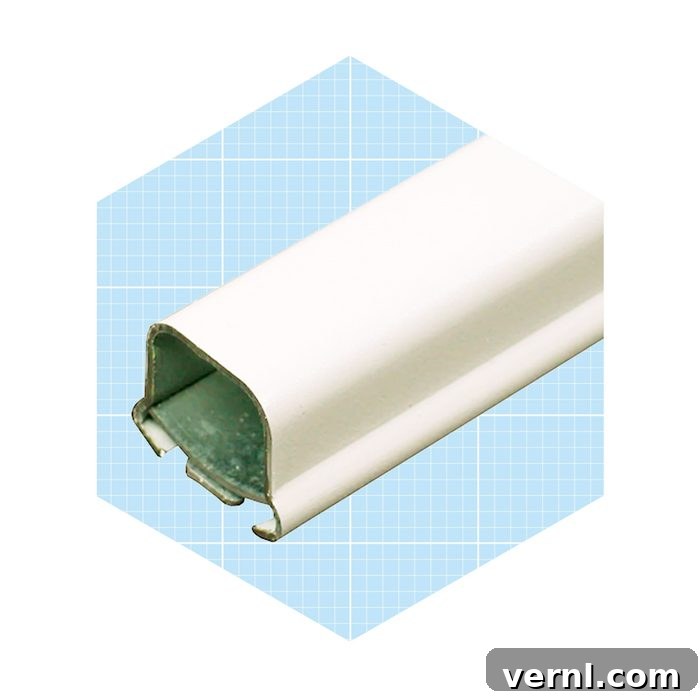
Surface raceways are an incredibly convenient solution for extending wiring for receptacles, light switches, or other electrical devices without the need to cut into and repair wall coverings like gypsum board or paneling. These raceway systems are designed to be mounted directly onto the surface of a wall or ceiling, providing a neat, enclosed channel for wires. Their primary appeal lies in their aesthetic design, which is far more discreet and visually appealing than exposed conduit or tubing. Many surface raceway systems can even be painted to match the existing decor, allowing them to blend seamlessly into any room.
Both metal and nonmetallic raceway systems are available, each with various profiles and capacities to suit different wiring needs. They are relatively easy to install, often featuring adhesive backing or simple screw-mount options, making them a popular choice for DIYers looking for a quick and clean wiring extension. While they offer good protection against light physical damage, it’s important to remember they are not typically designed for heavy-duty applications or where significant impact is expected. However, for adding outlets or switches in finished spaces, surface raceways provide an elegant and practical alternative to invasive in-wall wiring.
Understanding the different types of electrical conduit available empowers you to make informed decisions for your home electrical projects. Whether you prioritize maximum protection, flexibility, ease of installation, or aesthetic appeal, there’s a conduit type perfectly suited for your needs. Always remember that safety is paramount when working with electricity. Consult the National Electrical Code for specific requirements and consider seeking professional advice for complex installations to ensure compliance and peace of mind.