In today’s hyper-connected world, a slow internet connection is more than just an inconvenience – it’s a productivity killer and a source of constant frustration. Imagine settling in for a movie night on Netflix, only to be interrupted by endless buffering, or attempting to download an important work document that seems to take an eternity. For the ever-growing population of remote workers, these issues are amplified: a crucial Zoom meeting lags into disjointed silence, or a vital client call drops mid-sentence. If your online experience is consistently falling short, the culprit is often inadequate internet speed.
Understanding your internet speed requirements is paramount to enjoying a seamless digital life. This comprehensive guide will demystify common internet speed packages, help you determine precisely how much bandwidth you truly need, and provide expert insights from broadband and IT specialists on selecting a speed that perfectly aligns with your specific needs and lifestyle. Say goodbye to lag and buffering, and unlock the full potential of your digital world.
Mastering Your Connection: How Much Internet Speed Do You Really Need?
Understanding Common Internet Speed Packages
When you begin your quest for a better internet connection, you’ll encounter a variety of speed packages offered by internet service providers (ISPs). These packages are typically measured in Megabits per second (Mbps) or Gigabits per second (Gbps, where 1 Gbps equals 1000 Mbps). The specific offerings can vary significantly based on your geographical location and the provider. For instance, major players like Verizon Fios might offer tiers such as 300 Mbps, 500 Mbps, 1 Gig (1000 Mbps), and even 2 Gig (2000 Mbps). Optimum, another popular provider, might present options like 300 Mbps, 500 Mbps, and 1 Gig.
It’s crucial to remember that these advertised speeds often represent the “up to” maximum download speed. Actual speeds can be influenced by various factors, including network congestion, the type of connection (fiber optic, cable, DSL, satellite), your home’s internal wiring, and the quality of your networking equipment. Always check what specific packages are available in your area and compare them to find the best fit for your budget and performance expectations.
Determining Your True Internet Speed Needs
So, with all these numbers, how do you figure out the sweet spot for your household? The ideal internet speed isn’t a one-size-fits-all answer; it depends heavily on your household size, the number of connected devices, and the intensity of your online activities. Let’s break down what different speed tiers typically support.
300 Mbps: The Household Standard
According to Kevin Nanns, a seasoned IT technician and co-host of The Art of Network Engineering podcast, 300 Mbps is widely considered the baseline for most American households today. “You can stream high-definition content, engage in online gaming, and participate in video calls without encountering significant issues at this speed,” he explains. Nanns emphasizes its suitability for families: “If you have a household of four individuals, each using multiple devices simultaneously – be it streaming movies, playing online games, or working remotely – then a 300 Mbps connection should comfortably meet your demands.”
This speed tier is particularly beneficial for remote workers who depend on a stable connection throughout the day for critical tasks such as video conferencing, large file transfers, and constant email communication. It provides enough headroom to ensure that your professional life isn’t hampered by slow internet, even when other family members are online.
500 Mbps: Elevating the Connected Home Experience
For larger households, whether comprised of multiple roommates or a bustling family, an internet speed of 500 Mbps offers a noticeable upgrade and enhanced performance. “At 500 Mbps, multiple individuals can comfortably stream HD video content, engage in competitive online gaming, and conduct video calls simultaneously, all without compromising the quality of their experience,” Nanns clarifies. This tier addresses the needs of modern families with diverse digital habits.
Whether you have tech-savvy teenagers who are constantly scrolling through TikTok, a spouse immersed in 4K Netflix series, or kids engaged in online learning platforms, 500 Mbps typically proves to be the perfect balance between performance and cost for most active households. It provides ample bandwidth to prevent bottlenecks and maintain a smooth, responsive internet environment for everyone.
1000 Mbps (1 Gig): The Power User and Small Business Solution
Often referred to as 1 Gig, 1000 Mbps represents a significant leap in internet speed. While Nanns notes that this speed might be overkill for the typical household, its benefits become apparent in specific scenarios, particularly for homes with more than 10-20 concurrent users or devices. “The true advantages of a 1 Gig connection are realized through significantly increased upload speeds, especially with fiber optic services, and the robust capability to flawlessly handle multiple concurrent 4K video streams, rapid uploads of massive files, and uninterrupted video conferencing, all without any performance degradation,” he states.
To put this into perspective, Reviews.org provides an illustrative example: with speeds between 1,000 to 2,000 Mbps, a substantial 10GB file can be downloaded in as little as 80 seconds. This capability is invaluable for creative professionals, developers, or anyone frequently dealing with large data transfers.
While multi-person households with intensive usage patterns might consider a 1000 Mbps plan, it is often more appropriately suited for small to medium-sized businesses. These organizations rely heavily on constant, high-speed internet for their daily operations, cloud computing, customer relationship management systems, and internal communications, and a 1 Gig connection ensures they never have to worry about bandwidth limitations.
2 Gig: The Frontier of Connectivity
Venturing into the realm of 2 Gig (2000 Mbps) internet speed takes you into the cutting edge of consumer connectivity. As Nanns suggests, “Unless you are an avid tech enthusiast, a professional working with extremely high bandwidth demands, or managing a substantial office network, a 2 Gig connection is likely beyond what you currently require.” This tier caters specifically to power users, large multi-user environments, or office-sized spaces with a multitude of devices (20+ users) simultaneously connecting, browsing, streaming, and performing data-intensive tasks. It represents a significant investment in future-proofing and ensures unparalleled performance for the most demanding digital ecosystems.
Key Factors Influencing Your Internet Speed Needs
Beyond the sheer numbers, several other critical factors play a role in determining your optimal internet speed. Understanding these can help you fine-tune your choice and avoid overspending or under-provisioning.
- Number of Users and Devices: The more people and devices (laptops, smartphones, smart TVs, tablets, gaming consoles, smart home gadgets) connected simultaneously, the more bandwidth you’ll collectively consume. Each active device demands a portion of your total speed.
- Types of Online Activities: Not all online activities are created equal in terms of bandwidth consumption. Streaming 4K video is far more demanding than checking email. Understanding your household’s primary activities is crucial.
- Upload vs. Download Speed: Most internet packages heavily emphasize download speeds, as this is what’s needed for streaming, browsing, and downloading files. However, for video conferencing, online gaming, and uploading large files (e.g., cloud backups, YouTube videos), a robust upload speed becomes equally, if not more, important. Fiber optic connections typically offer symmetrical (equal upload and download) speeds, which is a significant advantage.
- Internal Network Infrastructure: Your internet speed is only as good as your home network. An outdated router, poor Wi-Fi coverage, or relying solely on Wi-Fi for high-bandwidth activities when a wired Ethernet connection is possible can significantly bottleneck your effective speed, regardless of what your ISP provides.
- Future-Proofing: Consider your evolving needs. Are you planning to add more smart home devices, upgrade to 8K TVs, or have more family members move in? Investing slightly more now might save you from frequent upgrades later.
Expert Tips for Choosing the Right Internet Speed
Selecting an internet plan can feel overwhelming, but these expert tips will guide you towards an informed decision:
- Assess Your Current Usage: Before looking at new plans, analyze your existing internet habits. How many devices are usually connected? What are the most common activities (streaming, gaming, working)? Many routers have apps that can show connected devices and their data usage.
- Consult a Bandwidth Calculator: Many ISPs and independent tech websites offer online bandwidth calculators. You input your household size and primary activities, and they recommend a suitable speed. While not definitive, they offer a good starting point.
- Understand Connection Types: Fiber optic internet offers the fastest and most reliable speeds, often with symmetrical upload and download. Cable internet is widely available and typically fast enough for most. DSL is slower but may be the only option in rural areas. Satellite internet is a last resort due to higher latency and data caps.
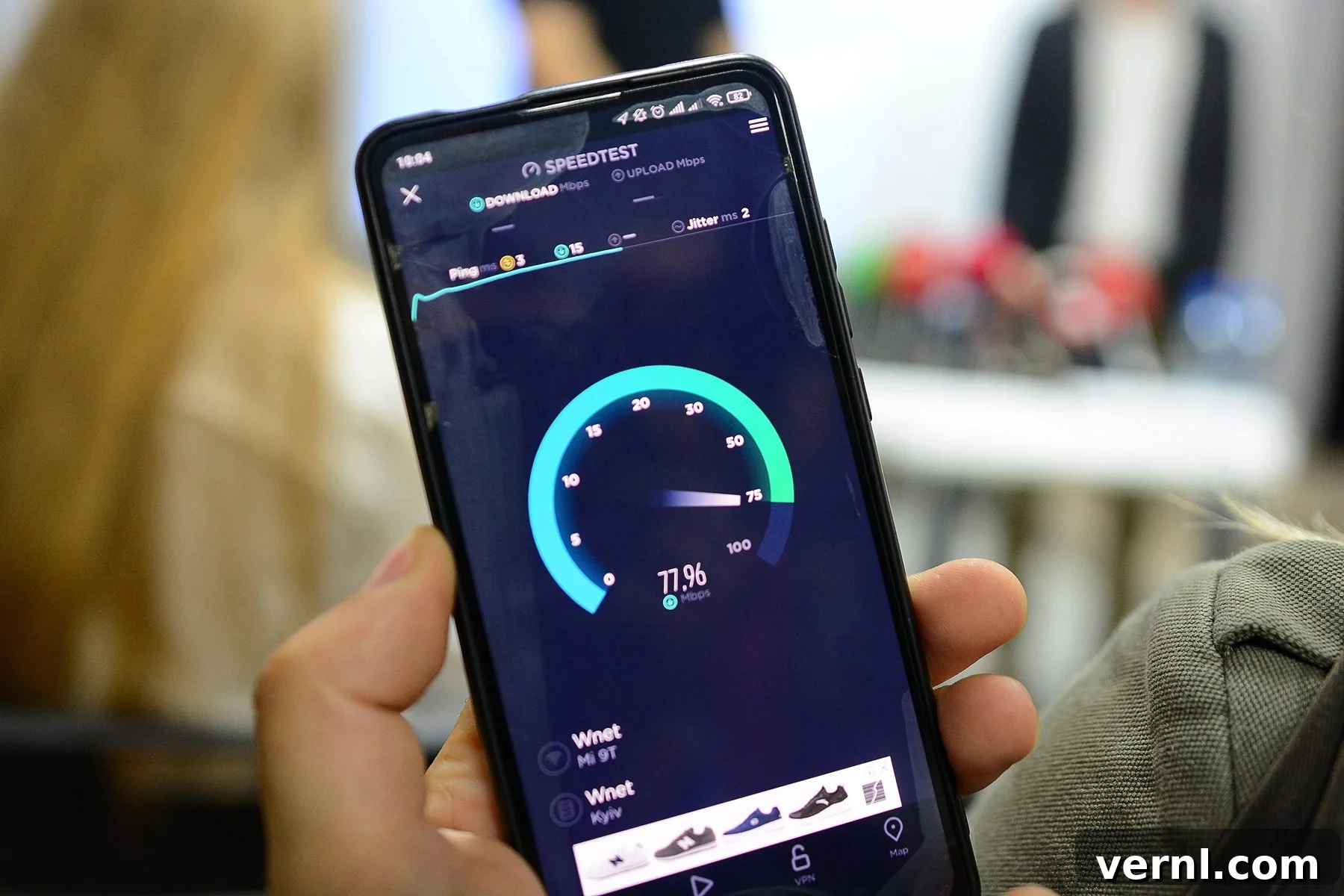
- Test Your Current Speed: Use online speed test tools (like Speedtest.net) to measure your actual current download and upload speeds. This can reveal if your current issues are truly due to insufficient bandwidth or perhaps an internal network problem.
- Read Reviews and Compare Providers: Don’t just pick the cheapest or fastest advertised plan. Look at local provider reviews for reliability, customer service, and actual reported speeds. Compare pricing, contract terms, and any hidden fees.
- Don’t Overpay: While it’s tempting to get the fastest speed available, remember that you pay for what you use. If 300-500 Mbps comfortably handles your household’s needs, there’s no logical reason to spend significantly more on 1 or 2 Gig plans unless you have specific, high-demand requirements.
Frequently Asked Questions (FAQ) About Internet Speed
How much internet speed do you need for streaming?
The internet speed required for streaming depends heavily on the content’s resolution and the number of concurrent streams. “For streaming in standard high-definition (HD), you should aim for a minimum of 5-10 Mbps per active stream,” advises Nanns. “However, if you’re stepping up to stream in pristine 4K resolution, you’ll need at least 25 Mbps or more for each individual stream to ensure a smooth, buffer-free experience.”
It’s critical to multiply these figures by the number of people streaming different content simultaneously within your household. As Nanns humorously but accurately points out, “If multiple people in the house are watching different things, you’ll want to multiply that speed accordingly. Otherwise, someone’s going to experience frustrating buffering, and that can certainly lead to some household tension!” For example, two 4K streams would ideally need 50 Mbps dedicated to streaming, plus bandwidth for other activities.
How much internet speed do you need for a smart TV?
The smart TV itself, as a device, doesn’t inherently consume a large amount of bandwidth when it’s just sitting idle or navigating menus. Its bandwidth demands primarily arise when it’s actively streaming content. Therefore, the recommendations for smart TVs largely mirror those for general streaming. You’ll want to follow the guideline of 5-10 Mbps per stream for HD content and 25 Mbps or more per stream if you’re enjoying your favorite shows or movies in stunning 4K resolution on your smart TV. Remember to factor in any other devices that might be using the internet simultaneously.
How much internet speed do you need for video calling?
With video calling becoming an indispensable part of both personal and professional communication, ensuring your internet speed is up to the task is crucial to avoid frustrating call drops or persistent lagging. “For a standard one-on-one video call, I recommend aiming for 3-5 Mbps,” Nanns suggests. “However, if you’re participating in multi-person meetings on platforms like Zoom or Microsoft Teams, I would advise having at least 10 Mbps available to prevent your video from freezing mid-conversation.”
Nanns further clarifies that raw speed isn’t the sole determinant of a quality video call experience. “Low latency – the time it takes for data to travel from your device to the server and back – and stable upload speeds are just as important, if not more so, than sheer download speed. A connection with lower latency and consistent upload performance can often mean more for the clarity and fluidity of your video calls than simply having the fastest download speed.” A stable connection minimizes jitters and ensures your voice and video transmit smoothly.
How much internet speed do you need for gaming?
Serious gamers understand that having the best peripherals, like high-performance keyboards, responsive headsets, and a robust Wi-Fi connection, are all part of the winning formula. When it comes to internet speed, Nanns notes, “With some modern, graphically intensive games, you might find that individual devices could demand as high as 100 Mbps for optimal performance.”
However, he quickly adds a crucial caveat: “When it comes to video games, especially competitive online titles, pure speed often matters less than low latency and exceptional connection stability. Any significant spike in ping or instances of packet loss will cause far more disruptive and frustrating damage to your gameplay experience than simply having slightly slower speeds.” High latency leads to “lag,” making games unplayable, while packet loss causes missed actions and disconnections. Therefore, gamers should prioritize a stable, low-latency connection over simply the highest advertised Mbps.
About Our Expert Contributor
- Kevin Nanns is a distinguished IT technician and the insightful co-host of The Art of Network Engineering podcast. With over 15 years of invaluable experience in the field, Kevin holds a prestigious Cisco Certified Network Associate (CCNA) certification. He is also a prolific networking and IT content creator, boasting an impressive following of over 200,000 across popular platforms such as TikTok and Instagram. (Information based on email interview, Feb. 10, 2025).
Choosing the right internet speed is about more than just numbers; it’s about matching your digital lifestyle with the right technology. By understanding your specific needs and leveraging expert advice, you can ensure a fast, reliable, and frustration-free online experience for years to come.