
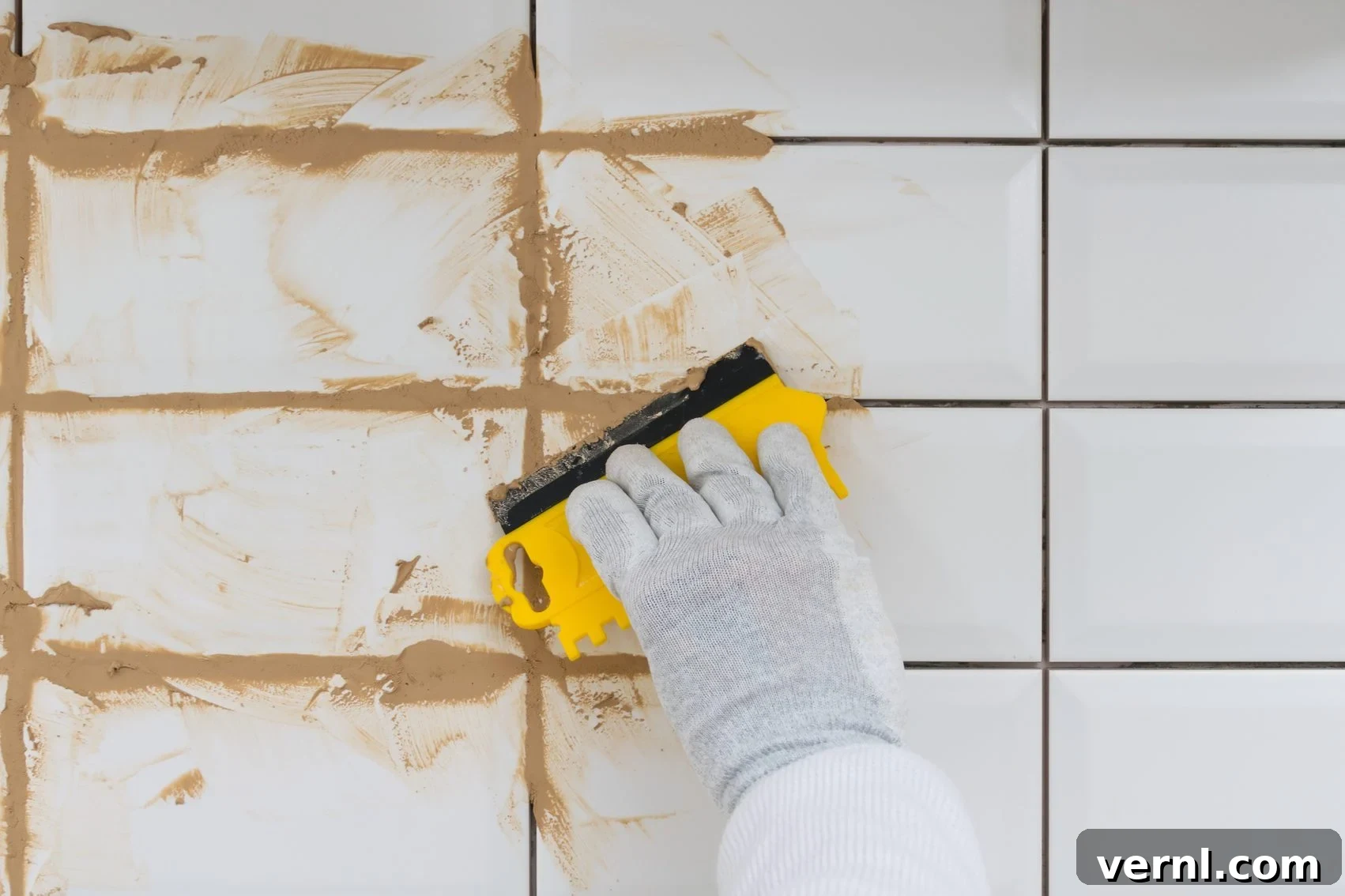
You’ve likely encountered grout in various settings, from your bathroom tiles to kitchen backsplashes, but do you truly understand its vital role? Often overshadowed by the visual appeal of the tiles themselves, grout is an unsung hero in the world of tiling. It’s much more than just a filler; it’s a fundamental component that provides structural integrity, visual cohesion, and long-term protection for any tiled surface. Delving into the specifics of grout will not only enhance your appreciation for this material but also empower you with deeper mastery over tilework, ensuring durable and beautiful results for years to come.
What Exactly Is Grout? The Unsung Hero of Tilework
At its core, grout serves as the essential material used to fill the spaces, or “joints,” between individual tiles. James Upton, a respected bathroom remodeling specialist and the founder of DIYTileGuy.com, defines grout as “a cement or chemical-based material used for filling spaces in-between tiles.” This definition is crucial because it immediately clarifies grout’s primary function: it’s not the adhesive that binds tiles to the subfloor or wall. Instead, grout is applied *after* the tiles have been set with thin-set mortar or adhesive, and its purpose is to create a seamless, finished surface that enhances both the durability and aesthetics of the installation. Without grout, a tiled surface would be unstable, difficult to clean, and prone to significant damage.
Understanding this distinction is vital for anyone undertaking a tiling project. While thin-set provides the initial bond, grout works in concert with the tiles to form a resilient, integrated system. It fills the gaps, protecting the tile edges, preventing moisture penetration to the substrate, and acting as a flexible buffer against environmental stresses. Ultimately, grout is an integral part of the finished appearance, contributing significantly to the overall professional look and longevity of your tile installation.
Exploring the Diverse Types of Grout Available Today
The world of grout has evolved significantly, offering a broader range of options than ever before. As James Upton explains, categorizing grout is no longer as straightforward as it once was, thanks to recent innovations. However, they can broadly be categorized into two primary basic types of grout: cement-based and non-cement based. Each type boasts unique properties, making it suitable for different applications and offering varying levels of performance and maintenance.
Cement-Based Grouts: The Traditional Workhorse, Reimagined
For decades, cement-based grout has been the go-to choice for tile installations. Traditionally, these grouts were offered in two main forms: sanded and unsanded. Sanded grout contains fine sand particles, making it ideal for wider grout joints (typically 1/8 inch or more) as the sand helps prevent shrinking and cracking. Unsanded grout, lacking these sand particles, is best suited for narrower joints (less than 1/8 inch) and for use with highly polished or delicate tiles that could be scratched by sand.
While effective, traditional cement-based grouts shared a common drawback: their inherent porosity. This characteristic made them highly susceptible to absorbing moisture, stains, and mildew, often requiring regular sealing and diligent cleaning. However, the landscape of cement-based grout has been significantly upgraded.
According to Upton, a modern innovation known as “high-performance” cement grout has emerged. These advanced formulations incorporate polymers and other additives that drastically improve their properties. High-performance cement grouts are remarkably stronger, exhibit superior color consistency over time, and are considerably less porous than their predecessors. This reduced porosity translates to enhanced stain resistance and less susceptibility to moisture absorption, effectively bridging the gap between traditional cement-based options and more advanced chemical grouts.
A key characteristic of these newer cement-based grouts is their fast-setting nature. While this speeds up project completion, it also demands careful attention during installation. Installers must work efficiently to ensure proper application, washing, and detailing before the grout begins to cure, preventing dried residue from becoming permanently affixed to the tile surface.
Non-Cement Based Grouts: Advanced Solutions for Demanding Applications
Beyond traditional cement, a category of non-cement-based grouts offers specialized performance for specific needs, often excelling in durability and resistance.
Epoxy Grout: The Pinnacle of Durability and Stain Resistance
Epoxy grout stands out as one of the most robust and high-performing options available. Composed of epoxy resins combined with a hardener and filler, it undergoes a chemical reaction upon mixing that results in an incredibly hard, dense, and impermeable material. Its non-porous nature makes it virtually stain-proof and waterproof, an invaluable asset in moisture-rich environments like showers, bathrooms, and commercial kitchens where hygiene and durability are paramount.
The unparalleled resistance of epoxy grout to chemicals, stains, and heavy traffic makes it an ideal choice for areas that demand the highest levels of performance. However, working with epoxy grout requires skill and speed. Once the components are mixed, a chemical reaction begins, initiating a limited “pot life” during which the grout must be installed and cleaned before it cures completely. This rapid setting time and the stickiness of the material can make installation more challenging for novices, often requiring professional expertise for the best results.
Single-Component Grouts: Aesthetics Meets Ease of Use
Another prominent non-cement-based option is single-component grout. As Upton points out, the name “single-component” can be somewhat misleading today. While these products were initially primarily urethane-based, many modern formulations now incorporate multiple ingredients, leading to a broader categorization. These grouts are pre-mixed and ready to use straight from the bucket, eliminating the need for on-site mixing and the complexities associated with chemical reactions, as seen with epoxy.
While single-component grouts may not offer the same extreme hardness or absolute stain resistance as epoxy, they provide a significant upgrade over traditional cement-based options in terms of durability and flexibility. Upton notes that “the finished appearance is more appealing, especially on walls.” Their ease of application, superior flexibility (which helps prevent cracking), and impressive color consistency make them a popular choice for residential applications, particularly for wall tiles where their aesthetic qualities can truly shine. They offer a great balance between performance, ease of installation, and a visually appealing finish.
The Indispensable Purposes of Grout in Tile Installation
Contrary to a common misconception that grout somehow adheres the tiles to the floor, its true functions are diverse and critical, impacting the longevity, hygiene, and aesthetic appeal of any tiled surface. Grout is far more than just a cosmetic filler; it’s an integral part of a robust and functional tiling system.
- Strengthen the Tiles and Absorb Movement: Tiles, despite their rigid appearance, are subject to subtle expansion and contraction due to temperature fluctuations and humidity changes. Without grout, these movements could lead to friction between adjacent tiles, causing chips, cracks, or even dislodgement. By filling the spaces between individual tiles, grout acts as a flexible cushion, absorbing these pressures. It allows for minor movement, distributing stress evenly across the tiled surface and significantly reducing the risk of tile damage over time. This crucial function contributes directly to the overall structural integrity and lifespan of your tile installation.
- Enhance Visual Appeal and Design Versatility: Grout plays a pivotal role in the final aesthetic of your tilework. Properly applied grout creates a seamless, professional, and visually pleasing finish that ties the entire installation together. Its width and color can be strategically customized to complement or dramatically accentuate the patterns and textures of your tiles. For instance, a contrasting grout color can highlight individual tiles and create intricate grid patterns, while a matching color can create a more unified, expansive, and natural look. Furthermore, grout is indispensable for intricate designs such as mosaics or complex tile patterns, as it securely locks tiles in place, preventing them from shifting or sliding and ensuring the precision of the design.
- Ensure Hygiene and Protect the Subfloor: One of grout’s most practical purposes is to create a continuous, sealed surface that simplifies cleaning and prevents damage. By filling the gaps, grout effectively blocks dirt, dust, bacteria, and spilled liquids from accumulating in the crevices between tiles. This makes routine cleaning tasks, such as sweeping or mopping, significantly easier and more effective, contributing to a more hygienic environment. More importantly, this continuous barrier prevents water and moisture from seeping into the subfloor or wall structure beneath the tiles. Unchecked moisture penetration can lead to serious issues like mold growth, mildew, wood rot, and structural damage, particularly in wet areas like bathrooms and kitchens. Grout acts as a critical line of defense against these costly and unhealthy problems.
Key Considerations for Grout Installation
Successful grout application goes beyond simply filling the gaps; it involves several critical considerations that impact both the functionality and aesthetics of your tiled surface. Understanding these factors before you begin will ensure a professional and durable finish.
- Grout Joint Size: Precision in Spacing
The grout joint size refers to the width of the space between individual tiles. This measurement is not merely an aesthetic choice but also has practical implications for installation and the overall look. James Upton notes that “in general, wider grout joints will make it easier to install and line up the tiles during installation.” This is because wider gaps offer more tolerance for slight variations in tile size or alignment. However, he adds, “it seems that thinner grout joints are more desirable these days,” reflecting a modern trend towards minimalist aesthetics that emphasize the tile itself rather than the grout lines. While aesthetic preferences vary, a common width cited by Upton is 1/8 to 3/16 inch. It’s crucial to adhere to tile industry standards, which stipulate that 1/16th of an inch is the absolute minimum joint width. Using joints that are too narrow can lead to grout failure due to insufficient material for proper adhesion and flexibility. The type of tile also plays a role; rectified tiles (mechanically cut for precise, uniform edges) can accommodate thinner grout lines, while non-rectified tiles (with slightly irregular edges) often require wider joints to compensate for variations. Learning how to grout tile effectively involves mastering the art of consistent joint spacing. - Grout Sealers: Enhancing Protection for Cement-Based Grout
Grout sealers are specialized products designed to protect cement-based grouts by making them less porous and therefore more resistant to stains and moisture. However, as Upton wisely explains, they are “not miracle products.” While sealers significantly reduce the absorption rate of cementitious grout, they won’t completely seal its pores or render it entirely waterproof or stain-proof. Their primary function is to form a protective barrier that helps prevent contaminants from penetrating deeply into the grout, giving you more time to clean up spills before they set in. Upton highlights that many high-performance cement grouts are marketed as needing no sealer. While these formulations are indeed less porous than traditional options, he emphasizes that they “doesn’t necessarily mean that they won’t benefit from one.” Applying a high-quality penetrating sealer can still provide an added layer of protection and prolong the clean appearance of even advanced cement grouts. It’s important to note that epoxy and single-component grouts, being inherently non-porous due to their chemical composition, do not absorb sealers and therefore do not require or benefit from them. For cement-based grouts, periodic reapplication of sealer, typically every one to five years depending on traffic and cleaning frequency, is recommended to maintain their protective qualities. - Grout Color: A Powerful Design Element
The choice of grout color is a significant design decision that can dramatically alter the perception and impact of your tile project. Grout color can be used to achieve various visual effects. A good rule of thumb is to choose a darker grout color if your goal is to accentuate the individual pattern, shape, or layout of the tile. Darker grout lines create contrast, making each tile stand out and highlighting the grid or mosaic effect. Conversely, selecting a lighter shade, or a color that closely matches your tiles, will create a more unified, natural, and seamless appearance. This approach often makes a room feel larger and less busy, allowing the texture or subtle variations of the tile to be the focal point without stark dividing lines. Beyond aesthetics, practical considerations also play a role. Darker-colored grout is generally easier to maintain as it naturally hides dirt, grime, and minor stains much more effectively than lighter grout, which tends to show discoloration more noticeably over time. When selecting a color, always test a small swatch or look at samples next to your chosen tiles under various lighting conditions to ensure the desired effect.