
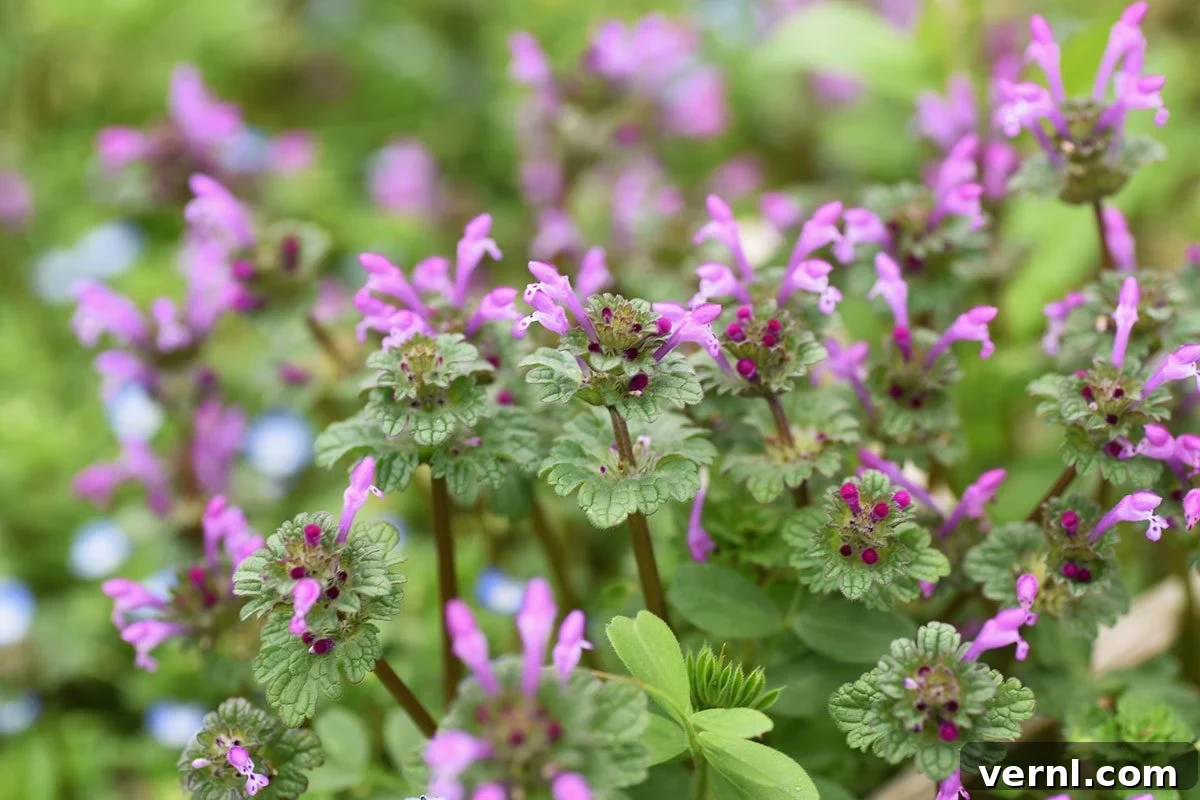
A common sight across the United States, henbit (Lamium amplexicaule) is widely recognized by its charming small purple blossoms that herald the arrival of spring. Often found in lawns, gardens, and even along roadsides, this plant adds a delicate splash of color to the landscape. Its cheerful appearance, however, can belie a more problematic truth for homeowners and gardeners: henbit is a highly invasive weed that can quickly take over turfgrass and cultivated areas if left unchecked.
Identifying henbit is relatively straightforward. Keep an eye out for low-growing plants featuring multiple square, green-to-purple stems emerging from a single taproot. Its distinctive leaves are heart-shaped with scalloped edges, growing in pairs directly opposite each other on the stem. These leaves often appear crinkled or slightly hairy. The characteristic light purple to pinkish-purple flowers are tubular and form in whorls or rings in the leaf axils along the upper parts of the stems. If these features sound familiar, you’ve likely encountered henbit. Understanding this pervasive winter annual is the first step toward effective management and preserving the health and aesthetics of your outdoor spaces.
Understanding Henbit: What Is It?
According to landscaping experts like Dave Holmes of The Grounds Guys, henbit is classified as a low-growing winter annual broadleaf plant. This means it germinates in the fall, establishes roots over the winter, and then grows rapidly and flowers in early spring before dying off as temperatures rise in late spring or early summer. Its widespread distribution makes it a familiar sight not just in manicured lawns and garden beds but also in agricultural fields, wild pastures, and ditches.
While often considered a nuisance in cultivated areas, henbit plays a surprisingly vital ecological role. Its early spring blossoms provide an invaluable food source, offering crucial nectar to native bees and other early-season pollinators when few other plants are in bloom. However, this beneficial aspect is often overshadowed by its aggressive growth habit. Henbit’s invasive nature means it can effectively compete with and “rob” desirable turfgrass and ornamental plants of essential nutrients, water, and sunlight, leading to weakened lawns and compromised garden beds if its spread is not controlled.
The prolific seeding capacity of henbit is a significant factor in its invasiveness. Drew Wagner of Sod Solutions highlights this challenge, noting, “Unfortunately, this weed’s flowers result in an abundance of seeds — up to 2,000 per plant.” This incredible reproductive potential means a single plant can contribute thousands of future weeds to your landscape. Wagner further explains the life cycle: “Henbit seeds germinate during the fall and through the winter. Plants remain relatively small and dormant until the early spring when they grow rapidly and the problem in your lawn becomes noticeable.” These hardy winter weeds are remarkably resilient, thriving in a wide range of climates across much of the United States, making consistent management crucial for homeowners.
Is Henbit Considered a Weed?
The definition of a “weed” is often subjective. Generally, any wild plant growing where it’s not desired—such as in a meticulously maintained lawn or a carefully curated garden bed—is considered a weed. By this common definition, henbit undoubtedly fits the description. Its rapid growth and ability to outcompete desirable plants make it a prime candidate for removal in many landscape scenarios.
However, henbit presents a fascinating dichotomy. Many homeowners and ecologists choose to tolerate or even encourage a certain amount of this plant due to its recognized benefits. As Dave Holmes points out, “Henbit’s attractive appearance, importance as a food source for bees, edibility, and ability to thrive in many climates means that it is occasionally allowed to grow where other weeds are not.” For those prioritizing biodiversity and natural foraging opportunities for pollinators, or even those interested in foraging for wild edibles, henbit can be viewed as a valuable addition rather than a detrimental intruder. The decision to label henbit purely as a “weed” often depends on individual landscape goals and priorities, balancing aesthetic desires with ecological considerations.
Is Henbit Safe? Exploring Its Edibility and Lookalikes
Despite its common name and frequent presence in lawns, henbit is a member of the mint family (Lamiaceae), although it notably lacks the characteristic minty aroma. Perhaps one of its most surprising attributes is its complete safety for consumption and contact. “It is an edible plant in which the young leaves, shoots, stems, and flowers can be eaten raw or cooked,” explains Holmes. “It has a slightly sweet and peppery flavor, similar to celery or even a mild peppery spinach.” This makes henbit a readily available wild edible, perfect for adding to spring salads, smoothies, or lightly sautéing as a nutrient-rich green. It is rich in vitamins, minerals, and antioxidants, offering a healthy and free supplement to your diet.
When foraging, it’s always critical to correctly identify plants. Fortunately, henbit does not have any known toxic lookalikes that commonly grow in similar environments. However, as Wagner notes, it can often be confused with purple deadnettle (Lamium purpureum), another common and entirely edible wild plant also belonging to the mint family. While both share similar growth habits and bloom times, there are key distinctions that help differentiate them. Purple deadnettle typically produces more triangular leaves that often have a distinct reddish-purple hue, especially on the upper foliage and stems, giving it its name. In contrast, henbit’s leaves are more uniformly green and heart-shaped, wrapping directly around the stem without a distinct petiole (leaf stalk) in the upper parts. Learning these subtle differences ensures safe and enjoyable foraging experiences.
Effective Strategies: How To Get Rid of Henbit
While a modest presence of henbit can offer charming spring color and vital sustenance for local bee populations, allowing it to spread unchecked can quickly lead to an overwhelming problem. The good news is that there are several effective methods for controlling henbit and preventing it from dominating your yard. The approach you choose will depend on the severity of the infestation, your environmental preferences, and the amount of time you can dedicate to the task.
-
Hand-Pulling for Small Infestations: For smaller patches or when plants are still young, manual removal is an excellent, chemical-free option. Holmes emphasizes the importance of thoroughness: “If you pull the plants individually, make sure to remove the entire fibrous root system or the weed will grow back.” Henbit has a relatively shallow root system, but any root fragments left behind can regenerate. Hand-pulling is most effective when the plants are small, before they have a chance to produce and release their abundant seeds. To make the task easier and more effective, moisten the surrounding soil thoroughly; this loosens the soil and allows for easier root extraction. Digging around the plant with a weeding hoe or a specialized weeding tool can help dislodge the entire root ball, ensuring complete removal. Dispose of the pulled weeds properly, preferably in yard waste or compost if they haven’t gone to seed, to prevent any chance of re-seeding.
-
Corn Gluten Meal as a Natural Pre-Emergent: For a natural and organic approach to preventing henbit, corn gluten meal can be a valuable tool. This byproduct of corn processing acts as a natural pre-emergent herbicide, inhibiting the root development of germinating seeds. The critical factor for success with corn gluten meal is precise timing. It must be applied before the henbit seeds germinate in the fall. If you apply corn gluten meal after germination has occurred, it unfortunately acts as a fertilizer, providing nitrogen and potentially encouraging the weed’s growth rather than suppressing it. For persistent problem areas, monthly treatments during the germination window may be necessary to effectively suppress new henbit seeds from establishing. Always follow product instructions for application rates and timing to achieve the best results.
-
Strategic Use of Chemical Herbicides: Chemical herbicides offer an effective solution for larger or more stubborn henbit infestations, but they require careful consideration and application due to potential risks. These products can be toxic and pose harm to children, pets, wildlife, and beneficial insects if not used correctly. Improper application can also lead to the contamination of groundwater and cause significant damage to your desirable turfgrass and nearby ornamental plants. If you opt for chemical weed killers, understanding the types and timing is crucial. Wagner advises that “complete control of henbit is easier in the fall if you treat the plants with a post-emergent option while they are still young and small, or put out a pre-emergent herbicide before seeds germinate.”
Pre-emergent herbicides are designed to create a barrier in the soil, preventing weed seeds from germinating. These are best applied in the late summer to early fall, before henbit seeds sprout. Post-emergent herbicides, on the other hand, are applied directly to actively growing weeds. For henbit, a selective broadleaf herbicide that targets weeds without harming most turfgrasses is recommended. Apply these products when henbit is actively growing but still young and vulnerable, typically in early to mid-fall or very early spring before it flowers and sets seed. Always read and strictly adhere to the manufacturer’s instructions for mixing, application rates, safety precautions, and appropriate weather conditions to minimize risks and maximize effectiveness.
Long-Term Prevention: How To Keep Henbit From Coming Back
Preventing henbit’s return is often more effective and less labor-intensive than battling an established infestation. The cornerstone of successful long-term control lies in understanding and disrupting its life cycle, primarily by preventing seed production. As Dave Holmes rightly states, “Timing is everything with henbit. It’s important to control henbit before it flowers. This will keep the weed from producing and releasing its seeds. Waiting until after it flowers will result in seeds being spread around, so new weeds germinate in the same general area the next growing season.” Implementing a proactive prevention strategy focuses on creating an environment where henbit struggles to thrive and desirable plants flourish.
Other crucial strategies for preventing a henbit comeback include:
-
Promoting a Healthy, Dense Lawn: One of the most powerful defenses against henbit and other weeds is a robust, thick lawn. A dense turfgrass canopy naturally crowds out weeds by monopolizing sunlight, water, and nutrients, leaving little room or resources for unwanted plants to establish. Holmes explains, “One of the best ways to control henbit is to grow a thick lawn so weeds struggle to compete.” Achieving a healthy lawn involves several key practices: performing regular soil tests to determine nutrient deficiencies and pH levels; implementing a consistent, tailored fertilization program; overseeding thin areas in the fall to increase turf density; and aerating the soil annually to improve air and water penetration. A well-nourished and vigorous lawn is naturally more resistant to weed invasion.
-
Mowing to the Correct Height: The way you mow your lawn significantly impacts its health and weed resistance. For most turfgrass varieties, especially cool-season grasses, a higher mowing height is universally recommended. Taller grass blades promote a deeper, more extensive root system, which strengthens the turf and makes it more resilient to stressors like drought and weed competition. Furthermore, longer grass blades create more shade at the soil surface. This shade is instrumental in preventing weed seeds, including henbit, from receiving the sunlight they need to germinate. Aim to remove no more than one-third of the grass blade’s height at each mowing to avoid stressing the lawn and to maintain that crucial canopy height.
-
Ensuring Sufficient Drainage and Sunlight: Henbit, like many winter annual weeds, thrives in specific environmental conditions, particularly overly moist or shady areas. Addressing these issues can dramatically reduce its prevalence. Improving soil drainage is vital; options include aerating your soil to break up compaction, incorporating coarse organic materials like compost, sawdust, sand, or gypsum to improve soil structure, or for severe issues, considering more extensive landscape drainage solutions. To increase sunlight exposure in shady patches of your lawn, judicious pruning of overgrown trees and shrubs can make a significant difference. Removing lower branches or thinning dense canopies allows more light to reach the grass below, creating an environment less hospitable to shade-loving weeds like henbit and more conducive to healthy turfgrass growth. Ensure your watering practices also support good drainage; deep, infrequent watering is generally better than shallow, frequent watering, which can encourage surface-level weed germination.
-
Utilizing Mulch in Garden Beds: While primarily focused on lawns, henbit can also invade garden beds. Applying a two-to-four-inch layer of organic mulch (such as wood chips, shredded bark, or straw) in garden beds is an excellent preventive measure. Mulch effectively smothers henbit seeds, preventing them from germinating by blocking sunlight and acting as a physical barrier. It also helps retain soil moisture and moderates soil temperature, creating a healthier environment for your desired plants while making it difficult for weeds to establish.