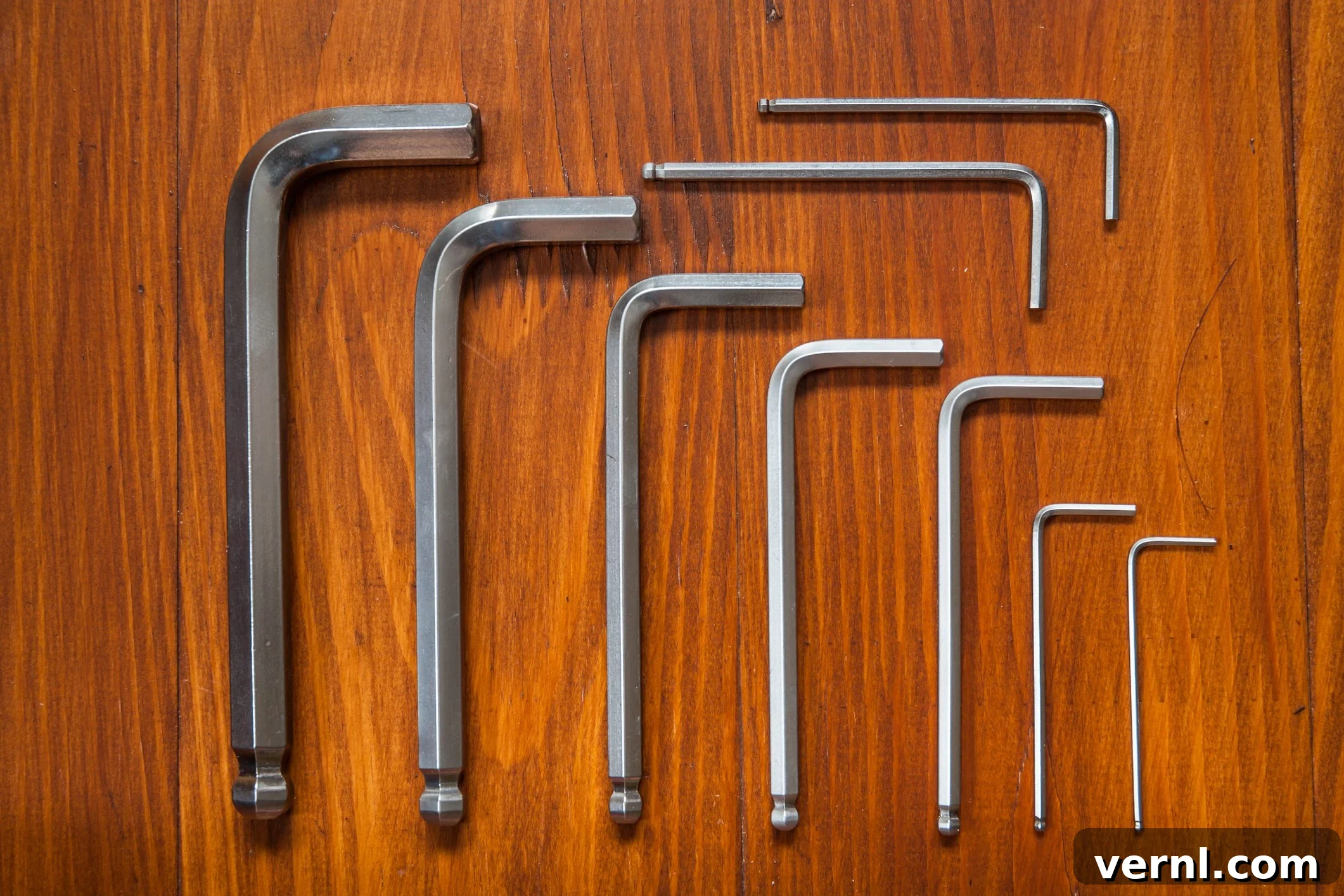
Even if you’ve never deliberately purchased an Allen wrench, chances are you already possess a few. These small, often L-shaped, hand tools frequently arrive as complimentary accessories with most flat-pack furniture you assemble yourself. While they might seem like a minor afterthought, easily overlooked among the assembly instructions, their utility extends far beyond simple furniture construction. Allen wrenches are, in fact, remarkably essential tools for a vast array of tasks, enabling precise work with hexagonal screws and bolts that demand an exact fit. Unlike common Phillips or slotted fasteners, which can sometimes be jury-rigged with a pocket knife or house key in a pinch, hexagonal fasteners require the specific geometry of an Allen wrench for proper engagement, ensuring both security and longevity of the connection.
What is an Allen Wrench, Allen Key, or Hex Key?
An Allen wrench, also widely known as an Allen key or hex key, is a specialized hand tool engineered for fastening screws or bolts that feature a hexagonal socket in their head. This distinctive six-sided internal recess is where the Allen wrench truly shines. Typically, these tools come with two working ends, though some minimalistic sets might only offer one. The design is elegantly simple yet highly effective: insert one end into the hexagonal socket of the fastener and turn. The hexagonal shape of both the wrench and the fastener provides six robust points of contact, allowing for an incredibly efficient transfer of torque. This multi-point engagement significantly reduces the risk of cam-out – where the tool slips out of the fastener head – a common problem with other drive types like Phillips. Consequently, it’s nearly impossible to strip the fastener head when using the correct size Allen wrench, making it a reliable choice for securing components tightly and safely.
A Brief History of the Hex Key
While the concept of hexagonal wrenches and fasteners existed in various forms during the 19th century, the modern Allen wrench as we know it today gained prominence through specific innovations. The pivotal moment arrived when William G. Allen patented the design for hex socket head cap screws in 1910. This patent, issued to the Allen Manufacturing Company of Hartford, Connecticut, not only protected the design of the screw but also implicitly popularized the corresponding wrench required to drive it. Over time, the company’s name, “Allen,” became inextricably linked with the tool itself, turning “Allen wrench” into a genericized trademark synonymous with hex keys worldwide. Other companies also contributed to the development and standardization of hexagonal drive systems, but it was Allen’s robust and widely adopted design that cemented its place in toolboxes across industries, from manufacturing to personal DIY projects. The hex key offered a superior fastening solution, allowing for more compact screw heads, greater torque transmission, and reduced likelihood of damage compared to its predecessors.
Mastering the Use of an Allen Wrench
Using an Allen wrench is fundamentally straightforward: simply insert one end into the head of the hex fastener and turn it to tighten or loosen. However, achieving optimal results and preventing damage requires a bit more nuance. One of the most crucial aspects is finding the correct size wrench for the fastener. Hex keys are precision tools, and using a wrench that is even slightly too small can lead to rounding out the fastener’s socket or damaging the wrench itself. This is precisely why owning sets with multiple sizes is so important, allowing you to quickly find the perfect fit through trial and error without risking damage. When it comes to technique, the design of the L-shaped Allen wrench offers flexibility. In our experience, the longer arm of the ‘L’ shape is often better suited for reaching fasteners in tight or recessed spaces, or for delicate work requiring precision and less torque. Conversely, the shorter arm provides a longer handle, which significantly increases leverage. This added mechanical advantage is invaluable when dealing with stubborn, overtightened, or corroded fasteners that require substantial force to break free. Always ensure the wrench is fully seated in the fastener head before applying significant torque to prevent slippage and potential injury.
Understanding Allen Wrench Sizes and Systems
Allen wrenches are manufactured in a vast range of sizes, catering to an incredibly diverse array of applications. You can find minuscule hex keys designed for intricate electronics and eyeglasses, all the way up to substantial wrenches used for heavy machinery, automotive components, and industrial equipment. A critical distinction of hex keys is that only the exact wrench size can be used on a fastener. This precision contrasts sharply with screwdrivers, where it’s sometimes possible to awkwardly turn fasteners that are slightly larger or smaller than the driver tip. Attempting to use an Allen wrench that is even slightly undersized will invariably lead to rounding out the hexagonal socket of the fastener, rendering it impossible to turn in the future, or it may damage the wrench itself. This strict requirement for an exact fit underscores why sets of Allen wrenches are overwhelmingly popular and highly recommended for anyone needing to work with these fasteners. These sets ensure you have a comprehensive range of sizes at your disposal, minimizing the risk of damage and maximizing efficiency.
Types and Forms of Allen Wrenches
While the classic L-shaped hex key is the most recognizable, Allen wrenches come in several configurations, each designed to optimize performance for different tasks and user preferences:
- L-shaped Hex Keys: The most common type, offering a good balance of reach and leverage. The two arms allow for versatile application, with the longer arm typically used for access and the shorter for torque.
- T-handle Hex Keys: Featuring a handle perpendicular to the shaft, these provide a more ergonomic grip, allowing users to apply more force and achieve higher torque with greater comfort. They are particularly favored for repetitive tasks or when significant tightening is required.
- P-handle Hex Keys: Similar to T-handles but often with a more contoured, often plastic or rubberized, handle for enhanced comfort and grip. They reduce hand fatigue during prolonged use and offer excellent control.
- Folding Hex Key Sets: These compact sets feature multiple hex keys housed within a single handle, much like a pocket knife. They are highly portable and excellent for carrying in a toolbox or pocket, though individual keys might be less accessible in very tight spots compared to standalone wrenches.
- Hex Key Bit Sets: Designed for use with screwdrivers, ratchets, or power drills, these sets consist of hex bits that fit into a standard bit driver. They offer immense versatility, allowing for rapid fastening and loosening, especially for high-volume work, and provide the benefit of adjustable torque settings when used with appropriate drivers.
- Ball-End Hex Keys: Many L-shaped and T-handle keys are available with a ball-end on the longer arm. This spherical tip allows the wrench to engage the fastener at an angle of up to 25-30 degrees, making it incredibly useful for reaching fasteners in awkward or obstructed locations where a straight entry is not possible. While convenient, ball ends transmit less torque than a straight end and should be used with caution when applying extreme force.
What to Consider When Buying Allen Wrenches
Although all Allen wrenches perform the fundamental task of turning hexagonal fasteners, several key differences exist between models and sets that you should consider before making a purchase. Investing in the right set can significantly enhance your efficiency and the longevity of both your tools and your fasteners.
- Size System: SAE vs. Metric: Allen wrenches are available in two primary measurement systems: SAE (Society of Automotive Engineers), also known as imperial or standard sizes, measured in fractions of an inch, and Metric, measured in millimeters. The type you need depends entirely on the fasteners you’ll be working with. For instance, most European-manufactured items and bicycles use metric fasteners, while older American products or specific machinery might use SAE. If you’re unsure which you’ll encounter, or if your projects vary widely, the most practical solution is to opt for a comprehensive set that includes both SAE and metric sizes. This versatility won’t typically cost much more and ensures you’re prepared for a wide spectrum of tasks and projects without having to buy separate sets later.
- Material Quality: The material of your Allen wrench directly impacts its strength, durability, and resistance to wear. Most basic and affordable hex keys are made from alloy steel or carbon steel. These are perfectly adequate for light-duty tasks and occasional use. However, for more demanding applications, such as working on motorcycles, heavy machinery, or automotive components, where fasteners can be extremely tight or rusted, consider higher-end models made from chrome vanadium steel or S2 tool steel. Chrome vanadium steel is renowned for its excellent strength-to-weight ratio and corrosion resistance, while S2 tool steel offers superior hardness and impact resistance. These premium materials are less likely to deform, twist, or break under high torque, offering a longer lifespan and better protection for your fasteners.
- Handle Design: The handle design significantly influences comfort, control, and the amount of torque you can apply. The traditional L-shaped options are the most common and cost-effective, offering versatility with their two working ends. For enhanced ergonomics and the ability to apply more rotational force, T-handle designs are excellent. Their longer handles allow you to grip them with your entire palm, providing better leverage and reducing hand strain during repetitive tasks. For maximum comfort and a secure grip, especially when working for extended periods, P-handle designs featuring plastic or rubberized handles are ideal. These soft-grip handles conform better to the hand, making turning easier and more comfortable, and often provide better grip in oily or greasy conditions.
- Set vs. Single Wrenches: Unless you have a very specific, recurring task that requires only one particular size of hex key, it is almost always more economical and practical to purchase a set rather than individual wrenches. Allen wrench sets are relatively affordable, and the likelihood of needing multiple sizes for various projects is very high. In our experience, you can never have enough sizes on hand, as different products and components will invariably call for different hex key dimensions. A good set ensures you’re prepared for unexpected projects and saves you the frustration of scrambling for the right size in the middle of a job.
- Organization and Storage: Allen wrenches are small and easily misplaced, especially when working on the go. To ensure you don’t lose your hex keys, particularly if you travel between job sites or have a busy workshop, prioritize buying a set that comes with an effective organizer. Many sets come in plastic cases, ring holders, or hinged holders that keep the wrenches together and clearly labeled. Some designs are even permanently set into a pocket-knife-style handle (folding hex key sets), which offers extreme portability, although these might not fit into extremely tight spots as easily as individual L-shaped wrenches. If you know you’ll primarily use your wrenches in a single, fixed location like a workbench, you might opt for a set that fits into a stationary base or stand. These are often more convenient for quickly grabbing and returning wrenches but are not designed for travel. Choosing a set with good organization will save you time, reduce frustration, and help prolong the life of your tools.
Maintenance and Care for Your Allen Wrenches
To ensure your Allen wrenches last for years and perform optimally, a little care goes a long way. Always keep them clean and free of dirt, oil, or corrosive substances. After use, especially in dirty environments, wipe them down with a rag. Storing them in their designated organizer or case helps prevent rust and keeps them from getting lost. Periodically, you might apply a light coat of oil to prevent rust, especially if you live in a humid climate. Avoid using your Allen wrenches as pry bars or hammers, as this can bend or break them, compromising their precision and integrity.
Common Mistakes to Avoid
Even with such a simple tool, common mistakes can lead to damaged fasteners or tools. Avoid using an Allen wrench as a substitute for another tool. Never use an undersized wrench, as this will inevitably strip the fastener head. Over-tightening fasteners can damage the threads or the component, while under-tightening can lead to loose parts. Always ensure the wrench is fully seated in the fastener’s socket before applying torque. Lastly, remember that while ball-end hex keys offer angled access, they are not designed for breaking loose extremely tight fasteners, as this can damage the ball end itself.
Conclusion: The Humble Yet Mighty Hex Key
The Allen wrench, or hex key, may be a humble tool, often taken for granted, but its importance and versatility in both professional and home settings cannot be overstated. From assembling flat-pack furniture to fine-tuning bicycles, maintaining machinery, and undertaking complex automotive repairs, the precision and efficiency of the hexagonal drive system make it indispensable. Understanding the different types, sizes, materials, and handle designs available empowers you to choose the right tools for your specific needs, ensuring durability, comfort, and effective results. By following best practices for use and maintenance, your collection of hex keys will serve you reliably for countless projects to come, proving that sometimes, the simplest tools are indeed the most essential.