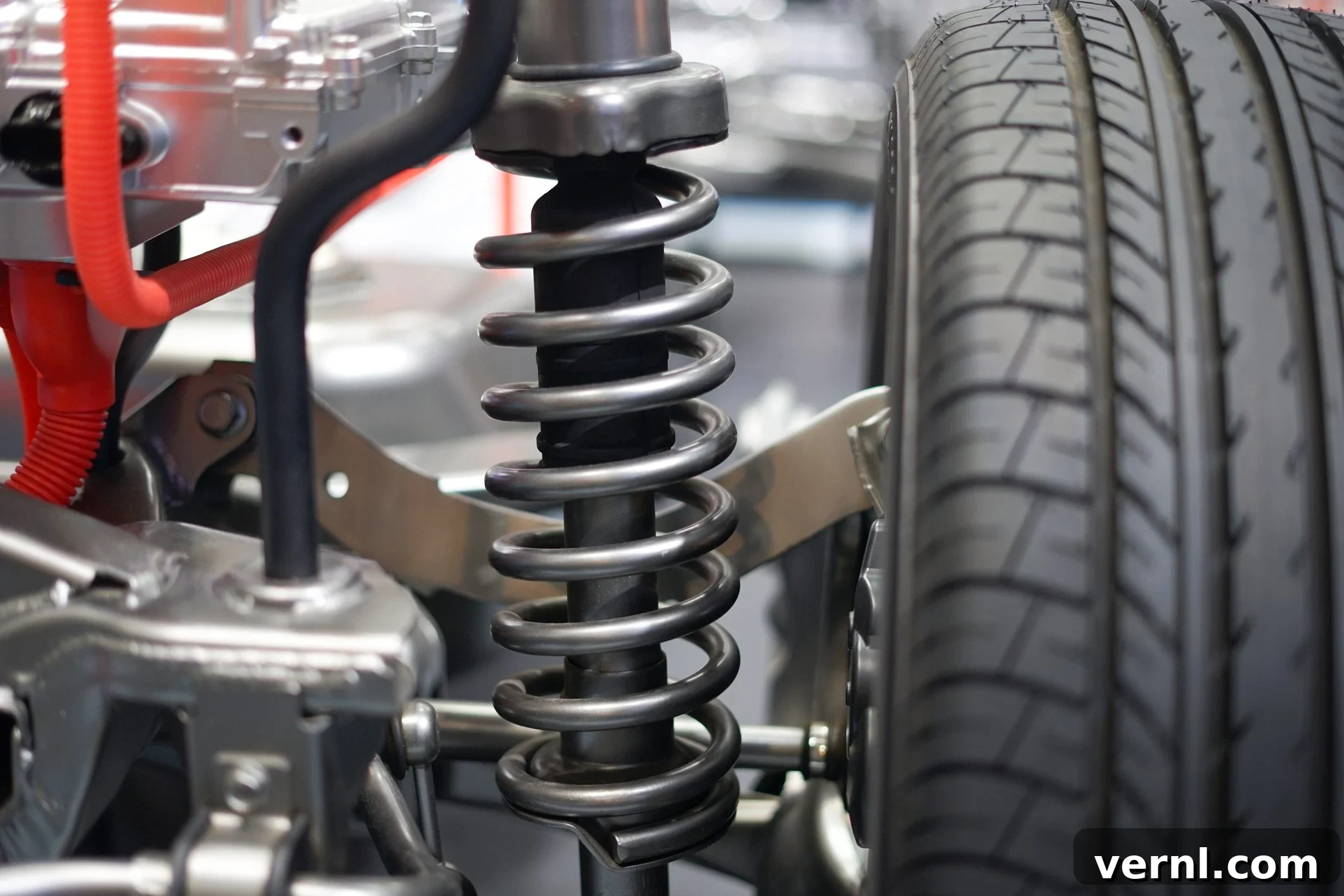
As an automotive technician with years of experience, I’ve had my hands on thousands of vehicle suspension systems, specifically shocks and struts. My career has provided me with countless anecdotes, illustrating the critical role these components play in vehicle safety and performance.
I recall one particular instance where a customer described a rather unusual symphony coming from their car: the distinct sound of a bell ringing, coupled with an alarming looseness in the steering, especially noticeable during turns. A diagnostic road test confirmed their complaints; the vehicle felt unstable, and the intermittent clang was unmistakable. Upon a closer visual inspection, the culprit was revealed: the top covers of both front shock absorbers were severely rusted. These covers had corroded to the point where they were scraping against and scoring the shocks’ pistons, leading to a catastrophic failure where all the hydraulic oil had leaked out. The loss of damping fluid meant the shocks were completely ineffective. After replacing all four shocks, the transformation was immediate and profound; the car drove and felt as if it had just rolled off the assembly line.
Shock absorbers are, without a doubt, one of the most frequently overlooked components of a vehicle’s suspension system. While they are crucial for providing a smooth and comfortable ride, preventing our teeth from rattling over every bump, their primary function extends far beyond mere comfort. They play a pivotal role in maintaining consistent tire contact with the road, which is fundamental for vehicle control, braking efficiency, and overall driving stability. Driving with worn-out or damaged shocks is not just uncomfortable; it can be incredibly dangerous, adversely affecting steering response, accelerating tire wear, and significantly increasing stopping distances. Understanding how these vital components work and how to identify when they need attention is essential for every vehicle owner. Here’s a comprehensive guide to what you need to know about your car’s shock absorbers.
How Long Do Shocks and Struts Last?
The lifespan of your vehicle’s shock absorbers and struts is not a one-size-fits-all answer; it largely depends on a variety of factors. Under typical driving conditions, where a vehicle primarily navigates well-maintained, level pavement and avoids aggressive driving habits, shock absorbers are generally expected to last approximately 50,000 miles, which translates to about four to five years of use. This estimate, however, can fluctuate significantly.
For drivers who frequently engage in demanding activities such as off-roading, or whose daily commutes involve driving on rough, uneven, or heavily potholed roads, the stress on the suspension components is considerably higher. Similarly, vehicles subjected to constant heavy loads, frequent towing, or extensive stop-and-go city driving will experience accelerated wear and tear on their shocks. In such scenarios, the lifespan can be considerably shorter than the average.
Conversely, if you drive cautiously and primarily on smooth, well-paved roads, it’s not uncommon for your shock absorbers to exceed the 50,000-mile mark, potentially lasting much longer. However, environmental factors also play a critical role. Living in regions prone to heavy road salt usage during winter, which promotes rust and corrosion, or in climates experiencing extreme temperature fluctuations, can severely compromise the integrity of the shocks’ inner seals and external components. This environmental exposure can significantly shorten their operational life, leading to premature failure.
MacPherson struts, which are a common type of suspension system found in many modern vehicles, often exhibit a longer lifespan, frequently lasting up to 100,000 miles. While both shocks and struts serve the fundamental purpose of dampening suspension oscillations, it’s important not to confuse them. MacPherson struts are a more integrated component, combining the functions of a shock absorber, a coil spring, and a steering pivot into a single unit. This design contributes to their enhanced durability and structural rigidity, often resulting in a smoother ride and superior vibration absorption compared to traditional shock absorbers. Despite their similarities in function, their distinct construction and operational mechanisms mean they are not interchangeable, and understanding the specific type of suspension your vehicle employs is crucial for proper maintenance and repair.
How To Tell if Shocks Are Bad: Key Indicators
Identifying failing or failed shock absorbers early can prevent more significant problems and ensure your safety on the road. Worn shocks often exhibit clear “tells” that signal their diminished capacity. The most common and easily recognizable symptom is excessive vehicle bounce or instability, particularly after encountering an imperfection in the road or after braking.
The Bounce Test
A simple yet effective test for your shocks involves checking your vehicle’s rebound capacity. With your vehicle safely parked on level ground, go to each corner of the car and push down hard on the bumper two or three times, exerting significant force. After releasing the bumper, the vehicle should settle back to its original position after just one smooth bounce. If your vehicle continues to bounce excessively (more than one oscillation), or if you hear a distinctive knocking or clunking sound, or if you notice any fluid leaking from the shock absorber itself, these are strong indicators that the shocks are compromised and require immediate replacement. Fluid leakage signifies a failed seal, meaning the hydraulic fluid necessary for damping is escaping.
Other Critical Indications Your Shocks Need Replacing Include:
Longer Stopping Distances
Weak or worn shocks significantly impair your vehicle’s braking performance. When shocks are unable to effectively dampen the suspension, the tire/wheel assembly tends to “hop” up and down, especially during braking or over uneven surfaces. This vertical movement causes the tire tread to intermittently lose full, consistent contact with the pavement. Consider that the actual section of your tire making contact with the road at any given moment is not much larger than the palm of your hand. When this crucial contact is compromised due to bouncing, the amount of friction generated between the tire and the road surface is significantly reduced. This makes bringing your vehicle to a complete stop much more difficult, especially at higher speeds or in emergency braking situations, directly impacting your ability to avoid collisions and potentially increasing stopping distances by several car lengths. This reduced control under braking is a major safety concern that should not be overlooked.
Abnormal Tire Wear
The same phenomenon of the tire/wheel assembly “hopping” that affects braking performance also leads to abnormal tire wear patterns. This irregular bouncing motion causes the tire to repeatedly impact the road surface unevenly, resulting in distinctive wear patterns known as “cupping” or “scalloping.” These terms describe worn, patchy sections that appear around the outer edge of a tire, giving it a wavy or scooped-out appearance. This type of wear is a clear visual cue that your shocks are failing to maintain consistent tire contact, leading to premature tire replacement and additional costs.
Poor Handling and Ride Quality
As shock absorbers wear out, your vehicle will progressively lose its smooth ride quality and precise handling characteristics. Even encountering minor road imperfections such as small bumps, potholes, or ripples can cause the steering wheel to shake or vibrate violently. This can make it incredibly difficult to maintain a straight line, especially at highway speeds, or to accurately control the vehicle during turns. You might also notice excessive body roll when cornering, a tendency for the vehicle’s nose to dive excessively during braking (nose-dive), or the rear to squat under acceleration. These symptoms collectively contribute to a feeling of instability and a significant loss of confidence in your vehicle’s handling capabilities, compromising safety and driving enjoyment.
Strange Noises
Worn-out, broken, or loose shock absorbers, as well as degraded or missing mounting bushings, can be the source of various unsettling noises. These can include sharp snapping, cracking, clunking, or rattling sounds, particularly when driving over potholes, navigating speed bumps, climbing a driveway incline, or executing turns. Mounting bushings, typically made from durable rubber, silicone, or polyurethane, serve a crucial function as cushions. They absorb vibrations and prevent direct metal-on-metal contact between the shock absorber and the vehicle frame or mounting points. When these bushings become brittle, cracked, or simply wear out, they lose their ability to dampen noise and vibration, leading to audible complaints from the suspension system.
Excessive Vibration
One of the primary functions of shock absorbers is to convert the kinetic energy of suspension movement—generated when driving over bumps or rough roads—into heat energy. This heat is then dissipated, effectively reducing road vibrations transmitted into the cabin. A shock absorber with weak internal seals, insufficient hydraulic oil, or internal damage cannot adequately perform this damping function. Consequently, more road vibrations will be felt through the steering wheel, floorboard, and seats, leading to an uncomfortable and fatiguing driving experience. This constant vibration is not only irritating but also indicates that the shocks are failing to protect other suspension components and the vehicle’s structure from undue stress.
Can You Replace Shocks Yourself? DIY vs. Professional Installation
The decision to replace shock absorbers yourself is another situation where “it depends.” While some mechanical tasks are straightforward for a novice, shock replacement can range from relatively simple to highly complex, depending on your vehicle’s make, model, and the specific design of its suspension system. It’s crucial to approach this task with caution and a clear understanding of the risks involved.
A significant safety concern when dealing with suspension components is the vehicle’s companion coil spring. These springs hold, or store, a tremendous amount of potential energy. Imagine a wind-up toy car; you tighten the spring until it’s compressed, and as it unwinds, it releases that stored energy to propel the car. Similarly, a compressed coil spring in your vehicle can release its energy with immense force if not handled properly, posing a severe injury risk. To safely remove a shock or strut that incorporates a coil spring, the spring typically needs to be compressed using specialized tools (a spring compressor) to de-tension it before removal.
The general procedure for accessing suspension components usually involves using a hydraulic floor jack to lift the vehicle, then securely supporting the vehicle on jack stands before lowering the suspension slightly. This allows the suspension to hang freely, making the shocks more accessible. Some shocks, particularly on the rear axles of certain vehicles, are relatively easy to reach, with their mounting bolts clearly visible and accessible. These might be suitable for a beginner with the right tools and guidance.
However, many other shock absorbers, especially front struts (which integrate the shock and spring), are buried under numerous other car parts, or their fasteners may be heavily rusted and seized, requiring significant effort and specialized tools for removal. Before attempting a DIY replacement, it is imperative to consult your vehicle’s service manual to locate your specific shock absorbers and understand the exact procedure. If you can clearly see and reach all the necessary nuts, bolts, and other fasteners, and you possess the correct tools and feel confident in your mechanical abilities, then proceeding with a DIY replacement might be feasible. However, if the shocks are deeply integrated into the suspension, if fasteners are corroded to the point of being immovable, or if you feel any uncertainty about the process, it is always best to entrust the job to a qualified professional mechanic. Safety should always be your top priority.
If you decide to undertake the DIY project, you will generally need a comprehensive set of tools, including:
- A 3/8-inch or 1/2-inch socket set with various extensions;
- Box-end or combination wrenches of appropriate sizes;
- A hammer (often useful for persuasion on stubborn bolts);
- A sturdy hydraulic floor jack for lifting;
- Reliable jack stands for supporting the vehicle;
- Rust-penetrating oil to loosen seized fasteners;
- Safety glasses to protect your eyes;
- A torque wrench to ensure proper fastener tightness;
- Wheel chocks to prevent the vehicle from rolling;
- Work gloves for hand protection;
- An impact wrench (optional, but highly recommended for speeding up the process and removing stubborn bolts).
Pro Tip: When installing new shocks, it’s crucial to properly tighten all fasteners. Over-tightening can be just as detrimental as under-tightening, especially for components involving rubber or polyurethane bushings. While you may not always find a specific torque specification for every mounting bushing nut, a general guideline is to tighten the hardware until the outside diameter of the bushing lines up evenly with the outside edge of the mounting washer. Avoid tightening the nut to the point where the bushing visibly flattens or squeezes out excessively past the mounting washer. Over-compressing the bushing in this manner can prematurely wear it out, reduce its intended cushioning effect, and ultimately diminish the shock’s ability to absorb road bumps and reduce vibrations, leading to a harsher ride and potential noise.
Cost Estimate To Have a Professional Replace Shocks
The cost associated with having a professional mechanic replace your vehicle’s shock absorbers can vary considerably. Several factors influence the final price, including the labor rates in your geographical area, the specific year, make, and model of your vehicle, the quality and brand of the replacement shocks chosen, and the inherent difficulty involved in removing the old components and installing the new ones.
Virtually every car on the road is equipped with one shock absorber per wheel, totaling two shocks per axle (front and rear). It is an industry best practice and highly recommended to always replace shocks on the same axle (either the front pair or the rear pair) simultaneously. Replacing only one shock can create an imbalance in the suspension, leading to uneven handling, premature wear on the new shock, and compromised safety. Labor costs for professional replacement typically range from $100 to $300 per axle, depending on the complexity of the job and regional labor rates. Some vehicles, particularly those with complex multi-link suspensions or severely rusted components, may incur higher labor charges.
When it comes to the cost of the shock absorbers themselves, expect to pay approximately $50 per axle for a pair of basic or conventional hydraulic shocks. However, if you are looking for improved performance, enhanced load capacity, or specialized handling characteristics, the cost can increase significantly, ranging from $100 to $300 or even more per axle for advanced shock types, such as:
- Heavy-duty shocks: Designed for vehicles that frequently carry heavy loads, tow trailers, or operate in demanding conditions, offering increased durability and load support.
- Air-adjustable shocks: These shocks allow for manual or automatic adjustment of ride height and stiffness, ideal for vehicles that experience variable loads or require leveling.
- Coilover shocks: Not to be confused with MacPherson struts, coilovers are performance-oriented units where the coil spring is integrated around the shock absorber body. They often offer adjustable ride height and damping, popular in sports and modified vehicles.
- Gas-filled shocks: These shocks utilize nitrogen gas under pressure to prevent cavitation (the formation of air bubbles in the hydraulic fluid), resulting in more consistent damping performance, especially under aggressive driving or prolonged use.
- Adjustable shocks: These allow drivers to fine-tune the damping characteristics (firmness/softness) of the suspension, controlling how the vehicle rides and handles according to personal preference or specific driving conditions.
Before making any purchase, it is highly advisable to conduct thorough research. The replacement shocks you choose should align with your specific driving needs and expectations. If your existing shocks are simply worn out and you were satisfied with your vehicle’s ride quality and handling when it was new, then opting for direct OEM (Original Equipment Manufacturer) equivalent replacement shocks is often the most straightforward and cost-effective solution. However, if you’re looking to improve specific aspects of your vehicle’s performance—such as towing stability, off-road capability, or sporty handling—then investing in a higher-grade, specialized shock absorber might be a worthwhile upgrade.