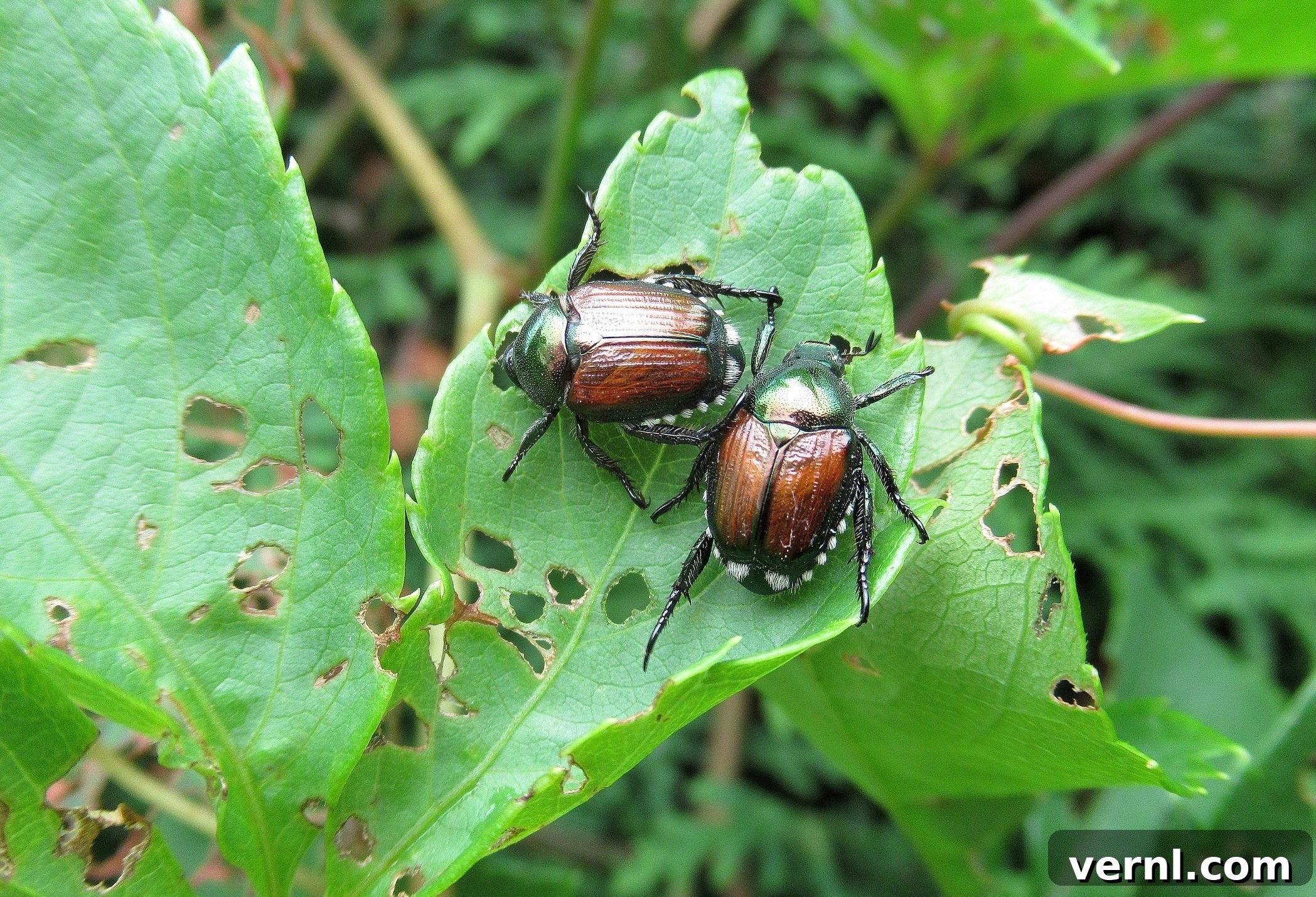
If you’ve ever witnessed the devastating aftermath of a Japanese beetle invasion in your yard or garden, you understand the sheer destruction these pests can inflict. “Japanese beetles are one of the most invasive species that can cause significant damage to plants and turf,” explains John Bell, a board-certified entomologist with Ehrlich Pest Control. Their voracious appetites can quickly turn lush greenery into tattered remains, posing a significant threat to both home gardeners and agricultural landscapes.
This comprehensive guide delves into everything you need to know about Japanese beetles, from their identification and life cycle to effective strategies for control and prevention. By understanding these persistent pests, you can safeguard your beloved plants and maintain a thriving outdoor space.
What Are Japanese Beetles?
The Japanese beetle, scientifically known as Popillia japonica, is a type of scarab beetle that has become an notorious plant pest across North America. Originally native to Japan, this insect was first introduced to the United States in the early 1900s and has since spread widely, establishing itself as a serious threat to agriculture and ornamental plants. The U.S. Department of Agriculture (USDA) recognizes it as one of the most destructive insect pests in the Eastern U.S. Their destructive nature stems from their dual threat: adult beetles defoliate plants above ground, while their larvae (grubs) wreak havoc on plant roots beneath the soil.
How to Identify a Japanese Beetle
Identifying adult Japanese beetles is relatively straightforward, even with the naked eye. Bell describes their distinctive appearance: “The beetles are usually brownish across the back with a black-colored head and legs. There are white spots around the edges of their bodies, and their bodies are shiny and iridescent, usually copper in color with shades of green.” These vibrant, metallic hues make them stand out against plant foliage.
Pro tip for positive identification: Pay close attention to the sides of their bodies. Look for six distinct white tufts of hair along the edges, just underneath their wings. This specific characteristic is a definitive confirmation that you are dealing with Japanese beetles, differentiating them from other similar-looking scarab beetles.
Where Do Japanese Beetles Come From?
As their name suggests, Japanese beetles are indigenous to Japan. They made their unwelcome debut in the U.S. around 1916, first detected in a nursery near Riverton, New Jersey. It is believed they arrived in shipments of iris bulbs, inadvertently transported across the Pacific. The mid-Atlantic region of the United States, with its warm, moist climate, extensive pastureland, and abundant turf grass, provided an exceptionally ideal environment for these foreign invaders to survive and proliferate without any natural predators to keep their populations in check.
Because these beetles had no natural enemies in their new habitat – unlike in Japan where parasitic wasps and flies help regulate their numbers – they were essentially left unchecked. This absence of biological control allowed them to rapidly spread and establish vast populations, leading to the evisceration of large swaths of lawns, nurseries, golf courses, and agricultural fields. While they initially thrived in the Eastern and Southeastern U.S., their adaptability has seen them expand their territory over the last three decades, spreading into Southern and Western states. Their preference for moist environments contributes to robust grub development, but they can adapt to a wide range of soil conditions, making them a widespread threat.
Do Japanese Beetles Bite?
No, Japanese beetles do not bite humans. While they possess mandibles, these mouthparts are designed for chewing plant material, not for breaking human skin. Therefore, of all the problems and damage Japanese beetles inflict on gardens and landscapes, posing a biting threat to humans or pets is thankfully not one of them. You can safely remove them from your plants without fear of being bitten.
Japanese Beetle Life Cycle
Understanding the life cycle of the Japanese beetle is crucial for effective management and control. As entomologist John Bell succinctly states, “Japanese beetles do two things: reproduce and eat vegetation.” Their life cycle typically spans one year, with distinct stages, each presenting different vulnerabilities and requiring specific intervention strategies.
Adult Mating and Egg Laying
The annual cycle begins with the emergence of adult Japanese beetles from the soil, usually occurring in mid-summer (late June to early August, depending on climate). Upon emergence, their primary focus is immediate mating. Female beetles then proceed to lay between 40 to 60 eggs, often in clusters, just beneath the surface of the topsoil. They prefer moist, healthy turf for egg deposition, which provides an ideal environment for the developing grubs. This egg-laying phase typically lasts several weeks, during which the adults also feed heavily on foliage, causing visible damage above ground.
Larva (Grubs)
Approximately 10 to 14 days after being laid, the Japanese beetle eggs hatch into small, white, C-shaped larvae, commonly known as grubs. These grubs immediately burrow deeper into the soil, where they begin their relentless feeding on the roots of various plants, particularly turf grass, but also ornamentals and vegetables. “So right from the start, these beetles are destroying plants,” Bell notes. This grub stage is arguably the most destructive phase of the beetle’s life cycle, as significant root damage can lead to widespread lawn and plant decline. The grubs will continue feeding underground for about 10 months, developing through three instars (growth stages) before overwintering deep in the soil to escape freezing temperatures.
Pupa
As early spring arrives and soil temperatures rise, the overwintered grubs ascend closer to the soil surface. Here, they transform into the pupal stage. During this non-feeding stage, the pupa undergoes a metamorphosis, developing into an adult beetle. This pupal phase typically lasts several weeks. Once fully developed, the mature adult Japanese beetles emerge from the ground, usually in early to mid-summer, restarting the entire cycle of feeding and reproduction. The timing of their emergence is highly dependent on local climate conditions and soil temperatures.
How Japanese Beetles Wreck Yards and Gardens
For roughly six intense weeks during the summer, swarms of adult Japanese beetles descend upon yards and gardens, searching for prime locations to feed and reproduce. Their wide-ranging palate, encompassing hundreds of plant species, makes them a dreaded sight for farmers and backyard gardeners alike. These pests are primed to feast on a delicious smorgasbord of leaves, flowers, foliage, and fruit, causing noticeable and often severe damage.
Signs of a Japanese Beetle Invasion:
- Brown Patches on Turf: This is a tell-tale sign of grub activity. As grubs feed on grass roots, they disrupt the plant’s ability to absorb water and nutrients, leading to irregular brown patches that expand over time. Infested turf often feels spongy underfoot and can even be lifted up like a carpet, revealing the grubs beneath.
- Skeletonized, Lacy Foliage: Adult Japanese beetles are notorious for their feeding pattern, known as skeletonization. They consume the soft tissue between the veins of leaves, leaving behind a delicate, lace-like skeletal structure. This damage reduces the plant’s photosynthetic capacity, weakening it significantly.
- Vegetation That’s Thinned, Yellowed, or Wilted: Plants under stress from either adult feeding or grub damage will exhibit signs of poor health. Leaves may become thin, yellow, or wilted, even with adequate watering, indicating compromised root systems or severe defoliation.
- Increased Presence of Grub-Eating Animals: A sudden increase in animals that prey on grubs can be an indicator of an infestation. Skunks, raccoons, moles, and certain bird species are natural predators of Japanese beetle grubs. If you notice these animals digging in your lawn, they might be feasting on a plentiful supply of grubs.
- Dead Plants: In severe cases of infestation, particularly when plants are repeatedly defoliated by adults and their roots are simultaneously damaged by grubs, plants may succumb entirely and die. Young or stressed plants are especially vulnerable.
- Actual Beetle Sightings: The most direct and undeniable sign of an invasion is the physical presence of adult beetles. Swarms of these iridescent pests on your prized roses, fruit trees, or vegetable plants confirm an active infestation.
How to Get Rid of Japanese Beetles
Effectively managing Japanese beetle infestations requires a multi-faceted approach, as there are no simple “quick fixes.” Scientists with the USDA’s Agricultural Research Service and Animal and Plant Health Inspection Service (APHIS) advocate for an integrated pest management (IPM) program. IPM combines chemical, biological, and cultural strategies to achieve sustainable and effective long-term control, minimizing environmental impact while maximizing results.
Chemical Controls
For homeowners who opt for chemical intervention, precise timing and application are paramount for success and safety. Always consult your state’s agricultural extension office or a local pest control professional for guidance on approved products and application methods in your area, and always read and follow product label instructions carefully. Misuse of pesticides can be harmful to beneficial insects, wildlife, and humans.
For Adult Beetles (Foliar Sprays):
These insecticides are typically applied as foliar sprays to plants that are actively being fed upon. Timing is critical, usually when adults are most active in early to mid-summer. Repeated applications may be necessary due to continuous adult emergence.
- Bifenthrin: A synthetic pyrethroid that offers quick knockdown and residual control.
- Carbaryl: A carbamate insecticide effective against a broad spectrum of insects, including Japanese beetles.
- Cyfluthrin: Another pyrethroid that works as a contact and stomach poison.
- Deltamethrin: A potent pyrethroid insecticide, often used for its effectiveness and residual action.
- Permethrin: A widely available pyrethroid, effective against adult beetles but should be used with caution around flowering plants where pollinators are active.
For Grubs (Soil Treatments):
Grub control products are applied to the soil to target the larval stage. They can be preventative (applied before grubs hatch) or curative (applied when grubs are present). Preventative treatments are generally more effective when applied in late spring to early summer, while curative treatments might be used in late summer or early fall.
- Imidacloprid: A systemic neonicotinoid that provides long-lasting preventative control. It is absorbed by plant roots and makes the plant toxic to feeding grubs.
- Halofenozide: An insect growth regulator that disrupts the molting process of grubs, preventing them from developing into adults. It acts as a preventative.
- Trichlorfon: A curative insecticide that offers quick action against existing grubs. Best applied when grubs are actively feeding in late summer or early fall.
- Chlorantraniliprole: (For professional applicators only) A newer class of insecticide that provides excellent, long-lasting preventative grub control with lower toxicity to non-target organisms.
Note: Even when used properly, insecticides can pose serious hazards to people, pets, and beneficial wildlife, including pollinators like bees. Always follow label directions precisely and consider less toxic alternatives first.
Biological Controls
Biological control methods harness natural enemies or pathogens to manage Japanese beetle populations. While they may take longer to show significant results, they often provide more lasting, environmentally friendly effects and typically do not adversely affect non-target organisms or beneficial insects.
- Parasites: The USDA has approved the use of specific parasitic insects as biological controls.
- Tiphia vernalis: A parasitic wasp that targets Japanese beetle grubs. Females lay eggs on the grubs, and the hatching wasp larvae consume the grubs. Establishing these wasps requires planting specific food sources that attract the adult wasps to your property.
- Istocheta aldrichi: A parasitic fly that targets adult Japanese beetles. The female fly lays its eggs directly on the adult beetle, and the developing fly larva eventually kills the host.
- Beneficial Nematodes: These microscopic, insect-eating parasitic roundworms are natural predators of grubs. Species such as Heterorhabditis bacteriophora and Steinernema carpocapsae actively seek out and infect grubs in the soil, releasing bacteria that kill them. They are safe for plants, humans, and pets, and are most effective when applied to moist soil in the evening or on a cloudy day, when soil temperatures are between 60-90°F (15-32°C).
- Milky Spore Disease (Paenibacillus popilliae): This naturally occurring bacterium specifically targets Japanese beetle grubs. When grubs ingest the spores, they develop a disease that gives them a milky appearance, eventually killing them. Milky spore can provide long-term control over several years once established, though it may take a few seasons to become fully effective and requires specific soil temperatures to thrive.
How to Prevent Japanese Beetle Infestations
Often referred to as habitat manipulation or cultural controls, proactive prevention is a cornerstone of managing Japanese beetles. By making your yard and garden less inviting to these pests, you can significantly reduce the likelihood and severity of future infestations.
- Don’t Plant Their Favorite Foods: Research plants that are highly susceptible to Japanese beetle feeding and consider opting for resistant varieties instead. Japanese beetles have over 300 host plants, but they show strong preferences for certain species like roses, linden trees, Japanese maples, grapes, and hibiscus. Conversely, plants like boxwood, dogwood, lilac, and most conifers are generally less appealing to them.
- Strategic Use of Traps: Pheromone traps designed to entice Japanese beetles can be a double-edged sword. While they attract beetles, they can also draw more pests to your property than they capture. Bell advises placing traps far away (at least 50 feet or more) from ornamental plants or gardens to avoid inadvertently attracting beetles to the very plants you want to protect. They are often best used for monitoring beetle presence rather than as a primary control method for heavy infestations.
- Maintain Healthy Trees and Plants: Healthy plants are more resilient and better equipped to withstand pest attacks. Ensure your trees, shrubs, and garden plants receive adequate water, proper fertilization, and regular pruning. Stressed or poorly nourished plants are often more susceptible to insect damage, making them prime targets for Japanese beetles.
- Pick Fruit as Soon as It’s Ready: Japanese beetles are strongly attracted to the sweet odor of ripe and overripe fruit. Promptly harvesting fruit as it matures, and regularly cleaning up any fallen fruit, can help eliminate a significant attractant for adult beetles in your garden.
- Hand-Picking: For smaller infestations or on highly valued plants, hand-picking beetles can be an effective non-chemical method. The best time to do this is in the early morning when the beetles are less active and more sluggish due due to cooler temperatures or morning dew. Simply knock them off plants into a bucket of soapy water, which will quickly kill them.
- Use Physical Barriers: For particularly vulnerable plants or small garden beds, consider covering them with fine mesh netting or row covers during the peak adult beetle season (late June through August). This physical barrier can prevent beetles from accessing and feeding on the foliage.
- Promote Soil Health: Healthy soil fosters strong root systems, which can help plants recover from grub damage more effectively and be more resilient overall. Incorporating organic matter like compost can improve soil structure and microbial activity.