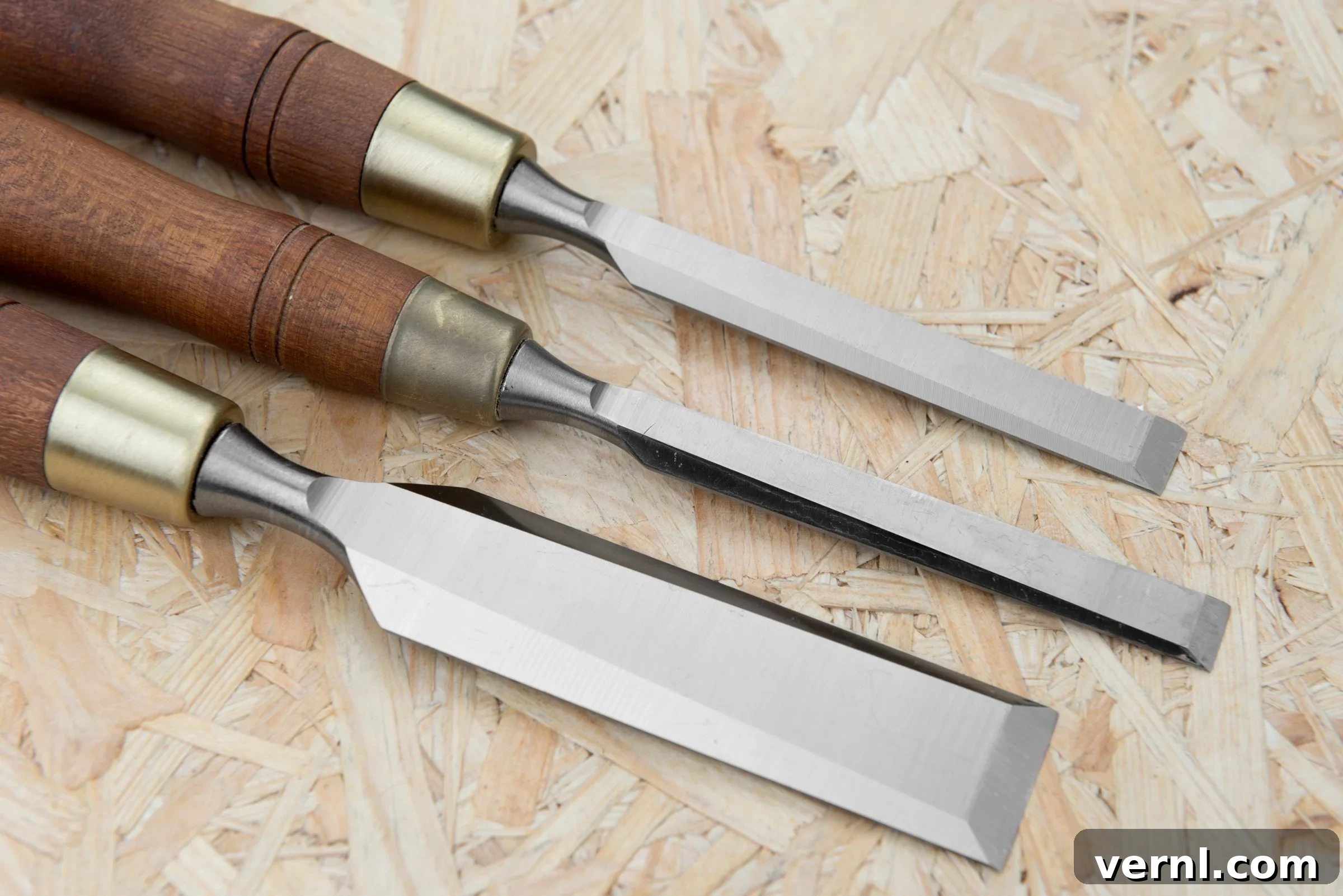
In today’s fast-paced world of woodworking, power tools have undeniably revolutionized many traditional tasks. Carpenters and cabinetmakers now frequently rely on advanced machinery for intricate joinery, precise shaping, and rapid cutting operations that were once exclusively performed by hand. However, this technological shift has certainly not rendered the humble wood chisel obsolete. Far from it, in fact. These foundational hand tools continue to hold an irreplaceable position in the workshop of any serious woodworker, who typically maintains a meticulously curated collection of various chisels, employing them regularly for a multitude of tasks that demand precision, control, and finesse that power tools simply cannot replicate. Even for the general DIY enthusiast, keeping at least one reliable chisel in their toolbox is a common practice, and many will invest in a comprehensive set as their skills and projects evolve.
Speaking from personal experience, the versatility of a good wood chisel is truly remarkable. My own well-worn, yellow-handled chisel, affectionately dubbed ‘Old Yeller,’ has served me faithfully through an incredibly diverse range of projects. It has been instrumental in tasks as varied as carefully separating fused plastic pipes, gently wedging stubborn floorboards into place, and meticulously cutting clean mortises for door hinges. While some of these applications may fall outside the traditional scope of a woodworking chisel – and indeed, some purists might consider them chisel maltreatment – there have been countless occasions where no other tool could perform the job with the same effectiveness or precision. This adaptability underscores the enduring value of a hand chisel, not just as a specialized woodworking instrument, but as a robust and reliable utility tool.
Of course, a tool like ‘Old Yeller,’ having seen such extensive and varied use, would likely not meet the exacting standards of a professional cabinet shop without a significant amount of care and attention. Its edge would need to be meticulously re-sharpened and honed to razor-sharp perfection. This brings us to one of the most remarkable qualities of chisels: their inherent longevity. With proper maintenance, particularly regular sharpening, a high-quality chisel can quite literally last a lifetime, becoming a trusted companion in countless projects and even being passed down through generations. This sustainable aspect makes chisels a truly worthwhile investment for any craftsperson.
What Is a Chisel?
At its core, a wood chisel is an essential hand tool expertly designed for the shaping, cutting, and trimming of wood. It is crucial not to confuse it with a cold chisel, which is a heavier-duty tool primarily used by stone masons or metalworkers for tougher materials. A wood chisel typically comprises two primary components: a robust, elongated blade, usually rectangular in cross-section, which tapers down to a precisely ground, sharp bevel at its working end; and a sturdy handle, traditionally made from wood or, in more modern designs, durable plastic or composite materials. The design of the beveled end can vary significantly, ranging from a perfectly flat, straight edge to a subtly angled or even curved profile, each tailored for specific cutting tasks. The quality of the steel in the blade, often high-carbon steel or chrome vanadium, is paramount to its ability to hold a sharp edge and withstand repeated use.
Using a chisel effectively involves understanding its two fundamental modes of operation. The most common and often most powerful method involves positioning the chisel’s sharp, beveled end precisely on the workpiece and then striking the handle with a mallet. This forceful impact drives the bevel into the wood, allowing for material removal, deep cuts, or the creation of joinery elements like mortises. The type of mallet used typically depends on the force required and the chisel’s handle material, with wood or plastic mallets being common choices to prevent damage to the handle. The other primary method of use, known as paring, involves a much gentler, more controlled approach. Here, the chisel is held at a very low angle relative to the wood surface and pushed by hand. This technique allows the woodworker to shave off incredibly thin, delicate layers of wood, making it ideal for fine-tuning joints, cleaning up surfaces, or achieving highly precise dimensions without the need for impact.
What Does a Chisel Look Like?
Chisels typically vary in overall length, generally falling within a range of six to twelve inches, with the blade and handle usually being roughly equal in proportion. However, the most significant structural difference lies in how the blade is attached to the handle, distinguishing between socket chisels and tang chisels. On a socket chisel, the end of the blade opposite the cutting bevel is forged into a hollow, conical socket. The handle is then firmly inserted into this socket, creating a very strong and durable connection. This design allows for easy replacement of the handle should it become damaged, as the handle simply slips into the socket.
Conversely, a tang chisel features a pointed, often tapered, extension of the blade itself, known as a tang, which is driven and epoxied into a corresponding notch or bore in the handle. While generally less robust than a socket connection under extreme stress, tang chisels are often more streamlined and can feel more balanced in hand for certain tasks. A critical consideration for tang chisels is durability, as excessive force or repeated heavy striking can potentially cause the tang to split the wooden handle. Fortunately, most chisel handles, regardless of the attachment method, are designed to be replaceable, ensuring the longevity of the blade. This also means that a craftsman can often fit a custom handle to a preferred blade, optimizing comfort and balance.
Beyond the internal connection, socket and tang chisels also present distinct external appearances. The socket on a socket chisel often extends partially up the handle, forming a noticeable bolster – a metal sleeve that reinforces the top of the handle, similar to the ferrule on a paintbrush. This bolster provides additional strength and a visual indication of the socket design. Tang chisels, lacking this external socket, do not feature a bolster in the same way. Instead, to prevent the tang from slipping out or the handle from splitting under stress, the top of the handle on a tang chisel may be tightly wrapped with wire, fitted with a metal hoop, or reinforced with a ferrule at its base where the tang enters. These design nuances are not merely aesthetic; they reflect functional differences in how the tools are intended to absorb and distribute impact forces during use, influencing their suitability for different woodworking applications.
What Is a Chisel Used For?
While a general utility chisel, much like my ‘Old Yeller,’ might occasionally be pressed into service for tasks beyond its original design, the chisels found in a dedicated woodworker’s shop are typically chosen for specific purposes and are used with precision and intent. Each type of chisel and technique is optimized for a particular aspect of wood shaping. Understanding these specialized uses unlocks the full potential of these versatile tools.
Shaving or Paring
Paring with a chisel involves removing thin, controlled layers of wood, demanding a high degree of precision and a keen edge. Woodcarvers, for instance, utilize a wide array of chisels and gouges to gradually whittle away material, shaping raw timber into intricate forms and detailed sculptures. These specialized carving chisels are generally smaller, exquisitely sharp, and come in a vast variety of widths, curves, and angles. Some feature complex bevels or profiles that make them resemble finely crafted knives, designed to access tight spaces or create specific textural effects. Beyond carving, woodworkers frequently pare wood to fine-tune dimensions for a myriad of purposes. This might involve reducing the thickness of a tenon to fit perfectly into a mortise, or subtly deepening an existing opening to accommodate a component. Paring is a highly versatile technique that can be executed both with light mallet taps for slightly larger removals or, more commonly, by hand-pressure alone for the utmost control and delicate material removal. The ability to pare allows for the exact fit and finish that is the hallmark of fine woodworking.
Chopping and Splitting
The act of driving a chisel straight down into a piece of wood with the force of a mallet is a fundamental method for significant material removal and creating specific cuts. When you orient the chisel’s edge perpendicular to the wood grain and strike it, you are chopping, a technique often used for rough waste removal. Conversely, when the chisel is aligned parallel to the grain and driven down, you are splitting the wood, leveraging the natural cleavage lines within the timber. These techniques are often employed in conjunction with paring to create precise notches and recesses, most notably the mortises required for installing hinges, locks, and other hardware. The combination of chopping out the bulk of the waste and then paring to refine the edges ensures clean, tight-fitting joinery.
Furthermore, chopping and splitting, meticulously applied, are indispensable for crafting complex joinery such as rabbets (grooves cut along the ends or edges of a board) and dados (grooves cut across the middle of a board). These cuts are crucial for shelves, drawer bottoms, and carcass construction. Another pinnacle of woodworking artistry where these techniques shine is in the creation of robust and aesthetically pleasing dovetail joints and the incredibly strong mortise-and-tenon joints. The accuracy required for these interlocking components makes the controlled removal of wood with a chisel an art form in itself, ensuring structural integrity and a beautiful finished appearance.
Scraping
While often overlooked in favor of sanding, a chisel can also be effectively employed as a powerful scraping tool. By holding the chisel at a very low angle and drawing it across the surface of the wood with firm, consistent pressure, you can efficiently remove the topmost layer. This technique is particularly effective for dislodging stubborn layers of old finish, such as paint or varnish, that might clog sandpaper. It’s also an excellent method for cleaning up dried glue deposits that have squeezed out of joints, or for removing superficial surface stains that haven’t penetrated too deeply into the wood fibers. The scraping action of a sharp chisel leaves a remarkably smooth surface, often superior to what fine-grit sandpaper can achieve, and it avoids the generation of fine dust associated with sanding, making it a clean and efficient preparation method before final finishing.
Types of Chisels
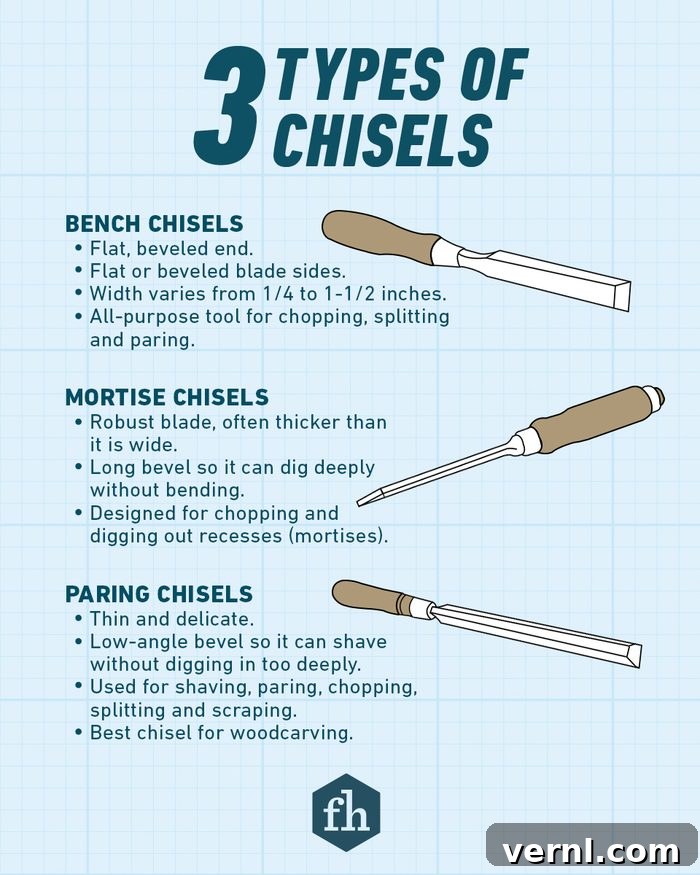
Having been central to woodworking for centuries, chisels have evolved into an astonishingly diverse array of forms, each optimized for specific tasks. While the sheer number of specialized chisels can seem overwhelming, most can be broadly categorized into a few core types, which form the foundation of any comprehensive woodworking chisel collection. Understanding these distinctions is key to selecting the right tool for the job and achieving superior results.
Bench Chisels
Bench chisels are perhaps the most common and versatile type, earning their name because they are almost universally found on a woodworker’s bench. Characterized by their flat, straight-beveled cutting edges, these chisels are true all-rounders. Their widths typically range from a narrow 1/4 inch for fine detail work up to a broad 1-1/2 inches or more for larger material removal. A distinguishing feature of bench chisels lies in the design of their blade sides. Some, known as registered chisels, have straight, parallel sides, making them robust for general work. Others feature beveled sides that taper towards the cutting edge. These “bevel-edged” chisels are incredibly popular because their tapered sides allow them to access and clean out tight corners, such as those found in dovetail joints, where a straight-sided chisel would be too cumbersome. This versatility makes them the primary workhorse for most joinery, paring, and general shaping tasks.
Mortise Chisels
As their name suggests, mortise chisels are purpose-built for the arduous task of cutting mortises – the crucial rectangular holes that house tenons in traditional joinery. These chisels are engineered for robustness and heavy-duty chopping. They feature a significantly thicker and stronger blade than a standard bench chisel, allowing them to absorb the considerable force of repeated mallet strikes without bending or flexing. Their cutting edge is typically ground with a steeply beveled angle, which may or may not terminate in a slight point, designed for aggressive material removal and leveraging out waste wood. The robust construction and steep bevel allow a mortise chisel to efficiently dig deep into the wood, acting like a lever to remove chips and clear out the mortise quickly and effectively. Their sheer mass and strength make them indispensable for creating strong, clean mortise-and-tenon joints, which are hallmarks of durable furniture and frame construction.
Paring Chisels
Paring chisels bear a superficial resemblance to bench chisels, but they are designed for an entirely different approach to material removal: delicate, precise shaving. They are typically thinner, more finely ground, and noticeably longer than their bench chisel counterparts. This increased length provides significantly greater leverage and allows the user to make long, sweeping, controlled cuts. The bevel on a paring chisel is typically ground at a very low angle, often around 20 degrees or even less. This shallow angle is crucial because it allows the chisel to glide along the surface of the wood, removing incredibly thin shavings without the tendency to dig in too deeply or tear the grain. Paring chisels are the preferred choice for fine-tuning the fit of complex joints, cleaning up delicate details, trimming veneers, and any task where absolute precision and minimal material removal are paramount. Their delicate nature means they are almost exclusively used with hand pressure rather than a mallet.
How To Use a Wood Chisel
Mastering the use of a wood chisel hinges on a singular, fundamental principle: maintaining a razor-sharp edge. A dull chisel is not merely inefficient; it’s dangerous, prone to tearing wood fibers, slipping, and requiring excessive force. Therefore, the most important habit to cultivate is to keep your woodworking chisels consistently sharp, a task typically achieved with a grinding stone, sharpening stones (whetstones), or specialized sharpening jigs. When a chisel is truly sharp, it transforms from a struggle into a joy to use. It will effortlessly pare off gossamer-thin layers, dig deeply and cleanly when driven by a mallet, and leave behind edges that are crisp, smooth, and free from unsightly tear-out. This meticulous attention to sharpness is the cornerstone of effective chiseling.
The distinction between “digging” (or chopping) and “paring” with a chisel is primarily a matter of the angle at which you hold the tool relative to the workpiece. For robust material removal, such as creating a mortise, you would typically hold the chisel at a steeper angle, generally exceeding about 30 degrees. This steeper angle allows the chisel’s bevel to act more aggressively, leveraging wood fibers out and facilitating deeper cuts when struck with a mallet. It’s a technique for making quick, substantial inroads into the timber. Conversely, for precise, fine-tuning work, such as shaving a tenon to fit perfectly or cleaning up a joint, you would employ a shallower angle. Holding the chisel at an angle of less than 30 degrees, often as low as 10-20 degrees for paring chisels, allows the tool to glide along the surface, removing only the thinnest of shavings without biting too deep. This controlled approach is essential for achieving the tight tolerances and smooth finishes characteristic of high-quality woodworking.
Beyond the angle, proper body mechanics and safety are paramount. Always ensure your workpiece is securely clamped or held in a vise; never hold wood with one hand while chiseling with the other. When paring, position your body so that the chisel is always moving away from you, preventing accidental slips that could result in injury. For chopping, use your body weight to guide the chisel and mallet, maintaining a stable stance. Pay close attention to the wood grain direction; chiseling with the grain yields cleaner cuts, while working against it can cause splintering. Using a straightedge or marking gauge can help guide your chisel for precise lines and consistent depths. Regular practice, coupled with consistent sharpening, will quickly build your confidence and proficiency with this essential hand tool, unlocking a new level of craftsmanship in your woodworking projects.
Where To Buy Woodworking Chisels
For those embarking on or continuing their woodworking journey, acquiring quality chisels is a crucial step. Fortunately, woodworking chisels are widely available through numerous channels, catering to various budgets and preferences. You can find basic to mid-range sets at large home improvement stores like Lowe’s or Home Depot, which are excellent starting points for DIY enthusiasts. For a broader selection and specialized options, online retailers are an invaluable resource. Major e-commerce platforms like Amazon offer a vast array of brands and types, often with competitive pricing and user reviews. Additionally, specialized woodworking suppliers such as Rockler and industrial supply companies like Grainger provide a more curated selection of high-quality tools, often favored by professional woodworkers for their durability and performance.
However, for many discerning woodworkers, some of the best quality chisels are not found new on a store shelf, but rather discovered in the secondhand market. Vintage chisels often boast superior quality steel, crafted at a time when tool manufacturing emphasized durability and edge retention over mass production. These older tools, with a little restoration and meticulous sharpening, can outperform many modern counterparts. Enthusiasts frequently seek out these hidden gems on online auction sites like eBay, local classifieds platforms such as Craigslist, or at community garage sales, flea markets, and estate sales. When buying used, look for chisels with good steel (even if rusty, it can often be cleaned), intact tangs or sockets, and handles that, even if damaged, are replaceable. Investing time in restoring a vintage chisel can be a rewarding experience, yielding a tool with character, superior performance, and a connection to woodworking history. Whether new or old, the right set of chisels will be a cornerstone of your woodworking success for years to come.