
Led by Ettore Sottsass, Memphis Milano was a distinctive design movement of the 1980s centred on a Milan-based collective of young furniture and product designers who set out to challenge the prevailing notions of modern design. The group deliberately rejected the restrained minimalism and strict functionalism that dominated the late 1970s and instead pursued a more expressive, colourful and often theatrical approach to objects and interiors.
As collector Dennis Zanone has observed, and as I discussed with him in an interview for Obsessionistas in 2011, Memphis Milano emerged as “a reaction to the ‘form follows function’ design thinking of the banal late 70s beige and black and chrome glass that was considered modern at the time.” That reaction produced a bold visual language: asymmetry, exaggerated geometry, unexpected material combinations and a palette that mixed bright primaries with pastels, black-and-white graphics and playful patterns.
In recent years, interest in Memphis design has resurged. Exhibitions and curators have revisited postmodern approaches to form and colour, while contemporary designers and retailers have mined Memphis patterns and motifs for fresh reinterpretations. This renewed attention has highlighted how the movement’s exuberant aesthetic still feels relevant, and how its embrace of ornament, narrative and irony continues to influence product and interior design today.
The Memphis colour palette—bold primaries clashing with pastels or high-contrast black-and-white—has proved especially resonant in contemporary trends. Its combination of high energy and graphic clarity allows pieces to function as focal points in interiors, giving designers and collectors a way to inject personality and theatricality into otherwise restrained spaces. The movement’s willingness to mix unexpected textures and finishes also encourages experimentation with materials and tactile contrast.
Below are several modern designs and exhibitions inspired by Memphis aesthetics that have recently drawn attention. For those interested in the original 1980s pieces, the personal collections and archives of dedicated collectors offer rich documentation and visual reference material that illustrate the movement’s breadth and influence.
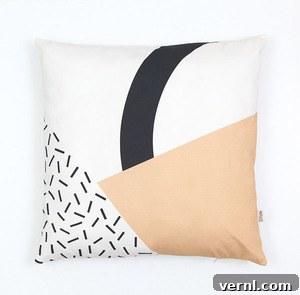
Above: A Memphis-inspired cushion created by an independent maker, showing how graphic prints and bold colour can translate into small, accessible home accessories.
The Curve Chair by Wrong for Hay features a textile designed by Nathalie Du Pasquier, one of the founding members of the original Memphis group. The piece demonstrates how classic Memphis motifs—geometric shapes and lively colour combinations—can be adapted for contemporary seating and textiles without losing their expressive character.
A geometric table in the Memphis style, created by a design duo based in Adelaide, exemplifies how the movement’s vocabulary of angles, contrasting surfaces and playful proportions continues to inspire craft-led furniture design. The result is both sculptural and functional, a hallmark of Memphis thinking.
Darkroom’s exhibition “So Sottsass” celebrated bright, tribal-inspired graphic prints and patterns that echo Sottsass’s sensibilities. Such curated shows underscore how Memphis aesthetics can be expressed in textiles, prints and small decorative objects as much as in large-scale furniture.
A drinks cabinet by a Johannesburg-based husband-and-wife team illustrates how designers around the world have adopted Memphis-inspired colour blocking and surface decoration to create pieces that are both functional storage and striking visual statements.
A table exhibited at a major Scandinavian furniture fair reflects the global reach of Memphis influences: designers in diverse contexts borrow the movement’s bold graphic elements while interpreting them through local materials and manufacturing techniques.
Threshold bookends by a Philadelphia-based designer show how Memphis motifs translate effectively into small-scale objects. These accessible pieces make it easy for people to introduce a touch of postmodern colour and geometry into everyday interiors without committing to large furniture purchases.
Overall, the renewed interest in Memphis Milano speaks to a broader appetite for design that balances function with personality. Its legacy persists in contemporary practices that value narrative, surprise and visual exuberance, proving that the movement’s challenge to conventional modernism still resonates in today’s design landscape.