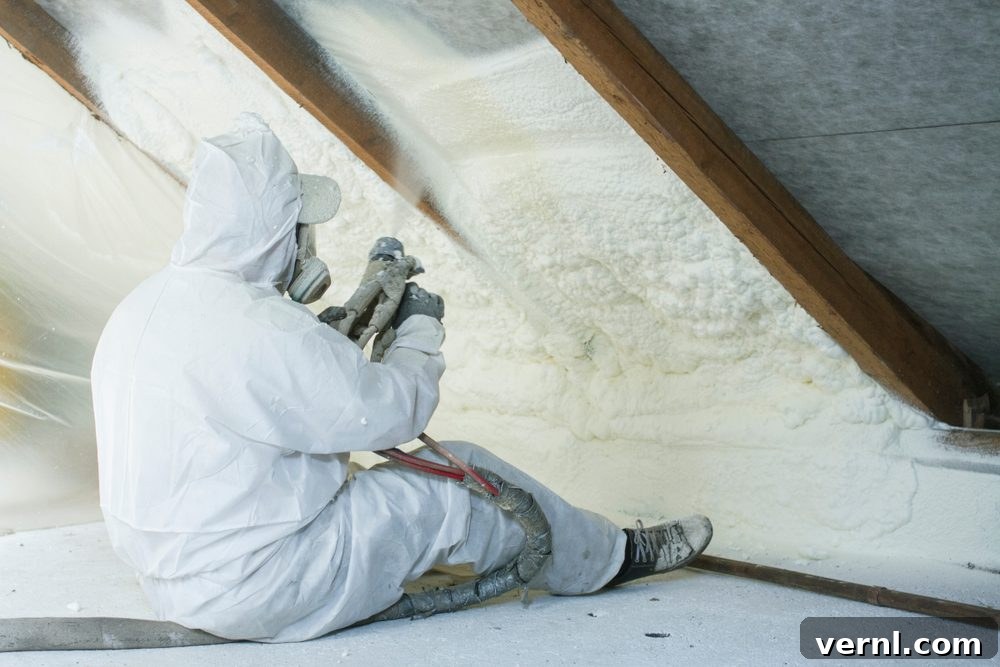
Embarking on a journey to enhance your home’s energy efficiency and comfort often leads to exploring various insulation methods. Among the leading contenders, spray foam insulation stands out as a formidable and highly effective solution. Once you’ve weighed the compelling benefits of spray foam over traditional fiberglass, it becomes evident that this modern approach offers superior performance for virtually any home. Spray foam insulation plays a pivotal role in maintaining consistent indoor temperatures, ensuring your living spaces remain delightfully cool during the sweltering summer months and wonderfully warm throughout the chilly winter season. This remarkable ability to regulate your house temperature translates directly into greater comfort and significant savings on your energy bills.
However, as homeowners begin to delve into the specifics of purchasing and installing spray foam, a common question arises that can initially seem like a small hurdle: “Should I opt for open-cell or closed-cell spray foam?” The answer isn’t always straightforward, as these two distinct types of spray foam, while sharing a common purpose of insulation, are designed with very different properties and applications in mind. Understanding these differences is crucial for making an informed decision that best suits your home’s unique needs and your desired outcomes. The distinction between open-cell and closed-cell primarily lies in their cellular structure, density, R-value, and how they perform once applied to a surface. This comprehensive guide will illuminate the characteristics, advantages, and ideal applications of both types, empowering you to choose the perfect spray foam solution for your insulation project.
Why Choose Spray Foam? Unpacking its Core Advantages
Before we dive into the specifics of open-cell versus closed-cell, let’s reaffirm why spray foam insulation, in general, has become the preferred choice for so many modern homeowners and builders. Its multifaceted benefits extend far beyond just thermal resistance:
- Superior Thermal Performance: Spray foam creates an incredibly effective thermal barrier, significantly reducing heat transfer. This leads to more stable indoor temperatures year-round, lessening the strain on your HVAC system.
- Exceptional Air Sealing: Unlike traditional batt insulation, spray foam expands to fill every crack, crevice, and void, creating a seamless air barrier. This eliminates drafts and prevents unconditioned outside air from infiltrating your home, which is a major contributor to energy loss.
- Moisture and Mold Resistance: By preventing air and moisture infiltration, spray foam insulation helps to control humidity levels within your home. Certain types also act as a formidable barrier against water, drastically reducing the conditions necessary for moisture buildup and the subsequent growth of mold and mildew, thus promoting a healthier indoor environment.
- Enhanced Structural Integrity: Depending on the type, spray foam can actually add racking strength to your walls and roof, making your home more resilient against high winds and structural stress.
- Effective Sound Dampening: The dense and expansive nature of spray foam helps to absorb sound waves, providing excellent sound attenuation. This means a quieter indoor environment, free from external noise pollution and even reducing sound transmission between rooms.
- Longevity and Durability: Once cured, spray foam is a robust material that does not sag, settle, or degrade over time, unlike some traditional insulation types. Its lifespan often matches that of your home, offering a lasting solution with consistent performance.
- Environmental Benefits: By significantly reducing energy consumption, spray foam insulation lowers your home’s carbon footprint, contributing to a more sustainable living environment. Many formulations also use recycled content or renewable resources.
With these overarching advantages in mind, let’s now explore the distinct properties of closed-cell and open-cell spray foams.
What is Closed-Cell Spray Foam? The Powerhouse of Insulation
Closed-cell polyurethane spray foam is often considered the more robust and common of the two types, renowned for its exceptional insulating properties and durability. It earns its “closed-cell” designation from its unique cellular structure: the tiny foam cells are completely enclosed, packed tightly together, and filled with an insulating gas, typically a hydrofluorocarbon (HFC) blowing agent. This dense, rigid structure is the key to its superior performance.
Key Characteristics and Advantages of Closed-Cell Spray Foam:
- Remarkably High R-value: Closed-cell spray foam boasts an impressive R-value, which is the material’s capacity to insulate and resist heat flow. Typically ranging from R-6.0 to R-7.0 per inch, it offers the highest insulating power per unit of thickness among spray foams. This high resistance means you achieve excellent insulation with less material, making it ideal for spaces where depth is limited. The higher the R-value, the greater the insulation and thermal resistance.
- Dense and Rigid Structure: This foam is significantly denser and more rigid than its open-cell counterpart. Once applied and cured, it creates a very hard, almost plastic-like surface. This density contributes to its excellent insulating capabilities and structural benefits.
- Exceptional Moisture and Vapor Barrier: One of the most significant advantages of closed-cell spray foam is its formidable resistance to water. Its tightly packed, impermeable cells prevent water molecules from seeping into the insulation. This makes it an effective moisture barrier and often a vapor retarder, drastically reducing the risk of moisture build-up within your walls and preventing the proliferation of bacterial and mold growth – a critical factor for maintaining a healthy and structurally sound home.
- Structural Enhancement: Due to its density and rigidity, closed-cell spray foam can significantly strengthen the building envelope. When applied to wall cavities or roof decks, it adheres firmly to the framing and sheathing, effectively “gluing” the structure together. This adds racking strength and rigidity, making your home more resistant to external forces like strong winds, which is particularly beneficial in hurricane-prone regions.
- Superior Air Barrier: Its dense nature ensures an outstanding air seal, preventing air leakage more effectively than almost any other insulation material. This complete air seal is crucial for maximizing energy efficiency and maintaining consistent indoor temperatures.
Ideal Applications for Closed-Cell Spray Foam:
Given its robust properties, closed-cell spray foam is the preferred choice for:
- Exterior walls where maximum thermal performance and structural rigidity are desired.
- Unvented attics or roof decks, where it seals the building envelope and prevents heat transfer through the roof.
- Crawl spaces and basements, due to its excellent moisture resistance and ability to protect against ground moisture.
- Commercial buildings and industrial applications requiring stringent temperature control and durability.
- Areas prone to flooding or high humidity, where moisture protection is paramount.
- Poles and foundations where extra rigidity is needed.
What is Open-Cell Spray Foam? Flexibility and Acoustic Comfort
As its name suggests, open-cell spray foam presents a contrast to its closed-cell cousin, primarily in its cellular structure and density. While it shares the fundamental purpose of insulating, its unique characteristics make it suitable for different applications. Open-cell foam cells are not completely enclosed; they are broken and interconnected, creating a soft, flexible, and spongy texture similar to a bath sponge once cured. These open cells are filled with air rather than an insulating gas.
Key Characteristics and Advantages of Open-Cell Spray Foam:
- Moderate R-value: Open-cell spray foam has a lower R-value per inch compared to closed-cell, typically ranging from R-3.6 to R-3.8 per inch. While lower, this is still a highly effective insulation material, particularly when applied in thicker layers. It provides excellent thermal resistance and air sealing capabilities, though not to the same degree as closed-cell in terms of per-inch performance.
- Expansive and Flexible Nature: One of open-cell’s most defining characteristics is its expansive nature. As soon as it’s applied, it expands significantly – often up to 120 times its liquid volume – effectively filling every nook, cranny, and irregular cavity. This makes it the perfect foam for hard-to-reach areas, intricate framing, and older homes with uneven surfaces. Its flexibility also allows it to accommodate structural movement without cracking or delaminating.
- Superior Sound Dampening: The soft, porous, and interconnected cellular structure of open-cell foam is exceptionally effective at absorbing airborne sound waves. This makes it an excellent choice for improving acoustic comfort, reducing noise transmission between rooms, and dampening exterior sounds, creating a quieter and more peaceful indoor environment.
- Permeable to Vapor and Air (to an extent): Unlike closed-cell, open-cell foam is vapor-permeable. This means it can allow some moisture vapor to pass through it. While it still acts as an effective air barrier, it typically does not serve as a true vapor barrier. In certain climates and building assemblies, this “breathability” can be an advantage, allowing the wall assembly to dry out. However, it also means it offers less resistance to bulk water.
- More Cost-Effective: Generally, open-cell spray foam is less expensive per board foot than closed-cell, making it a more budget-friendly option for larger projects where deep cavities allow for thicker applications.
Ideal Applications for Open-Cell Spray Foam:
Open-cell spray foam shines in specific applications where its characteristics are particularly beneficial:
- Interior walls and floor joists for superior soundproofing between rooms or floors.
- Vented attics, where it is typically applied to the attic floor, serving as a thermal and air barrier for the living space below.
- Retrofit projects in existing homes where its expansive nature can fill odd-shaped cavities and hard-to-reach spaces effectively.
- Areas where cost-effectiveness for a substantial thermal barrier and air seal is a primary concern, and a rigid moisture barrier is not strictly required by code or climate.
- Homes in climates where a vapor-permeable insulation might be preferred for managing moisture within wall cavities.
Side-by-Side Comparison: Open-Cell vs. Closed-Cell at a Glance
To help solidify your understanding, here’s a quick comparison of the key attributes of both spray foam types:
- R-value per inch:
- Closed-Cell: R-6.0 to R-7.0+
- Open-Cell: R-3.6 to R-3.8
- Density:
- Closed-Cell: Denser, rigid, solid (1.75 – 2.0 lbs/cu ft)
- Open-Cell: Lighter, soft, spongy (0.4 – 0.5 lbs/cu ft)
- Moisture Resistance:
- Closed-Cell: Excellent moisture barrier/vapor retarder, impermeable to water.
- Open-Cell: Permeable to water vapor, not a moisture barrier.
- Air Sealing:
- Closed-Cell: Excellent air barrier.
- Open-Cell: Excellent air barrier.
- Structural Support:
- Closed-Cell: Adds significant racking strength to structures.
- Open-Cell: Provides minimal structural support.
- Sound Dampening:
- Closed-Cell: Good, but less effective than open-cell due to density.
- Open-Cell: Superior at absorbing airborne sound.
- Expansion during application:
- Closed-Cell: Moderate expansion.
- Open-Cell: Expands significantly (up to 120x), excellent for filling cavities.
- Cost:
- Closed-Cell: Higher initial cost per board foot.
- Open-Cell: More affordable per board foot.
- Ideal Applications:
- Closed-Cell: Exterior walls, unvented attics, basements, crawl spaces, areas needing structural enhancement and water resistance.
- Open-Cell: Interior walls for soundproofing, vented attics (on floor), filling irregular cavities, budget-conscious projects.
Making the Right Choice: Factors to Consider for Your Home
Selecting between open-cell and closed-cell spray foam insulation requires a careful evaluation of several factors unique to your project and home. There isn’t a universally “better” option; rather, the optimal choice depends on your specific needs, budget, and the characteristics of the area being insulated.
- Location and Climate: In humid climates or areas prone to heavy rain and potential flooding, the superior moisture resistance and vapor barrier properties of closed-cell foam might be indispensable for protecting your home’s structure. In drier climates, or where specific building codes allow for “breathing” walls, open-cell might be a viable and cost-effective option.
- Budget: Open-cell foam generally offers a lower upfront cost, making it attractive for larger projects or when budget constraints are a significant factor. However, remember to consider the long-term energy savings and other benefits, as closed-cell’s higher R-value can lead to greater efficiency over time.
- Specific Area to Insulate:
- Exterior Walls & Roof Decks: For maximum thermal performance, structural integrity, and moisture control, closed-cell is often the top choice.
- Interior Walls: If soundproofing is a priority, open-cell foam excels at dampening noise.
- Attics: For unvented attics or insulation directly under the roofline, closed-cell creates an effective thermal and moisture barrier. For vented attics where insulation is applied to the attic floor, open-cell can be a cost-effective solution.
- Crawl Spaces & Basements: Due to potential moisture issues from the ground, closed-cell is typically recommended here for its water resistance.
- Desired Outcome: Are you prioritizing the absolute highest R-value, maximum structural reinforcement, and unparalleled moisture protection? Closed-cell is likely your answer. If your primary goals are excellent air sealing, effective sound dampening, and filling hard-to-reach cavities at a more accessible price point, open-cell could be ideal.
- Building Codes and Regulations: Always consult local building codes. Some regions may have specific requirements for R-value, vapor barriers, or fire ratings that could influence your choice.
The Installation Process: A Professional Endeavor
Regardless of whether you choose open-cell or closed-cell, spray foam insulation is not a DIY project for the faint of heart. The application requires specialized equipment, training, and adherence to safety protocols. Professional installers are equipped to handle the mixing of chemicals, ensure proper safety gear is worn, and apply the foam uniformly and correctly to achieve optimal performance and prevent potential issues. They understand the nuances of expansion rates, curing times, and environmental conditions that affect the foam’s effectiveness.
Conclusion: Investing in a Smarter, More Comfortable Home
In conclusion, the decision between open-cell and closed-cell spray foam boils down to understanding your priorities and the specific demands of your home. Both types offer significant advantages over traditional insulation methods, providing superior air sealing, enhanced energy efficiency, and a more comfortable living environment. Spray foam insulation represents a smart investment in your property’s long-term value, comfort, and sustainability.
If you are looking for the strongest insulation available, one that offers the highest R-value per inch, acts as a formidable moisture barrier, and can even bolster the structural integrity of your home, then closed-cell spray foam is undoubtedly the choice you want to grab. Its dense, rigid nature makes it an ideal solution for critical areas exposed to the elements or requiring robust protection.
Conversely, for projects focused on filling intricate cavities, achieving excellent sound dampening, or working within a tighter budget without sacrificing significant air sealing capabilities, an open-cell foam will do just fine. Its expansive quality and flexible structure make it incredibly versatile for interior applications and spaces where acoustic comfort is paramount.
Ultimately, the best approach is to consult with experienced spray foam insulation professionals. They can assess your home, discuss your specific needs and budget, and recommend the ideal type of spray foam, or even a combination of both (hybrid approach), to create a truly energy-efficient, comfortable, and healthy living space tailored just for you. Invest wisely in your home’s future by choosing the right spray foam insulation.