For centuries, the choice of interior wall covering has profoundly influenced the aesthetics, durability, and structural integrity of homes. At the dawn of the 20th century, plaster held an undisputed reign as the most popular interior wall covering across North America, a position it maintained for several decades. However, the architectural landscape shifted dramatically with the advent of drywall. First introduced in 1916 by United States Gypsum (USG), drywall rapidly emerged as a formidable alternative, eventually supplanting plaster as the go-to material for modern construction. Today, homes featuring plaster walls are largely relics of a bygone era, predominantly those built before 1940.
The widespread adoption of drywall was fueled by a combination of compelling benefits: its significantly lower cost, remarkable ease of installation, and inherent resilience. These advantages became particularly apparent and widely recognized by the home construction industry during the demanding war years and the subsequent post-war housing boom, which necessitated rapid and efficient building methods. In contrast, plastering evolved into a highly specialized trade, making it increasingly challenging to find skilled artisans proficient in this traditional craft.
Yet, despite drywall’s dominance, plaster is experiencing a notable resurgence, often championed for its unique qualities and historical charm. If you find yourself at a crossroads, contemplating the choice between plaster vs drywall for your next project, it’s crucial to understand their distinct characteristics. While general DIYers can readily undertake plaster repairs with some guidance, a full-scale plaster installation demands expert instruction and considerable practice. Although the creation of plaster walls is undoubtedly more labor-intensive and requires greater skill, its enduring advantages—including superior sound insulation, fire resistance, and an unmatched tactile quality—are once again capturing the attention of homeowners and designers seeking a blend of craftsmanship and lasting quality. This renaissance highlights plaster’s unique ability to influence the internal environment of a home, making it a compelling contender for those aspiring to distinctive and high-performance interior finishes.
What is Plaster? Unveiling the Ancient Art of Wall Covering
Plaster stands as one of humanity’s most ancient and enduring building materials, with a history that stretches back into the prehistoric period, predating many other construction techniques. This versatile material is typically created by mixing a binding agent such as lime, gypsum, or even cement with water and sand. The exact composition varies depending on regional availability and desired properties, with gypsum plasters known for their quick setting times and lime plasters celebrated for their breathability and flexibility.
The resulting creamy mixture possesses an exceptional adhesive quality, allowing it to conform and bond seamlessly to virtually any surface it’s applied upon. Whether it’s traditional wood lath, modern metal mesh, rough brick, rugged stone, or even concrete, plaster adheres with remarkable tenacity. Once dry, plaster might exude a velvety, smooth, or subtly textured appearance, but its delicate facade belies its inherent strength. Properly applied plaster walls are renowned for their incredible durability, capable of lasting for generations and withstanding the test of time far beyond many contemporary materials.
Beyond its historical availability and impressive durability, plaster offers another significant advantage: its inherent breathability. This unique property allows plaster walls to absorb excess moisture from the air on humid days, acting as a natural dehumidifier for your home. Conversely, when the air becomes drier, the plaster slowly releases this stored moisture back into the environment, helping to regulate internal humidity levels and creating a more comfortable living space. This natural moisture management contributes to better indoor air quality and can even mitigate issues like mold growth. While working with plaster can be a messy and labor-intensive endeavor, requiring patience and skill, the profound benefits a plaster wall brings to your home’s internal environment and its timeless aesthetic appeal make it a strong contender for discerning homeowners considering their next home improvement project.
What is Drywall? The Backbone of Modern Construction
Often referred to as plasterboard, wallboard, or gypsum board, drywall is the ubiquitous, yet often unsung, hero of contemporary construction. This foundational material forms the walls and ceilings of virtually every modern building, delivering efficiency and versatility. Drywall is ingeniously manufactured by sandwiching a dense core of gypsum plaster between layers of robust, specialized paper. This construction results in a panel that is both sturdy and surprisingly lightweight, designed for easy handling and installation.
Drywall’s primary function is to create smooth, uniform surfaces that serve as a pristine canvas for paint, wallpaper, or other decorative finishes. Its standardized dimensions and consistent quality are a testament to the precision-oriented methods that define today’s construction practices. One of its most celebrated attributes is its workability: drywall is exceptionally easy to cut, shape, and mold to fit various architectural designs and openings, making it a favorite for both professional builders and enthusiastic DIYers alike.
In stark contrast to the often uneven textures inherent in traditional plaster, drywall’s inherent uniformity allows for a perfectly smooth finish that readily accepts a wide array of decorative treatments. It can be painted, wallpapered, or even given various textured finishes to suit contemporary palettes and design trends. Despite its ease of cutting, drywall panels offer significant structural stability once firmly fastened to wall studs. Key drywall benefits that have cemented its status as the favored building material for the better part of the last century include its impressive fire resistance and excellent sound-dampening qualities. Gypsum, being naturally non-combustible, significantly slows the spread of fire, providing crucial safety. Furthermore, the density of drywall panels, especially thicker variants, effectively reduces sound transmission between rooms, contributing to quieter and more private living or working environments.
Plaster vs. Drywall: Key Differences Explored
When it comes to outfitting the interior walls of your home, the decision between plaster and drywall involves understanding fundamental differences in materials, installation, and performance. Each option presents a unique set of characteristics that impact the construction process, long-term durability, and aesthetic outcome.
Construction Methods and Installation Complexity
The installation of plaster and drywall represents two fundamentally different approaches to wall construction, each with its own level of complexity and required skill.
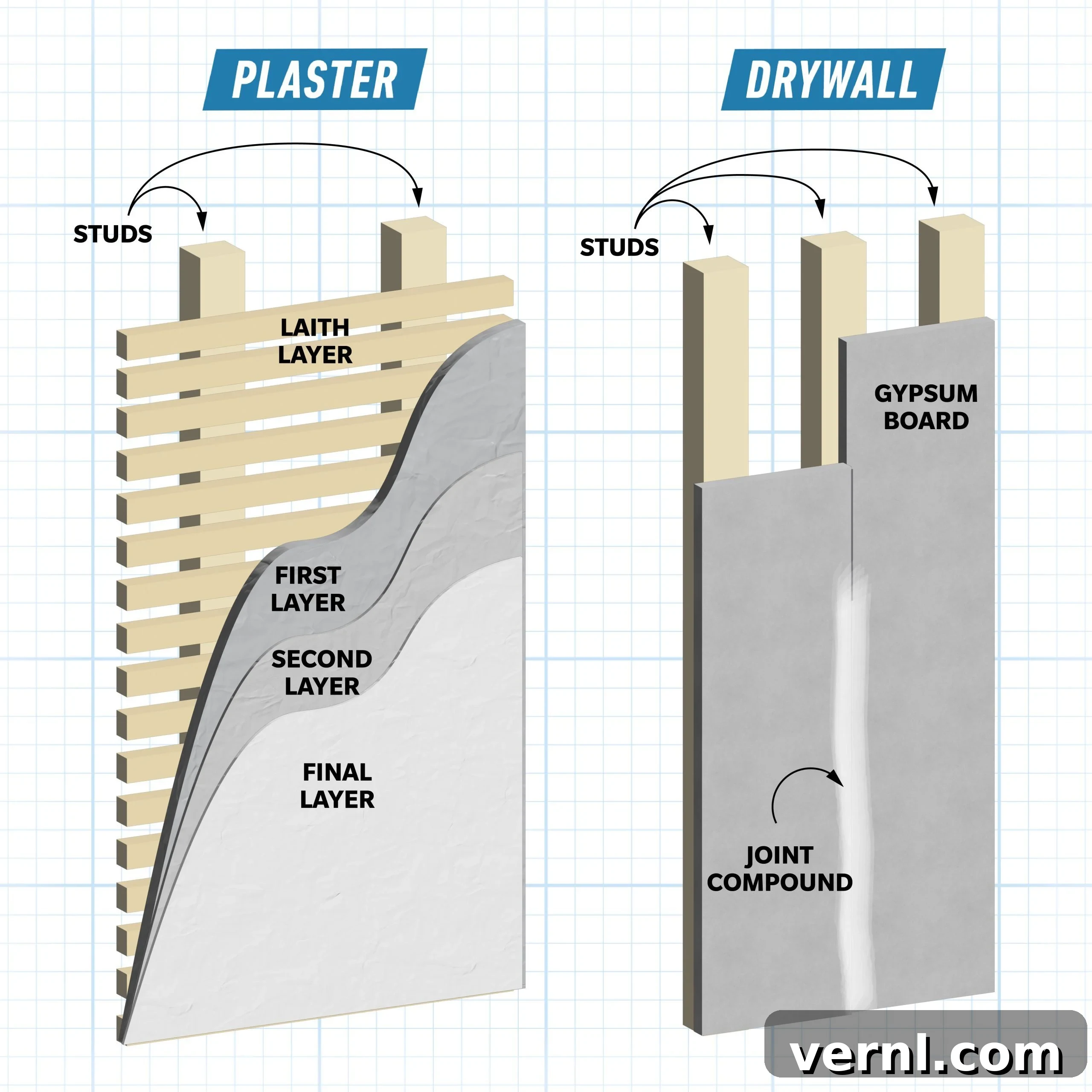
The traditional method of installing a plaster wall is a multi-stage process, demanding significant expertise. It begins with covering the framing studs with a substrate, historically wood lath—thin strips of wood nailed horizontally to the studs with small spaces in between. The first layer, known as the “scratch coat,” is then applied, forcefully pressed into these gaps to create a mechanical bond. This is followed by a “brown coat” (or leveling coat), which builds thickness and provides a flat surface. Finally, two or three more layers of finer plaster are meticulously applied as topcoats to create a smooth, visually seamless, and robust finish. This meticulous layering process is not only crucial for achieving a flawless surface but also significantly contributes to the wall’s insulation and soundproofing capabilities.
Modern plastering techniques often utilize a metal mesh backing instead of traditional wood lath. This metal lath provides an excellent key for the plaster and enhances the overall durability and resilience of the wall, making it more resistant to structural shifts and cracking over time. While the application procedure shares similarities with applying stucco to exterior walls, the interior finish is typically smoother and more refined. The inherent flexibility of plaster, particularly when applied over a suitable lath, allows it to accommodate irregularities in framing, making it an ideal choice for renovating older homes where stud spacing may be inconsistent.
Drywall installation, conversely, is a streamlined and standardized process designed for efficiency. It involves fastening large, pre-fabricated paper-covered sheets of compressed gypsum directly to the wall studs. While nailing is possible, screwing is generally recommended for a more secure and reliable attachment. The primary challenge in drywall installation lies in creating a continuous, seamless surface. This is achieved by applying a plaster-like compound, often referred to as “mud” or more formally as joint compound, to the seams between sheets and over the screw heads. These areas are then taped and feathered with successive layers of mud, followed by sanding to achieve a perfectly smooth transition. This procedure is considerably less time-consuming and requires much less compound than creating a full plaster wall. These simplified and quicker processes represent drywall’s key advantage, enabling faster construction times and significantly mitigating overall project costs.
An important consideration for drywall is the standardized dimensions of its sheets, typically 4- x 8-ft. or 4- x 12-ft. To ensure proper installation and minimize waste, wall studs must be precisely spaced during framing, usually 16 inches on-center, so that the ends of the boards consistently overlap a stud for secure fastening. This strict requirement for stud spacing is not necessary for plastering because the lath, rather than the studs themselves, provides the continuous support for the plaster coating. This flexibility makes plaster a particularly advantageous choice for older homes with irregular or non-standard stud spacing, avoiding the need for extensive reframing. Furthermore, for projects where intricate architectural detail and bespoke design are paramount, plaster offers unparalleled craftsmanship and character, capable of creating curved walls, decorative moldings, and unique textures that drywall struggles to replicate without extensive modification.
Pros and Cons: A Comparative Analysis
Deciding between plaster and drywall means weighing their respective advantages and disadvantages against your project’s specific needs, budget, and aesthetic goals.
Plaster Wall Advantages
- Superior Sound Insulation: The dense, multi-layered construction of plaster over wood or metal lath creates a highly effective barrier against noise. This inherent mass and solidity provide significantly better sound insulation compared to standard drywall, making plaster an excellent choice for quiet living spaces, bedrooms, or areas where noise reduction is a priority.
- Enhanced Fire Resistance: Plaster, especially when applied over metal lath, offers greater fire resistance than typical drywall. The non-combustible nature of gypsum and lime, combined with the multiple thick layers, slows the spread of flames and can offer crucial extra minutes in an emergency. For added safety, specialized fire-retardant coatings can also be incorporated.
- Flexibility for Curves and Unique Designs: Plaster’s pliable nature during application makes it far more contour-friendly than rigid drywall sheets. This allows it to be easily applied to curved walls, arches, and other intricate architectural features, enabling custom designs and historical accuracy that are challenging and costly to achieve with drywall.
- Authentic Aesthetic and Durability: The unique texture and inherent depth of plaster are highly desirable in historic homes or those seeking an old-world design aesthetic. Plaster walls are incredibly durable and resistant to dents and impacts, often lasting for centuries when properly maintained, offering a timeless quality that few other materials can match.
- Improved Indoor Air Quality: As a breathable material, plaster naturally regulates humidity by absorbing and releasing moisture. This can contribute to a healthier indoor environment, reducing the likelihood of mold and mildew growth and improving overall air quality compared to less permeable wall surfaces.
Plaster Wall Disadvantages
- High Skill and Labor Requirements: One of the main downsides of plaster is the significant extra effort, specialized skill, and time needed for installation. It is a labor-intensive process that requires multiple coats, careful drying times, and a practiced hand, making it less suitable for novice DIYers.
- Brittleness and Cracking: Despite its overall durability, plaster can be brittle and is more prone to developing hairline cracks than drywall when a home settles or experiences significant structural movement. These cracks, while often superficial, require specialized repair techniques.
- Difficulty with Repairs and Upgrades: Making cut-outs or extensive repairs in existing plaster walls for plumbing, electrical upgrades, or new installations is considerably more difficult and messier. The material’s hardness and thickness mean that opening up walls is a dusty, time-consuming process that often requires specialized tools and can be challenging to patch seamlessly.
- Potential for WiFi Signal Blockage: Because plaster walls are typically much thicker and denser than drywall, they can sometimes interfere with and block WiFi signals, potentially affecting wireless connectivity in larger homes or those with many plaster walls.
- Higher Weight: Plaster walls are significantly heavier than drywall walls, which can add substantial load to a building’s framing and foundation, a factor that must be considered during initial construction or major renovations.
Drywall Benefits
- Smooth, Versatile Finish: Drywall, when properly finished with joint compound and sanding, creates a perfectly smooth surface. This provides an ideal canvas that can be painted, wallpapered, or even textured using various techniques to add a texture, if desired, adapting to any interior design style.
- Cost-Effectiveness: Drywall is significantly cheaper to install than plaster, primarily due to lower material costs and drastically reduced labor time. This makes it the more economical choice for large-scale projects or budget-conscious renovations.
- Ease of Installation and Repair: Drywall is relatively easy for DIYers and professionals to install. Panels can be quickly cut and fastened, and future modifications or repairs are straightforward. It’s simple to cut holes in drywall for electrical work or plumbing, and patching these holes is a comparatively easy process.
- Thermal Insulation Properties: While both materials offer some insulation, drywall, especially certain types like insulated drywall, can have a slight edge over traditional plaster in thermal insulation, contributing to energy efficiency.
- Simplicity in Hanging Items: Hanging pictures, shelves, or other wall decor is generally easier on drywall due to the availability of a wide range of anchors and fasteners specifically designed for its gypsum core.
Drywall Disadvantages
- Weight and Handling Challenges: While individual sheets might seem manageable, drywall sheets are heavy and cumbersome, often requiring at least two people for installation, particularly for ceilings or upper wall sections. Special equipment, such as drywall jacks, is frequently needed to lift and position sheets before fastening.
- Susceptibility to Moisture Damage: Drywall is highly susceptible to water damage. Exposure to moisture can cause it to swell, crumble, and become a breeding ground for mold and mildew. This necessitates careful storage in dry conditions and makes it unsuitable for consistently wet environments without specialized moisture-resistant variants.
- Less Durable Against Impact: Compared to solid plaster, standard drywall is more prone to dents, dings, and holes from impacts, which can be a concern in high-traffic areas or homes with active children and pets.
- Dusty Installation and Finishing: The installation process, particularly the sanding phase of joint compound, generates a significant amount of fine dust, requiring thorough cleanup and proper ventilation.
Cost of Plaster vs. Drywall: A Financial Comparison
The financial implications are often a pivotal factor in the choice between plaster and drywall. While both incur material and labor costs, the ratio and total expenditure differ significantly, with plaster generally being the more expensive option.
Skilled plasterers, who are increasingly difficult to find, command premium prices for their specialized expertise. When installing plaster, the ratio of labor costs to material costs is heavily skewed towards labor, often accounting for as much as 70 to 90 percent of the overall project expense. This is due to the labor-intensive nature of multi-coat application, the extended drying times, and the high level of craftsmanship required to achieve a flawless finish.
In contrast, for a typical drywall job, labor accounts for a more moderate 35 to 60 percent of the total cost. The standardized sheets, quicker installation techniques, and simpler finishing process contribute to this lower labor share.
According to 2025 data from Home Advisor, the cost difference is stark. A typical drywall installation might range between $1 and $3 per square foot, making it an economically attractive option for most homeowners and builders. However, a plastering job can cost substantially more, ranging from $2 to $10 per square foot, and even higher for intricate designs or specialized finishes. This cost disparity underscores why drywall became the material of choice for mass construction, while plaster remains a premium option for those prioritizing traditional craftsmanship, unique aesthetics, and long-term durability over initial outlay.
DIY Installation for Plaster vs. Drywall: What to Expect
For homeowners tackling a renovation project that involves stripping walls down to the studs, the choice between installing drywall or plaster can be a critical decision, heavily influenced by skill level, available time, and desired outcome.
- Stud Spacing and Structural Flexibility: If your home is older and features irregular or non-standard stud spacing (which is common in pre-1940s construction), plaster offers a significant advantage. You can apply plaster directly over lath without the need for extensive reframing to achieve uniform stud spacing. This is not the case with drywall, which requires precise 16-inch or 24-inch on-center stud placement for secure and seamless panel attachment.
- Skill and Forgiveness: Plastering requires a high degree of skill, patience, and a delicate touch. It’s easy to make mistakes that are difficult to rectify. Unlike conventional drywall mud, which remains workable for a significant period and can be easily sanded once dry, plaster hardens through a chemical reaction, becoming rigid and difficult to sand or rework. While products like corner beads and trim from companies like USG can simplify some aspects, the overall learning curve for a flawless plaster finish is steep.
- Tool Requirements: Beyond installing the lath, which might require a full set of carpentry tools if using wood lath, plastering involves a range of specialized tools for mixing, applying, and finishing multiple coats. While some plastering tools are similar to those used for drywall finishing (trowels, hawks), the techniques differ. For drywall installation, the essential tools are more basic: a utility knife or drywall saw, a T-square for accurate cuts, a measuring tape, and a screw gun for fastening panels.
- Time Commitment: Plastering takes significantly more time than installing and finishing drywall. The multi-coat process, combined with crucial drying times between layers, means a plastering project can extend over several days or even weeks for an entire room. Because plaster sets and becomes unusable relatively quickly once mixed, realistic goals and efficient workflow are paramount. In contrast, for drywall, a skilled DIYer can often apply a coat of tape and joint compound to an entire room in a few hours, especially with time-saving tools like a banjo taper. An unskilled worker might take a day or more just to apply a single coat of plaster to the same room, highlighting the vast difference in project timelines.
Painting Plaster vs. Drywall: Surface Preparation and Priming
The painting process for plaster and drywall differs considerably due to their distinct material compositions and surface porosities. Understanding these differences is key to achieving a durable and aesthetically pleasing finish.
Painting Plaster Walls
Plaster is inherently more porous than drywall, meaning it will absorb paint more readily, potentially leading to an uneven finish or requiring multiple coats. Furthermore, the lime content found in many traditional plasters can be highly alkaline, which can react with certain paints, causing stains to bleed through the topcoat over time.
To effectively prepare plaster walls for painting, a stain-blocking primer is essential—preferably an oil-based formula. Oil-based primers are excellent at sealing the porous surface, preventing alkalinity from affecting the topcoat, and blocking any potential stains or discoloration from showing through. If the plaster is old and exhibits minor hairline cracks, these can often be addressed with a flexible, paintable caulk before priming. Once the chosen primer has thoroughly dried and cured according to manufacturer instructions, you can then apply any topcoat that is compatible with that specific primer, ensuring proper adhesion and longevity.
Painting Drywall
Drywall surfaces, particularly the paper facings and joint compound, require a different approach. Drywall primers are typically water-based and contain PVA (polyvinyl acetate) adhesives. These primers are designed to seal the surface evenly, create a uniform absorption rate for the topcoat, and enhance adhesion, preventing the paint from soaking in unevenly and causing “flashing” (areas where the paint appears duller or shinier due to differential absorption).
PVA primers for drywall are generally inexpensive and emit fewer volatile organic compounds (VOCs) compared to some oil-based alternatives, making them a more environmentally friendly option for interior use. After the drywall primer has dried completely, you have the flexibility to apply virtually any compatible water-based (latex) or oil-based topcoat, depending on your desired finish, durability requirements, and specific paint product. The key is to ensure the primer provides a consistent, sealed base for the subsequent paint layers.
Hanging Things on Plaster vs. Drywall: Secure Fastening Techniques
Hanging artwork, shelves, or other fixtures securely on walls requires different approaches depending on whether you have plaster or drywall. The internal structure and material properties dictate the most effective and safest fastening methods.
For drywall, most of the handy hanging implements available today are specifically designed for its gypsum core. Self-drilling screw anchors, conical plastic anchors, and various toggle bolts are widely used. For lighter items, a simple picture hook can suffice. If you need to hang something heavy, the most secure method is to drive a screw or nail directly into a wooden stud behind the drywall. When a stud isn’t accessible, a toggle bolt that anchors itself to the back of the drywall sheet provides excellent holding power by distributing the weight over a larger surface area.
Plaster walls, due to their brittle nature, present a different set of challenges. You cannot simply hammer nails into plaster as this will almost certainly cause cracking and damage to the surrounding area. For hanging heavy items on plaster walls, the best approach is to locate a stud and drive a screw long enough to sink securely into the lath behind the plaster, or directly into the wooden stud itself. If no stud is available, toggle bolts can be an option, particularly in plaster walls with a metal lath backing. However, extreme care must be taken when drilling the pilot holes for these fasteners to avoid cracking or spalling the plaster. Using a masonry drill bit and drilling slowly can help mitigate this risk. For lighter items, specialized plaster hooks that distribute weight across the surface can be used, but always test their stability before relying on them.
FAQ: Your Top Questions About Plaster vs. Drywall Answered
Is plaster more durable than drywall?
Yes, plaster is indeed significantly more durable than standard drywall. Its multi-layered, dense composition makes it exceptionally resistant to dents, impacts, and other forms of wear and tear that can easily damage drywall. Plaster walls are known for their longevity, often lasting for centuries, making them an excellent choice if your primary concern is enduring structural integrity and a robust finish that stands the test of time.
What is the cost difference between plaster vs. drywall?
Plaster is generally significantly pricier than drywall. While standard drywall installation typically costs between $1 and $3 per square foot (including materials and labor), plaster can range from $2 to $10 per square foot, and even higher for specialized finishes. A major factor contributing to this expense is labor, as plastering requires highly skilled artisans and a much more time-consuming, multi-stage application process, meaning labor often accounts for 70-90% of the total cost compared to 35-60% for drywall.
Which is better for older homes, plaster or drywall?
Plaster is often considered better suited for older homes due to its inherent adaptability and historical authenticity. It can accommodate the irregular stud spacing and unique architectural features common in older structures without requiring extensive reframing. Furthermore, plaster helps preserve the original aesthetic and tactile quality of historic interiors, maintaining the home’s character and charm in a way that modern drywall often struggles to replicate.
Can drywall replicate the look of plaster?
While drywall can mimic some surface characteristics of plaster through the application of joint compound and various decorative textures (like Venetian plaster techniques or skip trowel finishes), it generally doesn’t match the artisanal quality, inherent depth, or nuanced textures of genuine plaster. The unique, subtle imperfections and solid feel of true plaster, especially in intricate designs or curved applications, are difficult for drywall to replicate convincingly without considerable additional effort and specialized finishes. Drywall can provide a “look,” but often lacks the authentic feel and long-term durability of plaster.
Sources
- Plastering History: A Look At Plastering Across the Ages
- Home Advisor: “How Much Does Plastering Walls Cost in 2025?”
- National Gypsum: “Drywall Glossary: Important terms to know”
- Science Direct: “Gypsum Plaster”