
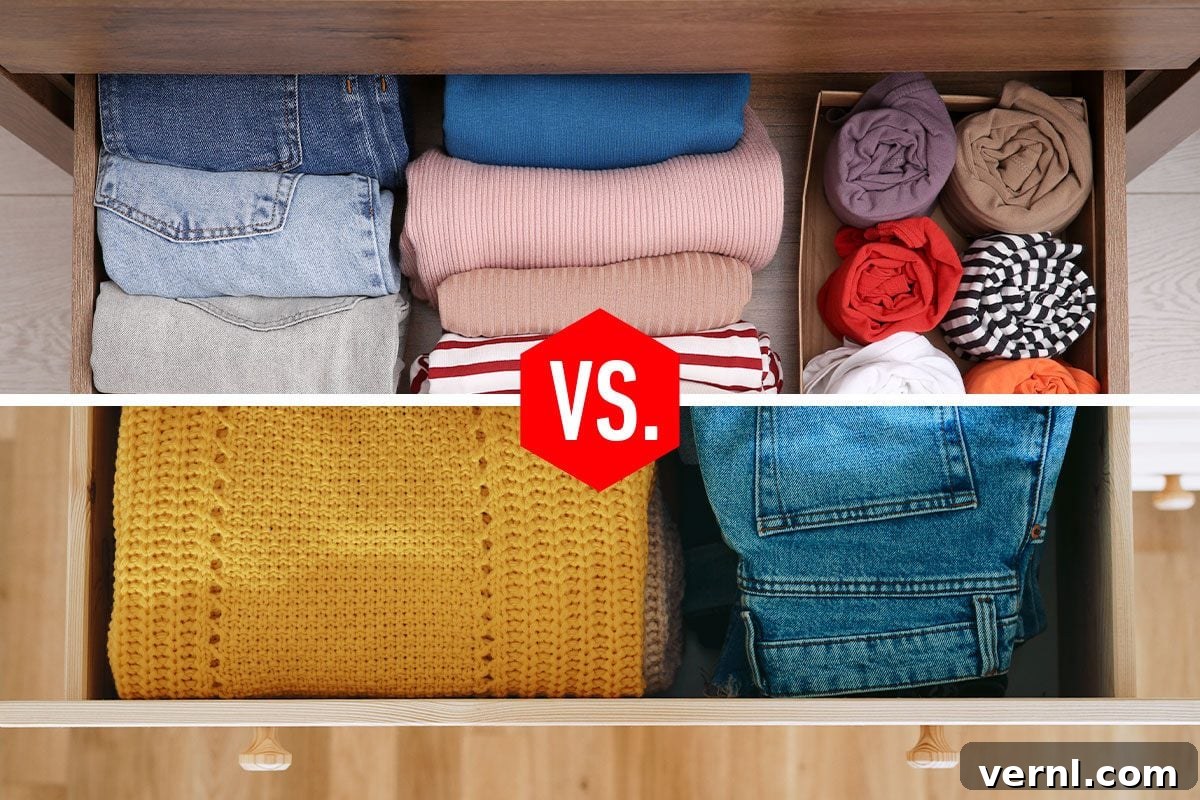
The Ultimate Guide: Rolling vs. Folding Clothes for Optimal Organization and Travel
For decades, a spirited debate has permeated the realms of travel and home organization: is it better to roll your clothes or fold them? The quest for maximizing suitcase space, preventing dreaded wrinkles, and maintaining an orderly wardrobe has led many to pick a side. While many seasoned travelers swear by the rolling method, especially when paired with innovative space-saving packing cubes, the applicability of this hack beyond a vacation suitcase often remains a mystery. Is rolling just for the road, or can it transform your everyday drawers and seasonal storage solutions too?
“The roll vs. fold debate has been going on for a long time, and for good reason,” says Darla DeMorrow, a Certified Professional Organizer and owner of HeartWork Organizing. “But the type of organization you prefer won’t magically change the dimensions of your drawers or how much stuff you can realistically put in them. As good as we are, even we professional organizers can’t bend the laws of physics!” This fundamental truth means that while methods can optimize space, they cannot create it from thin air. The real challenge lies in finding the most efficient technique that aligns with your specific needs, the type of clothing you own, and the storage environment.
To definitively address this age-old question, we consulted leading professional organizers Darla DeMorrow and Brenda Scott. They share their invaluable insights on the pros and cons of rolling versus folding across various scenarios, helping you make informed decisions for a more organized life.
Maximizing Space: The Great Roll vs. Fold Debate Across Different Scenarios
The core promise of both rolling and folding is efficient space utilization. However, our experts emphasize that the most effective method is highly contextual, depending on the specific space, the type of garment, and the purpose of the storage. Let’s explore their recommendations for common organizational challenges.
Organizing Everyday Clothes in Dressers and Drawers
When it comes to daily wardrobe management in a bedroom dresser, the choice between rolling and folding isn’t always clear-cut. Brenda Scott, a professional home organizer and declutter expert from Tidy My Space, suggests that the efficacy hinges on the clothing item’s bulkiness and size. “Folding generally saves more space for bulkier items. Children’s smaller clothing can be easily rolled or folded, but adult-sized t-shirts or jeans often benefit more from careful folding to create flatter, more uniform stacks,” she explains.
Darla DeMorrow offers a nuanced perspective based on drawer depth. “If you have very shallow drawers, rolling can be a game-changer. It helps you keep everything visible at a glance, arranged in a single, accessible layer, much like a file system,” DeMorrow notes. This approach prevents items from getting lost at the bottom of a stack and encourages a ‘grab-and-go’ efficiency. However, she cautions that “deeper drawers may not work as well for rolling lightweight and mid-weight fabrics, as they can unroll or collapse, leading to a messy appearance and reduced visibility.” For deeper drawers, a combination of folding or specific vertical folding techniques (similar to the KonMari method) might be more practical, allowing you to utilize the full depth without losing track of items.
Consider the fabric and structure of the garment too. Stiffer fabrics like denim jeans hold their folded shape well, creating compact blocks. Softer, stretchier fabrics like knit tops or activewear might benefit from rolling if the roll can be kept tight and secure, preventing it from unraveling. For items like socks and underwear, rolling them into small bundles or using drawer dividers alongside folding can be incredibly efficient, creating a neat grid system that maximizes every inch.
Putting Clothes Away for Seasonal Storage
Seasonal clothing storage presents a unique set of considerations, primarily focused on long-term preservation and maximizing space in less frequently accessed areas. On this front, Brenda Scott firmly advocates for folding. “You are likely to wash all your garments before wearing them next season anyway,” she points out, suggesting that temporary creases from folding are less of a concern. The priority here is to fit as many items as possible into your under-bed storage or bins or containers.
DeMorrow, conversely, maintains an indifferent stance for most garments in seasonal storage. “Pack them away however they fit best,” she advises. The rationale is practical: “For all but a very few delicate garments, like elaborate ballgowns or meticulously tailored tuxedos, a simple wash-and-dry cycle (or even just a quick fluff cycle in the dryer) will effectively remove any storage wrinkles that might have formed.” The true challenge in seasonal storage is often dealing with bulk. Items like winter coats, chunky sweaters, and blankets consume significant volume. Here, folding combined with vacuum-seal bags can drastically reduce their footprint, creating impressive space savings within your storage containers.
Packing for a Trip: The Traveler’s Choice
Travel is arguably where the rolling method gains the most traction and passionate advocates. Darla DeMorrow, a frequent traveler, explains her preference: “I prefer rolling, not because it completely eliminates wrinkles (it doesn’t, contrary to popular belief), but because rolling a day’s worth of travel clothes into a tight, self-contained package can make staying organized infinitely easier on the road.” This approach allows for quick identification of outfits and prevents the ‘rummaging effect’ in a suitcase.
Brenda Scott echoes this sentiment, endorsing rolling clothes for travel packing primarily because it “saves space, and items can often be rolled together, creating compact bundles.” This bundling technique is particularly effective for maximizing the capacity of luggage, especially when using packing cubes. Beyond space, rolling offers a significant organizational benefit. If you arrive at your destination and don’t have time or inclination to fully unpack, rolled clothes provide a quick, visual overview of your wardrobe choices directly from your suitcase, eliminating the need to pull everything out and then repack it.
For those aiming for a truly wrinkle-free travel experience, a combination of rolling, selecting wrinkle-resistant fabrics, and smart garment folding (like the “bundle wrapping” method where clothes are wrapped around a central core) can be employed. However, for most casual or business travelers, rolling provides an excellent balance of space efficiency and accessibility.
Packing for a House Move: A Large-Scale Organizational Challenge
When faced with the monumental task of packing up all your clothes for a move, the rules shift dramatically. Brenda Scott recommends folding clothes and utilizing vacuum bags to reduce the overall volume. “You can get significantly more into a moving box if the air is removed from bulky items. This is especially true for sweaters, parkas, bedding, and towels, which are primarily air,” she advises. This strategy doesn’t just save space; it can also reduce the number of moving boxes needed, thereby saving on moving costs and effort.
Darla DeMorrow provides practical advice tailored to the distance of the move. “For short-haul moves, you often have the luxury of keeping folded clothes inside dresser drawers and simply moving the entire dresser,” she says. This minimizes handling and repacking. “If that’s not an option, and certainly for long-haul moves, it’s best to place your clothing in moving boxes in neat, flat layers. Separate layers that belong in different drawers with a towel or packing paper to keep them identifiable and prevent shifting.” This layered approach ensures that clothes arrive in a relatively organized state, simplifying the unpacking process at your new home.
Preserving Garments: Which Method is Kinder to Your Clothes?
A persistent myth surrounding the roll vs. fold debate is the idea that rolling inherently prevents wrinkles. Our experts challenge this notion, offering a more realistic perspective on garment preservation.
“Wrinkles happen,” states Darla DeMorrow candidly. “The idea that rolled clothes miraculously don’t wrinkle is frankly ridiculous. What does change, though, is where you put the creases and whether you create excessive pressure on flat folded items by stacking more folded items heavily on top of them.” She explains, “If you flat-fold garments and then store them in tall stacks, the continuous weight of the other garments over time will inevitably cause sharp, noticeable creases along the fold lines.”
However, DeMorrow quickly clarifies that rolling isn’t a guaranteed panacea either. “If you convert a packed drawer full of t-shirts from folded to rolled, but then you tightly crush those rolls from the front to the back of the drawer, you’ll still end up with wrinkles, albeit perhaps in different places,” she warns. “Remember, there’s no new space created in that drawer without first editing out some items or rethinking your storage approach.” The key takeaway here is that excessive pressure, whether from stacking or crushing, is the primary culprit behind wrinkles, regardless of the initial folding or rolling method.
Brenda Scott does note an exception for certain delicate fabrics. “I prefer rolling slinky fabrics, like satin, silk, or certain delicate synthetics,” she says. “Rolling will often reduce the sharp, hard-to-remove wrinkles that traditional folding may cause in these materials. The curved nature of a roll creates softer creases, which are less noticeable.” She stresses the importance of proper technique: “Even when rolling, you need to ensure the garment is as smooth and flat as possible before you begin. Rolling doesn’t mean crumbling it up into a ball!” A careful, smooth roll minimizes friction and prevents harsh lines.
Beyond wrinkles, the long-term health of your clothes also depends on proper storage. Both rolling and folding should aim to minimize stress on fabric fibers. For valuable or very delicate items, hanging them in breathable garment bags or storing them flat with acid-free tissue paper might be preferable to either rolling or tight folding. Ultimately, the best method preserves the garment’s shape and integrity while optimizing for the storage space available.
Beyond Technique: The Role of Personal Preference and Practicality
After dissecting the technical merits of rolling and folding, it becomes evident that the “best” method often boils down to individual habits, preferences, and the practical realities of your life. The author recounts a personal anecdote: an attempt to implement a rolling system for her daughter’s shirts and pants, which was swiftly undone by a well-meaning mother-in-law who preferred folding. This highlights that organization isn’t just about efficiency; it’s also about sustainability within a household.
Brenda Scott confirms this, stating that the choice is as much a matter of personal preference as anything else. She identifies several contributing factors: “hand dexterity, mental capability to solve the folding puzzle for different items, the time you allocate to putting clothes away, and, of course, the specific space available for clothing storage.” If a method is too complex or time-consuming for you to maintain consistently, it’s unlikely to be successful in the long run.
Darla DeMorrow wholeheartedly agrees, positing that the decision between Team Roll and Team Fold is “100% a question of personal preference. Well, perhaps 95%,” she amends with a smile. “That remaining 5% often comes down to the peculiarities of your storage space. Some drawers are oddly narrow, others frustratingly shallow, and some are just too deep. These spaces need to be optimized for your unique wardrobe and lifestyle. It might take several tries, experimenting with both folded and rolled clothing configurations, to truly maximize the space in your drawers and on your shelves. Don’t stop at the first attempt if you intuitively feel there might be a better way to store your stuff.” This iterative approach—test, refine, re-test—is crucial for sustainable organization.
The beauty of personalized organization is that it allows for hybrid approaches. You might roll t-shirts for visibility in a shallow drawer, fold jeans for stability in a deeper one, and hang delicate blouses. There’s no single dogma to follow, but rather a spectrum of effective strategies.
DeMorrow concludes the roll or fold debate with a brilliant, universally applicable closet storage hack that transcends the folding vs. rolling dilemma: “Maximize all of your hanging space by swapping out a single clothes rod for a double-hang rod.” This simple yet powerful modification is an especially helpful tip for a small closet, where vertical space is often underutilized.
“This is one instance where you literally can double your usable space without having to declutter a single item, though decluttering is always a good first step!” DeMorrow emphasizes. It’s a testament to the idea that sometimes, the solution to organization isn’t about how you fold or roll, but how smartly you design and utilize your storage infrastructure.
Ultimately, the choice between rolling and folding is a personal journey. By understanding the advantages and disadvantages of each method across different contexts, and by being willing to experiment, you can cultivate an organizational system that not only saves space and reduces wrinkles but also brings a sense of calm and efficiency to your daily life. Whether you’re a devout roller, a meticulous folder, or a pragmatic hybrid, the goal remains the same: a functional, accessible, and aesthetically pleasing wardrobe.