
Embarking on DIY projects or professional construction endeavors often requires a foundational understanding of the tools and materials that hold everything together. Among the most fundamental yet frequently misunderstood components are fasteners—specifically, screws and bolts. These ubiquitous elements are essential for creating durable, reliable connections in countless applications, from assembling a simple bookshelf to constructing a robust deck. Yet, despite their widespread use, the subtle distinctions between screws and bolts, and knowing when to use which, can often elude even seasoned enthusiasts.
To demystify these critical fasteners and empower you with the knowledge to make informed choices, we’ve gathered insights from leading industry experts. We consulted with Patrick Holahan, Director of Engineering at Fastenal, a global distributor of industrial and construction supplies, and Drew Mansur, a professional contractor, co-founder, and director of TileCloud. Together, they provide crystal-clear definitions for bolts and screws, elucidate the core differences that set them apart, and offer invaluable practical advice for selecting the perfect fastener to ensure the success and longevity of your next project.
Understanding these distinctions is not just about academic knowledge; it’s about practical application, safety, and efficiency. Using the right fastener can mean the difference between a secure, lasting joint and one prone to failure. Let’s delve into the specifics of each type of fastener individually before drawing clear comparisons.
What Exactly Is a Bolt?
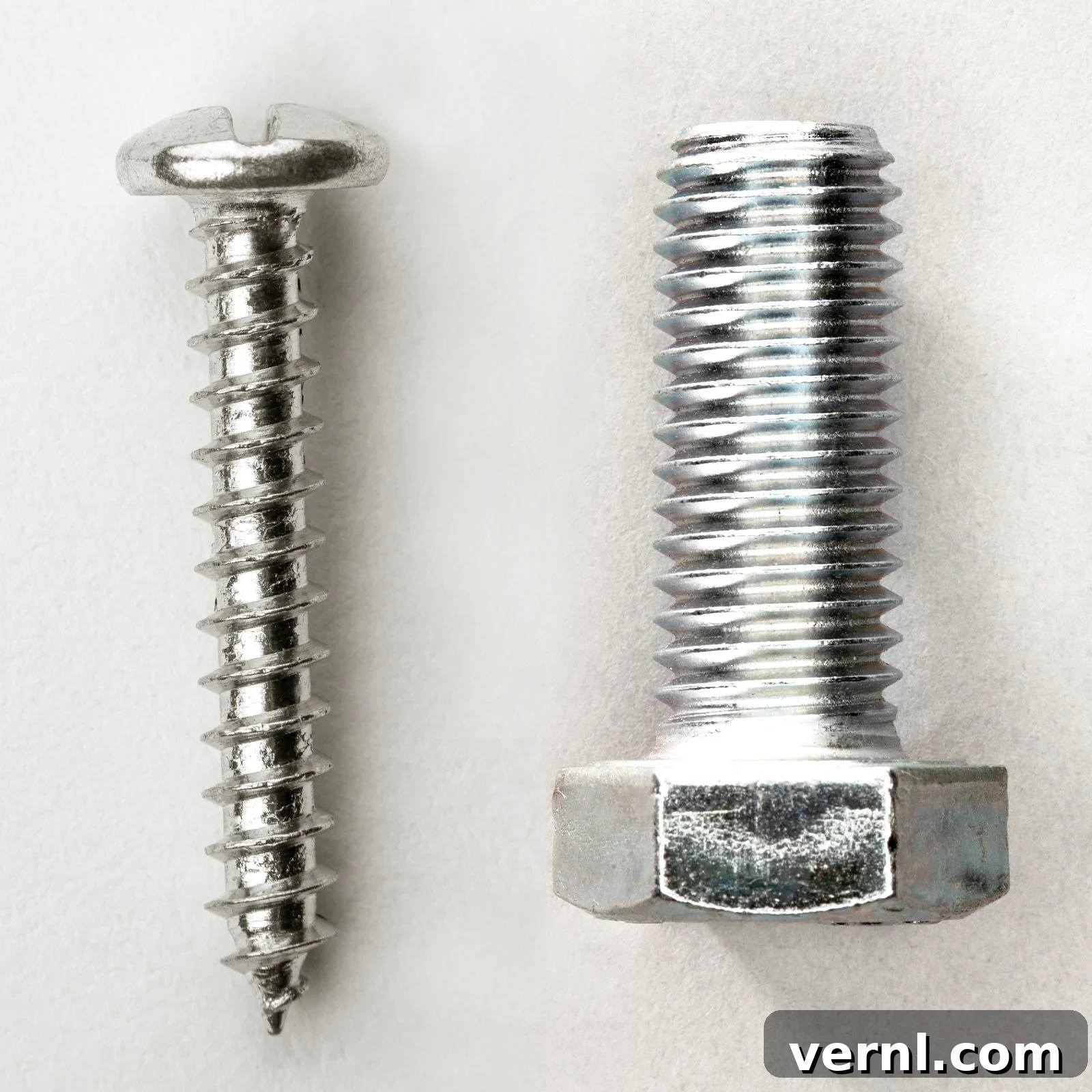
Bolts are essentially non-tapered, externally threaded cylindrical rods, most commonly featuring a hexagonal head, though square or round heads are also prevalent for specific applications. Their primary function is to pass completely through the materials being joined. Unlike screws, bolts do not create their own threads within the material; instead, they rely on external components to achieve tension and secure the joint. The tightening mechanism for a bolt involves attaching a corresponding nut on its far side.
Nuts are typically small, hexagonal components with internal threading designed to perfectly match the external threads of a bolt. For a bolt-and-nut assembly to be effective, the pitch and diameter of the threads on both components must align precisely. This ensures a tight, secure engagement when the nut is tightened onto the bolt.
To grasp the fundamental operation of a bolt, consider a simple analogy: imagine holding a multi-layered hamburger. The various components—buns, patty, and toppings—remain securely stacked because your hands apply equal and opposing pressure from the top and bottom. If you remove one hand, the burger would inevitably fall apart. Similarly, the head of the bolt and the nut function as opposing forces, squeezing the joined materials together to form an incredibly strong and stable connection. This compressive force is what gives bolts their characteristic strength.
As a seasoned construction professional, Drew Mansur frequently employs bolts in scenarios demanding exceptional structural integrity and load-bearing capacity. This includes critical applications such as fastening heavy timber beams, securing steel structures, or anchoring machinery where immense forces are at play.
Patrick Holahan from Fastenal underscores this point, explaining why bolts are often manufactured in higher strength grades compared to screws. “Bolts are engineered to carry significantly larger static and dynamic loads,” he states. “However, their effectiveness is contingent upon the robustness of the materials within the joint itself to adequately handle the applied forces.” (To extend our hamburger analogy: you wouldn’t want to squeeze a fragile cracker too hard between your hands, or it would crumble before it held anything.) This implies that while bolts offer superior strength, the surrounding material must be strong enough to withstand the clamping force without deforming or failing.
What Exactly Is a Screw?
In stark contrast to bolts, screws are characterized by their tapered, externally threaded shanks and do not typically penetrate fully through the joined materials. A defining feature of a screw is that it does not rely on a separate nut for tightening. Instead, the tightening action is achieved by turning the screw head, which rotates the threaded shank. This rotation causes the threads to either engage with an existing pre-threaded hole or, more commonly, to cut and create new, matching threads directly into the material as the screw advances.
This self-threading action establishes a powerful frictional and mechanical interlock between the screw’s threads and the material, generating immense pressure that securely holds the materials together. This elegant simplicity makes screws incredibly versatile and straightforward to use in a vast array of applications, particularly in woodworking, cabinetry, and general assembly tasks.
However, this inherent simplicity comes with certain limitations. As Holahan points out, “The connection strengths of screws are intrinsically limited by the properties of the materials into which they are installed.” If the material is too soft, brittle, or lacks the necessary density to form stable threads, the screw will fail to tighten securely, leading to a weak or compromised joint. A common example is attempting to drive a screw into ordinary drywall without proper backing; the drywall material will simply crumble under the screw’s threads instead of forming a gripping channel. This is why screws driven into drywall require either a structural element like a wood stud behind it or a specialized drywall anchor to provide adequate purchase and holding power.
Screws come in an incredible variety of head types (e.g., Phillips, flat, Torx, Robertson), drive types, and thread patterns, each designed for optimal performance in specific materials and applications. This adaptability makes them a go-to fastener for tasks ranging from delicate electronics to sturdy furniture assembly.
Screws vs. Bolts: Unpacking the Fundamental Differences
Patrick Holahan offers a succinct yet comprehensive distillation of the core distinctions: “To keep it simple, a screw is driven by its head and typically creates its own threads within the material it’s installed into. Conversely, a bolt is designed for heavy-duty applications and inherently requires a nut or a sufficiently strong tapped (pre-threaded) hole to function effectively.” This fundamental difference in how they create and maintain their connection is the key to understanding their respective applications and limitations.
Key Characteristics of Bolts:
- Full Penetration: Bolts are engineered to pass completely through all materials being joined, emerging on the opposite side. This through-hole design is fundamental to their operation.
- Nut Dependent: They explicitly require a separate nut, or a pre-tapped, internally threaded hole of adequate strength, to engage with the bolt’s threads and create the clamping force.
- Pre-Drilled Holes: Installation always necessitates a pre-drilled hole in the joined materials that is slightly larger than the bolt’s diameter, allowing it to pass freely.
- External Force Application: The clamping force is applied externally to the joined materials, with the bolt head on one side and the nut on the other, squeezing the components together.
- Heavy-Duty Applications: Bolts are the preferred choice for applications demanding high strength, resistance to shear forces, and the ability to withstand significant loads, such as in structural framing, heavy machinery, and critical automotive components.
- Flat Ends: The ends of bolts are typically flat, as they are not designed to self-thread into materials but rather to accept a nut.
- High Tensile Strength: Bolts are often specified for their high tensile strength, making them ideal for situations where materials need to be pulled tightly together without fear of stretching or breaking the fastener.
Key Characteristics of Screws:
- Partial Penetration: Screws typically do not fully penetrate all materials being joined. Their grip relies on the threads embedded within the material itself.
- Self-Tightening: They tighten by rotating the screw head, which drives the threads into the material, either forming new threads or engaging with existing ones. No separate nut is required.
- No Pre-Drilled Hole Often: Many types of screws, particularly self-tapping or self-drilling varieties, do not strictly require a pre-drilled hole in the joined materials. However, a pilot hole is frequently recommended or even necessary for certain materials (e.g., hardwood) to prevent splitting, ensure proper alignment, and ease installation.
- Internal Force Application: The holding power comes from the internal engagement of the screw’s threads with the material, creating frictional and mechanical resistance from within the joint.
- Light-to-Medium Duty Applications: Screws are commonly used for a wide range of tasks where moderate holding power is sufficient, including assembling furniture, installing drywall, fastening trim, and securing electrical components.
- Tapered (Pointy) Ends: Most screws feature a tapered or pointed end, which facilitates their initial penetration and aids in the creation of threads as they are driven into the material.
- Shear and Pull-Out Resistance: While they offer good shear strength for many applications, their primary limitation is often their pull-out resistance, which is dictated by the material’s ability to hold the threads.
The Curious Case of the Lag Screw vs. Lag Bolt
In the world of fasteners, there’s almost always an exception that blurs the neatly drawn lines, and Patrick Holahan aptly notes, “Nothing is ever quite universal.” Perhaps the most notable example of this fascinating ambiguity lies in the terms “lag screw” and “lag bolt.” These two names, often used interchangeably, refer to what is essentially the exact same fastener, creating a common point of confusion for DIYers and professionals alike.
Lag bolts (or lag screws) are substantial fasteners characterized by their coarse, aggressive threads, a sharp, tapered point, and most distinctively, a hexagonal head. Their considerable size and robust design make them ideal for joining heavy timbers, securing ledger boards, or fastening components to masonry with appropriate anchors. The hex head is a critical design choice; given the significant torque required to drive these large fasteners into dense materials, a slotted or Phillips head would almost certainly strip out before the screw was fully seated. The hex head provides a much more secure purchase for wrenches or sockets, allowing for maximum driving force.
From a purely technical perspective, the tapered point and the fact that they create their own threads in the material (without the need for a separate nut) firmly place lag fasteners in the “screw” category. However, their visually imposing hex head is a feature more commonly associated with traditional “bolts.” As Drew Mansur clarifies, “So technically, ‘lag screw’ is the correct name from an engineering standpoint, but ‘lag bolt’ is very commonly used and understood, particularly in certain trades or regions.”
The prevalence of one term over the other often depends on geographical location or specific industry jargon. Fortunately, this particular nomenclature discrepancy rarely causes issues on a job site or in a hardware store; most individuals will readily understand what you mean regardless of which term you employ. The key takeaway is to recognize the unique hybrid nature of this robust fastener: it combines the self-threading capability of a screw with the heavy-duty driving mechanism and appearance often found in bolts.
Essential Tips for Choosing the Right Fastener Every Time
Selecting the appropriate fastener is a critical decision that directly impacts the safety, durability, and aesthetic appeal of any project. Drew Mansur advises, “For DIYers and professionals alike, it’s paramount to consider two main factors: the type of material you’re working with and the anticipated load or stress the joint will bear.”
He elaborates, “For demanding, heavy-duty applications—such as securely fixing a deck post to a ledger board or assembling structural elements—bolts are almost always your best bet. Their superior strength and ability to create deep, consistent clamping forces make them indispensable. Conversely, for lighter tasks, like assembling a bookshelf, hanging decorative items, or attaching trim, screws offer an incredibly efficient, versatile, and user-friendly solution.”
Beyond strength and application, Mansur also stresses the importance of material compatibility: “Always match the material of your fastener to your project’s environment. For instance, when working outdoors or in damp conditions, opting for stainless steel or specifically coated fasteners is crucial to prevent rust, corrosion, and premature failure, which can compromise the entire structure.”
Patrick Holahan further expands on these considerations, providing a detailed checklist to guide your fastener selection:
- Head Type and Aesthetics: The head of a fastener plays a significant role in both function and appearance. Do you need the fastener to sit flush with the surface for a smooth finish (e.g., flat-head or countersunk screws)? Is there a particular cosmetic appearance you’re striving for, or do you prefer the fastener to be virtually unnoticeable? Consider options like pan heads, round heads, or trim heads based on visibility and the desired look.
- Strength and Material Compatibility: Assess the required strength. Self-threading fasteners, particularly those designed for metal or harder woods, are often case-hardened to allow them to self-drill or self-tap into a wide range of materials without bending or breaking. Always ensure the fastener’s strength grade is appropriate for the load and the materials being joined.
- Pilot Holes: While many screws are designed to be self-tapping, sometimes a pilot hole is essential. If you want to eliminate the step of pre-drilling pilot holes, consider using self-drilling screws, especially in metal applications. For dense hardwoods or to prevent splitting in softer woods, a pilot hole is almost always a good idea, even for standard wood screws.
- Size: Diameter and Length: The dimensions of your fastener are critical. The diameter impacts the shear strength and the size of the hole required. The length must be sufficient to provide proper holding power, ensuring adequate engagement with the receiving material without being excessively long. Avoid situations where threads are too close to the edge of a board or thin steel sheet; this can drastically reduce holding power and lead to easy failure, as the material can split or tear out.
- Materials and Environmental Exposure: This is paramount for longevity. If your project involves treated lumber (which can be corrosive to standard fasteners) or will be exposed to outdoor elements (moisture, temperature fluctuations, UV light), you must select a fastener with an appropriate protective finish. Options include hot-dip galvanized, stainless steel (304 or 316 for marine environments), ceramic-coated, or specialized polymer-coated fasteners that resist corrosion and chemical reactions.
- Drive Type: Consider the type of driver needed. Phillips head is common but can cam out. Square (Robertson) and Torx (star drive) heads offer superior grip, reducing stripping and making installation easier, especially with power tools. Slotted heads are traditional but offer the weakest grip for driving.
- Removability and Reusability: If the assembly might need to be taken apart in the future, consider fasteners that are easily removable without damage, such as machine screws with nuts, or screws with less aggressive threads.
By carefully considering these factors, you can confidently choose the right screw or bolt, ensuring a strong, lasting, and professional result for any project.
About the Experts
- Drew Mansur holds a degree in construction management. He began his career by co-founding a successful commercial tiling business and worked extensively as a contractor before leveraging his expertise to co-found and direct TileCloud, an innovative online tile retailer.
- Patrick Holahan serves as the Director of Engineering at Fastenal (FAST.O), a leading global distributor known for its extensive range of industrial and construction products. His deep knowledge encompasses a wide array of fastening solutions, including threaded fasteners, bolts, nuts, and screws, which are critical components across various industries.