Mastering Your Home’s Paper Trail: The Ultimate Guide to Organizing and Storing Important Documents
Congratulations! The exciting journey of homeownership has begun. You’ve not only acquired a valuable piece of real estate but also inherited an extensive collection of paperwork that accompanies it. From the thrilling start of your house hunting adventure to the pivotal closing day, your path to homeownership has left a tangible trail of forms, letters, detailed reports, crucial agreements, binding contracts, and countless other documents. This ever-growing stockpile of essential paperwork doesn’t magically disappear once you turn the key in the lock and step into your new dwelling. In fact, it often multiplies.
True home ownership ushers in a continuous flow of new documents. This includes everything from the operating manuals for your shiny new appliances to the indispensable permits required for future renovation projects. Each piece of paper holds significance and needs to be meticulously stored and easily accessible. Imagine the frustration of frantically searching for a critical document when you need it most. An effective organizational system ensures you can always find what you’re looking for, effortlessly and without unnecessary stress, saving you precious time and potential headaches down the line.
You might be wondering if it’s possible to fully embrace a paperless lifestyle, storing all documents digitally. While digital storage offers an excellent backup solution and enhances convenience – allowing you to quickly search computer files by name – it’s crucial to understand its limitations. Many important documents still require you to retain their original physical copies. Think of digital copies as a robust safeguard, not a complete replacement for the originals.
We highly recommend scanning critical financial records, past tax returns, important contracts, monthly bills, and receipts. Even key personal identification documents such as passports, birth certificates, and death certificates should be scanned to create easily retrievable digital copies. Once these digital copies are securely stored in the cloud, on an external hard drive, or within a dedicated Document Management System (DMS), remember that you will still need to safely file and store the original physical versions in a secure location. This hybrid approach offers the best of both worlds: quick access and robust protection.
To prevent yourself from feeling overwhelmed by a deluge of paper, the most proactive step you can take is to establish a comprehensive system for organizing and storing all your important documents. This task should be considered an integral part of settling into your new home. A well-structured system provides peace of mind and ensures that your vital information is always at your fingertips. Here are some invaluable tips to help you embark on this essential organizational journey.
The Initial Cull: Gathering Your Important Documents
The very first step in establishing an effective document management system, while potentially the most tedious, is undeniably the most critical: bring all your documents together into one central location. This initial consolidation allows you to comprehensively assess, sort, file, and ultimately, safely store them. Without this foundational step, your efforts will likely be fragmented and less effective. Here’s a comprehensive overview of the types of home-related records and other essential papers you should meticulously gather:
-
Buyer’s Agent Agreement: This legally binding document outlines the terms of your relationship with your real estate agent, protecting both parties.
-
Purchase Agreement: The cornerstone of your home purchase, detailing the terms and conditions of the sale. It’s vital for reference and legal purposes.
-
Addenda, Amendments, or Riders: Any modifications or additional terms added to the original purchase agreement are crucial and must be kept with the main contract.
-
Seller Disclosures: Documents where the seller reveals known property defects or issues. These can be important for future liability or repair discussions.
-
Home Inspection Report: A detailed assessment of the property’s condition, useful for understanding your home’s systems and potential maintenance needs.
-
Closing Disclosure: A five-page form that provides final details about your mortgage loan, including your closing costs. It’s essential for financial and tax records.
-
Title Insurance Policy: Protects you and your lender from financial loss due to defects in the title of your property. Keep this indefinitely.
-
Property Deed: The legal document that transfers ownership of the property from the seller to you. This is one of the most important documents you own and should be kept in a highly secure location.
-
Mortgage Agreement: Details the terms of your home loan, including interest rates, payment schedules, and other crucial financial information.
-
Home and Product Warranties: For systems like your water heater, furnace, air conditioning, and major appliances. These are invaluable for repairs or replacements during the warranty period.
-
System and Appliance Operating Manuals: Keep these for troubleshooting, maintenance, and understanding how to best use your home’s features.
-
Construction Plans and Permits: For any past remodels or additions. These are vital if you plan future renovations or need to prove structural changes were done legally.
-
Leases and Transferable Contracts: Documents from the seller, such as solar energy system leases, alarm system contracts, or HOA agreements. These dictate ongoing obligations.
-
Service Contracts and Receipts: For ongoing services like lawn care, pest control, pool maintenance, or HVAC servicing. Useful for tracking costs and service history.
While you’re diligently gathering these essential documents related to your home purchase to organize and file, consider this a prime opportunity to assemble other critical personal documents. Keeping these in a safe and easily accessible spot is equally important. Here’s a comprehensive checklist to guide you:
-
Birth and Death Certificates: Irreplaceable documents for identity, inheritance, and legal purposes.
-
Marriage Licenses: Essential for legal spouse recognition and family records.
-
Social Security Cards: Vital for employment, taxes, and government benefits.
-
Passports: Your primary international travel document and a strong form of identification.
-
Wills and Estate Planning Documents: Critical for ensuring your wishes are honored and protecting your beneficiaries.
-
Medical Records: Important for health history, insurance claims, and emergency situations.
-
Insurance Policies: Home, auto, life, and health insurance documents. Understand your coverage and keep policy numbers readily available.
-
Automobile Documents: Titles, registrations, loan agreements, and service records for your vehicles.
-
Credit Card Documents: Statements and agreements for tracking finances and resolving disputes.
-
Investment Documents: Statements, contracts, and records for stocks, bonds, retirement accounts, and other investments.
-
Loan Documents: Records for any personal loans, student loans, or other debts.
-
Banking Records: Account agreements, statements, and other documents related to your checking and savings accounts.
-
Tax Records: Income tax returns and supporting documents, crucial for audits or future financial planning.
-
Transcripts and Diplomas: Proof of education and academic achievements.
-
Monthly Bills and Receipts: Keep for budgeting, tax purposes, and proof of purchase (especially for large items under warranty).
Designing Your Document Management System
Once the initial (and often overwhelming) task of gathering all your home purchasing and other vital documents is complete, the next crucial step is to sort through them methodically. Begin by dividing your papers into distinct stacks based on their order of importance and how frequently you might need to access them. Documents like original birth certificates, Social Security cards, and the property deed should immediately take the top spot as they are irreplaceable and fundamental. Less frequently accessed items, such as old tax records or academic transcripts, can be set aside for later processing.
Now, confront those “low-priority mountains of paper” with a critical eye. This is your opportunity to aggressively eliminate clutter by shredding and discarding what is no longer necessary. This decluttering phase is paramount to creating an efficient system. Documents that have overstayed their welcome and can typically be shredded include:
-
Printed bank statements that are more than three years old, especially if you access them digitally or they are available online.
-
Credit card statements, unless they relate to specific large purchases for which you need proof of payment or warranty activation. Most can be discarded after a year, or once reconciled.
-
Tax returns that are more than seven years old. The IRS typically has a three-year audit window, but some circumstances extend it to six or seven years. Beyond that, the risk is minimal.
-
Monthly bills and receipts that are more than three years old, unless they support a tax deduction or a warranty. For general household expenses, a shorter retention period is often sufficient.
-
Expired service contracts, insurance policies, warranties, and leases. Once they are no longer active, these documents lose their practical value.
With your papers significantly culled, you can now begin to organize them in a way that makes future retrieval fast and intuitive. While alphabetical or chronological filing systems can work, most individuals find that filing paperwork by subject makes the most practical sense, especially for home documents. This method creates logical groupings: all personal records go into one file, banking records in another, home purchasing documents in a third, and so on. This approach mirrors how you think about your life categories, making document retrieval more natural.
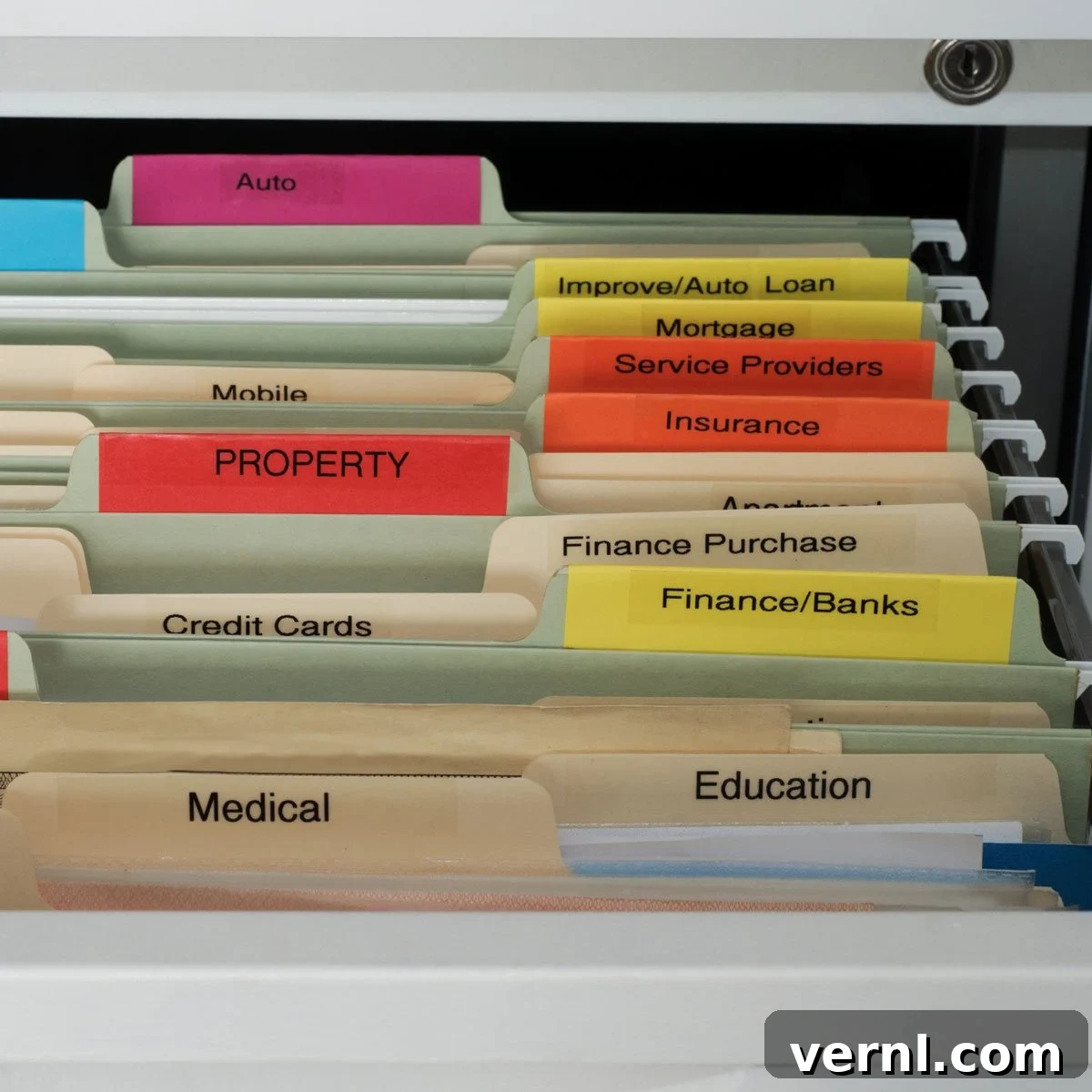
To further enhance your system’s efficiency, consider adopting a color-coded organizational method for grouping related documents. This visual cue allows you to quickly identify the general category of document you are looking for, preventing the common problem of over-stuffing a single file folder with hundreds of disparate sheets of paper. For example:
Assign a primary color to a broad category of files. For instance, red could be designated for all home-related documents. Within this category, place your most important documents – such as the home inspection report and the property deed – in the brightest red folder. Then, break down the category further by filing secondary but related documents in folders of different shades of the same color. For example, pink folders could hold appliance warranties, operating manuals, and service contracts. This gradient system allows for granular organization without overwhelming complexity.
Remember, the more you refine and break down your system into clear categories and subcategories, the less time-consuming and frustrating the process of tracking down specific documents will be in the future. To maintain the integrity of your system and prevent misfiling or misplacement, create a simple file index. This could be a physical table of contents in a binder or a digital spreadsheet, clearly listing each category and the types of documents it contains. Regular review and adherence to this index will be key to long-term success.
Choosing the Right Storage Solutions for Your Documents
It’s tempting to simply stack your carefully organized files into a cardboard box and relegate it to a forgotten corner of your attic or basement. However, this common practice carries significant risks. Many important documents are not only difficult but also expensive, if not impossible, to replace should they suffer damage from water, extreme temperatures, humidity, or pests like rodents and insects. Protecting your originals is paramount.
Instead, dedicate a suitable spot in a room with a relatively constant temperature and humidity level. This area should ideally not be prone to flooding, extreme heat or cold fluctuations, or pest infestations. A dedicated home office, a secure storage closet, or even a specialized under-bed storage container designed for documents can work exceptionally well, provided these areas meet the environmental criteria. The goal is to keep your documents safe from environmental hazards and easily accessible when needed.
A variety of containers and systems are available for storing important documents at home, ranging from traditional banker’s boxes to robust fireproof safes. The best choice depends on the document’s importance, your budget, and the level of protection required. Here are four common storage systems, each offering varying degrees of security and convenience:
Banker’s Box: Economical Archival Storage
The simplest and most budget-friendly solution, a standard banker’s box is essentially a sturdy cardboard container specifically designed to hold file folders. It typically comes with a durable lift-off lid and convenient handle holes, making it easy to carry and stack on shelving. While a banker’s box offers a cost-effective and straightforward method for organizing and storing documents, its limitations are significant. The cardboard construction provides no protection against fire, water damage, or pests. Furthermore, there is no inherent locking mechanism to guard against theft or unauthorized access. Therefore, banker’s boxes are best reserved for low-priority papers or documents that you have already backed up digitally and are less critical to retain in pristine original condition. For truly important documents, a more secure container is essential.
Plastic Storage Bin: Enhanced Protection for Bulk Storage
Similar to a banker’s box in its simplicity, a robust plastic storage bin offers a slightly upgraded, yet still affordable, solution for storing low-priority personal documents. Plastic bins are typically designed for secure stacking, making them an excellent choice when you have a large volume of files but limited floor space. The plastic construction provides a degree of protection against minor flooding and potential rodent damage, which is superior to cardboard. However, it’s crucial to note that most standard plastic bins are not fireproof, nor do they offer any integrated locking capability for enhanced security. They serve well for documents that need more protection than cardboard but don’t warrant the highest level of security.
Filing Cabinet: The Workhorse for Active Documents
Home filing cabinets are a popular and versatile storage solution, available in a variety of styles and finishes to seamlessly blend with your interior décor. They are designed to accommodate a large number of files across multiple drawers, offering excellent organization for your active documents. Many models come equipped with a lock, providing a limited but effective measure of protection against casual theft or unauthorized viewing. For added peace of mind, some specialized types of filing cabinets are constructed with heat-resistant materials, offering a degree of fire protection. These cabinets are an excellent solution for organizing and securing the majority of your personal and home-related documents. However, it’s important to remember that in the event of significant flooding, documents stored in the lowest drawer may still be susceptible to water damage, so proper placement within your home is still vital.
Home Safe or Lock Box: Ultimate Security for Irreplaceable Items
For your most critical, irreplaceable, and highest-priority documents, the most secure method of storage at home is undoubtedly a home safe or a dedicated lock box. These specialized units are engineered to be both fireproof and flood-resistant, offering robust protection against the most severe hazards. You can opt for a compact lock box to specifically house your absolute highest-priority documents, such as original birth and marriage certificates, passports, Social Security cards, your last will and testament, and your property deed. This specialized container can then be paired with a larger, locked home filing cabinet for the remaining, less critical (but still important) paperwork. For absolute maximum security and redundancy for truly irreplaceable items, consider also storing copies or even originals of certain documents (like wills or deeds) in an off-site bank safety deposit box or with a trusted legal professional.
Regardless of the physical storage method you ultimately choose, it is absolutely imperative to create robust digital backups of all your important personal and home-related documents. Store these digital copies securely in the cloud, on an encrypted USB flash drive kept in a safety deposit box, or with a trusted lawyer or close friend. This multi-layered approach ensures that even if a physical disaster strikes, your essential information remains safe and accessible, offering invaluable peace of mind.
By implementing a thoughtful and consistent document organization and storage system, you transform what could be a chaotic burden into an empowering tool for managing your home and life. This proactive approach saves time, reduces stress, and protects your most valuable assets and information for years to come.