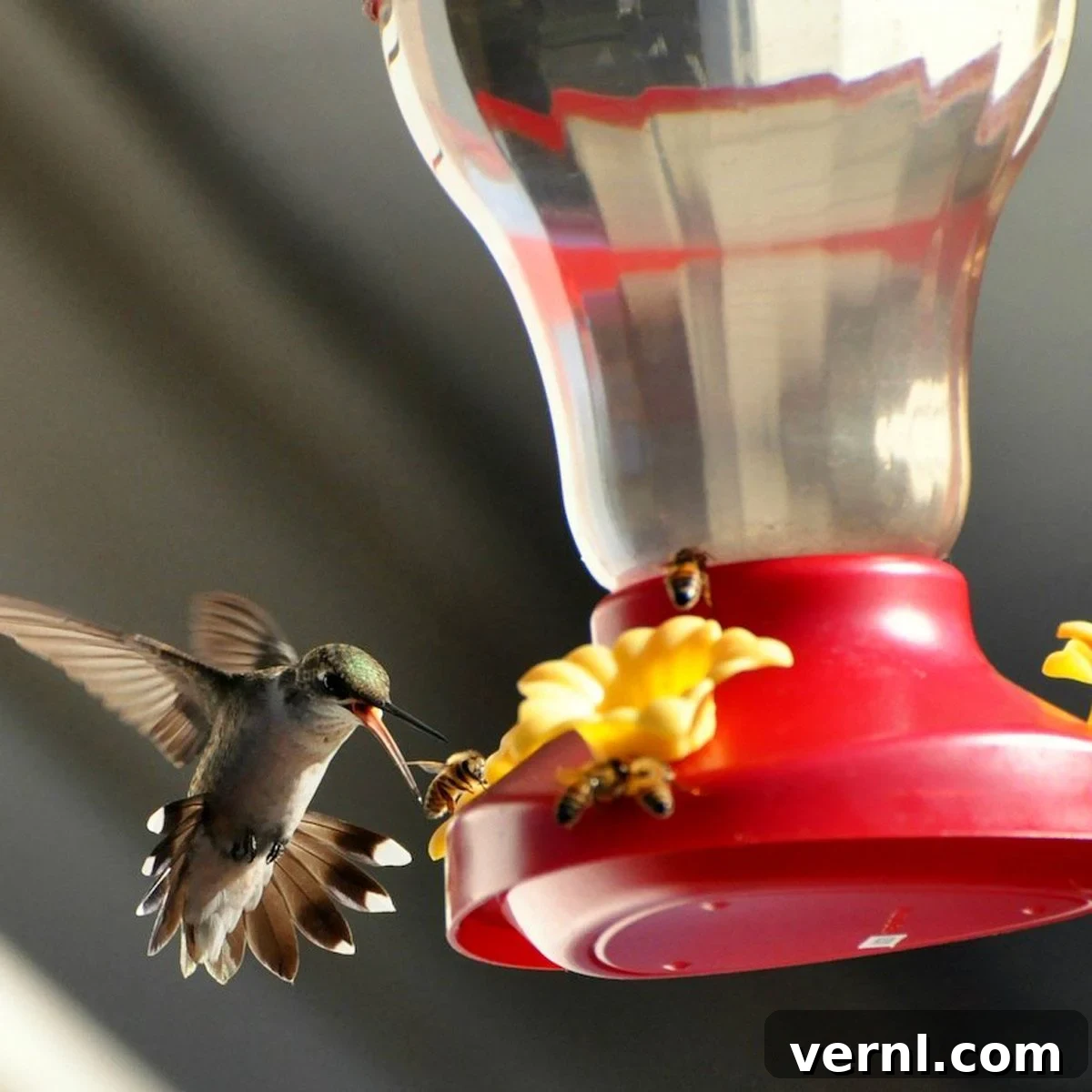
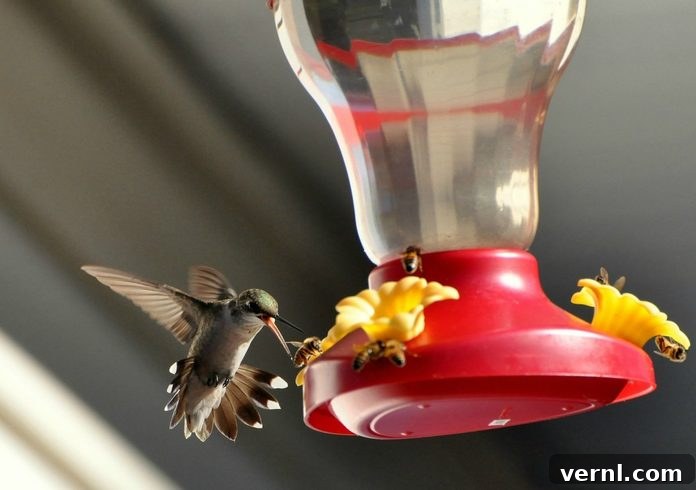
Attracting the iridescent beauty of hummingbirds to your backyard is a truly rewarding experience. These tiny, acrobatic birds bring life and vibrant energy as they flit from flower to feeder, sipping the sweet nectar. For many backyard enthusiasts, their feeders, often filled with sugar water, become a focal point of garden activity. However, the very sweetness that beckons hummingbirds can also draw in less welcome visitors: persistent ants, aggressive wasps, and even beneficial bees, all seeking an easy meal. This common dilemma often leaves backyard birders frustrated, wondering how to protect their feeders without harming any creatures.
The temptation to reach for chemical pesticides or insecticides to deter these unwanted bugs can be strong. However, experts strongly advise against this approach. Emma Greig, a project leader for Project FeederWatch at the esteemed Cornell Lab of Ornithology, emphasizes the critical dangers of such chemicals. Pesticides can not only directly harm hummingbirds, which are incredibly sensitive creatures, but also pose a significant threat to bee populations, many of which are already in alarming decline. “You can deter insects while remembering they’re part of nature, too,” Greig wisely notes. Fortunately, a host of all-natural, humane, and effective solutions exist to safeguard your hummingbird feeders, ensuring a safe and enjoyable environment for your feathered friends and the vital pollinators they share the garden with. The birds, and the bees, will undoubtedly thank you for choosing these eco-conscious methods.
Choose Red Saucer Feeders for Selective Attraction
One of the most effective strategies for preventing insects from reaching hummingbird nectar involves a clever design choice: opting for red saucer feeders. These feeders are specifically engineered to cater to the unique feeding mechanisms of hummingbirds while effectively deterring most insects. Hummingbirds possess long, slender tongues perfectly adapted to reach deep into flowers and the recessed ports of saucer feeders. Insects, such as bees and wasps, generally have shorter mouthparts and struggle to access nectar that is not immediately exposed.
The color red plays a crucial role in this strategy. Hummingbirds are famously attracted to the color red, which often signifies nectar-rich flowers in their natural habitat. Conversely, bees are far more drawn to colors like yellow, blue, and purple, and tend to be less interested in red. By selecting a feeder that is predominantly red and lacks yellow accents around the feeding ports, you create an environment that is highly appealing to hummingbirds but less inviting to bees.
When choosing a saucer feeder, look for models where the nectar reservoir is located at the bottom, and the feeding ports are designed to be shallow on the exterior but deep internally. This design allows a hummingbird to easily dip its long tongue into the sugar water, while ants, wasps, and bees find it nearly impossible to reach the liquid. Always ensure your feeder is made from durable, easy-to-clean materials, preferably glass, to maintain hygiene. Remember to replace your hummingbird sugar water every few days, especially in warm weather, to prevent spoilage and bacterial growth.
Attach an Ant Moat: A Watery Barrier to Success
Ants are relentless foragers, and the sweet nectar in a hummingbird feeder is an irresistible beacon. Fortunately, one of the simplest and most ingenious defenses against these tiny invaders is the ant moat. An ant moat is a small, cup-like device, typically measuring about three inches wide and one to two inches deep, designed to be filled with water. It is hung above the hummingbird feeder, effectively creating a watery barrier that ants cannot cross.
The principle is straightforward: ants cannot swim. When they attempt to crawl down the feeder hanger, they encounter the moat filled with water, which acts as an impassable obstacle. This forces them to turn back, preventing them from ever reaching the nectar. You can purchase standalone ant moats that easily attach to almost any existing feeder setup, or you can opt for hummingbird feeders with built-in ant moats, offering an integrated solution.
For optimal effectiveness, it is crucial to keep your ant moat consistently filled with water. Check it daily, especially during hot, dry periods or after rain, as evaporation and splashes can deplete the water level. Regularly clean the moat to prevent algae buildup or the breeding of mosquitoes. A quick rinse with plain water is usually sufficient. Some birders add a drop of vegetable oil to the water to create a slick surface that further discourages ants and helps reduce evaporation, though plain water is often enough. This simple, non-toxic barrier is an indispensable tool in your arsenal against ant invasions.
Hang Feeders with Fishing Line: The Invisible Pathway Deterrent
Another clever trick to outsmart ants, leveraging their physical limitations, is to hang your feeders using fishing line. Ants rely on textured surfaces to grip and climb. Standard cords, chains, or wire hangers provide ample purchase for their tiny legs. However, monofilament fishing line presents an entirely different challenge.
Fishing line is incredibly thin and smooth, offering virtually no grip for ants. When a feeder is suspended solely by a length of fishing line, ants find it almost impossible to traverse. They will attempt to climb it, but their legs will slip, preventing them from reaching the nectar. This method is particularly effective when combined with other deterrents, creating multiple layers of defense.
To implement this, simply replace the existing hanger of your hummingbird feeder with a sturdy length of fishing line. Ensure the line is strong enough to support the feeder’s weight, especially when full of nectar. Tie secure knots to prevent slippage. Place the feeder where ants cannot easily bridge the gap from nearby branches or structures. This method requires minimal effort and costs very little, yet provides a significant advantage in keeping ants at bay. Remember that regular cleaning of hummingbird feeders is essential, regardless of your ant-deterrent strategy, to maintain a healthy environment for your birds.
Slip Nectar Guard Tips Over Feeder Holes: A Targeted Solution
For issues with wasps and bees, especially yellow jackets, a highly effective and targeted solution comes in the form of nectar guard tips. These small, flexible attachments are designed to slip directly over the feeding ports of your hummingbird feeder. They feature tiny slits or openings that are large enough for a hummingbird’s slender tongue to access the nectar but too small for the heads or bodies of most insects.
The genius of nectar guard tips lies in their precision. Wasps and bees, with their broader heads and bodies, simply cannot push through the narrow openings to reach the sugar water. Hummingbirds, however, can easily extend their long tongues through the flexible material to drink. This ensures that your intended visitors can feed undisturbed, while nuisance insects are effectively locked out.
These tips are typically made from soft, pliable plastic or silicone and are easy to install and remove for cleaning. They come in various sizes to fit different feeder models, so ensure you purchase ones compatible with your specific feeder. Regular inspection and cleaning of the nectar guard tips themselves are necessary to prevent blockage or buildup. Investing in these inexpensive accessories can dramatically reduce insect interference, allowing hummingbirds to feed in peace. Consider combining them with feeders hummingbirds will absolutely love, designed for optimal bird comfort and viewing.
Periodically Move Feeders: Disrupting Insect Navigation
Insects, particularly ants and wasps, are creatures of habit and often follow established trails or visual cues to food sources. This behavior can be leveraged to your advantage by periodically moving your feeders. Even a slight relocation can be enough to confuse and deter persistent insects, while hummingbirds, with their keen eyesight and aerial prowess, will quickly rediscover their favorite feeding spots.
Ants, for instance, lay down pheromone trails to guide their colony mates to food. By moving a feeder, you break this trail, forcing them to start their search anew. Wasps and bees may also rely on visual memory. Shifting the feeder’s position by just three or four feet can often be sufficient to throw off their established routes and patterns.
This method is incredibly simple and requires no special equipment. Try moving your feeders every few days, especially if you notice a particular insect problem developing. While it might take hummingbirds a short time to adjust, they are highly adaptable and will usually locate the feeder within minutes or hours. Insects, on the other hand, often lose track entirely or find the effort of re-establishing a reliable path too cumbersome, especially if alternative food sources are available nearby. This simple change in routine can significantly reduce insect presence at your feeders.
Place Fake Wasp Nests Nearby: Harnessing Territorial Instincts
Wasps are highly territorial creatures. They will vigorously defend their nests from perceived intruders, including other wasp colonies. This natural instinct can be exploited to your advantage by deploying fake wasp nests in the vicinity of your hummingbird feeders. The presence of a “rival” nest often convinces real wasps to avoid the area, believing it is already occupied.
Before implementing this strategy, it is crucial to remove all active wasp nests from the immediate area where you plan to place your feeders. Do this cautiously and preferably at dusk or dawn when wasps are less active. Once the area is clear, hang your fake wasp nests in strategic locations.
Ideal placement for fake nests includes sheltered areas, such as under eaves, porch ceilings, or dense foliage, where they are protected from rain and wind but still visible to any approaching wasps. You can use one or several, depending on the size of your garden. While not 100% foolproof, many gardeners report significant success with this passive deterrence method, as it taps into the wasps’ innate territorial programming. It’s an excellent, chemical-free way to create a more peaceful feeding zone for your hummingbirds.
Plant Bee- and Hummingbird-Friendly Flowers: Offer Alternative Food Sources
Perhaps the most holistic and ecologically beneficial approach to managing insects at your feeders is to plant bee- and hummingbird-friendly flowers throughout your garden. By creating a diverse and abundant landscape of nectar-rich plants, you provide alternative food sources that can draw insects away from your feeders and enhance the overall health of your backyard ecosystem.
For bees and other pollinators, a variety of colorful flowers will be highly attractive. Consider planting species like lavender, coneflowers, zinnias, cosmos, and sunflowers. These plants offer a smorgasbord of nectar and pollen, giving bees plenty of reasons to forage elsewhere than your sugar water.
For hummingbirds, focusing on tubular, brightly colored flowers is key. Excellent choices include nectar-rich flowers such as fuchsia, impatiens, bee balm (Monarda), cardinal flower (Lobelia cardinalis), trumpet vine (Campsis radicans), and salvia. Native plants are always a fantastic option as they are perfectly adapted to your local climate and provide the best support for local wildlife.
By integrating a vibrant array of flowering plants in containers and garden beds near your feeders, you not only beautify your space but also effectively redistribute insect activity. This strategy turns your backyard into a comprehensive wildlife sanctuary, where hummingbirds find their feeders, and all pollinators find natural, abundant food sources. This reduces competition at the feeders and fosters a healthier, more balanced environment. For more in-depth advice on creating a hummingbird haven, explore our expert tips for attracting hummingbirds to your backyard, covering the best plants, feeder types, and other essential features.
Beyond Deterrence: Essential Feeder Maintenance for a Healthy Hummingbird Haven
While specific deterrent methods are crucial, the foundation of successful and responsible hummingbird feeding lies in consistent and meticulous feeder maintenance. A clean feeder and fresh nectar are not only more appealing to hummingbirds but also less attractive to many insects and vital for the birds’ health.
Regular Cleaning Schedule: This is paramount. Nectar can quickly ferment or grow mold, especially in warm weather, which is harmful to hummingbirds and can also attract ants and other pests. Aim to clean your feeders every 2-3 days, and daily during very hot spells. Use a brush to scrub all parts with hot water, and a mild vinegar solution if mold or residue is present. Rinse thoroughly with plain water – no soap or harsh chemicals should be used.
Proper Nectar Preparation: Always use a simple solution of one part granulated white sugar to four parts water. Boil the water first, then dissolve the sugar, and let it cool completely before filling the feeder. Never use honey or artificial sweeteners, and avoid red dyes; the feeder’s color is sufficient to attract hummingbirds, and dyes can be harmful. Store excess nectar in the refrigerator for up to a week.
Optimal Feeder Placement: Beyond moving feeders periodically, consider their initial location. Placing feeders in a partially shaded area can slow nectar fermentation. Avoid direct, intense sunlight for prolonged periods. Also, ensure feeders are hung high enough to deter ground predators and provide a clear flight path for hummingbirds, away from dense foliage where insects might easily hide.
By adhering to these fundamental maintenance practices, you create an environment that maximizes safety and appeal for hummingbirds while minimizing the enticement for unwanted insect guests. A holistic approach, combining intelligent feeder design, natural deterrents, a vibrant garden, and impeccable hygiene, will ensure your backyard remains a cherished haven for these tiny wonders.
Up next, learn what you should do if you find a bird’s nest in your backyard.