
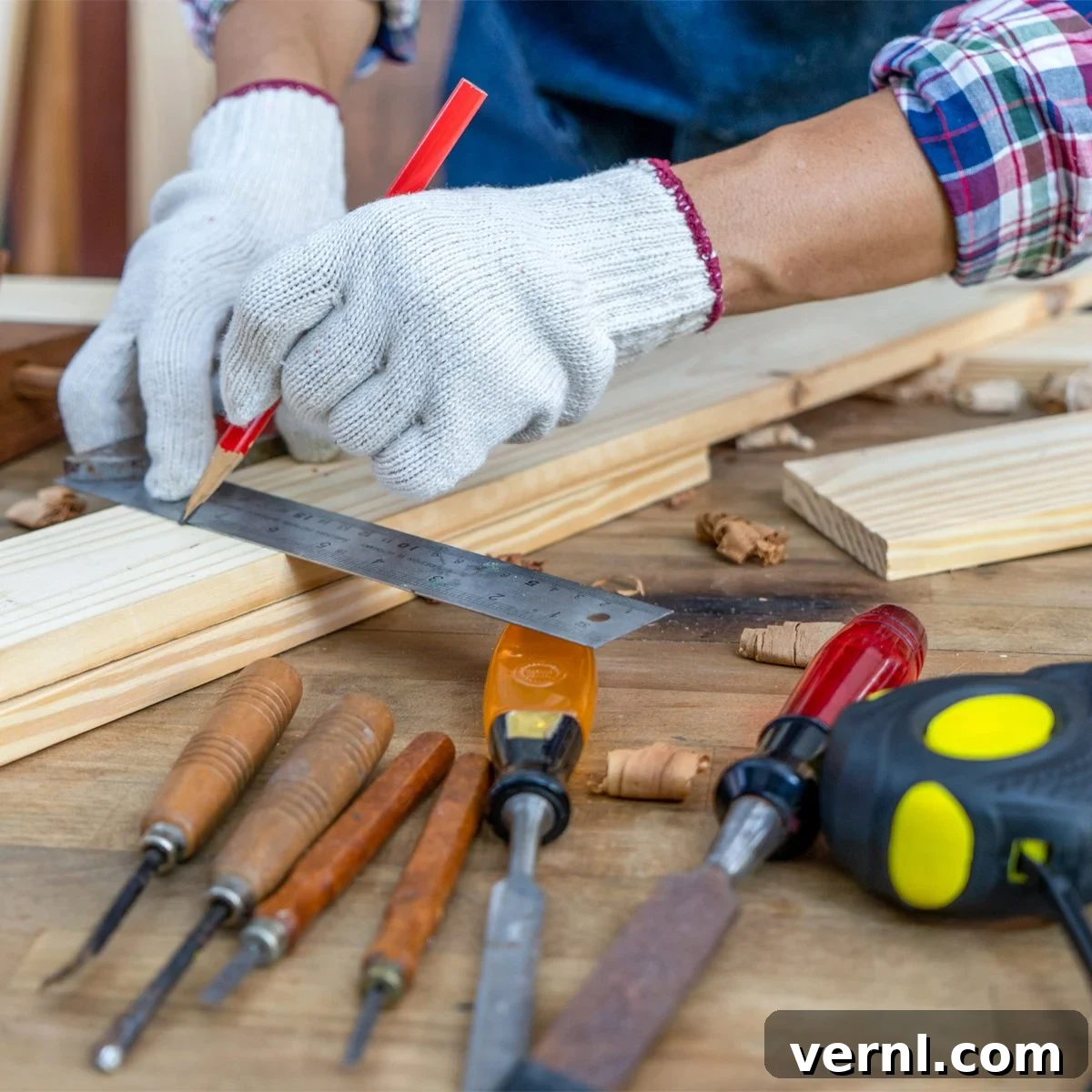
The Essential Woodworking Tool Guide: Building Your Workshop for Success
Woodworking is a deeply rewarding craft, blending artistry with precision to transform raw timber into functional and beautiful objects. Whether you’re dreaming of crafting custom furniture, intricate carvings, or practical home decor, the journey into woodworking begins with understanding and acquiring the right tools. For newcomers, the sheer variety of options can be daunting, leading to confusion about what’s truly necessary versus what’s a luxury.
However, regardless of your chosen woodworking niche, certain fundamental skills are universally applicable. Every woodworker, from novice to master, engages in a core set of processes: cutting, drilling, shaping, fastening, measuring, and finishing. Each of these vital tasks requires specific tools designed to achieve optimal results. This comprehensive guide will navigate you through the most common and essential tools in each category, helping you make informed decisions as you build or expand your workshop.
Instead of haphazardly buying tools and then searching for projects to use them on, we recommend a more strategic approach: identify projects that genuinely excite you, then invest in the specific tools required for those endeavors. This budget-conscious method ensures your tools are actively used and truly contribute to your woodworking passion.
Before we dive into the specifics, here are a few important considerations:
- Our focus here is on woodworking, distinct from carpentry. While there’s considerable overlap, carpentry generally involves constructing buildings and structures, whereas woodworking centers on creating individual objects like chairs, cabinets, or even finely crafted pens. Many tools listed are indeed valuable in both trades.
- For the sake of brevity and focus, we have not included safety tools in this list. Always prioritize personal safety by wearing appropriate gear such as eye protection, hearing protection, and dust masks, and by understanding safe operating procedures for all your equipment.
- Tool names and specific materials can vary regionally. For example, what one person calls a coping saw, another might refer to as a hand saw or dovetail saw. Rest assured, the fundamental function remains the same.
Woodworking Tools That Cut: Laying the Foundation for Your Projects
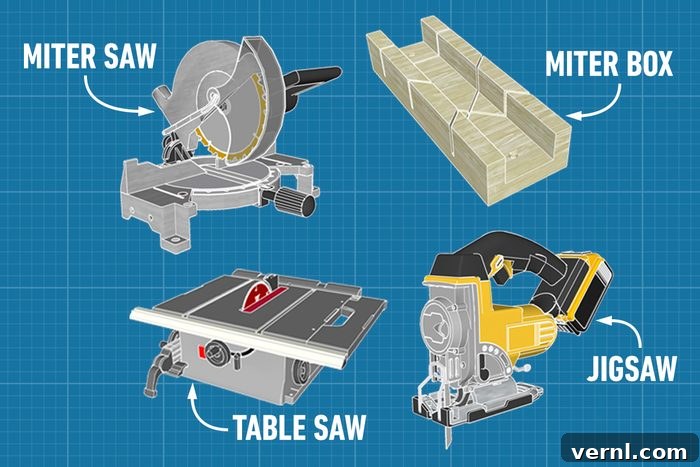
Cutting wood is arguably the most fundamental and frequent operation in woodworking. Whether you’re breaking down raw lumber, preparing components for joinery, or crafting decorative elements, every woodworker must master precise cuts. This involves both ripping (cutting along the grain) and crosscutting (cutting across the grain). While modern power tools offer unparalleled speed and precision, many detailed woodworking cuts are still best executed with high-quality hand saws, a testament to the enduring craft.
Table Saw: The Heart of the Workshop
A table saw is often considered the cornerstone of a woodworking shop due to its incredible versatility. It excels at both ripping long boards and making accurate crosscuts, particularly when paired with a sled or miter gauge. Its large, flat tabletop provides excellent support for cutting expansive sheet goods like plywood or MDF, ensuring stability and accuracy. For those hesitant to commit to a full-size, often expensive table saw, a portable jobsite version can be an excellent entry point, offering significant capability at a more budget-friendly price.
Miter Saw: Precision for Crosscuts
The miter saw is a specialized tool designed for making fast, accurate, and repeatable crosscuts and angled cuts. If your projects frequently involve cutting boards to length or creating precise mitered corners for frames or trim, a miter saw is an invaluable time-saver. It’s particularly efficient for working with relatively narrow stock, typically up to six inches wide, and ensures consistent results every time.
Miter Box: The Manual Alternative for Accurate Angles
For woodworkers who don’t require the power and speed of a miter saw, or for those on a tight budget, a miter box is an excellent manual alternative. This simple yet effective tool consists of a plastic or wooden frame with pre-cut slots that guide a hand saw at specific angles, typically 45 and 90 degrees. A miter box allows for surprisingly accurate cuts at an incredibly low cost, making it perfect for occasional crosscutting needs.
Jigsaw: Mastering Curves and Contours
A jigsaw is the go-to tool for cutting intricate curves, circles, and irregular shapes in wood. While beginners might initially find themselves battling “chatter” (rapid vibration), a little practice and patience will reveal the jigsaw’s immense value. It’s an indispensable tool for decorative woodworking, creating unique designs, or simply cutting out openings for sinks or electrical boxes.
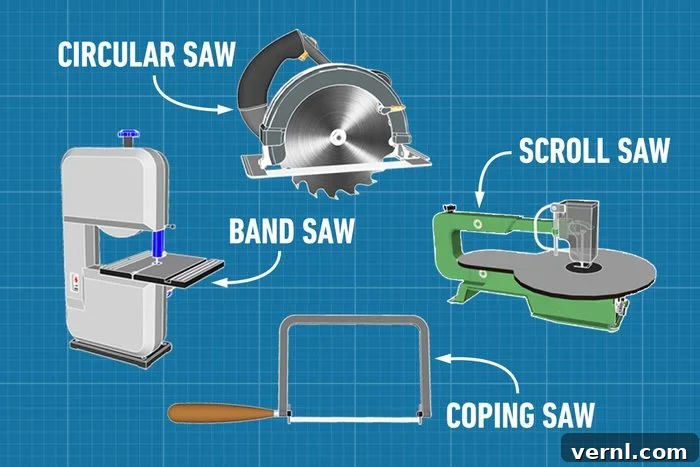
Coping Saw: Precision for Fine Details
The narrow, interchangeable blade of a coping saw makes it ideal for highly detailed work, such as coping joints (which gives the tool its name), cutting tight curves, and crafting intricate dovetail joinery. Its ability to maneuver in small spaces and change blade direction makes it indispensable for fine woodworking where precision and delicate cuts are paramount.
Band Saw: Resawing and Complex Curves
A band saw, with its continuous loop blade, is excellent for resawing (splitting thicker stock into thinner pieces) and cutting complex curves that are beyond the capability of a jigsaw. Its stationary nature allows the woodworker to control the material being cut, making it safer and more precise for larger pieces and intricate freehand shapes. For tasks like turning a 2×6 into two 1x6s, a band saw offers superior control and efficiency compared to multiple passes on a table saw.
Scroll Saw: The Art of Fretwork and Intarsia
A scroll saw is essentially a smaller, more refined version of a band saw, specifically designed for extremely delicate and intricate work. With its fine, often removable blade and limited throat opening, it’s perfect for fretwork, intarsia, and other artistic endeavors on thin stock where minute details are crucial. If your projects involve cutting elaborate patterns or designs, a scroll saw is an unparalleled tool.
Circular Saw: Portable Power for General Cuts
While often associated with carpentry, a circular saw definitely has a valuable place in a woodworker’s toolkit, especially for those with limited space or budget. It’s a highly portable and powerful tool for making quick, straight cuts, particularly useful for breaking down large sheets of plywood or rough lumber before moving to more precise tools. For occasional straight cuts, a circular saw offers excellent utility without the significant investment and space requirement of a full table saw.
Woodworking Tools That Drill: Creating Connections and Details
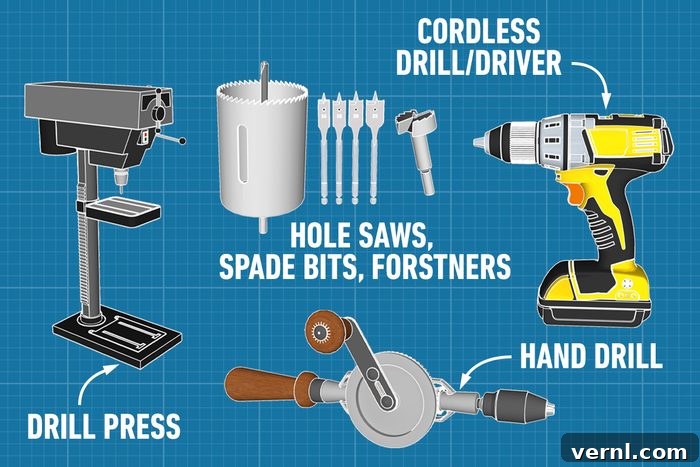
Drilling is an indispensable part of woodworking, whether it’s creating pilot holes to prevent splitting when driving screws, boring holes for dowel joinery, or crafting decorative elements. The right drilling tool ensures precision and efficiency, impacting the strength and aesthetics of your finished piece.
Cordless Drill/Driver: The Modern Workhorse
Once considered a luxury, the cordless drill/driver has become an absolute necessity in almost every workshop. Its portability and versatility make it ideal for both boring holes and driving screws with ease. With numerous affordable and high-performance options on the market today, most woodworkers will find a single cordless drill/driver sufficient for a wide array of tasks, from assembling projects to preparing for fasteners.
Drill Press: Unmatched Precision and Repeatability
When your projects demand holes with absolute precision, consistency, or at specific depths, a drill press is an essential tool. It offers a level of accuracy that simply cannot be replicated freehand with a cordless drill. A drill press allows you to make perfectly perpendicular and easily replicated holes, critical for tasks like doweling, mortising with specific attachments, or drilling pocket holes with maximum consistency.
Hand Drill: Control for Delicate Work
While power drills dominate, the hand (manual) drill has retained its place as a specialty tool for fine woodworking. Its manual operation provides unparalleled control, allowing woodworkers to drill in minute increments and apply precise pressure. This makes it extremely helpful when working with thin, delicate, or valuable materials where over-drilling or splintering would be disastrous.
Specialty Bits: Expanding Your Drilling Capabilities
The drill itself is only half the story; the bits you use determine the type and quality of the hole. Most woodworkers will gradually amass a collection of specialty bits over time. These include:
- Hole saws: For cutting large diameter holes.
- Spade bits: Fast and economical for larger, rougher holes.
- Forstner bits: For creating flat-bottomed holes, useful for hinges or inlays.
- Step bits: Versatile for drilling multiple size holes in thin materials.
- Countersink bits: To create a recess for screw heads to sit flush.
Instead of buying a complete, expensive set all at once, it’s often more practical and cost-effective to acquire these bits as specific project needs arise. Before you know it, you’ll have a surprisingly comprehensive assortment ready for any task.
Woodworking Tools That Shape: Bringing Form to Your Vision
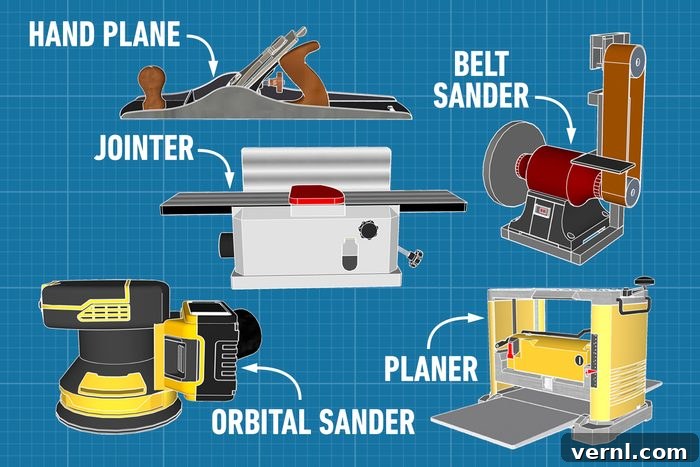
Shaping wood is where a project truly begins to take form, transforming rough stock into refined components or finished works of art. This process can occur at various stages, from initial stock preparation to intricate decorative details. In disciplines like wood carving and wood turning, shaping isn’t just a step, it *is* the entire project. Here are the essential tools for shaping wood:
Hand Plane: The Art of Smoothness and Flatness
This deceptively simple tool has been a woodworking staple for centuries and remains incredibly effective. A well-maintained and properly calibrated hand plane can quickly remove material or shave off transparently thin layers, creating perfectly flat, smooth surfaces and precise dimensions. Hand planes come in a multitude of sizes and styles for different tasks. For most beginner woodworkers, a Stanley six-inch block plane is an excellent starting point, versatile for small adjustments and chamfering edges.
Orbital Sander: Achieving a Flawless Finish
When it’s time to smooth out surfaces and eliminate blade marks, an orbital sander, particularly a random orbital sander, makes the task significantly easier and faster than hand sanding. Its unique motion helps to minimize swirl marks, leaving a uniform and smooth surface ready for finishing. It’s a must-have for preparing your project for stains, paints, or clear coats, ensuring a professional appearance.
Belt Sander: Aggressive Stock Removal
A belt sander is a powerful and aggressive tool capable of removing material extremely quickly. It’s ideal for flattening large surfaces, shaping rough lumber, or rapidly bringing dimensions down to size. However, its aggressive nature demands careful handling; it’s easy to overdo it and remove too much material if not used with a steady hand and proper technique.
Planer: Uniform Thickness for Your Boards
A planer is designed to reduce the thickness of boards and make them uniformly dimensioned. This tool is invaluable if you’re working with rough lumber, allowing you to mill stock to precise thicknesses and create two perfectly parallel faces. Not only does it save money by enabling you to buy cheaper rough lumber, but it also ensures consistency across all your project components.
Jointer: Creating Perfect Edges for Glue-Ups
Often used in conjunction with a planer, a jointer is essential for squaring lumber. It precisely shapes the edges and faces of boards, creating a perfectly flat and square reference surface. When joining multiple pieces of lumber side-by-side, such as for a tabletop or panel, a jointer ensures that the edges are perfectly straight and square, allowing for tight, gap-free glue lines that are incredibly strong and visually appealing.
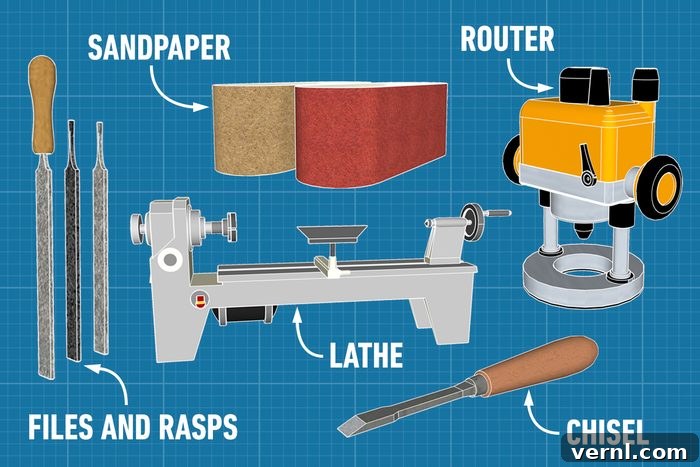
Sandpaper: The Unsung Hero of Smoothness
While technically a consumable material, sandpaper is so fundamental to shaping and refining wood that it deserves a place among essential tools. It’s particularly effective for detailed work, curved surfaces, and achieving that final silky-smooth finish. Always use fresh sandpaper; once the grit is worn down, it becomes ineffective and can burnish the wood rather than abrade it. Remember the old DIY adage: “Life is short, abrasives are cheap.” Don’t hesitate to replace it!
Lathe: The Magic of Wood Turning
If you’re captivated by the art of wood turning, a lathe will be the central piece of equipment in your workshop. There’s a captivating allure in watching a skilled wood turner at work, as wood chips gracefully fly and a beautifully symmetrical object—be it a bowl, spindle, or decorative turning—slowly emerges from a rapidly spinning block of wood. The lathe opens up a unique dimension of woodworking creativity.
Chisel: Precision Hand Shaping
A chisel is a versatile hand tool used to shape everything from precise hinge mortises to intricate sculptures. While the specific size and shape of chisels vary depending on the task, a set of quality, well-sharpened chisels is essential for almost every type of woodworking, allowing for clean cuts, precise trimming, and detailed shaping where machinery cannot reach.
Router: Adding Decorative Edges and Joinery
A router is an incredibly versatile tool for changing the edge profile of your project, cutting dados and rabbets for joinery, or even creating decorative inlays. From compact palm routers perfect for delicate work on shelving to powerful table routers used for custom wood trim, the range of applications for this handy tool is vast. It’s excellent for adding a professional, finished look to almost any piece.
Files and Rasps: Refinement and Rapid Material Removal
Hand files and rasps are crucial for refining shapes and removing material. Rasps, with their coarser teeth, are designed for more aggressive material removal and rough shaping, while files, with finer teeth, are used for making smaller adjustments and smoothing surfaces. Combo file and rasp tools offer convenience, allowing the user to seamlessly transition between rapid material removal and finer surface refinement.
Woodworking Tools That Fasten: Bringing It All Together
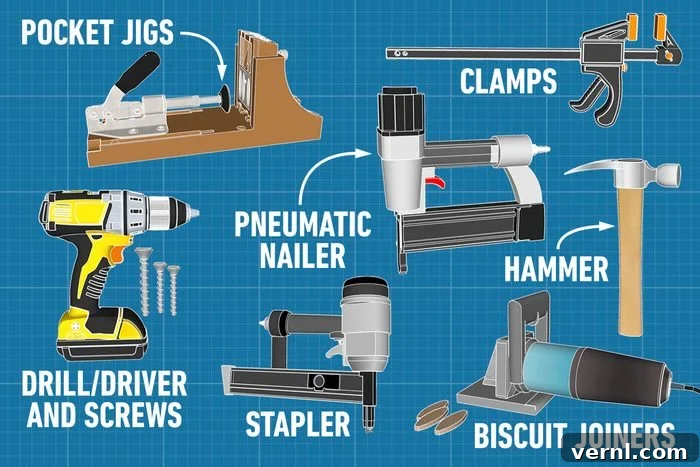
Once your wood pieces are expertly cut, drilled, and shaped, the next critical step is to securely fasten them together. Effective fastening ensures the structural integrity and longevity of your woodworking projects. A combination of mechanical fasteners and strong adhesives allows woodworkers to create durable and aesthetically pleasing joints.
Hammer: The Classic Fastener
A fundamental tool in any workshop, a selection of hammers and mallets, alongside various nails and other fasteners, provides the means to secure almost any joint or component. Different hammer types are suited for different tasks, from driving common nails to tapping delicate joinery into place with a mallet, ensuring your pieces stay put.
Pneumatic Nailer: Speed and Efficiency for Nailing
For projects requiring a large number of nails, or for quick assembly tasks, pneumatic nailers are phenomenal tools. They offer incredible speed and efficiency, driving nails flush or below the surface with consistent power. From finish nailers for delicate trim to framing nailers for heavy-duty construction, they significantly reduce the physical effort and time involved in fastening, making them a great multipurpose shop tool.
Drill/Driver and Screws: Strong and Demountable Fasteners
Screws offer a strong and often demountable method of fastening wood together. Used in conjunction with your drill/driver, screws create robust connections. Always remember to drill pilot holes before driving screws to minimize the risk of splitting the wood, especially in hardwoods or near edges. Your drill/driver’s clutch settings are also crucial for sinking screws to the correct depth without stripping heads or overtightening.
Stapler: Quick and Temporary Holds
Sometimes, a simple staple is all that’s needed for a quick, temporary hold, or for tasks like attaching fabric or thin backing materials. Both manual and pneumatic staplers are particularly useful if your project involves upholstery, securing dust covers, or holding thin veneers in place while glue dries.
Pocket Jigs: Invisible Joinery Solutions
Pocket hole joinery, popularized by brands like Kreg, provides a strong and hidden fastening method. Pocket hole jigs guide a drill bit at an angle into one workpiece, allowing a screw to connect it to another, often used in furniture construction to conceal fastener heads for a cleaner appearance.
Biscuit Joiners: Alignment and Strength for Panels
Biscuit joiners cut narrow, crescent-shaped slots into two abutting pieces of wood. A thin, compressed wooden oval (the biscuit) is then glued into these slots, swelling with the glue to create a strong, aligned joint. They are excellent for aligning panels during glue-ups and adding shear strength to edge joints, acting somewhat like horizontal dowels.
Clamps: The Woodworker’s Extra Hands
Most woodworkers will tell you they can never have enough clamps. Whether holding pieces tightly together while glue dries, stabilizing workpieces for drilling, or simply holding components during assembly, clamps are indispensable. From bar clamps and pipe clamps for large assemblies to quick-grip clamps for smaller tasks, having a diverse collection will significantly ease your workflow and improve the quality of your joints.
Woodworking Tools That Measure: Precision for Perfect Results
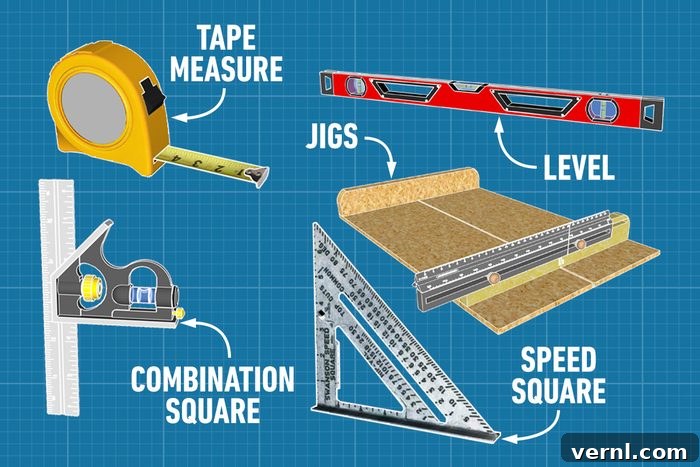
The timeless advice “measure twice, cut once” highlights the paramount importance of accurate measurement in woodworking. Precision measurement isn’t just about reading distances; it also involves checking for squareness, ensuring level surfaces, and finding efficient ways to ensure repetition. The world of measuring tools is vast, encompassing everything from calipers and try squares to specialized moisture meters. Here, we focus on the most common and universally essential measuring tools for the woodworker.
Tape Measure: The Everyday Essential
Found in virtually every woodworker’s toolkit, a reliable tape measure is arguably one of the most frequently used tools on this entire list. It’s essential for taking overall dimensions, marking cut lines, and generally laying out projects. Invest in a good quality tape measure that offers clear markings, a strong lock, and a durable case.
Level: Ensuring Flatness and Plumb
Levels are critical for checking both horizontal (level) and vertical (plumb) alignment. They ensure that surfaces are flat, posts are straight, and assemblies are square to the world around them. Longer metal levels often serve a dual purpose, also functioning as reliable straightedges for marking or checking long surfaces.
Combination Square: Versatility for Layout and Calibration
A combination square is an exceptionally versatile tool, useful not only for planning and marking cuts but also absolutely vital for calibrating your machinery. An out-of-square table saw or miter saw will lead to endless frustration and inaccurate projects. This tool helps ensure your equipment is perfectly set up for precision, capable of marking 90 and 45-degree angles, measuring depth, and checking squareness.
Speed Square: Quick and Convenient Layouts
While carpenters tend to favor the Speed square slightly more, these small, convenient, triangular tools are a worthwhile investment for any woodworker. They allow for quick and accurate marking of 90 and 45-degree angles, as well as serving as a fence for guiding circular saws for short crosscuts. When purchasing, always opt for a metal speed square; plastic versions can warp with heat and are easily damaged in the demanding workshop environment.
Jigs: Repetitive Accuracy and Time-Saving
A jig is a magnificent time-saver and can effectively act as a de facto measuring device. Jigs guide your tools—be it a router, saw, or drill—to help you make identical cuts, curves, holes, or finishes with minimal individual measurement for each piece. This greatly reduces layout time and improves consistency across multiple components.
While predesigned jigs are commercially available, many woodworkers discover that crafting their own custom jigs allows for unparalleled precision tailored to specific projects. For tasks involving numerous identical cuts or operations, even a single-project jig will often save more time than it takes to construct, proving its value immediately.
Woodworking Tools and Materials for Finishing: The Final Touch
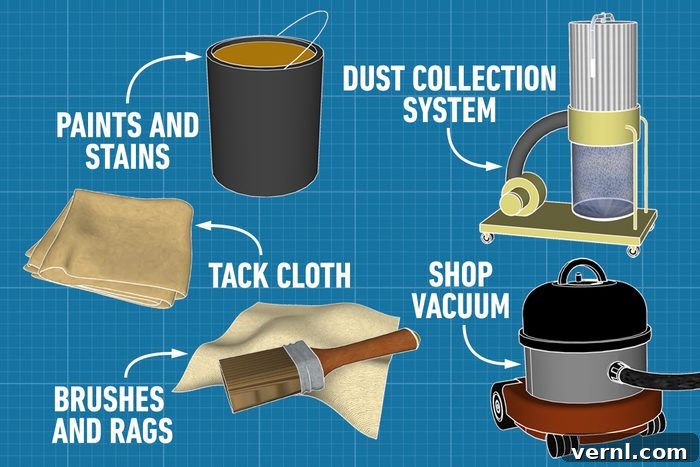
After all the meticulous cutting, shaping, and refining, the finishing stage is where your project truly comes to life and is protected for years to come. Do not falter at this final hurdle; apply the same level of care and attention to detail to ensure your project is something you can genuinely be proud of. The right finishing tools and materials not only enhance the beauty of the wood but also provide crucial protection.
Paints and Stains: Enhancing Natural Beauty or Adding Color
Every woodworking project has unique needs, and every woodworker develops personal preferences for finish coats. From clear varnishes that highlight the natural grain to opaque paints that add a pop of color, the options are vast. Experiment with different brands, types of wood stains, and finishes to discover the products that consistently yield the best results for your desired aesthetic and durability requirements.
Brushes and Rags: Essential Applicators
A diverse collection of brushes and rags will significantly simplify the application of paints, stains, and clear coats. Just as with finishes, personal preference plays a role here. Try out different materials—natural bristles, synthetic brushes, foam applicators, and various types of rags—to find your favorites that provide smooth, even coverage for different finish types.
Tack Cloth: The Dust Magnet
Tack cloth is a specially treated, slightly sticky fabric used to meticulously wipe down surfaces between finish coats. It’s designed to pick up fine dust particles that might otherwise mar your finish. While some woodworkers swear by their necessity for a pristine finish, others opt for alternative methods. If you’re aiming for a mirror-smooth, dust-free finish, a tack cloth can be a valuable ally.
Keep Dust Out of Your Finish: Critical for Flawless Results
Dust collection system: A pristine finish is impossible if sawdust and debris are suspended in the air. That gorgeous wet stain or varnish will quickly become marred with fallen sawdust if proper precautions aren’t taken. A dedicated dust collection system is crucial for extracting airborne dust particles as you work, especially during sanding and cutting operations. This not only makes it significantly easier to achieve a flawless finish but also dramatically improves air quality, protecting your lungs.
Shop vacuum: A dedicated workshop vacuum can serve as the primary power source for a smaller dust collection setup or work in tandem with a larger system. Either way, it’s indispensable for keeping your shop clean and maintaining an organized, less chaotic workspace. Many modern power tools also feature exhaust ports that can connect directly to a shop vacuum, minimizing dust expulsion right at the source, which is especially beneficial when finishing.
Building a well-equipped woodworking workshop is an ongoing journey, evolving with your skills and project ambitions. By understanding the purpose of each tool and investing thoughtfully, you’ll lay a solid foundation for countless rewarding hours of craftsmanship and stunning creations.