
For millions of Americans, the summer of 2023 presented an unprecedented challenge, marked by record-setting heatwaves that pushed temperatures to historic highs. Across vast swathes of the country, the only reliable refuge from the relentless sun and stifling humidity was the cool, conditioned air found indoors. The ubiquitous hum of air conditioning units became the defining soundtrack of the season, a testament to modern society’s reliance on climate control technology.
Indeed, air conditioning has become an indispensable part of American life. Data reveals that almost 90% of U.S. homes are now equipped with central or single-unit air conditioning systems. This figure represents a dramatic transformation in home comfort over just a few decades. To put it in perspective, a mere 40 years ago, in 1980, less than 50% of U.S. residences had air conditioning. This rapid adoption underscores not only the technological advancements but also the societal shift in expectations for indoor comfort and quality of life.
This widespread reliance prompts an intriguing question: How long has air conditioning truly been a part of our world, and what exciting innovations can we anticipate for its future? To understand its present dominance and its potential trajectory, we must delve into the fascinating history of this transformative technology, from its unexpected origins to its cutting-edge developments.
The Genesis of Modern Air Conditioning: A Story of Humidity and Innovation
The origins of modern air conditioning, as we know it, can be traced back to the burgeoning industrial era of the early 20th century. The year was 1902, and a brilliant 25-year-old engineer named Willis Carrier was tasked with a unique problem at a Brooklyn printing facility. His challenge was not initially about cooling but rather about maintaining a consistent level of humidity. The fluctuating moisture in the air was causing paper to expand and contract, leading to misaligned ink and blurred images, making high-quality color printing nearly impossible.
Carrier’s ingenious solution laid the foundational principles for modern air conditioning. He designed an apparatus that circulated air over a series of metal pipes, which were chilled by the compression and subsequent expansion of a gas. The cold surface of these pipes caused moisture in the air to condense, much like a glass of ice water collects droplets on its exterior on a humid day. This process effectively removed water from the air, creating the world’s first modern dehumidifier and solving the printing plant’s immediate dilemma.
However, what truly captivated Carrier was a significant “side effect” of his invention: the air temperature was dramatically reduced. He quickly recognized the profound implications of this discovery, realizing that controlling temperature could be as vital as controlling humidity. Despite Carrier’s foresight, his employers at Buffalo Forge initially failed to grasp the full potential of his temperature-controlling innovation. Instead of pursuing this new avenue themselves, they made a pivotal decision: they allowed Carrier and a small group of ambitious fellow engineers to take the patents and establish a new company. This decision paved the way for the Carrier Corporation, which today stands as a global leader in HVAC systems, boasting annual sales of approximately $20 billion.
The near-universal availability of air conditioning in contemporary society would have seemed nothing short of magical to anyone living at the turn of the 20th century. Initial public reactions were often skeptical, viewing attempts to artificially control temperature as unnatural or even unhealthy. For Willis Carrier and other pioneers in the field, this skepticism marked the beginning of a decades-long struggle for acceptance. The widespread adoption of air conditioning ultimately required not only significant technological advancements but also a major societal shift, propelled in part by the post-World War II housing boom and the rise of homeownership, which transformed air conditioning from a luxury into a household staple.
The Transformative Journey: A Detailed Evolution of Air Conditioning
While Willis Carrier is credited with inventing modern mechanical air conditioning, the human desire for cooling stretches back to antiquity. Ancient civilizations devised ingenious methods to combat heat, demonstrating an early understanding of thermal comfort. For instance, ancient Egyptians utilized evaporative cooling techniques, hanging wet mats in doorways to cool incoming breezes and even circulating water through the walls of homes. Similarly, the Romans ingeniously channeled cool aqueduct water through their walls to lower indoor temperatures. In the 18th century, pioneering minds like Benjamin Franklin studied similar evaporative cooling principles, noting how the evaporation of alcohol could rapidly cool objects.
The 19th century saw further scientific exploration into refrigeration. Dr. John Gorrie, a physician in Florida, created a small refrigeration unit in the 1840s to produce ice and then blow air over it, primarily to ease the suffering of malaria patients by lowering their fever-ridden body temperatures. Gorrie’s vision extended to cooling entire cities, though his groundbreaking work predated the necessary industrial infrastructure to make such a dream a reality. These early efforts laid crucial groundwork for the advancements that would follow.
Here’s a comprehensive timeline charting the development and widespread acceptance of air conditioning as we recognize it today:
- 1902: Willis Carrier Invents the Modern Air Conditioner. Carrier’s “Apparatus for Treating Air” was initially designed for industrial humidity control. Early models, however, used dangerous and flammable refrigerants such as ammonia and propane, posing significant safety risks.
- 1911: Carrier Publishes “Rational Psychrometric Formulae.” This seminal paper provided the scientific and mathematical basis for air conditioning engineering, outlining the fundamental principles of thermodynamics and psychrometrics. It remained the bedrock for HVAC design for over a century.
- 1914: First Residential Air Conditioner Installed. The luxurious Charles Gates mansion in Minneapolis became home to the first residential air conditioning system, signaling the technology’s potential for personal comfort, albeit initially only for the extremely wealthy.
- 1928: Chlorofluorocarbon (CFC) Gas Developed. A major breakthrough in refrigerant safety occurred with the development of CFCs, which were non-flammable and non-toxic, addressing the dangers of earlier refrigerants and paving the way for broader adoption.
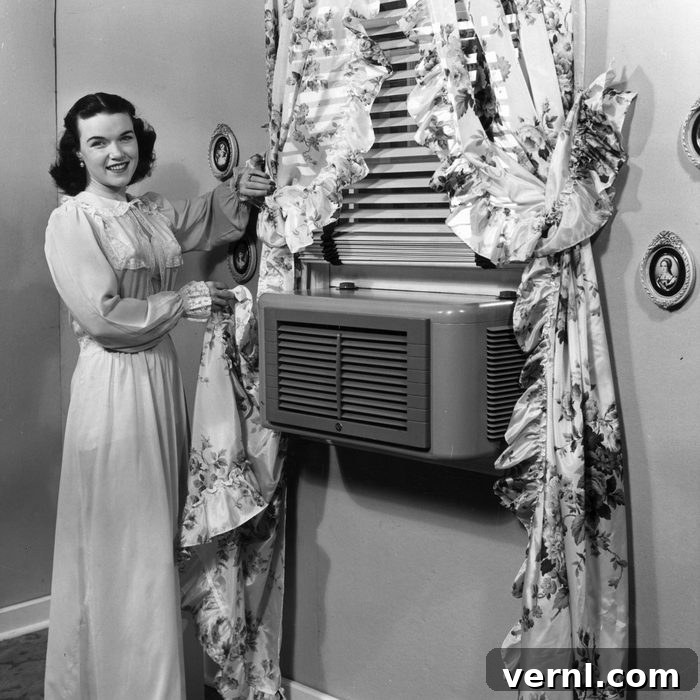
- 1931: H.H. Schultz and J.Q. Sherman Invent the Window Air Conditioner. This innovation introduced the concept of a self-contained unit, but its initial cost was prohibitive, often exceeding the price of a new home. This meant consumer demand was limited to the very affluent.
- 1938: Fredrick McKinley Jones Invents Portable Air Conditioning. Jones’s invention revolutionized the transportation of perishable goods. His portable refrigeration units allowed trucks and trains to transport food, blood, and other temperature-sensitive items over long distances, vastly improving supply chains and public health.
- 1940: The Packard Becomes the First Car with Factory-Installed Air Conditioning. While still a luxury option, this marked the beginning of mobile climate control, making car travel more comfortable, especially in hotter climates.
- 1944: The G.I. Bill Spurs Homeownership and AC Demand. The Servicemen’s Readjustment Act provided veterans with assistance for purchasing homes, significantly transforming American homeownership. This post-war boom in suburban housing, combined with rising disposable incomes, created a massive new market for air conditioning.
- 1945: Affordable Window Air Conditioners Patented by Robert Sherman. This innovation made window units more accessible to the average consumer, marking a pivotal step in the democratization of home cooling.
- 1987: First Set of Efficiency Standards (SEER) from the Department of Energy. Recognizing the growing energy consumption of AC units, the U.S. Department of Energy introduced the Seasonal Energy Efficiency Ratio (SEER) standards, encouraging manufacturers to produce more energy-efficient models.
- 1990: CFC Phase-Out Mandated by the U.S. Government. Driven by the Clean Air Act and irrefutable scientific evidence linking CFCs to the depletion of the ozone layer, the U.S. government mandated a phase-out of CFCs, favoring hydrofluorocarbons (HFCs) as replacements.
- 2022: Kigali Amendment Ratified by U.S. Senators. Acknowledging that while HFCs did not harm the ozone layer, they were powerful greenhouse gases contributing significantly to climate change, U.S. senators ratified the Kigali Amendment. This international agreement initiated a global phase-down of HFCs, prompting a search for even more environmentally benign refrigerants. Potential replacements include renewed interest in natural refrigerants like ammonia and propane, used in original systems, alongside new synthetic compounds.
- 2023: SEER2 Standards Go Into Effect. Building upon previous efficiency mandates, SEER2 standards were implemented, requiring higher efficiency levels for new air conditioning units. This move aims to further encourage energy savings and reduce the environmental impact of residential and commercial cooling.
Air Conditioning: Today and Tomorrow – A Vision for Sustainable Comfort
Home air conditioning has truly advanced by leaps and bounds since Willis Carrier’s initial breakthrough of putting a fan on a dehumidifier. The journey from industrial necessity to widespread residential comfort has been incredible, and the evolution continues at a rapid pace. As we look ahead, air conditioning technology is poised for even greater transformation, integrating cutting-edge innovations to become more convenient, significantly more efficient, and far more environmentally responsible.
We can anticipate several key trends shaping the future of cooling technology:
- New and Sustainable Refrigerants: As highlighted in the historical timeline, the industry has cycled through several types of refrigerants, each presenting its own set of hazards, either to users or to the broader environment. The phase-out of HFCs under the Kigali Amendment is accelerating the search for truly sustainable alternatives. This includes a resurgence of interest in natural refrigerants like ammonia and propane, which were used in early systems, but with greatly improved safety protocols. Researchers are also exploring novel refrigerants with ultra-low Global Warming Potential (GWP), as well as entirely new cooling technologies that don’t rely on traditional refrigerants at all, such as magnetic cooling, solid-state cooling, or even water-based systems.
- Expanded Smart Home Integration: The convergence of air conditioning with smart home technology is set to deepen. Beyond simple control via smartphones and voice assistants, future HVAC systems will feature highly intelligent thermostats equipped with advanced learning algorithms. These systems will analyze occupancy patterns, local weather forecasts, and even utility pricing to optimize cooling schedules autonomously. Integration with motion detectors, door/window sensors, and even personal wearable devices will allow systems to precisely determine when and how vigorously to run, minimizing waste and maximizing personalized comfort. Remote diagnostics and predictive maintenance will also become standard, alerting homeowners and technicians to potential issues before they become major breakdowns.
- Advanced Zoning and Ductless Systems: The days of cooling an entire house to satisfy one room’s preference are fading. Zoned systems, which utilize dampers and multiple thermostats, allow for independent temperature control in different areas of a home. Even more flexible are ductless mini-split HVAC units, which provide highly localized temperature control on a room-by-room basis. These systems offer significant energy savings by only conditioning occupied spaces and cater to individual preferences, enhancing comfort while reducing the overall energy footprint. Their ease of installation also makes them ideal for older homes without existing ductwork.
- Proliferation of Heat Pumps: Heat pumps are no longer a niche technology; they are rapidly becoming a mainstream solution for residential heating and cooling. Essentially, heat pumps function like reversible air conditioners, capable of both heating a home in cooler months and cooling it during warmer ones by moving thermal energy rather than generating it. This makes them incredibly efficient, often three to four times more efficient than traditional furnaces or electric heaters. With each passing generation, heat pumps are becoming more robust, capable of performing effectively in increasingly colder climates. Significant government tax incentives and their inherently lower operating costs are accelerating their adoption, positioning heat pumps as a cornerstone of home electrification and decarbonization efforts.
- Holistically Environmentally Friendly Technology: The focus on sustainability extends beyond refrigerants and efficiency ratings. Modern air conditioning units are continuously becoming more efficient, boasting higher SEER2 ratings and often incorporating smart algorithms that reduce energy waste. Furthermore, the industry is exploring broader “green designs,” such as units that integrate with renewable energy sources like solar panels, utilize recycled and sustainable materials in their construction, and even incorporate elements like biophilic designs. The future of cooling envisions systems that are not only powerful and efficient but also harmoniously integrated into a sustainable ecosystem, minimizing their environmental impact throughout their lifecycle.
From Willis Carrier’s unexpected discovery in a Brooklyn printing plant to the smart, sustainable systems of tomorrow, the journey of air conditioning reflects humanity’s persistent quest for comfort and control over our environment. As climate challenges intensify, the ongoing evolution of cooling technology will play an even more critical role in ensuring livable spaces and a sustainable future.