Electrical safety in our homes is often taken for granted until a problem arises. A common yet potentially dangerous issue is a circuit overload. Consider the experience of a caregiver friend of mine, who faced this very challenge while trying to ensure the comfort of her 100-year-old client during a severe heatwave. Her seemingly straightforward solution was to plug in a portable air conditioner. However, the immediate result was a tripped circuit breaker, indicating the air conditioner’s current demand surpassed the circuit’s capacity. Despite trying multiple outlets throughout the house, the outcome was the same until she found a compatible one. This outlet, unfortunately, was so far from the bedroom that it necessitated a 75-foot extension cord, highlighting the inconvenience and potential hazards of an inadequate electrical system.
Circuit breakers are vital safety devices designed to trip when the electrical current demand on a circuit exceeds its safe limit. This protective mechanism is crucial because it prevents wires from overheating, which can lead to insulation damage, short circuits, and potentially devastating electrical fires. While a tripped breaker is often just a minor inconvenience, as in my friend’s scenario, it underscored a more critical issue: fire safety for the home’s electrical system was prioritized over immediate comfort, leaving an elderly individual in significant discomfort amidst sweltering heat. Such situations reveal the need for a robust and well-planned electrical infrastructure.
When confronted with a circuit overload, a quick fix might be to relocate the offending appliance to a different outlet on another circuit, much like my friend eventually did. You might have better luck finding an available circuit than she did. Another immediate step is to unplug less critical devices from the overloaded circuit to reduce the current draw. However, these are often temporary solutions that don’t address the root cause of frequent overloads. The most effective long-term strategy for preventing future overloads and ensuring sustained electrical safety and convenience is to enhance your home’s electrical capacity. This often involves installing more receptacles and, critically, adding one or more new circuits directly to your main electrical panel. This article will guide you through the considerations and steps involved in evaluating if an electrical upgrade is a viable option for your home.
Understanding and Avoiding Electrical Panel Overload
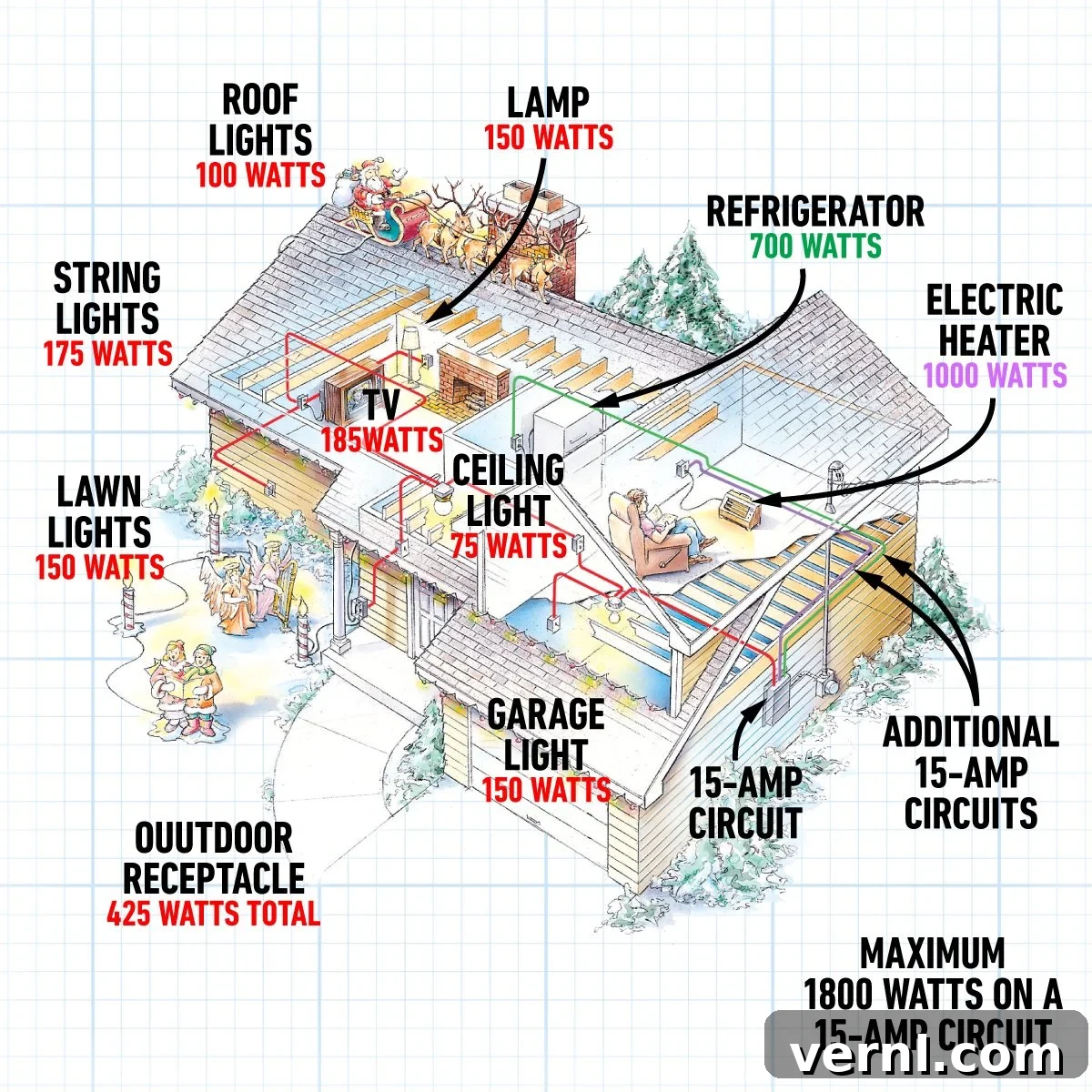
When considering any electrical modifications, especially adding new circuits, it’s paramount to understand the capacity of your main electrical panel. The panel is the heart of your home’s electrical system, distributing power safely to all circuits. Adding new circuits inherently increases the total electrical load on the panel, and it is crucial that this cumulative load does not exceed the panel’s maximum rated capacity. Ignoring this fundamental principle can lead to severe safety hazards, including overheating of the main panel components and a complete system shutdown.
The electrical load represents the total amount of current drawn by all devices, appliances, and lighting fixtures demanding power at any given time. While this sounds straightforward, electricians utilize a detailed and somewhat complex methodology to accurately calculate the total electrical load. This calculation considers both continuous loads (such as electric heat or air conditioning) and non-continuous loads (like a toaster or microwave), along with future expansion. Unless you possess specific expertise in electrical engineering or have a deep understanding of the National Electrical Code (NEC) guidelines, it’s highly recommended to hire a licensed electrician. They can expertly evaluate your current electrical load, factor in any proposed additions, and definitively determine if your panel can safely accommodate increased demand.
Determining your electrical panel’s capacity, on the other hand, is usually a simpler task. This capacity is clearly indicated by the amperage rating of the main circuit breaker, which serves as the primary safeguard for your entire electrical system, tripping to shut off power to the whole house in the event of an extreme overload. According to the National Electrical Code (NEC), residential electrical panels must have a minimum capacity of 100 amps. However, for most new constructions today, the standard capacity is 200 amps. A 200-amp service is generally considered sufficient to comfortably support a modern home’s electrical needs and typically allows for the addition of several new circuits without requiring a major upgrade. In contrast, many older homes that have never undergone an electrical upgrade might still operate with panels rated for 60 amps or even less. These older panels are often inadequate for contemporary electrical demands, making any significant additions problematic.
To ensure both safety and code compliance, the NEC stipulates that the total electrical load on your panel should not exceed 80 percent of its stated capacity. This 80% rule provides a critical safety buffer, preventing the panel from operating at its absolute maximum capacity for extended periods, which can cause premature wear and potential failure. Therefore, if your proposed new circuit would push your total calculated load beyond this 80 percent threshold, upgrading your entire electrical panel is not just advisable, but often a necessary step to maintain safety and comply with local electrical codes. An upgraded panel provides peace of mind, greater flexibility for future electrical needs, and enhanced safety for your family and home.
Ensuring Ample Space for a New Breaker in Your Panel
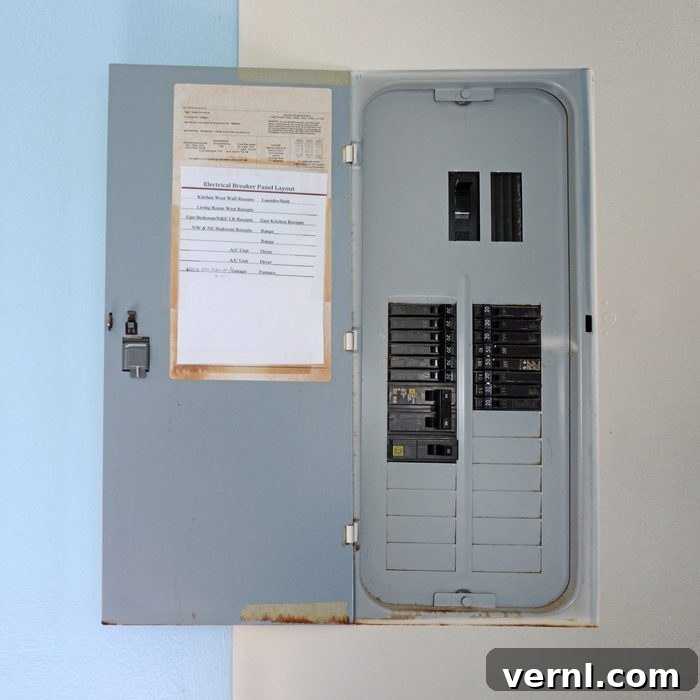
Each individual electrical circuit in your home is protected by its own circuit breaker housed within the main electrical panel. These breakers are typically arranged vertically in two columns. Some breakers are dedicated to controlling specific, high-power appliances like electric ovens or water heaters, while others manage multi-use circuits that power lights and receptacles in various rooms. For common household multi-use circuits, breakers are typically rated for either 15 or 20 amps. If your goal is to add a new general-purpose receptacle circuit to mitigate overloads, you will need to install a new single-pole breaker of either 15A or 20A, depending on the circuit’s design requirements.
A significant practical consideration when planning to add a new circuit is the physical space available within your electrical panel. Panels, regardless of their overall amperage capacity, have a finite number of slots for breakers. While the NEC permits up to 42 circuit breakers in a 100-amp panel, the vast majority of residential panels are smaller and are designed to accommodate 20 or fewer breakers. Many older homes might even have panels with as few as 12 to 16 slots. If your current panel is already at its maximum capacity, with all available slots filled, then adding another circuit necessitates a more substantial upgrade: replacing your existing panel with a larger one that has more breaker slots, or in some cases, installing a sub-panel. This ensures that you have the physical infrastructure to support your expanding electrical needs safely and efficiently.
Can You Safely Swap a Breaker for One With a Higher Amperage Rating?
A common scenario leading homeowners to consider a breaker swap is when a 15-amp circuit breaker frequently trips due to an overload. The immediate thought might be to simply replace it with a higher-rated 20-amp breaker to prevent further trips. While this might seem like a simple solution, it carries significant safety implications and is only sometimes permissible.
The crucial factor governing whether you can upgrade a breaker’s amperage is the gauge (thickness) of the electrical wire connected to that circuit. Circuits rated for 15 amps are typically wired with 14-gauge wire. In contrast, 20-amp circuits require a thicker, 12-gauge wire to safely carry the higher current without overheating. You absolutely cannot replace a 15-amp breaker with a 20-amp breaker if the circuit is wired with 14-gauge wire. Doing so would allow more current than the wire is safely designed to handle, leading to severe overheating of the wires, potential melting of insulation, and a high risk of fire within your walls. This is a direct violation of electrical codes and a grave safety hazard.
Some electricians, recognizing this common dilemma and aiming for future flexibility, exclusively use 12-gauge wire when wiring all 120-volt circuits in a new home. If your entire home has been wired with 12-gauge wire for all its general-purpose circuits, then theoretically, you might be able to upgrade a 15-amp breaker to a 20-amp one. However, this is not a decision to be made lightly or without professional consultation. For paramount safety, you must have a licensed electrician thoroughly inspect and evaluate the specific circuit in question. They will confirm the wire gauge, assess the condition of the wiring, and determine if an amperage upgrade can be safely and legally performed without compromising your home’s electrical integrity.
Strategically Redistributing Electrical Loads Among Existing Receptacles
One of the most immediate and common ways to address a circuit overload is to redistribute the electrical loads. This involves moving one or more high-draw devices from an overloaded circuit to another circuit that has sufficient capacity. This usually means little more than unplugging a device from one outlet and plugging it into another on a different circuit. However, there’s a critical caveat: you must avoid simply overloading a different circuit. To do this safely and effectively, you need to understand which devices are on which circuits throughout your home, which often requires a bit of investigative work.
Mapping Your Home’s Electrical Circuits: The Detective Work
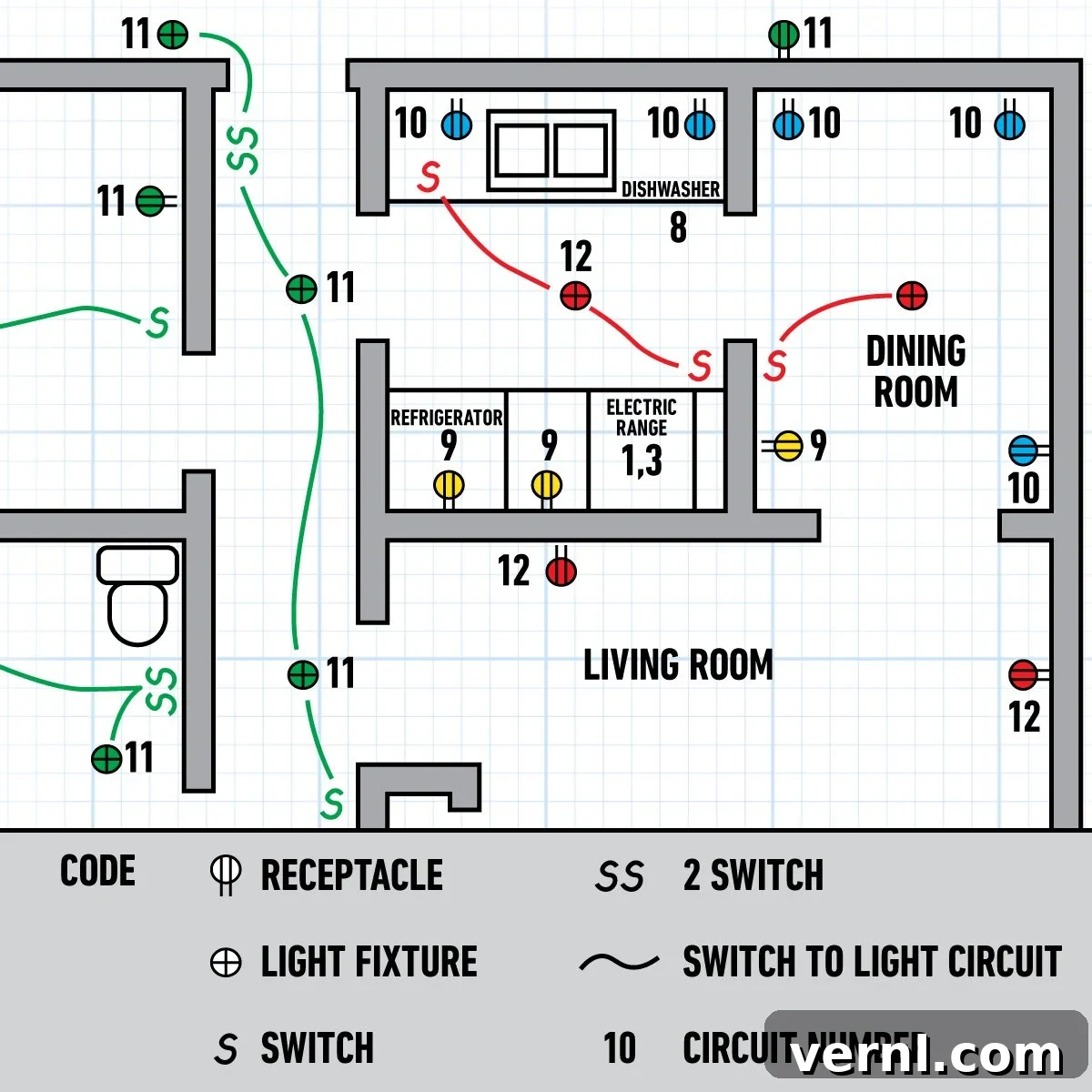
The labels on your main electrical panel are the logical starting point for tracing your home’s circuitry. Ideally, a well-indexed panel will have clear labels next to each circuit breaker (or on the inside of the panel door) that provide a general description of what that circuit powers. For instance, a label might read “Kitchen Counter” or “Master Bedroom Lights.” Unfortunately, these labels often lack precise detail, or worse, they may be outdated, illegible, or completely missing. In such cases, you will need to meticulously map out each circuit yourself to gain a clear understanding of its coverage and connected devices.
To accurately trace a circuit, follow these steps: First, ensure you have a reliable voltage tester or an outlet tester. Go to your main panel and turn off the circuit breaker you wish to trace (or carefully unscrew the fuse if you have an older fuse box). Next, systematically move through your entire home. In each room, test every single outlet by plugging in a small lamp or an outlet tester. Flip on all light switches and try any permanently plugged-in devices (like a TV or computer). It’s crucial to test both the upper and lower receptacles of standard duplex outlets, as they are occasionally wired to separate circuits, especially in older installations. Always confirm that any switched receptacles are in the “on” position before testing them. Don’t forget to check outdoor lights and receptacles as well. Any outlets or lights that no longer work are connected to the circuit you have turned off. As you go, meticulously record your findings. A simple floor-plan diagram can be immensely helpful for noting which receptacles and lights are controlled by each breaker, preventing confusion and ensuring no locations are missed. This detailed mapping is invaluable for future troubleshooting and load balancing.
Accurately Calculating Your Circuit Load for Safety
Once you have painstakingly mapped out which devices, including all lights and receptacles, are connected to a particular circuit, the next step is to calculate the total electrical load for that circuit, typically expressed in watts. This calculation helps you understand if the circuit is operating within safe limits or if it’s prone to overloads. The wattage rating for incandescent light bulbs is usually printed directly on the bulb. For most appliances and electronic devices that are permanently plugged into a circuit (such as a television, gaming console, or even a desktop computer), you can find a label on the back or bottom indicating its wattage rating. Simply add up the wattage ratings of all continuous or regularly used devices connected to that specific circuit. Devices that are only plugged in temporarily and infrequently, such as a vacuum cleaner or a power drill, generally do not count towards this continuous load calculation.
For standard residential circuits, the maximum allowed wattage on a 15-amp circuit is 1,800 watts (15 amps x 120 volts), and for a 20-amp circuit, it’s 2,400 watts (20 amps x 120 volts). However, for enhanced safety and to comply with the National Electrical Code’s best practices, you should adhere to the 80-percent rule. This rule dictates that a circuit should only be loaded to 80% of its maximum capacity for continuous use. Applying this, the practical maximum wattage for a 15-amp circuit becomes 1,440 watts, and for a 20-amp circuit, it is 1,920 watts. Adhering to this 80% rule provides a crucial safety margin, preventing circuits from operating at their absolute limits and reducing the risk of overheating and tripped breakers.
- Pro Tip: Dedicated Circuits for High-Draw Appliances: Any single device or appliance that consistently draws more than half of the allowed maximum wattage for a multipurpose circuit should ideally have its own dedicated circuit. This includes appliances like refrigerators, microwave ovens, washing machines, dishwashers, and often hair dryers used in bathrooms. Dedicated circuits prevent these high-power items from overloading general-purpose circuits and ensure their reliable operation.
After carefully calculating the loads on all your general-purpose circuits, you can then strategically redistribute the plug-in devices to ensure that no single circuit exceeds its maximum allowed wattage, especially considering the 80% rule. While this redistribution is a vital step in managing existing overloads, it’s not always the most convenient or practical long-term solution. You might find that the power outlets you need are still too far from the available capacity, or that you simply lack enough circuits. In such cases, the next logical step is to consider adding a new circuit or installing new outlets to bring power precisely where it’s needed.
The Process of Adding a New Electrical Receptacle
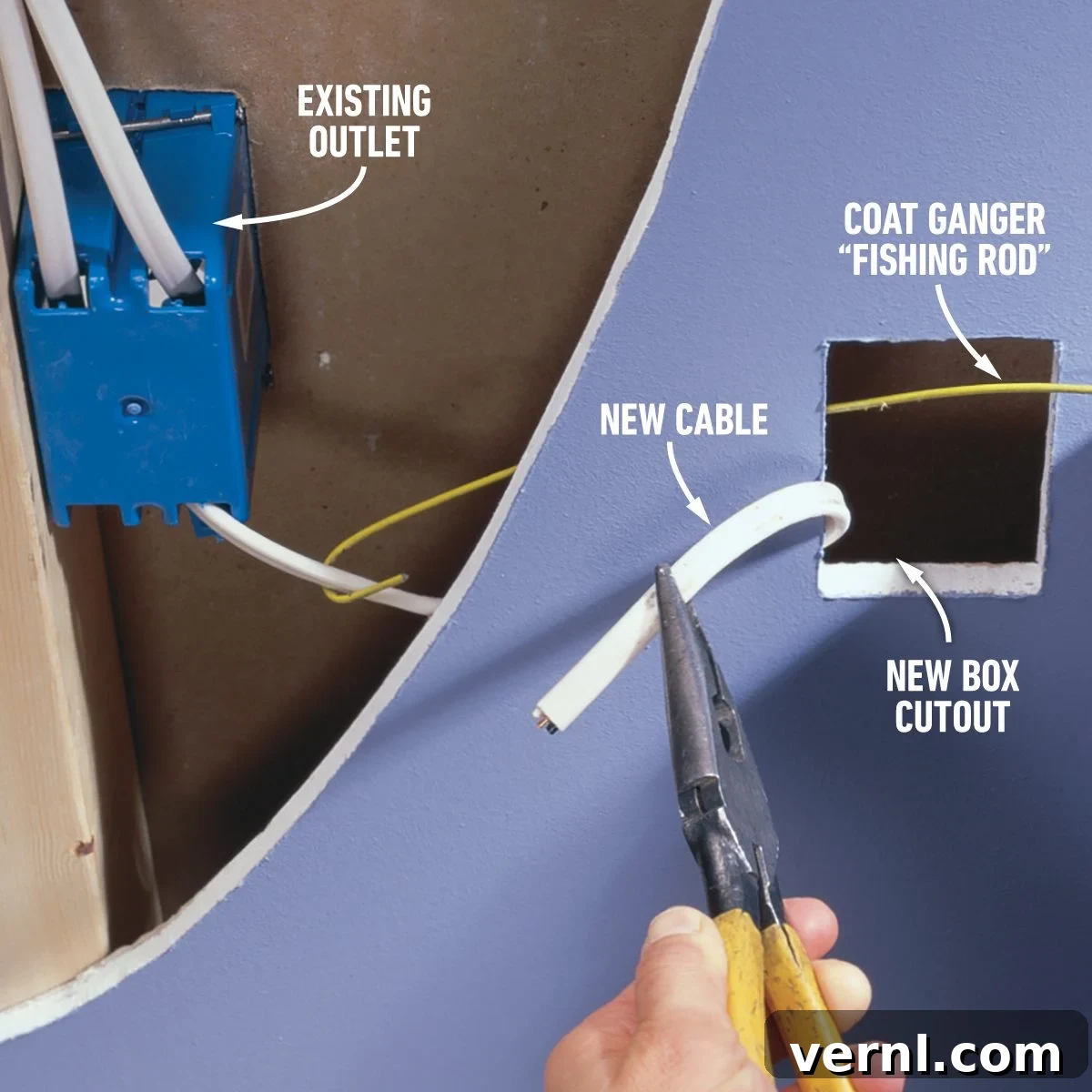
Adding a new electrical receptacle can significantly improve convenience and help alleviate circuit overloads. The simplest approach for adding a new outlet is to identify an existing circuit that has sufficient spare capacity and also features a conveniently located junction box from which to “tap in” or extend the circuit. Sometimes, you can extend directly from an existing wall outlet, provided it’s on an appropriate circuit. If that’s not feasible, often you can find easier access points in an unfinished basement, where wiring runs might be exposed, making it possible to tap into a light fixture box or a switch box. Alternatively, if your basement isn’t unfinished, the attic can be another viable option. Junction boxes in most accessible attics are frequently buried beneath insulation, so you’ll likely need to carefully rake the insulation aside to locate them. (Always wear a dust mask, protective goggles, and long sleeves if you undertake this, as insulation can be irritating.) Begin your search for junction boxes near the attic access hole or directly above ceiling light fixtures in the rooms below, as these are common wiring hubs. Critically, ensure that the power to the light box comes directly from the panel, not through a wall switch, as this provides a constant hot feed for your new receptacle.
- Caution: Inspect and Test Carefully: Electrical boxes, especially older ones, might contain wires from multiple circuits. Before touching any wires, always use a reliable voltage tester to meticulously confirm that the power to all wires within the box is completely off. Even if you’ve turned off what you believe is the correct breaker, always double-check. Electrical shock can be fatal.
- Pro Tip: Box Capacity is Key: It’s essential to ensure that the existing electrical box you plan to tap into is adequately sized to accommodate the additional new cable and its associated wiring connections. Wires packed into a box that is too small can lead to overheating, creating a fire hazard. There are specific NEC fill limits for electrical boxes based on wire gauge and number of conductors. If the wiring within an existing box appears complicated, overcrowded, or you’re uncertain about its capacity, it is always safer and wiser to find an alternative box or, better yet, enlist the expertise of a licensed electrician to make the connections safely.
If, after careful investigation, you cannot locate an existing circuit with enough spare capacity and a convenient tap-in point, or if the existing wiring is too complex or old, then running an entirely new circuit directly from the main electrical panel is often the safest and most effective solution. This approach provides a dedicated power source for your new receptacles, minimizing future overload risks. This, however, assumes your main panel has the necessary capacity and available space for a new breaker, as discussed earlier. While you might be able to install the new outlet yourself and run the new electrical cable back to the main panel through walls, ceilings, or conduit, the critical and dangerous step of making the final hook-up inside the electrical panel should always be left to a licensed electrician. Working inside the main electrical panel exposes you to the un-switched main power lines, which carry extremely high voltage and amperage, posing a severe risk of electrocution or fire. Trust this intricate and hazardous task to a qualified professional.
Prioritizing Safety in All Electrical Endeavors
Whenever you undertake any electrical project in your home, from installing a new outlet to upgrading your electrical panel, the paramount consideration must always be safety. A crucial step in ensuring safety and compliance is to apply for an electrical permit from your local building inspections department. This isn’t merely a bureaucratic formality; it’s a vital safeguard. The permit process ensures that your work will be inspected by a qualified professional, verifying that proper techniques have been used, current electrical codes are followed, and the overall electrical plan for your home is sound and safe. Inspections protect you, your family, and your property from the significant risks associated with improper electrical installations, such as fire hazards, electrical shock, and equipment damage. Always remember that cutting corners on electrical work can have catastrophic consequences.
Understanding overcurrent protection is fundamental to maintaining a safe electrical system. It refers to the devices, primarily circuit breakers and fuses, designed to protect electrical circuits from currents that exceed the acceptable maximum for the circuit’s components. Proper overcurrent protection prevents wires from overheating, safeguards appliances, and is the front line of defense against electrical fires.
Meet Our Electrical Expert
- John Williamson is a highly respected master electrician with extensive experience. He is also the retired chief electrical inspector for the Minnesota Department of Labor and Industry, bringing a wealth of knowledge and practical insight into electrical safety and code compliance.
[cf]skyword_tracking_tag[/cf]