Understanding Wood Durability: The Indispensable Janka Hardness Scale
Every woodworker, regardless of experience level, has likely encountered the heartbreaking moment when a cherished project suffers an unexpected dent or scratch. Imagine pouring hours into crafting a beautiful coffee table, only for it to be marred by a dropped item, a playful pet, or an enthusiastic guest’s footwear. This scenario is all too common and often stems from a fundamental misunderstanding of a critical wood property: its hardness.
I distinctly recall the disappointment of my first major woodworking piece – a cypress coffee table. Despite its aesthetic appeal, it quickly bore the unfortunate imprint of a friend’s boot. At the time, I assumed all wood possessed a similar resilience, an assumption that proved costly. The truth is, just as wood varies in grain patterns, colors, and growth characteristics, it also varies dramatically in density and resistance to indentation. My cypress table, while beautiful, was simply too soft for its intended use, a fact I only learned through a painful lesson.
To avoid similar heartaches and ensure your woodworking projects stand the test of time, it’s crucial to understand the Janka Hardness Scale. This invaluable tool empowers woodworkers, designers, and homeowners to make informed decisions, ensuring the right wood is chosen for the right application. Let’s delve into the specifics of this essential scale so you can confidently select materials that match your project’s durability requirements.
What Exactly Is the Janka Hardness Scale?
At its core, the Janka Hardness Scale serves as the global standard for measuring the resistance of wood to denting and wear. It provides an objective and quantitative assessment of wood density, offering a tangible number that represents a species’ ability to withstand impact and everyday use. The test itself is meticulously standardized to ensure consistent and comparable results across various wood types and testing facilities.
The Janka test involves a precise procedure: a .444-inch (11.28mm) diameter steel ball is embedded halfway into a piece of wood. The specific force required to achieve this depth is then recorded. In the United States, this force is typically expressed in pounds-force (lbf), while in other parts of the world, it may be measured in kilograms-force (kgf) or newtons (N). Regardless of the unit, the principle remains the same: a higher Janka rating indicates a harder, more dent-resistant wood, while a lower rating signifies a softer, more susceptible material.
This standardized measurement is vital because it moves beyond subjective descriptions of “hard” or “soft,” providing a universal language for wood properties. Without such a scale, comparing the durability of different wood species would be largely guesswork, leading to costly errors and unsatisfactory project outcomes. The Janka rating acts as a reliable benchmark, guiding material selection for everything from flooring to fine furniture, ensuring that the chosen wood possesses the intrinsic strength required for its intended purpose.
The Origins of the Janka Hardness Scale: A Legacy of Precision
The Janka Hardness Scale owes its existence to the pioneering work of Austrian wood researcher Gabriel Janka. In 1906, Janka introduced the hardness test that would eventually bear his name, revolutionizing the way wood properties were assessed. His motivation stemmed from a critical need within burgeoning industrial applications of wood. As wood became a more widely used material in construction and manufacturing, there was an increasing demand for an objective, reliable, and repeatable method to evaluate its physical characteristics, particularly its density and resistance to mechanical stress.
Janka adapted and refined existing methods used for testing the hardness of metals, tailoring the approach to suit the unique fibrous structure of wood. His ingenuity led to the creation of a testing protocol that proved remarkably effective and enduring. By establishing a standardized test with specific parameters (like the size of the steel ball and the depth of penetration), Janka provided the industry with a scientific means to compare and select wood based on its inherent hardness. This innovation was transformative, moving wood selection from anecdotal experience to empirical data, a legacy that continues to benefit woodworkers and engineers alike over a century later. The higher the number derived from his test, the greater the material’s resistance to indentation, signifying enhanced durability.
Why the Janka Hardness Scale is Indispensable for Every Woodworker and Homeowner
Understanding the Janka Hardness Scale is far more than an academic exercise; it’s a practical skill that can save you time, money, and heartache on countless projects. Whether you’re a seasoned professional or a weekend DIY enthusiast, integrating Janka ratings into your material selection process is a game-changer. I personally consult this scale regularly when making critical material decisions, and here are several compelling reasons why you should too:
Beyond the Misleading Labels: Hardwood vs. Softwood Clarified
One of the most common misconceptions in woodworking revolves around the terms “hardwood” and “softwood.” Many novices assume these labels directly correspond to a wood species’ actual hardness, which is often not the case. Botanically speaking, “hardwood” refers to wood from deciduous trees – those that lose their leaves annually (e.g., oak, maple). “Softwood,” conversely, comes from coniferous trees, which are typically evergreens (e.g., pine, cedar).
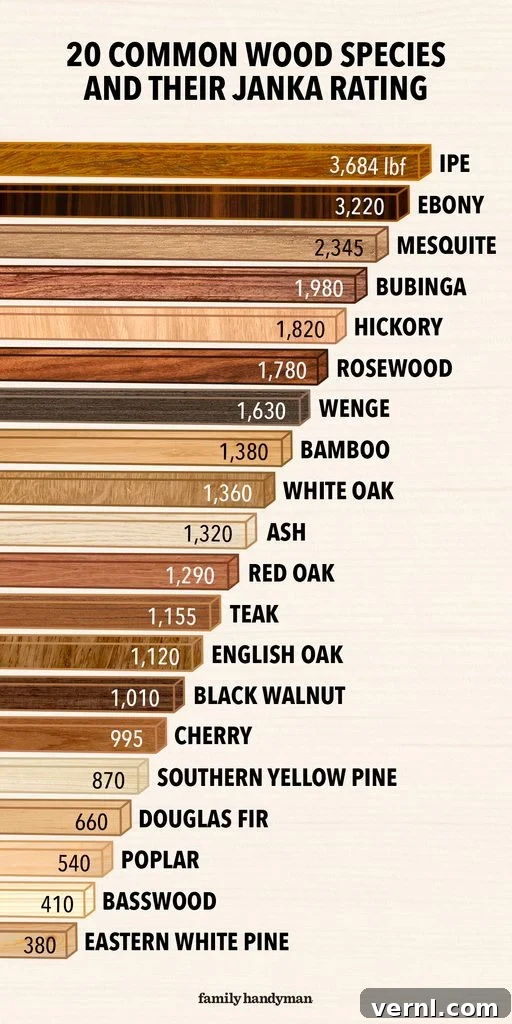
While deciduous trees generally tend to be denser and thus harder than conifers, there are significant exceptions. Take basswood, a deciduous hardwood with a surprisingly low Janka rating of around 410 lbf. It’s often chosen for carving due to its uniform consistency and ease of manipulation, despite being botanically a “hardwood.” In contrast, Western white pine, a coniferous softwood, boasts a slightly higher Janka rating of approximately 420 lbf. This example clearly illustrates that relying solely on the “hardwood” or “softwood” label can be misleading. The Janka scale provides the objective data needed to avoid choosing a “soft hardwood” when durability is a primary concern, or conversely, overlooking a “hard softwood” that might be perfectly suitable for a less demanding application.
Selecting the Perfect Wood for Optimal Project Performance
The Janka Hardness Scale is your ultimate guide to matching wood characteristics with project requirements. Different applications demand varying degrees of durability, and the Janka rating offers a clear metric for making the right choice:
- Flooring: This is arguably where Janka ratings are most critical. Floors endure constant foot traffic, furniture movement, and the occasional dropped item. While reclaimed hemlock might offer a rustic aesthetic, its Janka rating of around 500 lbf suggests it might not withstand the rigors of a busy household. To put it in perspective, woods with Janka ratings below 1,000 lbf can often be dented with a thumbnail. If your home features pets, children, or heavy-duty footwear, opting for a species like white oak (1,360 lbf) or hickory (1,820 lbf) will provide significantly greater resistance to dents and scratches, ensuring your investment lasts for decades. For high-traffic commercial spaces, even harder woods like Brazilian Cherry (2,350 lbf) or Ipe (3,510 lbf) might be preferred.
- Tabletops and Countertops: Dining tables, coffee tables, and kitchen island tops are prone to impacts from dishes, cutlery, and daily activities. A Janka rating of at least 1,000-1,200 lbf is generally recommended for these surfaces. Woods like hard maple (1,450 lbf), red oak (1,290 lbf), or even some varieties of walnut (1,010 lbf) offer a good balance of durability and workability for furniture that needs to withstand regular use.
- Outdoor Furniture: While weather resistance is a primary concern for outdoor pieces, impact resistance also plays a role. Woods like teak (1,000 lbf) or Ipe (3,510 lbf) not only resist rot and insects but also offer excellent hardness against bumps and scrapes, making them ideal for durable patio sets.
- Cabinets and Doors: These elements experience frequent opening, closing, and incidental contact. While not as critical as flooring, a moderately hard wood (e.g., cherry at 950 lbf or birch at 1,260 lbf) helps prevent dings and ensures the surfaces maintain their appearance over time.
- Workbenches: For a workbench top, extreme hardness is often desirable to resist tool drops and heavy impacts. Woods like rock maple (1,450 lbf) or even specialized hardwoods are excellent choices for a resilient work surface.
Exploring the Extremes: The Softest and Hardest Woods on Earth
The Janka Hardness Scale reveals an astonishing range of wood properties, from the incredibly soft to the astonishingly dense.
On the softer end of the spectrum, we find Balsa, often crowned as the softest wood in the world. With an incredibly low Janka rating of just 70 lbf, balsa is more akin to compressed cardboard than traditional timber. Its extreme softness and light weight make it unsuitable for most structural or furniture applications, but perfectly suited for insulation, buoyancy (life rafts, model aircraft), and crafting where ease of cutting is paramount. I’ve personally experienced how easily particularly soft pieces can be crushed by hand, illustrating its minimal resistance to impact.
Conversely, the hardest wood known to humankind is the formidable Australian Buloke. Hailing from Australia, this ironwood boasts an astounding Janka rating of 5,060 lbf – a number so high it surpasses the hardness of many types of stone. Working with Australian Buloke presents significant challenges; its extreme density can severely damage woodworking machinery, rapidly dulling blades and bits. While its unparalleled hardness might seem appealing for ultimate durability, the practical difficulties and tool wear involved often make it impractical for most conventional woodworking projects. It serves more as a testament to the incredible diversity of natural materials than a common building material.
Other exceptionally hard woods include Lignum Vitae (4,500 lbf), widely known for its self-lubricating properties and use in propeller shaft bearings, and Quebracho (4,570 lbf), an incredibly dense South American wood historically used for railroad ties and tannin extraction.
Making Confident Choices with the Janka Scale
The journey of a woodworker, from novice to expert, is filled with learning and discovery. Understanding the Janka Hardness Scale is a fundamental step in mastering material selection, moving beyond guesswork to informed decisions. It empowers you to predict how your chosen wood will perform, ensuring your projects are not only beautiful but also built to last.
By consulting the Janka rating, you gain the confidence to select woods that truly align with the demands of each specific application, whether it’s a bustling kitchen floor, a delicate decorative carving, or a sturdy outdoor bench. This knowledge prevents costly mistakes, maximizes the longevity of your creations, and ultimately enhances your satisfaction as a craftsperson. Embrace the Janka Hardness Scale as an essential tool in your woodworking arsenal, and transform the way you approach every project, guaranteeing durability, resilience, and lasting beauty.