Transforming your backyard into a personal oasis with a swimming pool is an exciting prospect, but the journey to crystal-clear water starts with a crucial decision: selecting the right pool filter. Far from being interchangeable, the three primary types of pool filters—DE (Diatomaceous Earth), Sand, and Cartridge—each operate on distinct principles, requiring different equipment and maintenance approaches. Understanding these differences is paramount for any pool owner seeking optimal water quality and efficient pool operation.
As you embark on discussions with various pool contractors, you’ll quickly find that each professional often has a preferred filter system. Empowering yourself with knowledge about each option allows you to engage in informed conversations, weigh the pros and cons against your specific needs, budget, and lifestyle, and ultimately make the best long-term choice for your swimming pool.
To provide a comprehensive overview, we consulted Brian Wells, a seasoned expert at Leslie’s Pools. Wells meticulously detailed the characteristics, benefits, and drawbacks of DE, sand, and cartridge pool filters, offering invaluable insights to guide prospective and current pool owners through this essential decision-making process.
DE Pool Filters: Unrivaled Clarity and Performance
DE stands for diatomaceous earth, a remarkable naturally occurring sedimentary rock composed of fossilized diatoms. When crumbled, it forms a fine, porous powder with exceptional filtration capabilities. Within a DE pool filter, this powder adheres to fabric-covered grids inside the filter tank, creating a microscopic filter bed that can capture even the tiniest particles, often down to 1-3 microns. This unparalleled filtration precision is what sets DE filters apart, delivering the most pristine and sparkling pool water possible.
According to Wells, many discerning pool owners and professionals highly favor DE filters precisely because of their superior ability to remove the smallest suspended particles from the water. This results in an unmatched level of clarity, making your pool water truly inviting. Furthermore, the process of maintaining a DE filter, which involves replacing the DE powder after each backwash cycle, is straightforward once you’re familiar with the steps.
While DE filters are most commonly associated with in-ground pools due to their higher initial cost and sophisticated design, models are also available for above-ground pools, allowing a wider range of owners to benefit from their exceptional performance. It’s true that the upfront investment for a DE filter system is typically higher than for sand or cartridge alternatives. However, as Wells points out, this initial expenditure is often justified by the filters’ outstanding ability to provide superior filtration, leading to cleaner water and potentially reducing the need for other chemical treatments over time. The long-term benefits of crystal-clear water and efficient particle removal often outweigh the initial cost considerations for those prioritizing the highest water quality.
Sand Pool Filters: The Workhorse of Simplicity and Durability
Sand pool filters represent a time-tested and widely adopted solution for pool filtration. This system features a robust, large tank filled with specialized filter sand, typically silica sand, which acts as the primary filtering medium. The filtration process is elegantly simple: water from the pool is drawn by the pump and enters the top of the filter tank. The pool pump then efficiently pushes this water down through the dense bed of sand inside. As the water percolates through the granular sand, microscopic pores and the irregular surfaces of the sand grains trap debris, dirt, and impurities. The now filtered and cleaned water is then returned to the pool, completing the cycle.
Wells highlights several compelling reasons why sand filters remain a popular choice among pool owners and professionals. Their inherent durability makes them resilient to various conditions, ensuring a long operational life. They are also remarkably easy to operate, often requiring little more than turning a valve for routine maintenance like backwashing. Furthermore, sand filters are considered fairly low maintenance, especially when compared to the more frequent requirements of DE filters. The filter sand itself boasts an impressive lifespan, typically needing replacement only every three to five years, or even longer with diligent care and proper cleaning protocols. This longevity contributes significantly to their cost-effectiveness over time.
One of the most attractive aspects of sand filters is their affordability. Compared to other advanced filtration systems, they generally have the lowest purchase price, making them an accessible option for many pool owners. However, Wells notes a trade-off: sand filters may not offer the same ultra-fine level of filtration as DE or cartridge filters, typically filtering down to 20-40 microns. To achieve enhanced water clarity and combat smaller particles that might escape a standard sand filter, he frequently recommends incorporating an alternate filter media type, such as Zeolite, or using a pool clarifier. These additions can significantly boost the filtration efficiency, allowing sand filters to deliver water quality that rivals more expensive systems while retaining their core benefits of durability and ease of use.
P.S. Knowing the best pool shock treatments to clean your pool will also come in handy, regardless of your filter type, to maintain optimal water chemistry and clarity.
Cartridge Pool Filters: Energy Efficiency and Water Conservation
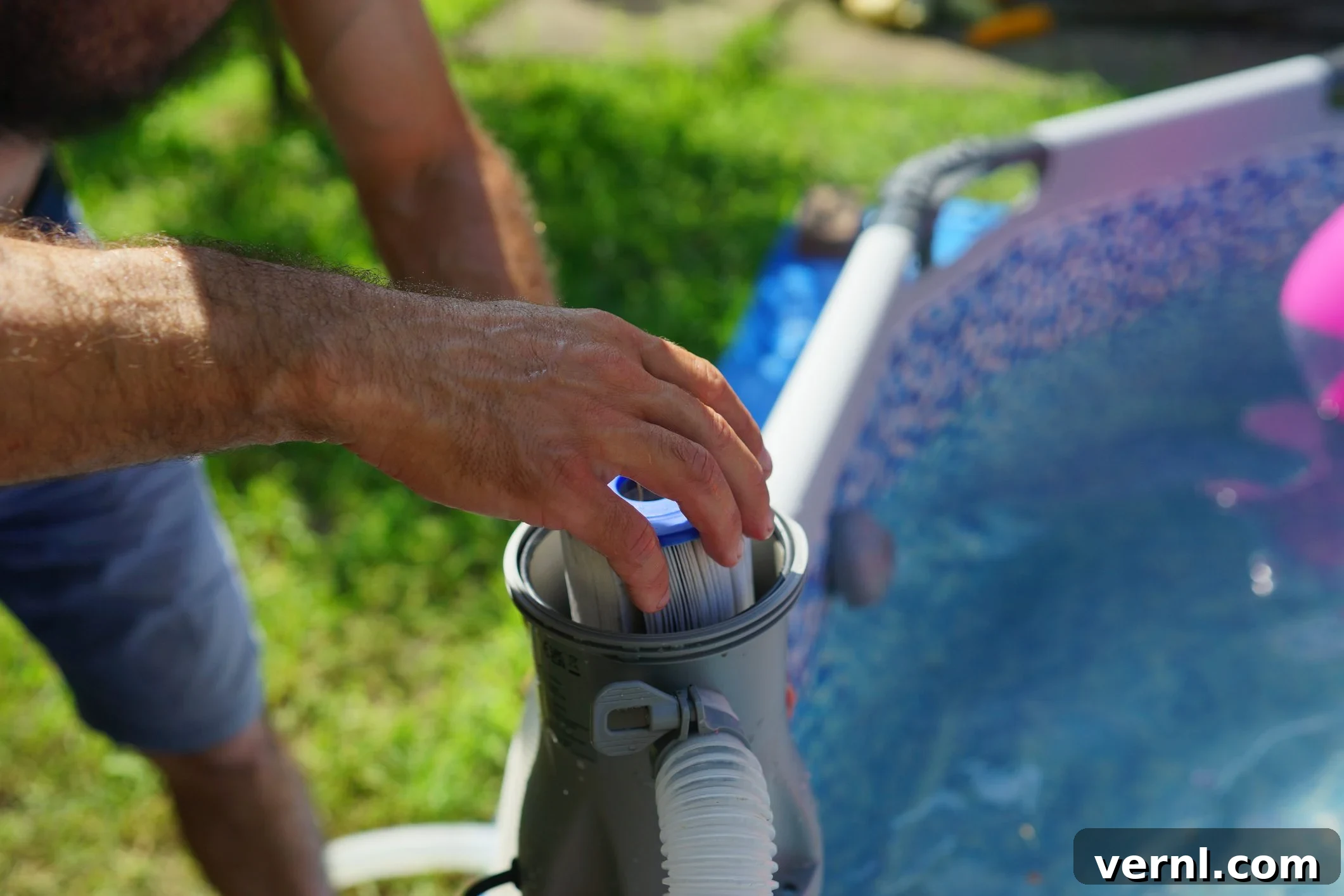
Cartridge pool filters offer a modern and increasingly popular filtration solution, characterized by their innovative design. These systems typically involve one or more cylindrical filter cartridges, meticulously constructed from pleated, fabric-like material, often a polyester or spun-bonded polypropylene. These cartridges are housed within a tank, and as water flows from the pool into the tank, it is forced through the fine pleats of the cartridge material before cycling back into the pool. This design effectively captures debris and impurities, delivering clean water with remarkable efficiency.
Wells explains a key advantage of cartridge filters: “Although cartridge filters tend to be narrower [than other filter types], the long rows of pleats allow the water to filter over a much larger surface area.” This expansive surface area is crucial because it significantly reduces the pressure on the pool pump. A lower operating pressure means the pump doesn’t have to work as hard, which translates directly into less energy consumption and extended pump lifespan. This inherent energy efficiency makes cartridge filters an environmentally friendly and cost-effective choice for many pool owners.
The popularity of cartridge filters stems from several compelling benefits. Wells highlights that “they’re the most energy-efficient option, they’re simple to replace, they help conserve water without the need to backwash, and they work great for both in-ground and above-ground pools.” The absence of backwashing is a significant advantage, as it eliminates the wasteful discharge of thousands of gallons of water, a common necessity with DE and sand filters. This water conservation aspect is particularly appealing in regions facing water restrictions or for environmentally conscious individuals.
When comparing filtration ability and overall costs, Wells positions cartridge filters as an ideal “middle ground.” He notes that “cartridge filters land between sand filters and DE filters, which is a nice middle ground that meets the needs of most pool owners.” They typically filter down to 10-25 microns, offering better filtration than traditional sand filters without the higher operational complexities and costs associated with DE filters. This balance of performance, efficiency, and ease of maintenance makes them a versatile and appealing choice for a wide spectrum of pool owners.
Mastering Pool Filter Cleaning: Essential Maintenance for Longevity and Clarity
Regardless of the type of pool filter you ultimately choose, one truth remains constant: routine cleaning and diligent maintenance are absolutely critical. Neglecting your filter can lead to diminished water quality, increased chemical consumption, higher energy bills due to an overworked pump, and significantly shorten the lifespan of your filtration system. A clean filter is the cornerstone of a healthy, sparkling pool.
While you might plan to undertake regular cleaning tasks yourself, we strongly advocate for an initial hands-on demonstration from a qualified pool professional. This guided session will ensure you understand the specific nuances of your system, learn proper safety procedures, and gain confidence in performing the necessary maintenance. Ideally, your pool technician can provide a video or written tutorial, or you can take meticulous notes during their explanation to serve as a future reference.
Cleaning DE Pool Filters: Precision for Superior Filtration
DE filters, known for their superior filtration capabilities, do require a slightly more involved routine cleaning process compared to sand or cartridge filters. However, this effort is well worth it for the pristine water quality they provide. Basic cleaning should be performed approximately once a month during the swimming season, with a more thorough deep cleaning recommended prior to pool winterization or if you notice a significant drop in pressure or water clarity. The basic cleaning steps are as follows:
- Initiate a Backwash Cycle: Begin by running your pool through its backwash cycle. This process reverses the flow of water through the filter, dislodging and flushing out accumulated debris, including larger particles like leaves and smaller microscopic contaminants. This step is crucial for clearing the filter grids of the bulk of the collected dirt.
- Remove and Clean Grids: After backwashing, turn off the pump and safely relieve any residual pressure in the filter tank. Carefully remove the manifold and the individual fabric-covered DE grids. It’s essential to handle these grids gently to avoid damage. Use a garden hose with good pressure to thoroughly rinse off each grid, ensuring all remaining DE powder and trapped debris are dislodged. Inspect the grids for any tears or damage during this process.
- Recharge with New DE Powder: Once the grids are clean and reassembled within the filter tank, it’s time to recharge the filter. Prepare a slurry by mixing the appropriate amount of new DE powder with water in a bucket (always refer to your filter’s manual for precise ratios). Carefully pour this DE solution into the skimmer, allowing the pool pump to draw it into the filter tank, where it will coat the grids and recreate the filtering surface. Ensure the pump is running on the filter setting during this process.
Cleaning Sand Pool Filters: The Simplicity of Backwashing
Routine cleaning for sand pool filters is notably simpler and primarily involves running a backwash cycle. This process is essential for flushing out the accumulated dirt and debris trapped within the sand bed, restoring its filtration efficiency. Unlike DE filters, which require fresh DE powder after every backwashing, the filter sand itself only needs to be replaced every few years. The frequency of backwashing depends on several factors, including pool usage, bather load, and environmental debris, but typically ranges from once a week to once a month, or whenever the filter’s pressure gauge indicates a rise of 5-10 PSI above its normal operating pressure.
- Prepare for Backwash: Turn off your pool pump. Set your multi-port valve (the valve on top or side of your filter) to the “Backwash” position.
- Start Backwash Cycle: Turn the pump back on. You will observe dirty water being discharged through the waste line. Allow the backwash to continue until the water running through the sight glass (a clear dome on the valve) runs clear, usually for 2-5 minutes.
- Rinse Cycle (Crucial Step): Turn the pump off again. Set the multi-port valve to the “Rinse” position. Turn the pump on for 30-60 seconds. This step is vital to settle the sand bed and flush any residual dirt from the valve itself, preventing it from re-entering your pool.
- Return to Filter: Turn the pump off one last time. Set the valve back to the “Filter” position, and then restart your pump to resume normal filtration.
Cleaning Cartridge Pool Filters: Water-Wise and Efficient
Cartridge pool filters offer a distinct advantage over DE and sand filters: they do not require backwashing. This eliminates the significant water waste associated with backwashing, making them an excellent choice for water-conscious homeowners. Instead of backwashing, cleaning cartridge filters involves periodic removal and manual rinsing. For a comprehensive guide on how to clean cartridge pool filters, including steps for pool winterization, you can refer to detailed resources. However, essentially, routine cleaning means turning off your pump, safely relieving any pressure, removing the cylindrical cartridges from the filter tank, and rinsing them thoroughly with a garden hose to dislodge trapped debris. For deeper cleaning, especially during winterization or if buildup is severe, soaking the cartridges in a specialized cleaning solution is highly recommended.
Understanding Pool Filter Lifespan: Maximizing Your Investment
Understanding the expected lifespan of your pool filter components is crucial for planning replacements and budgeting for maintenance. Brian Wells provides valuable insights into how long you can anticipate your DE, sand, and cartridge pool filters to last, along with tips for extending their utility.
DE Filter Grids: The cloth-like inserts that hold the diatomaceous earth are the primary components responsible for filtration. These grids typically have a lifespan of three to four years before they begin to degrade, develop tears, or become permanently clogged, necessitating replacement. However, it is paramount to remember that the DE powder itself is a consumable item and must be replenished after every backwash cycle. Regular inspection of the grids during cleaning can help identify wear and tear early, preventing potential issues with water quality.
Sand Pool Filters: The specialized filter sand within the tank will eventually lose its sharp edges and become smooth or “polished” over time, reducing its ability to trap fine particles effectively. Consequently, the filter sand will need to be replaced every three to five years on average. Wells strongly recommends occasionally using a cleaning solution specifically designed for filter sand. These solutions help to dissolve and remove stubborn oil, mineral buildup, and organic matter that can coat the sand grains, maintaining their filtration efficiency and potentially extending their effective life. When it is finally time for replacement, Wells advocates for considering Zeolite sand filter media. He explains that Zeolite “can provide up to 90% more efficient filtration than sand alone, rivaling the efficiency of diatomaceous earth.” While Zeolite costs more than traditional pool filter sand, its superior performance and longer lifespan (averaging four to six years) often make it a worthwhile upgrade, offering a significant boost in water clarity and reducing the frequency of replacement.
Filter Cartridges: Pool filter cartridges typically require replacement every two to three years. However, this interval can be shorter if you notice signs of damage such as tears, rips, or significant fraying during your routine cleaning and inspection. To maximize the lifespan and maintain the efficiency of your cartridges, Wells advises periodically soaking them in a dedicated cartridge cleaning solution. These solutions effectively break down oils, lotions, and other organic matter that can become embedded in the pleats, restoring the cartridge’s filtration capacity and allowing for easier rinsing. Proper handling, avoidance of high-pressure washing (which can damage the pleats), and consistent cleaning will help ensure your cartridges perform optimally for as long as possible.
Ultimately, the longevity of any pool filter system is heavily influenced by factors such as pool usage, local water chemistry, environmental conditions, and the diligence of your maintenance routine. Adhering to manufacturer guidelines and consistent cleaning practices will go a long way in ensuring your chosen pool filter system provides years of clean, sparkling water for your swimming enjoyment.