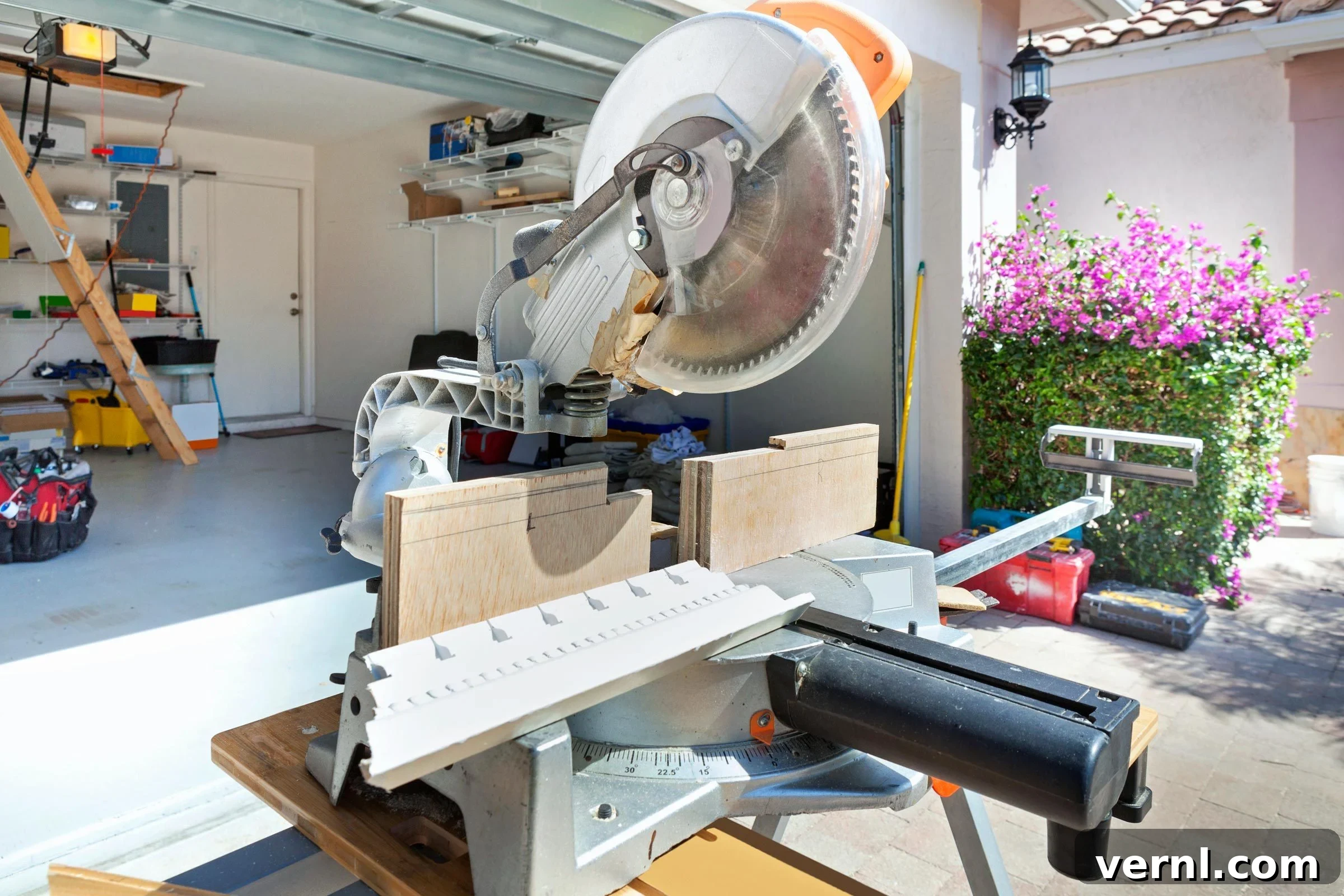
A miter saw is an indispensable tool in any serious woodworking or finish carpentry workshop, and it has also become incredibly popular with DIY enthusiasts across all skill levels. If you’re contemplating adding a miter saw to your power tool arsenal but feel overwhelmed by the numerous options, this comprehensive guide will equip you with the essential background information and crucial considerations needed to make an informed purchase. Understanding the nuances of this versatile machine can significantly enhance the precision and efficiency of your projects, from intricate trim work to robust framing.
What Exactly Is a Miter Saw?
At its core, a miter saw functions as a specialized cutting tool featuring a circular saw blade securely mounted on a hinge mechanism. This design allows the blade to be precisely swung down into the material, creating exceptionally clean and consistent cuts. The fixed hinge ensures that the blade always descends in a controlled motion, which is paramount for achieving accurate results and enhancing user safety.
While excelling at straightforward crosscuts (cutting across the width of a board) for perfectly flat ends, the miter saw’s true versatility shines through its ability to rotate its cutting head left and/or right. This rotation enables the blade to cut at various angles, known as miter cuts. This makes it an invaluable tool for fine woodworking, trim installation, picture framing, and any project requiring precise angled joints.
Miter saws are frequently recommended as excellent entry-level tools for newcomers to woodworking. A robust guard system typically encases the saw blade, offering a crucial layer of protection. The material to be cut is placed on the miter saw table and firmly pressed against the saw’s back fence – a vertical metal wall that provides essential support and ensures square cuts. This stable setup, combined with the relatively simple operation of a miter saw, is often perceived as far less intimidating than the exposed blades of a bandsaw or table saw. Furthermore, individuals with hand strength limitations often find a miter saw significantly easier to manage and operate than a handheld circular saw, which requires more physical control during the cut.
It’s important to emphasize that while miter saws offer enhanced safety features compared to some other saws, they are still powerful machinery. Like all power tools, especially saws, they must always be handled with the utmost respect and adherence to safety guidelines. Always wear appropriate personal protective equipment (PPE), such as safety glasses, and ensure the workpiece is properly secured before making any cuts.
While a miter saw undoubtedly offers superior precision and speed, many of its tasks can technically be accomplished manually using a miter box and a hand saw. Similarly, a circular saw can perform similar cuts, but achieving the same level of consistent precision and efficiency as a dedicated miter saw is considerably more challenging and time-consuming. For those looking to master this essential tool, here are a few miter saw tips and tricks to optimize your workflow and results.
Exploring the Different Types of Miter Saws
Miter saws are generally categorized by their blade size and the specific types of cuts they are capable of making, as well as their power source (corded or cordless). Understanding these distinctions is crucial for selecting the right tool for your specific project needs.
Standard Miter Saw
The most basic and fundamental type, a standard miter saw, is designed primarily for making miter cuts. This means its blade assembly can pivot or swing to either side, allowing you to cut angles, typically up to 45 or 50 degrees, both to the right and, in most cases, to the left. These saws are excellent for basic trim work, cutting framing lumber to length, and creating simple angled joints. Their simplicity often translates to a more affordable price point, making them a good entry-level choice for basic angled cuts.
Compound Miter Saw
Building upon the capabilities of a standard miter saw, a compound miter saw takes versatility a step further. Not only does it allow the blade to swivel left or right for miter cuts, but it also enables the entire blade assembly to tilt at an angle, creating what are known as bevel cuts. This dual-action capability allows you to make “compound cuts,” which are simultaneous miter and bevel angles – essential for complex crown molding, intricate trim, and other projects where two angles converge. Some compound miter saws offer the flexibility to tilt in only one direction, while others, known as “dual compound” or “dual bevel” miter saws, can tilt in both directions (left and right). Dual bevel models eliminate the need to flip the workpiece for opposing bevel cuts, saving time and improving accuracy.
Sliding Miter Saw
One of the primary limitations of both standard and compound miter saws is their restricted crosscut capacity, meaning the maximum width of material they can cut in a single pass. A sliding miter saw addresses this by incorporating a rail system that allows the blade and motor assembly to slide horizontally a short distance during the cut. This sliding action significantly increases the effective cutting width, allowing you to tackle much wider boards and larger trim pieces that would be impossible with a non-sliding model. This feature is particularly beneficial for cutting wider shelving, decking, or any material that exceeds the fixed crosscut capacity of a standard miter saw. Many smaller-blade miter saws (e.g., 7-1/4 inch or 8-1/2 inch) integrate sliding rails to allow their lighter, more portable bodies to handle cuts on wider trim, combining portability with increased capacity.
Compound Sliding Miter Saw
As the name suggests, a compound sliding miter saw combines all the advanced features: it can make miter cuts, bevel cuts (often dual bevel), and offers an extended crosscut capacity thanks to its sliding rails. These saws represent the pinnacle of miter saw technology, providing the highest level of versatility and capability for a wide range of woodworking tasks. Consequently, they tend to be the heaviest, largest, and most expensive miter saws on the market. They are often favored by professionals and serious DIYers who require maximum flexibility for diverse and complex projects.
Miter Saw Blade Sizes
Miter saws are classified by the diameter of the blade they are designed to accept. For instance, a 10-inch miter saw uses a blade with a 10-inch diameter. This dimension directly influences the saw’s cutting depth and width capacity. The most common miter saw sizes available are 10-inch and 12-inch.
- 10-inch Miter Saws: These models typically can cut boards up to six inches wide at a 90-degree (right) angle and approximately four inches wide at a 45-degree angle. They offer a great balance of portability, affordability, and capability for most common DIY and light professional tasks.
- 12-inch Miter Saws: Offering greater capacity, 12-inch saws can generally cut eight-inch wide boards at a 90-degree angle and six-inch wide boards at a 45-degree angle. They are preferred for larger projects, wider materials, and when deeper cuts are frequently needed.
It’s important to remember that these are typical dimensional lumber measurements, so the actual cutting size will be slightly less due to the blade’s kerf and the saw’s design. Other less common but available sizes include 7-1/4-inch for extremely precise, narrow trim work and enhanced portability, and 14-inch for those working with exceptionally large materials or who require even greater depth of cut. For the majority of DIY users, a 10-inch miter saw often represents the optimal choice, providing an excellent balance of cost-effectiveness, manageable size, and ample cutting versatility for a broad spectrum of projects.
Corded vs. Cordless Miter Saws
Historically, miter saws have been almost exclusively corded, requiring a direct power outlet for operation. However, advancements in battery technology have led to a significant improvement in cordless power tools, making cordless miter saws a viable and increasingly popular option. Cordless models offer unparalleled portability and freedom from power outlets, which is incredibly useful on job sites without readily available electricity or when moving the saw frequently. They are powered by high-voltage battery packs (typically 18V, 20V, or 40V), providing considerable power. However, cordless saws often come at a higher price point, and battery life can be a limiting factor for extended use without backup batteries. For stationary workshop use or if continuous, heavy-duty cutting is a primary requirement, a corded model generally provides more consistent power and is often more budget-friendly. While a small number of gas-powered saws exist for specialized outdoor applications, they are outside the scope of this discussion for typical woodworking and DIY use.
Advantages and Disadvantages of Miter Saws
Like any power tool, miter saws come with their own set of pros and cons that users should consider before making a purchase. Evaluating these points against your typical projects and workshop environment is key to making the best decision.
Advantages (Pros)
- Unmatched Precision for Crosscuts and Angles: Miter saws are engineered for accuracy. They allow angles to be locked in precisely, and many models feature detents or stops at common angles (e.g., 0°, 15°, 22.5°, 30°, 45°) for quick, repeatable, and exact cuts. This precision is critical for projects like intricate trim, molding, and furniture making where tight joints are paramount.
- Fast, Easily Repeatable Cuts: Once a miter saw is set up for a specific angle and depth, it can produce numerous identical cuts with remarkable speed and consistency. This efficiency significantly speeds up production for tasks involving multiple pieces of the same size and angle, such as cutting studs for framing or components for cabinetry.
- Less Intimidating for New Users: The inherent stability of a miter saw, combined with its robust blade guard system and fixed operation, makes it a welcoming introduction to power saws for inexperienced DIYers. Unlike handheld circular saws that require significant user control, the miter saw guides the blade, reducing the perceived risk and learning curve.
- More Accessible for Users with Limited Mobility or Strength: Miter saws enable accurate crosscuts without the need to manage the weight and balance of a handheld circular saw or to stretch uncomfortably across a large table saw. The controlled downward motion and stationary workpiece make it an excellent choice for individuals who may have limited hand strength or mobility issues, allowing them to perform precise cuts with greater ease and safety.
Overall, miter saws are an excellent choice for precision-focused work such as installing interior trim, cutting crown molding, building picture frames, or crafting custom cabinetry components. Their controlled movements and extensive range of motion also make them a highly accessible tool for DIYers who might have limitations in hand strength or dexterity.
Disadvantages (Cons)
- Limited Material Width Capacity: Despite the advancements of sliding models, all miter saws have an inherent limit to the width of material they can cut in a single pass. For exceptionally wide panels or sheet goods (like plywood or MDF), you will inevitably need a different tool, such as a table saw or a track saw, to achieve the required cut.
- Heavy and Bulky: While the actual cutting process requires minimal force from the user, miter saws, especially the larger compound sliding models, are generally heavy and cumbersome. Moving them around a workshop or transporting them to a job site can be physically demanding compared to the relative portability of a circular saw. This bulk also contributes to their substantial storage footprint.
- Significant Floor Space Requirement: The integrated miter table, while providing support, is often not wide enough to adequately support longer boards without additional assistance. To maintain accuracy and safety, you will need to set up temporary outfeed and infeed supports on either side of the saw, or build a permanent miter saw station. Both options, particularly a dedicated station, can consume a considerable amount of valuable floor space in a smaller workshop.
In summary, a miter saw is not the ideal tool if your primary tasks involve ripping (cutting wood along its grain) long pieces of lumber or cross-cutting very wide materials. While they provide an excellent and precise workstation for many tasks, they are nowhere near as portable or versatile as a handheld circular saw for general rough cutting. Many DIYers and professionals who own a miter saw also choose to invest in a table saw to handle ripping tasks and cross-cutting wider panels, creating a complementary set of tools for comprehensive woodworking.
Making an Informed Purchase: Key Considerations When Buying a Miter Saw
Ready to discover the best miter saw for your projects? Navigating the various features and specifications can be daunting. Here are some critical factors to meticulously consider before making your final selection:
- Saw Style and Project Needs: Your project type is the primary driver for choosing a miter saw style.
- Standard Miter Saw: Best for basic crosscuts and mitered angles on narrower stock. Most affordable.
- Compound Miter Saw: Essential for crown molding, trim work, and projects requiring both miter and bevel cuts. Dual bevel models offer maximum convenience.
- Sliding Miter Saw: Crucial for cutting wider boards, shelving, and decking. Increases crosscut capacity significantly.
- Compound Sliding Miter Saw: The most versatile option, combining all capabilities for complex and wide cuts. Typically the most expensive and heaviest.
Consider the widest material you expect to cut and the complexity of angles required.
- Power Source: Corded vs. Cordless:
- Corded: Offers consistent, uninterrupted power, generally more torque, and is typically more budget-friendly. Ideal for workshop use or projects where power outlets are readily available.
- Cordless: Provides ultimate portability and freedom from power cords, excellent for job sites or remote locations. Look for higher voltage systems (e.g., 40V, 60V) and consider investing in multiple batteries for extended runtime. Be prepared for a higher initial cost.
If portability isn’t a top priority or you plan heavy, continuous use, a corded model is often the more practical and economical choice.
- Build Quality and Durability: A miter saw is a significant investment, so assess its construction. Look for sturdy metal components (cast aluminum or steel) for the base, fence, and pivot points. A heavy-duty motor, often brushless in higher-end models, indicates better durability and efficiency. Smooth-gliding rails on sliding saws are also a hallmark of quality. These elements contribute to the saw’s longevity and ability to maintain accuracy over time.
- Dust Extraction Efficiency: Miter saws generate a substantial amount of sawdust, which is both a nuisance for cleanup and a health concern. Check the size and design of the dust port to ensure it’s compatible with your shop vacuum or dedicated dust extraction system. A larger, well-positioned dust port will significantly improve dust collection. Some saws come with integrated dust bags, but connecting to a vacuum is always more effective for maintaining a clean and healthy workspace.
- Laser Guides and LED Worklights: Many modern miter saws feature laser guides that project a line onto the workpiece, indicating the precise path of the blade. This can greatly enhance cutting accuracy and speed, especially for repetitive cuts. LED worklights illuminate the cutting area, improving visibility in poorly lit environments or when making intricate cuts, reducing eye strain and improving safety.
- Fence and Table Quality: The quality of the fence and table directly impacts the accuracy of your cuts. Look for a tall, rigid fence that provides ample support for taller workpieces like crown molding. Adjustable fences are a bonus, allowing for better clearance. The table itself should be flat and robust, capable of supporting the material securely.
- Safety Features: Beyond the standard blade guard, consider additional safety features. An electric brake that stops the blade quickly after the trigger is released is a valuable safety enhancement. Material clamps or vises can help secure the workpiece, preventing kickback and ensuring precise cuts. Ergonomic handle designs also contribute to safer operation by reducing user fatigue.
- Price and Value: Miter saws span a wide price range. Plan on spending between $200 and $400 for a solid, reliable miter saw, depending on its size, power source, style, and build quality. In this range, most DIY users can find an excellent saw that meets their needs without overspending. Models priced above $600 are typically aimed at professional users who demand high-end performance, maximum durability, or advanced features for daily, heavy-duty use. For most enthusiasts, a saw in the mid-range offers exceptional value and capability for the vast majority of projects.