
Embrace the Green Revolution: The Ultimate Guide to Cultivating a Thriving Clover Lawn
In a refreshing shift from traditional landscaping, a growing number of homeowners and gardening enthusiasts are reconsidering their relationship with their lawns. The once ubiquitous, thirsty turf grass, demanding constant feeding and meticulous maintenance, is giving way to a more sustainable, environmentally conscious alternative: the clover lawn. Where gardeners once battled against “interloping” clover, many are now actively embracing its myriad benefits, transforming their yards into lush, resilient, and eco-friendly spaces.
Clover lawns stand out as an exceptional, sustainable alternative to conventional turf grass. My personal experience, sowing annual crimson clover (Trifolium incarnatum) in my tomato containers during the fall, perfectly illustrates its soil-enriching capabilities. It effectively revitalized the tired soil, preparing it for a bountiful harvest the following season, showcasing clover’s powerful role as a natural soil improver.
Beyond its soil benefits, clover offers significant advantages for practical lawn care. It rarely requires mowing, maintaining its vibrant green hue throughout the season. Perhaps most importantly, it creates a nourishing haven for essential pollinators like bees, butterflies, and other beneficial insects, contributing to local biodiversity. Acting as natural fertilizers, clovers significantly enhance soil health by fixing atmospheric nitrogen directly into the ground, reducing the need for chemical inputs.
Discover how to choose the perfect clover variety and successfully cultivate a beautiful, perennial clover lawn that not only looks great but also supports a healthier planet.
Understanding Clovers: Nature’s Little Nitrogen Factories
Clovers belong to the Fabaceae (pea) family, classifying them as legumes, much like beans or peas. This botanical classification is key to understanding their profound benefits. Legumes possess a remarkable ability to form a symbiotic relationship with specific bacteria in their root nodules. These bacteria perform a process called nitrogen fixation, capturing inert nitrogen gas from the atmosphere and converting it into a usable form for plants.
This natural nitrogen-capturing ability means clovers effectively fertilize themselves and surrounding plants, significantly boosting the availability of other vital nutrients in the soil. For years, clover was erroneously deemed a mere lawn weed, yet we now fully appreciate the extensive benefits a clover lawn offers, from enriching the soil to supporting local ecosystems. Furthermore, certain clover species are highly valued as nutritious livestock feed and are instrumental in producing the popular and delicious clover honey.
Popular Clover Varieties for Sustainable Lawns
With over 300 species of clover existing worldwide, choosing the right one for your lawn can seem daunting. However, a few key varieties have emerged as favorites for their suitability in lawn applications, offering distinct characteristics for various needs and aesthetic preferences.
1. White Clover (Trifolium repens), also known as Dutch White Clover
A true champion of the sustainable lawn movement, white clover is a resilient perennial hardy in USDA Zones 3-10. This widely popular clover variety is an excellent choice for incorporating into an existing lawn or replacing it entirely. It typically grows to a manageable height of about 3-6 inches without the need for frequent mowing, creating a soft, appealing groundcover.
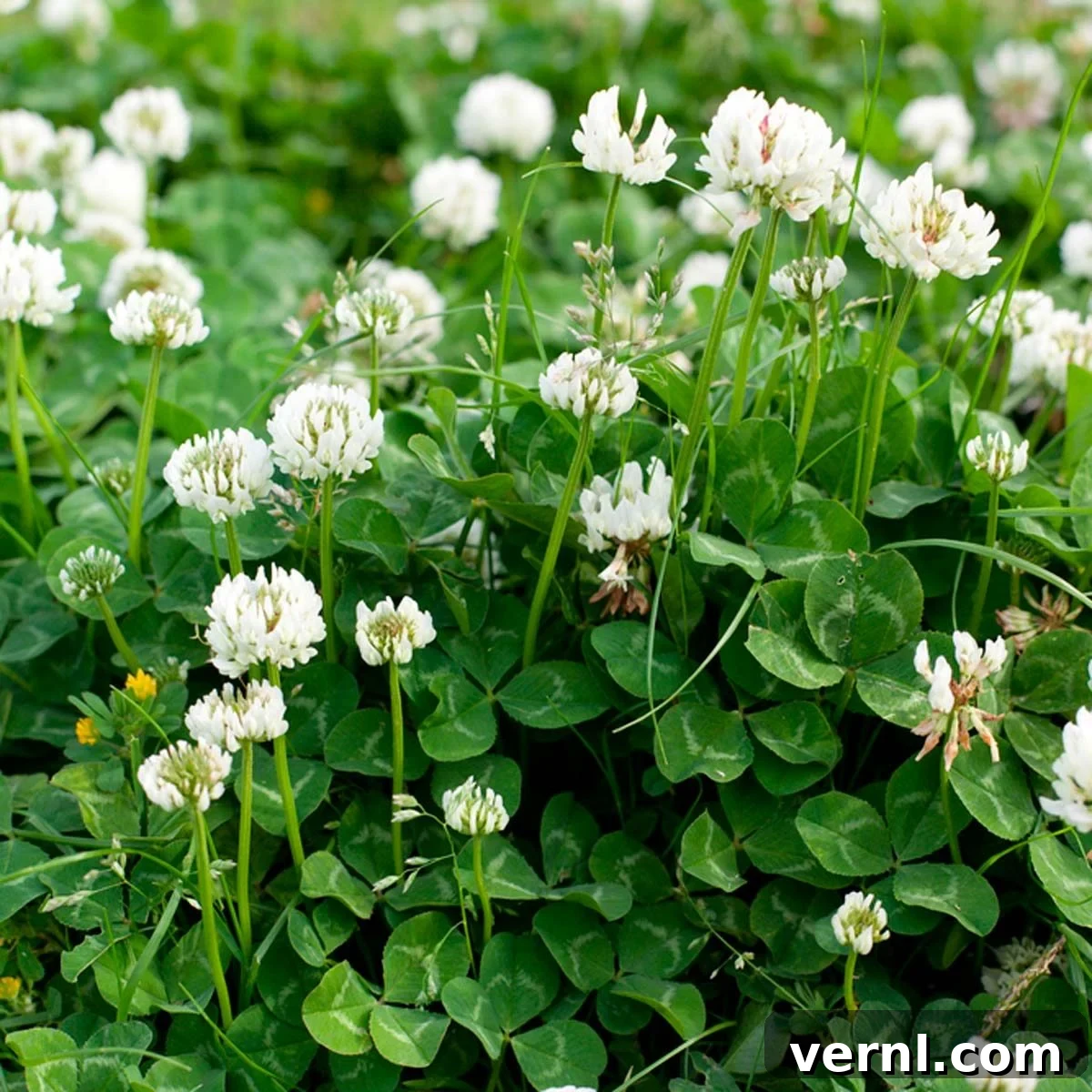
White clover is renowned for its charming, creamy white, ball-shaped flowers that emerge profusely, attracting and sustaining a vibrant population of bees and other beneficial insects. Its versatility extends beyond lawns; it’s also effectively utilized as a cover crop to enrich soil, a moisture-retentive ground cover, an effective agent for erosion control, or as a component in pasture mixtures for livestock feed. Seeds for white clover are readily available, often found in “no-mow” or “flowering” lawn mixes, or sold individually for pure clover installations.
2. Microclover / Miniclover (Trifolium repens var. ‘Pipolina’)
Microclover, specifically the ‘Pipolina’ variety, is a specially bred variant of white clover designed to offer an even more refined lawn aesthetic. Its key distinguishing features are smaller leaves and a much denser growth habit compared to standard white clover. This results in a more uniform, “lawn-like” appearance that many find more akin to traditional turf grass.
Cold hardy in USDA Zones 3-8, microclover also reaches a height of 3-6 inches. Its robust and compact growth pattern naturally suppresses weeds, making it a low-maintenance option. Microclover is particularly well-suited for high-traffic areas due to its resilience, and it maintains its lush green color from spring through fall. While it does flower, it does so less frequently than standard white clover. Interestingly, occasional mowing encourages even smaller leaf development, further enhancing its dense, carpet-like quality.
Choosing the Right Clover for Your Lawn: White Clover vs. Microclover
The choice between white clover and microclover largely depends on your desired aesthetic and functional needs. For those seeking a more relaxed, naturalistic, or “meadowy” look, traditional white clover is an excellent choice. Its more abundant flowering schedule also provides maximum support for pollinators. With white clover, you can embrace a truly low-mow approach, allowing its natural beauty to flourish.
Conversely, if your goal is a denser, more uniform green carpet that closely resembles a traditional lawn, or if your yard frequently hosts playing children and pets, microclover is the superior option. Its ability to thicken up with occasional mowing and its increased tolerance to foot traffic make it ideal for active households. While microclover also supports pollinators, its less frequent flowering might be a consideration for those prioritizing continuous bee activity.
The Advantages and Challenges of a Clover Lawn
Opting for a clover lawn comes with a unique set of benefits and considerations. Understanding these can help you make an informed decision for your landscape.
Pros of a Clover Lawn: Sustainable and Low-Maintenance Living
A primary draw of clover lawns lies in their powerful combination of being significantly more low-maintenance and environmentally friendly compared to conventional turf lawns. This dual benefit offers a compelling reason for gardeners to make the switch.
“As a legume, clover excels at nitrogen fixation,” explains Ashleigh Smith, Managing Editor at True Leaf Market. “This means it can capture atmospheric nitrogen and convert it into a form readily usable within the soil. When clover is interplanted with grass, it naturally feeds the entire lawn, drastically reducing or even eliminating the need for synthetic fertilizers.” Horticulturist Laura Matter of Seattle’s Tilth Alliance also praises clover for its long-lasting and abundant flowers, which provide crucial sustenance and habitat for bees, butterflies, and a wide array of other beneficial insects.
Key advantages of cultivating a clover lawn include:
- Reduced Water Needs: Clover is notably more drought-tolerant than most turf grasses, requiring significantly less irrigation once established. This translates to lower water bills and a more responsible use of natural resources.
- Minimal Mowing: Unlike grass which demands weekly cuts, clover maintains a desirable height (typically 3-6 inches) without constant trimming, saving time, effort, and fuel.
- Natural Fertilization: Through nitrogen fixation, clover continually enriches the soil, effectively acting as a living fertilizer. This eliminates the need for chemical fertilizers, benefiting the environment and your wallet.
- Soft and Cushy Underfoot: Clover creates a wonderfully soft, dense carpet that feels delightful to walk on barefoot, enhancing the sensory experience of your yard.
- Feeds Pollinators: The abundant flowers of white clover, and to a lesser extent microclover, are a vital food source for bees, butterflies, and other essential pollinators, supporting local ecosystems.
- Beautiful Summer Flowers: The delicate white blooms not only attract pollinators but also add a charming, natural beauty to your landscape throughout the warmer months.
- Weed Suppression: Its dense growth habit helps to naturally crowd out common weeds, reducing the need for herbicides.
- Pest Resistance: Clover is generally less susceptible to common lawn pests and diseases that plague turf grass.
- Green All Season: While some variations may experience dormancy, many clover types maintain a vibrant green hue longer than traditional grass, even during dry spells.
Cons of a Clover Lawn: Understanding the Challenges
While clover offers numerous benefits, it’s important to be aware of potential challenges. “Establishing a clover lawn can be trickier than planting grass,” notes Ashleigh Smith. “Many gardeners find it might take multiple seasons of sowing to achieve uniform coverage. However, once established, clover tends to thrive and become quite resilient.” Laura Matter concurs, stating, “Starting clover is often the most challenging phase.”
Main considerations and potential drawbacks of a clover lawn:
- Slower Establishment: Clover seeds can take longer to germinate and fill in than grass seeds, requiring patience and consistent care during the initial phases.
- Foot Traffic Tolerance: While microclover offers better resistance, clover lawns generally cannot withstand heavy foot traffic as robustly as certain turf grasses. For very high-traffic areas, a grass-clover mix might be a better solution.
- Bee Attraction: Because clover flowers are a magnet for bees, individuals with bee allergies or families with young children might need to exercise caution. Wearing shoes during flowering periods is a simple solution.
- Winter Dormancy: In colder climates, clover may go dormant and turn brown during the winter months, from late fall through early spring. Smith suggests mixing clover with a resilient grass type in freezing regions to maintain year-round greenness.
- Weed Competition During Establishment: Young clover seedlings can be outcompeted by aggressive weeds, requiring diligent weed management in the first few months.
- Appearance: For those accustomed to a perfectly manicured, uniform turf lawn, the slightly less formal appearance of a clover lawn might be an adjustment.
How to Successfully Plant a Thriving Clover Lawn
Proper planting techniques are crucial for the successful establishment of your clover lawn. Follow these steps to ensure a healthy and robust start.
- Timing is Key: The optimal time to sow clover seeds is in early spring, once all danger of frost has passed and soil temperatures begin to warm. This allows the seedlings ample time to establish before the heat of summer. For some regions, late summer to early fall can also be suitable, allowing roots to develop before winter dormancy.
- Prepare the Soil: Clover thrives in soil with a pH between 6 and 7, which is slightly acidic to neutral. If you’re unsure of your soil’s pH, a simple soil test kit can provide this information. Adjust the pH as needed using amendments like lime (to raise pH) or sulfur (to lower pH). Clear the planting area of any debris, rocks, and existing vegetation. Level the ground as much as possible to ensure even seed distribution and consistent growth.
- Remove Existing Vegetation (Full Clover Lawn): If you are aiming for a pure clover lawn, it’s essential to remove existing grass and weeds thoroughly. These established plants will vigorously outcompete delicate clover seedlings for nutrients, water, and sunlight. Methods include solarization, sheet mulching, or careful removal with a shovel or sod cutter.
- Prepare for a Clover-Grass Mix: If you plan to overseed an existing lawn with clover, start by mowing your grass to a very short height, about an inch tall. Then, dethatch the area with a sturdy rake or a dethatching machine. This process removes thatch (a layer of dead organic matter) and roughs up the soil surface, creating good seed-to-soil contact for the clover.
- Sow the Seeds Evenly: Clover seeds are quite small, making even distribution challenging. To facilitate more uniform spreading, consider mixing the seeds with fine sand or an inert carrier. This increases the volume of the material you’re broadcasting, helping to prevent clumping. Use a broadcast spreader for larger areas or hand-sow for smaller sections. Aim for a seeding rate appropriate for your chosen clover type (typically 0.5 to 2 lbs per 1,000 sq ft for white or microclover, depending on whether it’s a new lawn or overseeding).
- Ensure Good Seed-to-Soil Contact: After broadcasting the seeds, gently rake them into the top 1/8 to 1/4 inch of soil. Avoid burying them too deeply, as clover seeds need light to germinate. A light rolling with a lawn roller can also help press the seeds firmly into the soil, ensuring they can draw moisture efficiently.
- Crucial Initial Watering: The most critical step post-sowing is consistent watering. Keep the soil consistently moist (but not waterlogged) until the clover seedlings emerge and become well-established, usually for the first 2-4 weeks. Light, frequent watering is better than heavy, infrequent watering during this period to prevent seeds from washing away.
Caring for Your Established Clover Lawn
Once your clover lawn is established, its low-maintenance nature truly shines. However, some ongoing care will ensure its continued health and beauty.
- Watering: While more drought-tolerant than grass, clover still benefits from occasional watering during prolonged dry spells, especially in hot climates. Aim for deep, infrequent watering to encourage strong root growth.
- Mowing: The beauty of a clover lawn is minimal mowing. If you prefer a shorter, neater appearance or wish to encourage denser growth (especially with microclover), you can mow it occasionally, perhaps once every few weeks. Set your mower to its highest setting (3-4 inches) to avoid stressing the plants. Mowing also helps to spread seeds for thicker coverage.
- Weed Management: Once established, clover’s dense growth typically outcompetes most weeds. For any persistent weeds that appear, hand-pulling is often the simplest and most eco-friendly solution. Avoid broadleaf herbicides, as they will harm your clover.
- Fertilization: Thanks to nitrogen fixation, your clover lawn will rarely, if ever, require additional fertilization. This is a major cost and environmental benefit.
- Pest and Disease: Clover is generally quite resilient to pests and diseases. Monitor for any unusual signs, but severe issues are uncommon. Healthy soil and proper care are your best defense.
Beyond the Lawn: Other Uses for Clover
The benefits of clover extend far beyond creating a beautiful lawn. Its ecological advantages make it a valuable asset in various gardening and agricultural contexts:
- Cover Crop: Clover is an excellent cover crop, planted to protect and enrich soil during off-seasons. It prevents erosion, suppresses weeds, and adds organic matter and nitrogen to the soil when tilled in as “green manure.”
- Pasture Mixes: For livestock owners, clover is a highly nutritious component of pasture mixes, offering palatable and protein-rich forage for grazing animals.
- Erosion Control: Its extensive root system makes clover an effective natural solution for stabilizing slopes and preventing soil erosion.
- Attracting Beneficial Insects: Planting clover in garden beds can attract predatory insects that prey on common garden pests, reducing the need for chemical insecticides.
Frequently Asked Questions About Clover Lawns
Are clover lawns safe for pets?
The most common clover varieties used for lawns, such as white clover and microclover, are generally considered safe for pets. However, it’s crucial to be aware that alsike clover (Trifolium hybridum) can be toxic to horses, according to the Association for Prevention of Cruelty in Animals. Always identify your clover type if you have horses. Ashleigh Smith adds a bonus for pet owners: “Clover often stands up to pet urine better than common grass does, helping to avoid those unsightly brown spots.”
How long does it take for a clover lawn to grow and establish?
You can expect clover seeds to sprout quite quickly, sometimes in as few as 7 days under ideal conditions. However, the roots and overall plant structure may take several months to fully establish and fill in. Achieving a dense, uniform carpet often requires patience, potentially taking a full growing season or even two to reach its full potential. You may find it necessary to resow in certain empty patches to bolster coverage. Regular and consistent watering is essential during this establishment phase to encourage vigorous growth.
Can I mix clover with my existing grass lawn?
Absolutely! Mixing clover with an existing grass lawn, known as overseeding, is a popular and highly recommended approach. This creates a resilient, biodiverse lawn that combines the benefits of both. The clover will naturally fertilize the grass, reduce the need for mowing, and attract pollinators, while the grass provides additional durability for foot traffic and can help maintain color during winter dormancy in colder areas.
Will clover spread to other parts of my garden?
White clover can spread through both seeds and stolons (runners that grow along the ground and root). While it is not typically aggressive like some invasive weeds, it can gradually spread into adjacent garden beds if not contained by edging or regular trimming. Microclover tends to be less aggressive in its spreading habit due to its more compact growth.
Do clover lawns attract snakes or other unwanted pests?
Clover lawns do not inherently attract snakes or a wider array of unwanted pests any more than a traditional grass lawn would. The presence of snakes is more often tied to local environmental factors like available food sources (rodents, frogs) and shelter, rather than the type of groundcover. The beneficial insects attracted to clover are usually harmless to humans and beneficial to the garden ecosystem.
About Our Experts
- Laura Matter: With 45 years of experience, Laura is a distinguished horticulturist. She spearheads the Natural Yard Care program at Tilth Alliance in Seattle, WA, a non-profit dedicated to fostering a sustainable, healthy, and equitable food future. She holds a B.A. in botany and successfully managed a landscape maintenance business for 14 years.
- Ashleigh Smith: Ashleigh is the Managing Editor at the organic seed company True Leaf Market. She possesses a bachelor’s degree in Horticulture from Brigham Young University – Idaho, bringing a wealth of academic and practical knowledge to her role.
Sources and Further Reading
- Britannica: Clover
- American Meadows: All About Microclover: The Secret To A Self-Sustaining Lawn
- American Meadows: Clover Seeds
- ASPCA: Alsike Clover
- Outside Pride: Miniclover Seeds