
If you’ve tackled interior painting, you likely agree it’s more challenging than it appears. One persistent hurdle is achieving that elusive perfectly smooth wall surface, a finish many homeowners desire but often struggle to attain.
Modern paint rollers have undoubtedly revolutionized the painting process, making it significantly faster and less arduous. However, this convenience often comes with a trade-off: many common rollers are crafted from fibrous materials like wool or synthetic equivalents. While efficient, these materials invariably leave behind a subtle, sometimes noticeable, textured finish on the painted surface. For those aspiring to perfectly smooth, glossy walls, this inherent texture can be a source of frustration, leading to a perceived imperfection that traditional roller application struggles to avoid.
It’s precisely this common dilemma that gave rise to a viral sensation: a popular internet hack promising a quick and easy way to smooth out freshly rolled paint. This article delves into the efficacy of this trending technique, offering a detailed review based on practical application and exploring more reliable alternatives for achieving that coveted glass-smooth finish.
How To Achieve Perfectly Smooth Walls: Debunking the Viral Squeegee Hack
The quest for perfectly smooth walls often leads DIY enthusiasts down various experimental paths. While the primary goal of painting is to refresh and protect surfaces, the aesthetic desire for a flawless finish is paramount for many. The texture left by paint rollers, often referred to as “stipple” or “orange peel,” can detract from this ideal, especially when using higher sheen paints that highlight every imperfection.
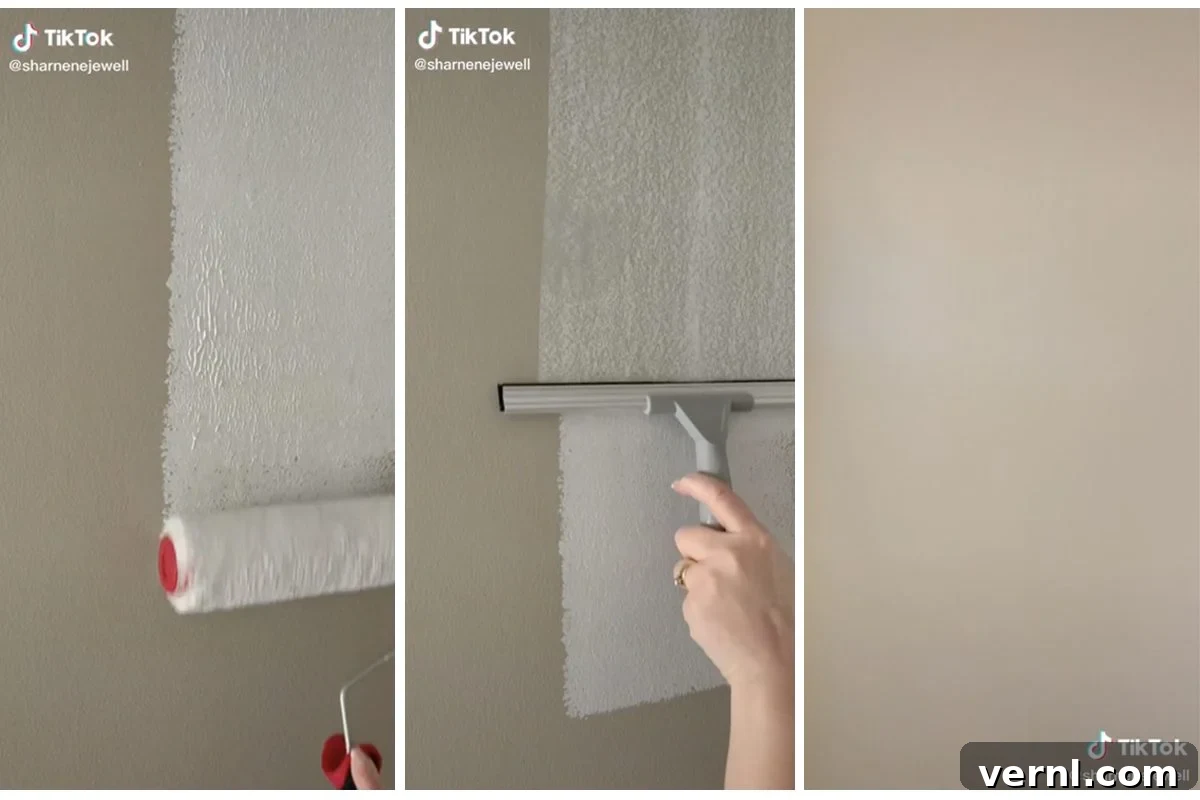
Traditional wall painting is a methodical process involving several crucial steps: thorough surface preparation, priming, and then applying paint as smoothly and evenly as possible with a roller or brush. The viral TikTok hack introduces an additional, unconventional step. Beyond a meticulously prepped and primed wall, a roller, and a paint tray, this technique suggests having a rubber-edged squeegee readily available.
Squeegees are typically tools for tasks like cleaning windows or drying shower walls, designed to guide a medium-soft, straight rubber blade precisely over a surface to remove liquid. The premise of this hack is straightforward: after applying a coat of paint with a roller, you gently pass the squeegee over the wet paint. The theory is that the squeegee’s blade will smooth out the roller stipple, ensuring an unblemished, perfectly flat surface by leveling the paint without removing it. It’s a compelling idea, offering a seemingly simple solution to a common painting headache.
Our Smoothing Paint Hack Results: A Hands-On Evaluation
Intrigued by the promise of effortless smooth walls, I put this viral squeegee hack to the test. Despite my considerable experience with various painting techniques, the results were far from the instant perfection depicted online. The primary and most significant issue I encountered was the unwanted removal of paint.
My experiment began by painting a section of a wall with a standard roller, applying paint as I normally would for an even coat. The moment of truth arrived when I passed the squeegee over the still-wet paint. To my dismay, instead of merely smoothing the surface, the squeegee blade acted more like a scraper, removing almost all of the freshly applied paint. While the underlying wall was indeed smoother in those areas, it was only because it was virtually devoid of paint, exposing the primer or even the bare wall beneath. This result rendered the entire process counterproductive, forcing me to reapply paint, which, of course, reintroduced the very texture I was trying to eliminate.
Unwilling to dismiss the hack prematurely, I embarked on a series of experimental adjustments. I varied the pressure applied to the squeegee, attempting feather-light touches and slightly firmer strokes. I experimented with different angles, trying to find an optimal approach that would glide over the paint rather than strip it. I even tried different squeegee blades, hoping that a softer or stiffer rubber might yield better results. For the most part, the outcome remained consistent: it proved incredibly difficult to move the squeegee across the wall with enough gentleness to smooth out the roller texturing without simultaneously removing substantial quantities of paint.
Adding to the frustration, I observed another significant problem: the squeegee blade often acted like a miniature dam, pushing and accumulating wet paint into unsightly ridges at the edges of each stroke. These ridges then required additional roller work to smooth out, negating any potential benefit the squeegee might have offered and, in many cases, creating more texture and unevenness than was present before the squeegee’s intervention. This “damming” effect essentially undid any good I’d hoped to achieve, forcing me to rework areas multiple times and significantly extending the painting process.
Eventually, after considerable practice and a tedious process of trial and error, I did manage to identify an “optimal” level of squeegee pressure and technique that smoothed most of the roller texturing while removing only minimal paint. However, even with this perfected approach, the finished result still fell short of expectations. Upon closer inspection, the wall exhibited visible lines where the squeegee had passed, and some areas displayed inconsistent paint thickness, appearing either too thin or noticeably thicker than others. The overall finish lacked the uniformity and professional quality one would expect from a well-executed paint job.
In conclusion, my extensive hands-on testing revealed that this viral hack is ultimately not worthwhile. Despite my considerable painting experience and willingness to experiment, this technique demanded an excessive amount of trial and error to implement even marginally correctly. The inconsistent results, the added time, and the sheer effort involved simply did not justify its use. For anyone seeking truly smooth walls, more reliable and less frustrating methods exist, which I believe offer a far better return on investment in terms of time and quality.
Better Options For Achieving a Smooth Paint Finish
If the subtle texture left by traditional paint rollers concerns you, rest assured there are far more effective and less cumbersome methods than the squeegee hack to achieve a smooth finish. As someone who has applied countless coats of paint to various surfaces, I can confidently recommend the following options, which offer superior results and a more efficient painting experience:
- 1. Utilize a High-Quality Foam Roller:
Not all paint rollers are created equal, and the material plays a crucial role in the final finish. While wool and synthetic fiber rollers are excellent for coverage, they are inherently designed to hold and release paint through their fibers, which is precisely what creates the subtle stipple. For an exceptionally smooth finish, opt for polyurethane foam rollers. These rollers are engineered with a dense, closed-cell foam that leaves considerably less texturing behind than their fibrous counterparts. Foam rollers are particularly effective with gloss, semi-gloss, and enamel paints, as well as primers, where a glass-like finish is desired. When using them, avoid overloading the roller and apply paint with even, gentle pressure to prevent air bubbles and ensure a uniform, smooth application. While they might pick up slightly less paint per dip, the superior finish they deliver makes the extra effort worthwhile.
- 2. Incorporate a Paint Additive (Flow Enhancer/Extender):
One of the most effective ways to combat roller marks and achieve a smoother finish is to modify the paint itself. Latex paint additives, also known as flow enhancers or extenders, are designed to slow down the drying process. By increasing the paint’s “open time” – the period it remains wet and workable after application – these additives allow the paint more time to “flow out” and self-level on the wall. This extended drying window helps reduce the appearance of brush strokes, roller marks, and lap lines, leading to a much more uniform and smoother surface. Products like Floetrol for latex paints (or Penetrol for oil-based paints) are excellent choices. They improve paint workability, especially in hot or dry conditions, making the application process easier and the final finish more professional. Always follow the manufacturer’s mixing ratios to ensure optimal performance without compromising the paint’s integrity or sheen.
- 3. Master Proper Painting Technique:
Even with the best tools and additives, technique remains paramount. Achieving a smooth finish largely depends on how you apply the paint. Start by properly loading your roller, ensuring it’s saturated but not dripping. Employ a consistent “W” or “M” pattern to distribute the paint evenly across a section of the wall, then fill in the pattern with vertical strokes, working from the top down. Crucially, always maintain a “wet edge” – meaning you should always roll into the previously painted, still-wet section to avoid visible lap lines. Avoid overworking the paint; once an area is covered, move on. Excessive rolling over partially dried paint will only create more texture. Using high-quality brushes for “cutting in” around trim and corners also contributes significantly to an overall smooth and professional appearance.
- 4. Select the Right Type and Quality of Paint:
The paint itself plays a crucial role. Higher quality paints generally contain better binders and leveling agents that naturally contribute to a smoother finish. Some paints are specifically formulated as “self-leveling,” designed to minimize brush and roller marks as they dry. Additionally, consider the paint’s sheen. Flat or matte finishes are inherently better at hiding minor surface imperfections and roller stipple. As you move towards eggshell, satin, semi-gloss, and especially high-gloss, any texture or imperfection becomes much more apparent, demanding an even smoother underlying surface. Choosing a premium paint designed for interior walls will often provide superior flow and leveling properties right out of the can.
- 5. Consider Airless Spray Painting for Ultimate Smoothness:
For those seeking the absolute smoothest finish, akin to factory-applied coatings, airless spray painting is the gold standard. Airless sprayers atomize paint into a fine mist, applying an even, consistent layer without any physical contact with a roller or brush. This method eliminates all roller stipple and brush marks, resulting in an incredibly smooth, professional-grade finish. However, this option comes with a higher initial equipment cost and requires extensive masking and preparation to protect surrounding areas from overspray. It also has a learning curve to master the technique, but for large areas or projects demanding flawless results, it’s an unparalleled choice.
- 6. Learn to Embrace the “Roller Stipple” (Ignore It):
As a seasoned painter, I can assure you that the subtle texture left by a well-used roller is often hardly noticeable in most residential settings. Once the paint is fully dry, and under normal room lighting, this minor stipple typically blends into the overall appearance of the wall. You would genuinely have to look very carefully with direct, strong lighting, such as a flashlight held at an angle, to detect it. For all practical intents and purposes, properly roller-painted walls generally appear perfectly smooth, without any extra, tedious work. Furthermore, roller-textured paint has an often-overlooked advantage: it helps to hide imperfections. No drywall taping and mudding job is ever perfectly seamless, and a slight texture can cleverly disguise some of these natural irregularities, minor dings, or subtle patch lines. Embracing this characteristic can save you considerable time and effort, allowing you to focus on a clean, even application rather than an unattainable, microscopic level of smoothness.
Ultimately, achieving a smooth paint finish is a balance of preparation, proper tools, quality materials, and skilled technique. While the viral squeegee hack might seem like a tempting shortcut, practical experience reveals its limitations and potential for frustration. By employing proven methods such as foam rollers, paint additives, diligent technique, and thoughtful paint selection, you can achieve beautiful, professional-looking walls that meet your aesthetic standards without unnecessary hassle or rework.