The Ingenious Ladder Caddy: Revolutionizing Your Work at Height
Working on a stepladder is a ubiquitous experience for countless home improvement enthusiasts, dedicated DIYers, and seasoned professionals alike. From the delicate touch required to paint a ceiling to the precision needed for installing complex light fixtures, or the meticulous detail involved in electrical work and intricate carpentry, the stepladder remains an indispensable tool in every toolkit. However, for all its undeniable utility, the stepladder often introduces a unique set of frustrations, primarily revolving around inefficient tool management and the inherent challenges of working at an elevated height. Imagine a scenario where every tool, every screw, and every small component you need is precisely where you expect it to be—always within arm’s reach, without the perilous balancing acts or the constant, energy-draining trips up and down the ladder. This vision is not a distant dream but an entirely achievable reality, thanks to a remarkably simple yet profoundly effective innovation: the Ladder Caddy.
This comprehensive article delves into the transformative power of a thoughtfully designed Ladder Caddy, a custom-built solution engineered to enhance your productivity, significantly improve safety, and seamlessly streamline your workflow when undertaking tasks at elevated heights. Inspired by a common, yet often overlooked, challenge faced by many, the Ladder Caddy emerges as a powerful testament to practical problem-solving, turning what might seem like a minor inconvenience into a major operational hurdle, and then effortlessly overcoming it with clever design and execution.
The Universal Frustration: Why Traditional Ladder Work Often Falls Short
Before we fully appreciate and celebrate the elegant solution that the Ladder Caddy offers, it is crucial to thoroughly understand the depth and breadth of the problems it so effectively addresses. Let’s consider the all-too-common experience shared by Ron Brewer, a scenario that resonates with anyone who has tackled projects demanding multiple tools at height. Ron was engaged in the challenging task of hanging suspended grid for ceiling tiles—a job demanding both precision and constant access to an array of different implements. His workflow was incessantly interrupted by the repetitive and time-consuming need to switch between two essential power tools: one drill dedicated to creating accurate pilot holes and another driver specifically for securing screws. This wasn’t merely a minor annoyance; it was a significant drain on both his valuable time and his physical energy.
The Hidden Costs of Inefficiency and Disorganization on a Ladder:
- Constant Tool Switching Interruptions: The repetitive action of setting down one tool, carefully picking up another, and then reversing this process, not only breaks concentration but also drastically slows down overall progress. Each switch is a miniature disruption that accumulates over a project.
- Perilous Balancing Acts with Tools: In most traditional ladder setups, there is no safe or dedicated place to temporarily store tools. This often leads to precarious balancing acts on narrow rungs, attempting to wedge tools between ladder legs, or holding them awkwardly with one hand. All these methods dramatically increase the risk of accidental drops and potential injury.
- Wasted Time and Physical Energy: Every single trip down and then back up the ladder—whether for a forgotten drill bit, a misplaced box of screws, or a different hand tool—translates directly into wasted minutes and unnecessary physical exertion. Over the duration of a substantial project, these accumulated minutes can easily snowball into hours of lost productivity.
- Significant Safety Hazards: Tools that are dropped from height can pose severe risks. They can cause expensive damage to delicate flooring or other equipment, and, more critically, they can cause serious personal injury to anyone below or even to the worker themselves. Furthermore, reaching for tools from awkward or extended positions can compromise a worker’s balance, significantly increasing the likelihood of dangerous falls from the ladder.
- Loss of Work Momentum and Flow: Frequent interruptions are a death knell for productivity and focus. When you are constantly forced to break your stride and refocus your attention on managing tools, the overall quality, precision, and speed of your work inevitably suffer. Maintaining a smooth workflow is essential for efficiency.
These significant challenges are by no means exclusive to ceiling grid installation. They consistently plague painters who struggle to find a convenient spot for their brushes and paint cans, electricians who juggle wires and connectors, carpenters meticulously assembling structures, and even general repairmen performing tasks on HVAC units or cleaning gutters. The fundamental, underlying issue across all these scenarios is a conspicuous lack of an organized, stable, and easily accessible workspace precisely where the actual work is being performed.
Introducing the Ladder Caddy: A Simple, Yet Brilliant, Elevating Solution
It was this very real and pressing need that galvanized Ron Brewer to embark on a quest to find “a better way.” His eventual solution was not a complex, high-tech gadget or an expensive, off-the-shelf product, but rather a profound testament to practical ingenuity: a custom-built Ladder Caddy. This simple yet truly revolutionary device effectively transforms the typically unused and often cumbersome top section of your stepladder into a highly efficient, meticulously organized, and remarkably stable mini-workbench. It ingeniously functions as a dedicated tool holder, a convenient parts tray, and a versatile work surface, all cleverly rolled into one indispensable accessory.
At its fundamental core, the Ladder Caddy is essentially a robust, flat platform meticulously designed to securely rest on the uppermost section of a stepladder. It is engineered to provide a series of dedicated slots and ample surfaces for neatly organizing and easily accessing various tools, small components, and fasteners. The true genius of its design lies in its elegant simplicity and inherent adaptability, making it an absolutely essential companion for virtually any task that requires spending a significant amount of time working on a ladder.
The Genesis of a Game-Changer: Ron Brewer’s Journey of Innovation
Ron’s personal journey to conceptualizing and creating the Ladder Caddy began, as so many great innovations often do, out of pure, unadulterated frustration. Faced with the arduous and repetitive job of installing suspended ceiling grids, he found himself trapped in an endless and exasperating cycle of tool retrieval and constant swapping. The repetitive actions of drilling precise pilot holes and then swiftly driving screws, each requiring a distinct power tool, were relentlessly consuming his valuable time and relentlessly testing his patience to its limits.
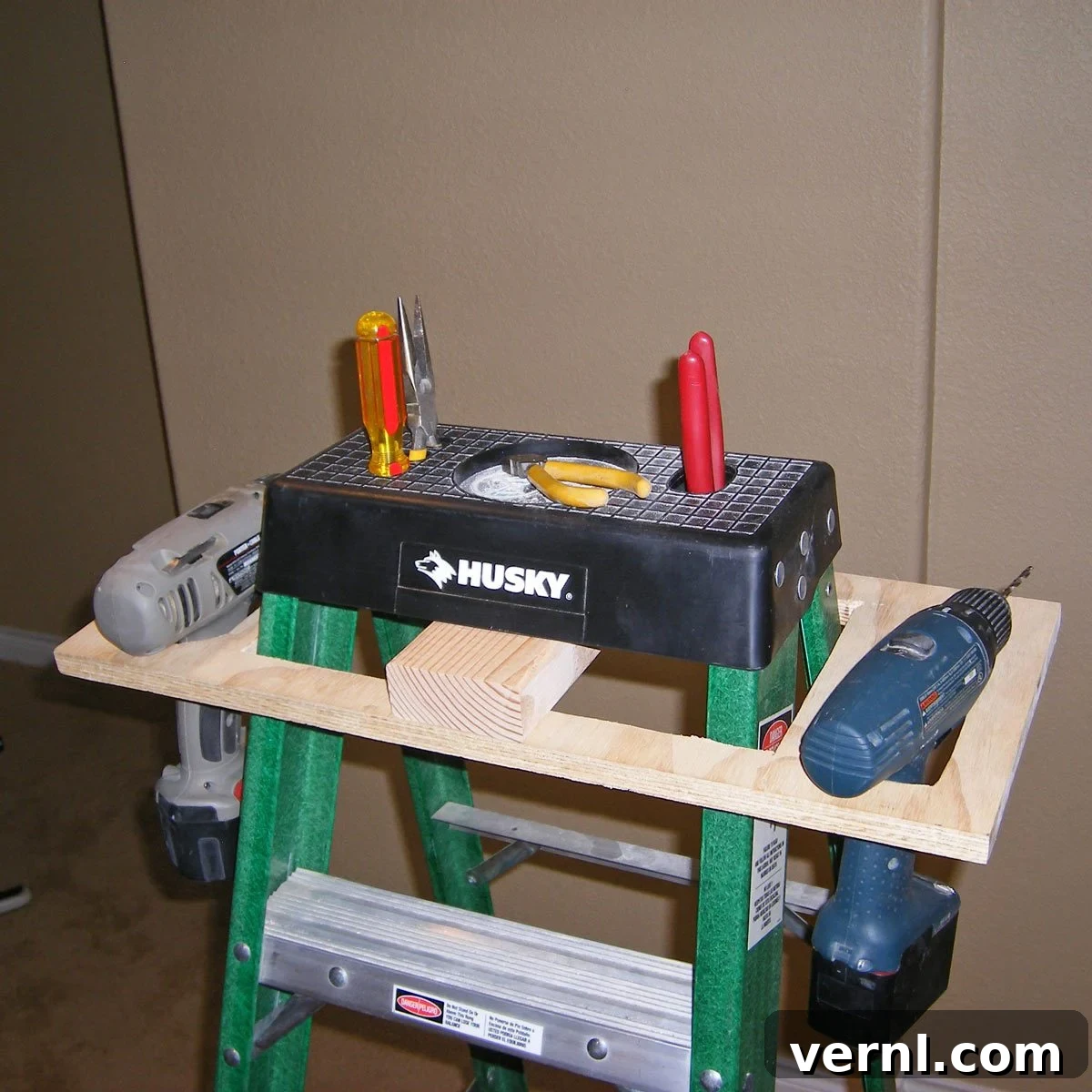
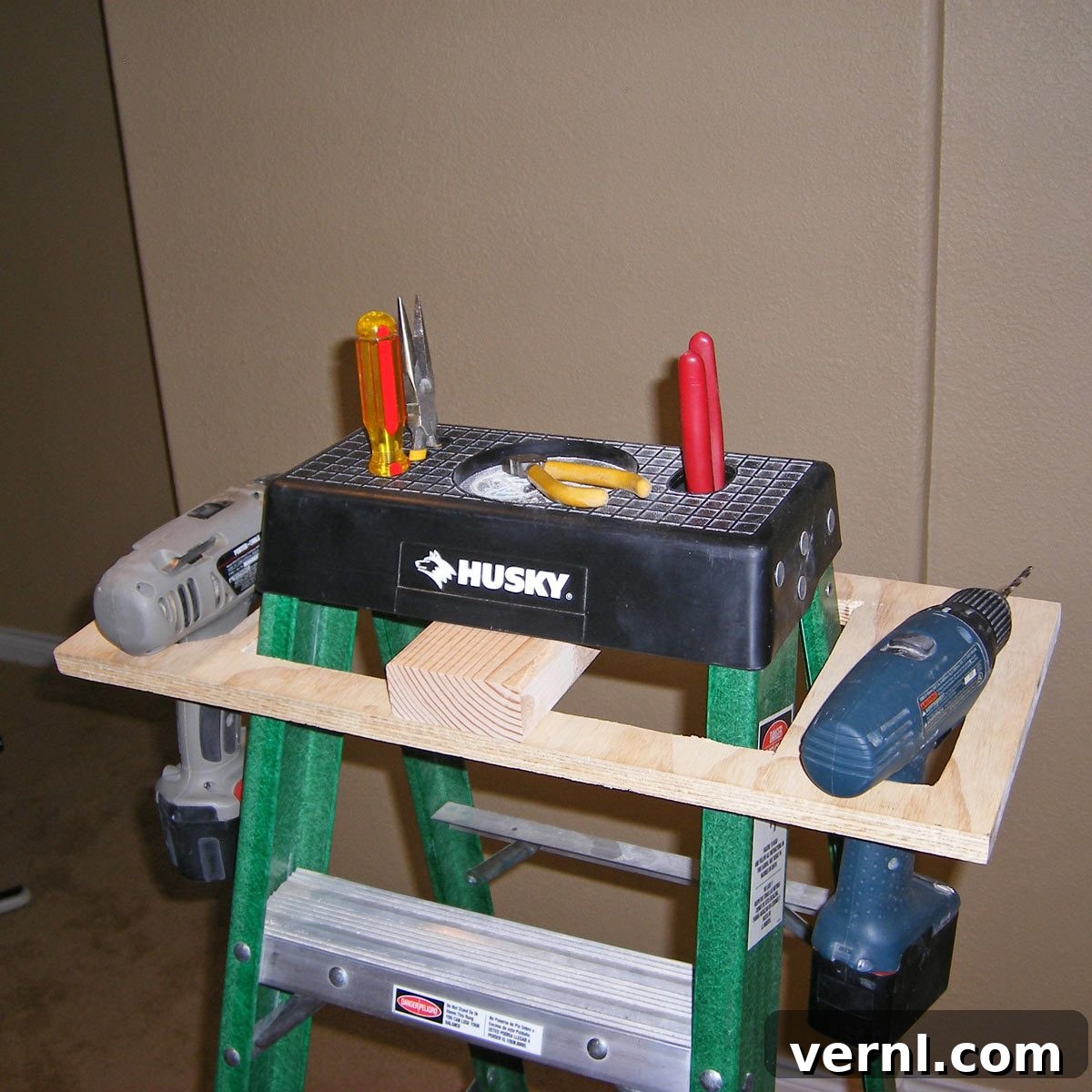
His pivotal “aha!” moment prompted him to actively scavenge for suitable materials. His search led him to a readily available scrap piece of 3/4-inch plywood, a material known for its robustness and ease of workability, measuring a highly convenient 10 inches by 24 inches. This chosen size offered an optimal balance: ample surface area for tool placement without becoming cumbersome or unwieldy. The next crucial step in his design process was to meticulously tailor this piece of plywood to perfectly fit his specific stepladder. He carefully cut a precisely dimensioned opening in the plywood, measuring 7 inches by 14 inches. This precise cutout allowed the caddy to fit snugly and securely over the top section of his stepladder. This snug fit was absolutely vital for ensuring maximum stability and preventing any unwanted movement.
Further enhancing its functionality, Ron embarked on extensive customization, which involved meticulously creating specific cutouts designed to perfectly cradle his two primary power tools: his drill and his driver. These intelligently designed, dedicated slots ensured that the tools remained upright, effortlessly accessible, and, most importantly, completely secure, thus eliminating any risk of them accidentally tipping over or falling. To bolster the caddy’s stability even further, particularly when one heavier tool was being retrieved or placed, Ron ingeniously wedged a scrap piece of 2×4 lumber between the ladder’s top platform and his newly crafted holder. This simple yet highly effective addition completely prevented any unwanted rocking, shifting, or wobbling, solidifying the caddy’s position and ensuring a consistently steady and reliable platform.
Ron aptly described his brilliant creation as a “seat-of-the-pants solution,” a genuine testament to its practical, on-the-spot, and incredibly effective design. The immediate impact of this innovation was nothing short of profound: it saved him “a lot of time and labor.” What began as a highly specific solution for one particularly challenging task quickly transcended its initial purpose. Ron now proudly and regularly utilizes his custom-built Ladder Caddy for “a variety of ladder-related tasks,” a clear demonstration of its broad applicability, enduring utility, and versatile design.
Build Your Own Ladder Caddy: A Practical DIY Guide to Enhanced Efficiency and Safety
The inherent beauty of Ron Brewer’s innovative Ladder Caddy design lies in its remarkable accessibility. Building one does not necessitate specialized tools, exotic materials, or advanced carpentry skills; indeed, most of what you’ll require can typically be found within a well-stocked home workshop or very easily acquired from any local hardware store. Embarking on the project of building your own Ladder Caddy is an incredibly rewarding endeavor that promises to pay significant dividends in terms of convenience, vastly improved safety, and streamlined efficiency across countless future tasks.
Essential Materials You’ll Need for Construction:
- Plywood: One robust piece of 3/4-inch plywood, ideally measuring approximately 10 inches by 24 inches. This thickness offers excellent durability and stability, while these dimensions provide a generous balance of usable workspace and comfortable portability.
- Scrap 2×4 Wood: A relatively small piece, typically around 6 to 12 inches in length, will be perfect for crafting the crucial stabilizing wedge.
- Measuring Tape or Ruler: Absolutely essential for ensuring precise and accurate measurements throughout the project.
- Pencil: For clearly marking all your cuts and design outlines on the plywood.
- Jigsaw or Circular Saw: Either tool will work effectively for cutting the plywood. A jigsaw is particularly ideal for making intricate, curved, or internal cuts, offering greater versatility.
- Drill (Optional but Recommended): Useful for starting pilot holes within the marked internal cuts, making it easier to insert the jigsaw blade.
- Sanding Block or Sandpaper: Crucial for smoothing all cut edges, which prevents splinters and ensures a safer, more refined finish.
Step-by-Step Construction Guide:
- Accurately Measure Your Stepladder: This is arguably the most critical initial step. Carefully measure the exact dimensions of the top platform of your specific stepladder. Be sure to pay close attention to any tapering, unique angles, or distinctive features. For reference, Ron’s ladder top measured 7 inches by 14 inches. These precise dimensions will dictate the size of the central cutout you’ll create in your plywood base.
- Cut the Plywood Base to Size: Using your chosen saw, cut your 3/4-inch plywood to your desired overall external dimensions for the caddy. Ron opted for 10 inches by 24 inches, which effectively provides ample tool real estate without becoming unwieldy or too large to manage.
- Mark the Central Ladder Cutout: Meticulously mark the precise outline of your ladder’s top platform in the dead center of your plywood base. Ensure that you maintain even margins around this central rectangle to maximize the usable space on the caddy.
- Execute the Ladder Opening Cut: If you are using a jigsaw, it’s often beneficial to drill a small pilot hole inside one corner of your marked rectangle. This allows for easy insertion of the jigsaw blade. Carefully cut along your precisely marked lines to create the opening. Periodically test-fit this cutout onto your ladder as you cut, ensuring a snug, secure, and stable fit. Make any necessary minor adjustments as you go.
- Design and Mark Custom Tool Cutouts: Now, carefully consider the specific tools you use most frequently when working on the ladder. Ron wisely created dedicated cutouts for his drill and driver. You might also wish to include slots for items such as a tape measure, a carpenter’s pencil, a utility knife, or even small, recessed compartments for screws, nails, and other various fasteners. Place your preferred tools directly onto the caddy’s surface and carefully trace their outlines to create perfectly custom holders. Consider incorporating small finger holes or gently sloped edges to facilitate easier tool retrieval.
- Cut the Custom Tool Cutouts: Utilizing your jigsaw (or appropriate drill bits for circular holes), carefully cut out these custom tool slots. Again, regularly test-fit your tools into their respective slots to ensure they slide in and out with ease while remaining securely held in place when not in use.
- Craft and Position the Stabilizing Wedge: Cut a short, appropriate piece from your 2×4 scrap. This crucial piece will be strategically wedged between the underside of the caddy platform and either the top rung or a structural support of your ladder. Its primary purpose is to prevent the caddy from tipping or rocking, especially when a heavier tool is placed predominantly on one side. The exact length and optimal placement of this wedge will depend entirely on the specific design and dimensions of your ladder. Test its position carefully for maximum, unwavering stability.
- Sand and Finish (Optional, but Highly Recommended): Thoroughly sand all cut edges to effectively remove any potential splinters and smooth out any rough spots. For added durability and longevity, you might also consider applying a coat of paint or a protective sealant to the plywood. This will shield it from moisture, wear, and tear, extending the life of your Ladder Caddy.
By diligently following these comprehensive steps, you will successfully construct a custom Ladder Caddy that is perfectly poised to make your next project significantly easier, remarkably safer, and considerably more efficient!
The Unbeatable Benefits of Integrating a Custom Ladder Caddy into Your Workflow
Beyond the immediate and apparent convenience, a custom-designed Ladder Caddy delivers a cascade of profound advantages that fundamentally enhance and improve the entire experience of working at elevated heights. Its positive impact stretches across critical aspects such as efficiency, safety protocols, and the overall quality and enjoyment of your project.
1. Drastically Improved Efficiency and Productivity:
- Significantly Reduced Trips: Completely eliminate the wasteful and tiring need to descend and ascend the ladder multiple times for forgotten tools, misplaced fasteners, or essential measuring devices. With the caddy, everything you require is consistently right there, within effortless reach.
- Seamless and Uninterrupted Workflow: Maintain unwavering focus and critical momentum throughout your task. The invaluable ability to switch between different tools instantly, without breaking your stride or losing concentration, keeps your productivity consistently high and your work flowing smoothly.
- Substantial Time Savings: Those precious saved seconds and minutes that accumulate from not constantly searching for tools or repeatedly climbing up and down the ladder quickly add up. Over the course of a project, these small increments can lead to significantly shorter project completion times.
2. Enhanced Safety Measures:
- Prevents Dangerous Dropped Tools: The provision of dedicated, secure slots and an inherently stable platform means that your tools are far less likely to accidentally fall. This protects your valuable equipment, safeguards delicate surfaces below, and, most importantly, prevents potential injuries to personnel.
- Maintains Crucial Balance: Say goodbye to awkward reaching, uncomfortable stretching, or precarious balancing acts simply to retrieve or place tools. With the caddy, your center of gravity remains stable and controlled, drastically reducing the inherent risk of dangerous falls from the ladder.
- Promotes Hands-Free Climbing: Climb the ladder with both hands completely free, allowing you to firmly grip the rungs for maximum safety and stability, rather than precariously juggling an armful of tools.
3. Superior Organization and Unrivaled Accessibility:
- Tools Always Within Effortless Reach: Your most critical and frequently used tools are consistently readily available, neatly organized, and precisely where you expect them to be, eliminating frustrating searches.
- Cultivates a Clutter-Free Workspace: The caddy keeps your immediate work area tidy, significantly reducing distractions and fostering a more professional, focused, and efficient working environment.
- Effectively Prevents Misplacement: Because each tool now has its own designated and custom-fitted spot, it becomes incredibly difficult to misplace items and remarkably easier to pack up and account for all your tools at the conclusion of your workday.
4. Unmatched Versatility and Adaptability:
- A True Multi-Tasking Platform: The Ladder Caddy is ideally suited for an incredibly wide array of tasks, including painting (expertly holding brushes, rollers, and even small paint cans), intricate electrical work (securely organizing wire nuts, electrical tape, screwdrivers, strippers, and voltage testers), detailed carpentry (providing immediate access to screws, nails, measuring tapes, levels, and small pieces of trim), and general household repairs.
- Infinitely Customizable Design: Its design is inherently flexible and can be easily adapted to securely hold specific tools or a unique set of materials required for any particular project. You can even add custom hooks, magnetic strips, or small, detachable bins as your specific needs dictate.
5. Inherent Cost-Effectiveness:
- Protects Your Valuable Tools: By providing secure, dedicated storage, the caddy significantly reduces the likelihood of expensive tools being dropped, damaged, or lost. This proactive protection directly extends their functional lifespan, saving you money on replacements.
- Utilizes Readily Available Scrap Materials: A Ladder Caddy can often be constructed almost entirely from leftover wood scraps that might otherwise go to waste, making it an incredibly inexpensive yet exceptionally valuable addition to your workshop arsenal.
Beyond the Workshop: Diverse Applications and Broad Utility of the Ladder Caddy
While Ron Brewer’s initial and specific need for the Ladder Caddy arose from the challenges of hanging suspended ceiling grids, the overarching utility and profound versatility of this innovative device extend far beyond that single application. Its inherently adaptable design makes it an absolutely invaluable tool for a vast array of tasks across different domains:
- General Home Maintenance & Repair: Perfect for tasks such as safely changing hard-to-reach light bulbs, effectively fixing smoke detectors, patching unsightly drywall, efficiently cleaning clogged gutters, or meticulously repairing exterior siding.
- Detailed Painting Projects: An ideal companion for holding paint trays, various brushes, rollers, masking tape, and convenient small cans of touch-up paint, keeping everything neat and accessible.
- Intricate Electrical Work: Essential for keeping wire nuts, electrical tape, screwdrivers, wire strippers, and voltage testers neatly organized and immediately accessible, enhancing both safety and speed.
- Precision Carpentry & Installation Tasks: Provides secure and immediate access to drill bits, various fasteners, measuring tapes, spirit levels, and small, delicate pieces of trim, streamlining the entire assembly process.
- Outdoor Gardening & Chores: Highly useful for tasks like pruning high branches (allowing you to hold small shears and collect trimmings), or efficiently cleaning windows at height.
- Creative Projects & Decorating: Invaluable for artists or decorators working on large murals, intricate installations, or decorative tasks that require sustained effort at elevated heights.
Essentially, any task that requires you to spend more than a few concentrated minutes on a stepladder, especially when juggling more than one tool or multiple small components, can benefit immensely and dramatically from the presence of a well-designed Ladder Caddy.
Elevating Your Workspace: The Future of Efficient and Safe Ladder Work
In a world increasingly prioritizing smart, innovative solutions and highly optimized workflows, the simple yet profound Ladder Caddy stands out as a brilliant and exemplary illustration of how modest innovation, born from practical necessity, can lead to truly remarkable improvements. It effectively addresses a fundamental need with an elegance that is both practical and intuitive, transforming what could be a potentially hazardous, frustrating, and inefficient workspace into an exceptionally organized, highly productive, and significantly safer environment.
The sheer ingenuity embedded within Ron Brewer’s original design, which sprang forth from a very personal and relatable frustration, serves as a powerful source of inspiration for anyone actively seeking to dramatically enhance their efficiency, bolster their safety, and streamline their processes in both casual DIY settings and demanding professional environments. By committing a relatively small amount of time and investing minimal material resources, you can equip your trusty stepladder with an indispensable accessory that will undoubtedly repay itself many times over in the form of invaluable saved time, drastically reduced frustration, and significantly enhanced safety on every single project.
Do not allow the perennial challenge of inefficient tool management to hinder or complicate your next crucial project at height. Embrace the elegant simplicity and the proven effectiveness of the custom-built Ladder Caddy. Take the initiative to build your own, meticulously customize it to perfectly suit your individual needs and the demands of your specific tasks, and then experience firsthand the remarkable, tangible difference that a truly organized, incredibly accessible, and utterly stable workspace can make. Your back will thank you, your valuable tools will be preserved, and your project timelines will be met with unparalleled efficiency and peace of mind.