The Waffle House Index: An Unofficial Guide to Hurricane Impact and Community Resilience
As Hurricane Helene makes its presence felt, communities along its projected path brace for potential devastation. For millions living in hurricane-prone regions, the arrival of hurricane season ushers in a period of heightened vigilance and concern. Families with loved ones in the storm’s trajectory eagerly monitor updates, desperately awaiting confirmation of their safety, while those directly in harm’s way confront harrowing decisions about safeguarding themselves and their homes. In these critical moments, access to timely and accurate information is paramount, guiding evacuation plans, emergency responses, and the initial stages of recovery.
Traditionally, primary sources of hurricane information include official meteorological reports and the widely recognized Saffir-Simpson Hurricane Wind Scale. This essential scale classifies hurricanes into categories based on wind speed, providing a scientific metric for understanding a storm’s potential destructive power. However, beyond these formal assessments, a unique and surprisingly reliable indicator has emerged from the heart of American roadside dining: The Waffle House Index.
What Exactly is The Waffle House Index?
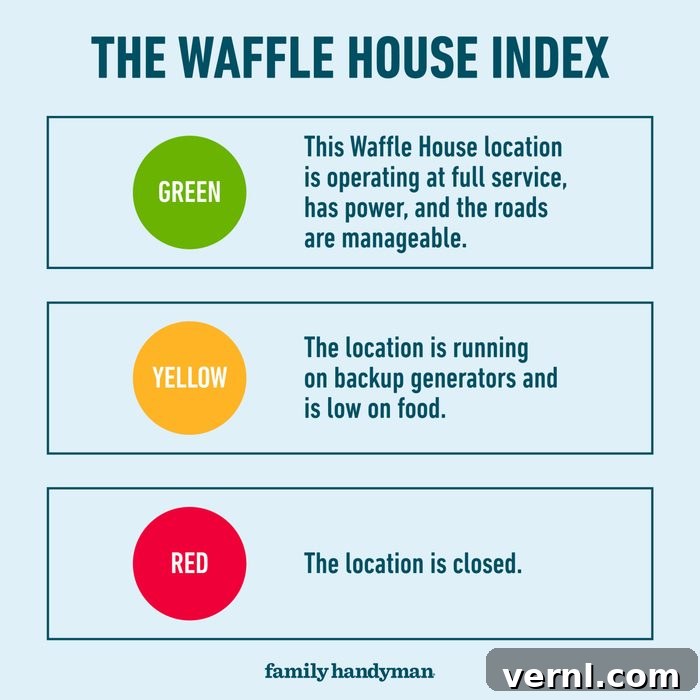
The Waffle House Index is an informal, three-tiered system designed to assess the operational status of Waffle House restaurants in areas impacted by natural disasters, predominantly hurricanes. It offers a swift, real-time snapshot of the damage severity and the extent of infrastructure disruption within a storm-affected region. This seemingly lighthearted metric has garnered significant attention, not only among the public but crucially within official disaster response agencies, most notably the Federal Emergency Management Agency (FEMA).
The index employs a straightforward, color-coded scale to communicate the operational status of these ubiquitous diners:
- Green: Full Menu – Signifies that the restaurant is fully operational, offering its complete menu. This indicates minimal to no significant damage in the immediate vicinity, suggesting stable power and clear, passable roads.
- Yellow: Limited Menu – Indicates that the restaurant is open but operating with a reduced menu. This typically points to limited power (often relying on backup generators), potential supply chain interruptions, or minor local damage.
- Red: Closed – Means the restaurant is completely shut down. This is the most critical indicator, signaling severe damage, widespread power outages, impassable roads, or other major hazards that prevent the establishment from opening its doors.
Why Waffle House? A Symbol of Unwavering Resilience
The selection of Waffle House as a disaster indicator is far from random. The restaurant chain is renowned for its steadfast commitment to operating “24/7/365.” This unparalleled dedication to continuous service, even in the face of extreme adversity, makes their operational status an incredibly reliable barometer for local conditions. Waffle House boasts an impressively robust and meticulously practiced disaster preparedness protocol. Their internal systems, affectionately known as “Waffle House Storm Center” procedures, are engineered to prioritize employee safety and facilitate rapid reopening post-storm.
This comprehensive strategy includes strategically pre-positioning supplies, arranging for emergency backup generators, and deploying specialized “jump teams” of employees from unaffected regions to assist in reopening damaged locations. Their capability to serve a simplified, limited menu during crises underscores their streamlined operations, focusing on essential items like coffee, eggs, and grits—dishes that require minimal cooking and can be prepared even with diminished resources. Consequently, if a Waffle House is closed, it sends a powerful signal that conditions are truly dire, far exceeding what most other businesses could endure. It speaks volumes about the severity of the situation, making it an invaluable, albeit informal, piece of intelligence for emergency managers.
Interpreting the Waffle House Index: A Deeper Dive into the Color Codes
A thorough understanding of what each color level truly represents offers critical insights into the post-disaster landscape, guiding both official responses and community actions:
-
Green: A Beacon of Normalcy and Stability
A “Green” Waffle House status denotes an area that has largely withstood the worst effects of a storm. It means the restaurant benefits from stable power, clear and navigable roads for both customers and supplies, and an intact supply chain sufficient to offer its full, comforting menu. For local residents, witnessing a Waffle House operating at green status can provide immense psychological relief—a tangible slice of normalcy amidst regional upheaval. It suggests that while the broader geographical area might be struggling, this specific locality has maintained vital infrastructure and a relatively high degree of functionality, indicating a quicker path to full recovery.
-
Yellow: Navigating Challenges with Resourcefulness
A “Yellow” Waffle House indicates that the area has experienced a significant impact, but not one of catastrophic proportions. The restaurant is open, but likely relying on backup generators for power, and operating with a restricted menu due to power fluctuations or disruptions in its supply lines. This status suggests that while main roads might be partially cleared and some essential services might still be functioning, the area is still far from its pre-disaster state. Widespread power outages are probable, and essential resources might be strained. For emergency responders, a yellow status points to an area requiring attention and support, but not necessarily immediate, life-saving interventions on the same critical scale as a red zone.
-
Red: Severe Damage and Critical Conditions
The “Red” Waffle House status is the most alarming and consequential indicator. It signifies that the establishment, renowned for its relentless commitment to staying open, is completely shut down. This is an unequivocal sign of severe, widespread damage in the immediate surrounding area. A red status often implies a combination of the following critical conditions:
- Widespread and Prolonged Power Outages: Indicating extensive damage to the electrical grid that even Waffle House’s robust backup systems cannot overcome.
- Impassable Roads: Resulting from downed trees, significant debris, severe flooding, or structural damage, making access impossible for both customers and employees.
- Structural Damage: The restaurant itself, or surrounding buildings, may have sustained direct and severe structural damage, rendering them unsafe or inoperable.
- Lack of Essential Services: Beyond power, there may be disruptions to clean water supply, communication networks, or other critical infrastructure components, highlighting a broader collapse of basic community functions.
When a Waffle House goes red, it serves as an undeniable signal to emergency services that this area is among the hardest hit and requires immediate, substantial recovery resources, including search and rescue, medical aid, and rapid infrastructure repair. It represents a complete breakdown of normal community functions and a high likelihood of danger to residents.
FEMA’s Endorsement: From Informal Gauge to Official Tool
The Waffle House Index truly ascended to prominence when it was formally embraced by the Federal Emergency Management Agency (FEMA). FEMA Agency Director W. Craig Fugate is widely credited with coining the term and championing its practical utility during disaster response. Fugate, who previously served as the director of the Florida Emergency Management Division, recognized that while sophisticated meteorological models predict storm paths, real-time, ground-level intelligence is absolutely invaluable for assessing the actual, on-the-ground impact.
FEMA utilizes the index not as a standalone, definitive metric but as a crucial complement to its official data, satellite imagery, and reconnaissance efforts. When assessing a post-disaster landscape, the Waffle House Index provides an immediate, easily interpretable data point. Areas registering a “Red” Waffle House status are almost invariably among the hardest hit by any given natural disaster, signaling to FEMA where to prioritize the deployment of critical resources, organize search-and-rescue operations, and initiate infrastructure restoration. Conversely, “Green” or “Yellow” statuses can indicate areas where basic needs might still be met, allowing for a more strategic and efficient allocation of often limited emergency resources.
More Than Just Damage Assessment: A “Little Piece of Normal”
Beyond its tangible utility as a damage assessment tool, FEMA also acknowledges the profound psychological impact of an open Waffle House. As highlighted in a poignant FEMA.gov article titled, “It’s a Little Piece of Normal,” the ability of a familiar restaurant to open its doors, even with a limited menu, provides immense comfort and reassurance to a traumatized community. It serves as a powerful symbol of resilience, signaling the first hopeful signs of recovery, and offering a place where people can find warmth, a hot meal, and a much-needed sense of community amidst the chaos. This psychological boost is an often understated yet vital component of disaster recovery, helping communities begin the arduous process of healing and rebuilding.
Waffle House’s Role in Community Recovery and Morale
Waffle House’s commitment during crises extends far beyond simply being open. In the aftermath of severe weather, these restaurants frequently transform into impromptu community hubs. Locals who are fortunate enough to leave their damaged homes can find not just sustenance but also solidarity, shared experiences, and a brief respite from the harsh realities outside. The franchise often leverages its social media channels, as noted in an insightful article forThe Smithsonian, to disseminate real-time storm updates and restaurant statuses. This proactive communication further solidifies its role as an informal but highly trusted information source for local communities, enhancing its value during and after severe weather events.
Their unparalleled ability to provide a warm, affordable meal when virtually all other businesses are shuttered makes them indispensable. For many, it’s not merely about the food itself; it’s about the comforting presence of something familiar and dependable. This embodies a unique form of corporate social responsibility, demonstrating how a private enterprise, through its meticulously crafted business model and unwavering operational commitment, can seamlessly integrate itself as an essential component of public safety and recovery infrastructure.
Beyond Hurricanes: Broad Applicability to Other Disasters
While the Waffle House Index initially gained widespread fame primarily during hurricane seasons, its underlying principles and practical utility extend to a broad spectrum of other natural disasters. Whether confronting a sudden tornado outbreak, widespread regional flooding, or even the paralyzing effects of a major blizzard, the operational status of a Waffle House can consistently offer a quick, practical assessment of localized impact and the functionality of essential services. Its enduring strength lies in its remarkable simplicity and the chain’s consistent, robust disaster readiness protocols, making it an invaluable informal indicator for a diverse range of emergency scenarios across the nation.
Conclusion: A Symbol of Resilience and Practicality in Disaster Management
The Waffle House Index stands as a captivating and truly unique example of how an unconventional metric can evolve into an indispensable tool in the complex realm of emergency management. It beautifully illustrates the synergistic intersection of private enterprise and public safety, transforming a beloved diner’s operational status into an incredibly reliable indicator of disaster severity and inherent community resilience. From providing rapid, actionable assessment data for FEMA to offering a much-needed “piece of normal” for affected residents, the Waffle House Index is far more than just a quirky anecdote or a curiosity. It is a powerful testament to meticulous disaster preparedness, an enduring spirit of community, and the profound, comforting power of a hot meal during humanity’s most challenging and uncertain times. As hurricane seasons continue to bring unpredictable and often devastating storms, the Waffle House Index will undoubtedly remain a trusted, unofficial guide, serving as a distinctive beacon of both vital information and unwavering hope.
Sources
- WaffleHouse.com: “How to Measure a Storm’s Fury One Breakfast at a Time”
- FEMA.gov: “It’s a Little Piece of Normal” (2017)
- EHSToday.com: What Do Waffles Have to Do with Risk Management? (2011)
- SmithsonianMag.com: How Waffle House Uses Twitter to Help Recovery Efforts (2016)