Navigating the roads after dusk presents a unique set of challenges compared to daytime driving. Reduced ambient light naturally limits visibility, making it harder to perceive hazards and react quickly. Compounding this issue is the increasing prevalence of modern vehicles equipped with incredibly bright headlights, which, while beneficial for the driver using them, can become a significant source of discomfort and danger for oncoming traffic and drivers behind them. The intense glare from these headlights, particularly when reflected in your rearview mirror, can lead to momentary blindness, eye strain, and ultimately, a compromised driving experience. Fortunately, your vehicle’s rearview mirror is ingeniously designed with a crucial feature specifically intended to counteract this very problem.
While many newer vehicles boast advanced automatic systems that seamlessly adjust to varying light conditions, drivers of older models still benefit from a simple, yet highly effective, manual mechanism. Understanding and utilizing this often-overlooked feature is paramount for enhancing safety and comfort during nighttime journeys. This guide will delve into the mechanics of both manual and automatic rearview mirror adjustments, empowering you to drive with greater confidence and reduced eye fatigue after sundown.
The Indispensable Role of Your Rearview Mirror in Night Driving Safety
The rearview mirror is far more than just a convenience; it’s a vital safety component that provides critical information about the traffic behind you. During daylight hours, its function is straightforward: to offer a clear, unobstructed view of what’s approaching from the rear. However, its role transforms dramatically at night. The high-intensity beams of following vehicles can strike your mirror directly, bouncing back into your eyes as a blinding glare. This isn’t just an annoyance; it’s a genuine safety hazard that can significantly impair your vision, delay your reaction time, and even contribute to driver fatigue.
The science behind this glare reduction lies in what’s often referred to as a “prismatic mirror.” This term refers to a mirror designed with the ability to switch between two different reflectivity settings – a day mode offering full clarity and a night mode specifically engineered to diffuse incoming light. Mastering the use of this feature, whether manually or through automatic systems, is fundamental to maintaining optimal visibility and reducing the risks associated with night driving.
Understanding the Manual Day/Night Rearview Mirror System
For countless drivers, the ability to control rearview mirror glare rests in a simple, manual adjustment. This system is a testament to clever engineering, allowing drivers to quickly adapt their mirror’s properties to prevailing light conditions. Knowing where to locate this control and how to operate it is essential for anyone operating a vehicle not equipped with automatic dimming features.
Where Is the Rearview Mirror Tab Located?
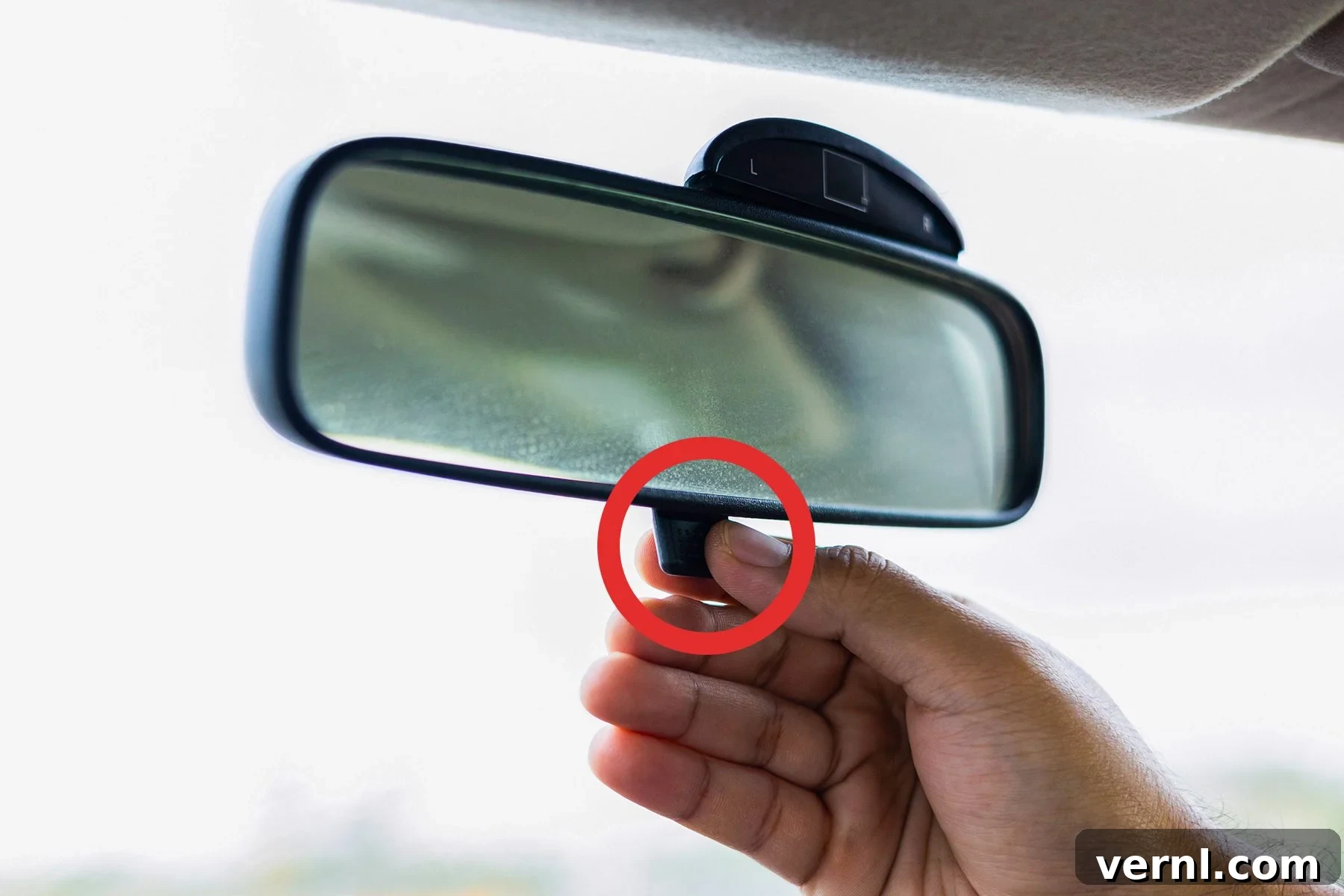
If your vehicle utilizes a manual day/night adjustment system, you’ll almost invariably find the control tab located discreetly on the bottom edge of the rearview mirror housing. This small, often rectangular or lever-like tab is designed for easy access and manipulation while driving. It’s the tactile interface that connects you to your mirror’s dual functionality. Sometimes, the mirror itself might be described as a “prismatic mirror,” which is just a technical way of saying it has this dual-mode capability. The operation is intuitive: typically, you push the tab down to engage night mode and pull it back up to revert to day mode.
Day Setting: Your Default View for Maximum Clarity
The “day setting” is the default position for your rearview mirror. In this mode, the mirror surface directly reflects the light from behind, providing the clearest and brightest possible image of the road and traffic. This unimpeded reflection is crucial for accurately judging distances and speeds in well-lit conditions. It does not incorporate any glare-reducing properties; its sole purpose is to present an unadulterated view of what’s happening behind your vehicle.
Automakers universally recommend ensuring your mirror is in this setting when performing any adjustments or when driving in daylight. As the 2022 Mazda CX-30 owner’s manual advises, it’s always wise to confirm that your mirror is in the day setting before making any physical adjustments to its angle or position. This ensures you are working with the maximum level of clarity, allowing for precise positioning that caters to your individual driving posture and line of sight. Maintaining a crystal-clear rear view during the day is as vital for safety as it is at night, preventing blind spots and enhancing overall situational awareness.
Night Setting: Deflecting the Glare for Enhanced Comfort
When the sun sets and the headlights come out, switching your mirror to the “night setting” becomes a critical safety measure. You activate this mode by pulling the tab on the bottom of your rearview mirror towards you. The Kia Sonet manual succinctly explains the benefit: this adjusted angle of the mirror will “reduce the glare from the headlights of the vehicles behind you during night driving.”
The magic behind this transformation lies in the mirror’s clever construction. A manual dimming mirror is essentially a wedge-shaped piece of glass with two reflective surfaces. The front surface, facing the driver, is only partially reflective, while the rear surface, further from the driver, is fully silvered. In the day setting, the mirror is positioned so that light passes through the partially reflective front surface and reflects off the fully silvered rear surface, giving you a bright, clear image. When you pull the tab for the night setting, the entire mirror assembly slightly pivots. This change in angle means that the intense light from following headlights no longer reflects off the fully silvered surface directly into your eyes. Instead, the primary reflection that reaches your eyes comes from the less reflective front surface. This secondary, weaker reflection significantly dims the glare, making it far more tolerable. While this process does result in a slightly dimmer image of what’s behind you – a trade-off in clarity for comfort and safety – it dramatically reduces the blinding effect of bright headlights. If you observe closely while toggling the tab, you can distinctly see this subtle shift in the mirror’s angle and the immediate reduction in perceived brightness.
The Evolution to Automatic Dimming Rearview Mirrors
As automotive technology advances, many modern vehicles feature automatically adjusting rearview mirrors, offering an even more seamless and hands-free solution to headlight glare. These sophisticated systems eliminate the need for manual intervention, allowing drivers to focus entirely on the road ahead.
How Automatic Dimming Technology Works
Automatic dimming rearview mirrors, often referred to as electrochromatic mirrors, operate using advanced sensor technology and electro-optical principles. These mirrors are equipped with two sensors: one facing forward, towards the ambient light, and another facing backward, towards the headlights of following vehicles. When the rear sensor detects a significant difference in light intensity compared to the front sensor (indicating bright headlights behind you in a dark environment), it triggers an electrical current.
This current then activates an electrochromatic gel or liquid crystals sandwiched between two layers of glass within the mirror. This material darkens in response to the electrical charge, effectively absorbing a portion of the incoming light and reducing the glare that reaches the driver’s eyes. The system continuously monitors light levels and adjusts the mirror’s tint dynamically, ensuring optimal glare reduction without any driver input. This continuous, adaptive adjustment provides superior comfort and consistent visibility, significantly reducing eye strain during prolonged night driving.
The Reverse Gear Exception
While automatic dimming mirrors are incredibly intelligent, they also incorporate a crucial safety override. As the Kia Sonet manual explains, there is an exception to their automatic dimming function: “If your vehicle is in reverse, the mirror will automatically go to the brightest setting in order to improve the driver’s view behind the vehicle.” This feature is a thoughtful design choice, recognizing that during reversing maneuvers, maximum visibility is paramount, regardless of potential glare. When backing up, drivers need every bit of available light to identify obstacles, pedestrians, and other vehicles, making a temporarily brighter mirror a necessary safety enhancement.
Beyond the Rearview Mirror: Comprehensive Tips for Night Driving Safety
While correctly utilizing your rearview mirror’s day/night setting is a crucial step towards safer night driving, it’s part of a broader strategy for maximizing visibility and minimizing risks after dark. Consider these additional tips to enhance your nighttime driving experience:
- Keep Your Windshield Clean: A dirty or smudged windshield can scatter light, exacerbating glare from headlights and streetlights. Regularly clean both the inside and outside of your windshield for optimal clarity.
- Ensure Headlights are Clean and Properly Aimed: Dirty headlight covers can significantly reduce light output. Also, improperly aimed headlights can blind other drivers and reduce your own effective range of vision.
- Avoid Staring Directly at Oncoming Headlights: While difficult, try to glance down and to the right side of your lane when approaching bright oncoming headlights. This helps preserve your night vision.
- Reduce Interior Lighting: Dim your dashboard lights and turn off unnecessary interior lights. Excess interior illumination can reduce your eyes’ ability to adapt to the dark outside.
- Take Breaks: Night driving can be more taxing on your eyes and mind. If you feel tired or experience eye strain, pull over safely and rest.
- Maintain Proper Following Distance: In reduced visibility, it takes longer to react to hazards. Increase your following distance to allow more time to stop or maneuver.
- Check Wipers and Washer Fluid: Clear vision during rain at night is extremely difficult. Ensure your wipers are in good condition and your washer fluid reservoir is full.
- Be Mindful of Pedestrians and Cyclists: They are much harder to spot at night, especially if they are wearing dark clothing. Drive cautiously and be prepared to stop.
Maintenance and Care for Your Rearview Mirror
To ensure your rearview mirror continues to function optimally, especially its glare-reducing capabilities, a little care goes a long way. Regularly clean the mirror surface with a soft, lint-free cloth and a glass cleaner that is safe for automotive use. Avoid harsh chemicals or abrasive materials, which can damage the reflective coating or, in the case of automatic mirrors, interfere with the electrochromatic layer. For automatic mirrors, ensure the forward and rear-facing sensors are kept clean and free from obstructions, as any blockage could impair their ability to detect light levels accurately. A well-maintained mirror is a reliable mirror, providing clear and safe views for many years to come.
Conclusion
Driving at night inherently carries greater risks due to diminished visibility. However, by understanding and proactively utilizing the features designed to mitigate these challenges, you can significantly enhance your safety and comfort. Whether your vehicle is equipped with a simple manual tab or an advanced automatic dimming system, your rearview mirror’s ability to reduce headlight glare is an invaluable tool. Make it a habit to check your mirror settings before embarking on any nighttime journey, and combine this awareness with other safe night driving practices. Prioritizing clear vision and reduced eye strain isn’t just about personal comfort; it’s a critical component of responsible driving that protects you, your passengers, and everyone else on the road.
Sources
2022 Mazda CX-30 Owner’s Manual, Mazda.
Sonet Manual, Kia.