
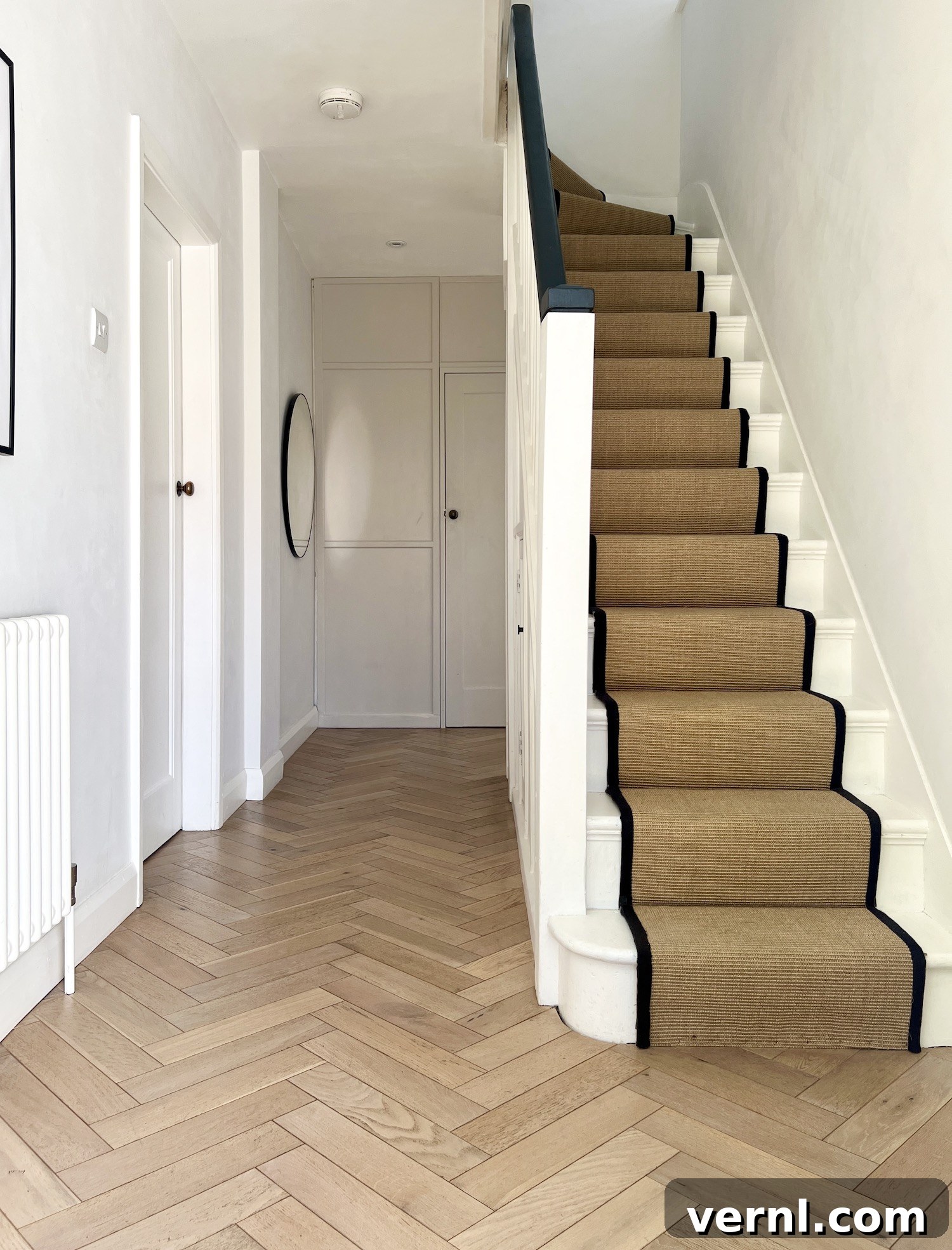
Hallways are often thought of as transitional spaces, but they deserve attention. As the first part of your home that greets visitors and residents, an entrance hallway sets the tone and offers a chance to showcase your style and character.
Decorating a hallway brings its own challenges: narrow proportions, limited natural light and the practical demands of coats, shoes, bags and keys. Yet those constraints can inspire creative solutions. Whether you’re starting from scratch or refreshing a tired entry, thoughtful choices in colour, lighting, furniture and finishes will transform a corridor into a memorable, useful space.
Below are eight practical, creative ideas to give your hallway stronger character while keeping it functional and welcoming.
1. Be braver with colour
While white and soft neutrals are safe and help reflect daylight, they aren’t the only options. Richer wall colours instantly alter the mood of an entrance: earthy greens, warm terracotta, deep blues or warm neutrals add depth and personality. Darker shades can create a cosy, enveloping atmosphere rather than just making a space feel smaller.
You don’t need to paint every surface the same shade. Try contrasting woodwork, a painted ceiling, or a darker accent on one wall to add interest without overwhelming the space. If you struggle to balance colours, use simple composition rules like the 60-30-10 approach—choose a dominant colour, a secondary colour and a small accent colour to tie the scheme together.
Also consider how the hallway relates to adjoining rooms: repeating a colour or motif from nearby spaces creates flow through the home without forcing an exact match.
2. Make more of your lighting
Good lighting changes everything, especially where natural light is limited. Think beyond brightness: the fitting itself contributes to the style. A sculptural pendant becomes an immediate focal point; wall lights help illuminate a long corridor without harsh overhead glare. Scale matters—tall ceilings can carry larger pendants, while flush or semi-flush fittings suit lower ceilings.
Layer your lighting for flexibility. Overhead fixtures provide general illumination; wall lights or a table lamp add warmth and atmosphere in the evenings. Treat lighting as part of the decoration rather than an afterthought, choosing fittings that complement the hallway’s character.
3. Turn an empty wall into a gallery
Hallways naturally lend themselves to artwork because they lack competing furniture. A gallery wall introduces colour and personality with contemporary prints, vintage photographs or paintings. The look doesn’t need to be perfectly matched—mixing frame styles and artwork sizes creates interest, while a recurring colour or similar frame finish provides cohesion.
If you prefer a simpler aesthetic, one oversized piece at the end of a long hallway can make a strong statement and draw the eye down the space.
4. Introduce pattern underfoot
When wall space is limited, look to the floor. A patterned runner adds colour, texture and direction—stripes emphasize length, while geometric or vintage patterns create a decorative focal point. The flooring itself can be a design opportunity too: checkerboard tiles, encaustic-style patterns, parquet or characterful timber all add personality.
Practicality matters in a high-traffic zone. Choose durable materials and finishes that will cope with daily use without losing their style.
5. Mix old and new
Combining vintage or antique pieces with modern items prevents a hallway from feeling overly staged. A preloved bench, an antique mirror or a vintage console introduces individuality and history. The juxtaposition of an ornate mirror against a simple contemporary wall colour, or a sleek modern light with traditional detailing, often produces a compelling result.
Mixing eras, textures and materials creates a personal, collected look that feels authentic.
6. Add architectural detail
If a hallway feels flat, add architectural interest. Panelling, dado rails, picture rails and decorative mouldings bring depth and structure, and are particularly effective in modern homes that lack period features. Minimal box moulding or half-height panelling can break up large expanses without dominating the space.
Make the most of existing features too: original floorboards, decorative cornices, stained glass or a character staircase can become the room’s main attraction when highlighted thoughtfully.
7. Create a focal point
Every space benefits from a point of focus. In a hallway this might be a bold central pendant, a large mirror above a console or a standout artwork at the end of the hall. A console table styled simply with a lamp, vase and a small stack of books creates an inviting vignette; using objects of different heights keeps the arrangement relaxed.
When working with smaller accessories, styling in odd numbers helps create balance without feeling too symmetrical. In compact hallways a painted internal door, an unusual wall light or a single striking piece of art can provide plenty of identity.
8. Layer different materials and textures
Texture adds depth and makes restrained colour schemes feel warm and lived-in. Combine painted walls with natural timber, woven baskets, metal lighting and a wool runner. A few contrasting finishes—timber, linen, wool, stone or rattan—are usually enough to prevent the space from feeling flat.
Small additions like ceramics on a console or an aged brass mirror against crisp painted woodwork introduce tactile variety and a sense of comfort.
Give your hallway its own identity
A hallway doesn’t have to be merely a passage between rooms. Even one or two well-chosen changes—a bolder colour, improved lighting, a cherished piece of furniture or a gallery of collected artwork—will give it presence and personality. Focus on details that feel right for your home and build the space up thoughtfully rather than trying to apply every idea at once.