Painting your home’s exterior is one of the most impactful ways to refresh its aesthetic, boost curb appeal, and protect your investment. A fresh coat of paint can dramatically transform a property, making it look vibrant and new. However, with exterior paint prices having escalated by as much as 30% since 2021, the financial stakes of a painting project are higher than ever. Consequently, accurately determining the precise amount of paint you’ll need is no longer just about efficiency—it’s about smart financial planning and preventing costly waste. If you’re embarking on a DIY exterior painting journey, harnessing the power of an online paint calculator is not just a convenience; it’s an essential first step. By simply inputting your home’s measurements, these intuitive tools can provide a reliable estimate of the gallons required, setting your project up for success from the outset.
Having undertaken numerous painting projects on my own home and rental properties, I’ve learned that starting with a meticulous paint calculation is paramount. It’s the surest way to circumvent the expensive pitfall of purchasing excessive paint, which often leads to wasted product and money. In this comprehensive guide, I’ll walk you through expert tips for precisely measuring your home’s exterior, provide clear, step-by-step instructions on how to effectively utilize an online paint calculator, and share my top recommendations for the best tools to ensure your painting project is both efficient and economical.
The Indisputable Benefits of Using an Exterior Paint Calculator
Before dipping your brush into a single can of paint, leveraging an exterior paint calculator offers a multitude of advantages that can streamline your project, save you money, and contribute to a more sustainable approach. It’s more than just a numbers game; it’s a strategic tool for any homeowner.
- Saves Time and Effort: Imagine the frustration of running out of paint mid-project, forcing an unplanned trip to the hardware store. Or, conversely, making multiple return trips to exchange or return surplus cans. A paint calculator eliminates these time-consuming detours by providing an accurate estimate upfront. This means you can purchase the correct quantity in one go, allowing you to focus entirely on the painting itself, rather than logistics. It streamlines your project timeline and minimizes disruptions.
- Saves Money and Prevents Waste: In an era of rising material costs, every drop of paint counts. Buying too much paint not only ties up your capital unnecessarily but also leaves you with leftover cans that might expire, become unusable, or require special disposal. Buying too little can lead to multiple purchases, potentially from different batches, which might result in slight color variations (known as “flashing”) across your walls. A calculator helps you hit that sweet spot, ensuring you buy just what you need, thereby optimizing your budget and avoiding financial waste.
- Environmentally Friendly Choice: Unused paint, especially in significant quantities, can pose an environmental challenge. Proper disposal often requires specific procedures, which aren’t always convenient or free. By accurately estimating your needs, you minimize excess paint, reducing the amount of chemical waste that needs to be managed. This small act contributes to a more sustainable and responsible approach to home improvement, lessening your ecological footprint.
- Empowers the DIY Homeowner: For those who prefer to tackle home improvement projects themselves, a paint calculator is an empowering tool. It demystifies one of the most crucial planning stages of exterior painting. Instead of relying on guesswork or rough estimates that can lead to errors, you gain confidence from a precise calculation. This fosters a sense of control over your project, making DIY painting more accessible and less intimidating for homeowners of all experience levels.
Mastering Exterior Measurement: How To Accurately Measure Your Home
Regardless of which paint calculator you ultimately choose, the foundation of an accurate estimate always begins with precise measurements of your home’s exterior. This step requires a bit of diligence, but it’s crucial for avoiding costly errors. Gather your essential tools: a reliable tape measure, a basic calculator, paper, and a pencil. For safety, especially for higher areas, consider using a sturdy ladder or a long measuring pole if available, and ideally, work with a partner.
Step-by-Step Measurement Guide:
- Visualize and Section Each Side: Begin by observing one side of your house. Mentally, or even physically with a quick sketch, break down this side into basic geometric shapes: squares, rectangles, and triangles. For instance, if your house features a gable roof, one side will likely comprise a large rectangle (the main wall area) topped by a triangle (the gable peak). For complex shapes, simplify them as much as possible.
- Measure Basic Dimensions and Round Up:
- For each square and rectangle, measure its total length and height.
- For each triangle (like a gable), measure its base (the length along the top of the wall) and its vertical height (from the base to the peak).
Always round up your measurements to the nearest foot. This slight overestimation is a good practice, as it provides a small buffer for slight miscalculations or unexpected needs, rather than leaving you short.
- Calculate the Area of Each Shape:
- For squares and rectangles: Multiply the length by the height (Area = Length × Height).
- For triangles: Multiply the base by the height, then divide by two (Area = (Base × Height) / 2).
Perform these calculations for every individual shape you identified on that side of your house.
- Sum for Total Side Area: Once you have the area for each shape on a given side, add them all together to get the total gross square footage for that entire side of your house.
- Identify and Measure Non-Paintable Areas: Now, focus on all surfaces on this side of the house that will NOT be painted. This primarily includes windows, doors, garage doors, and any unpainted materials like stone facades, brick accents, decorative trim (if not painting), or chimneys. For each of these elements, measure their length and height, then calculate their individual square footage using the rectangle formula (Length × Height).
- Calculate Paintable Surface Area Per Side: Add up the total square footage of all the non-paintable areas on that particular side. Then, subtract this sum from the gross total area you calculated for the side. The resulting number is the net paintable square footage for that side of your house. This is the crucial number you’ll input into your calculator.
- Repeat for All Sides: Consistently repeat this entire process (from step 1 to 6) for every exterior side of your home. It’s essential to be thorough and meticulous with each section.
- Consider Linear Measurements (If Applicable): Some advanced paint calculators, particularly those that estimate trim paint, may ask for linear measurements (total length) of trim, eaves, or specific architectural features. If you are using such a calculator or planning to paint trim separately, you can easily derive these linear feet totals from your existing measurements as you go.
By following these steps, you’ll have a precise and reliable set of measurements ready for any online paint calculator, ensuring the most accurate paint estimate possible.
Your Step-by-Step Guide: How To Effectively Use an Exterior Paint Calculator Online
Once you have your meticulous measurements in hand, using an online exterior paint calculator is the next straightforward step. While specific interfaces may vary, the general process remains consistent across most reputable platforms.
- Select a Reputable Paint Calculator Website: Begin by choosing an online paint calculator from a well-known paint manufacturer or a trusted home improvement resource. Avoid generic apps that might not be geared towards homeowners or require subscriptions for basic functionality. Stick to websites known for their accuracy and user-friendly design. My recommendations later in this guide will point you to some excellent choices.
- Fill Out All Relevant Fields with Your Gathered Measurements: Navigate to the calculator’s input fields. This is where your diligent measuring pays off. You’ll typically find fields for:
- Total Paintable Square Footage: This is the net square footage you calculated for each side of your house after subtracting windows, doors, and other unpainted areas. Some calculators allow you to input dimensions (length, height, gable height) for each side, automatically calculating the area.
- Number of Windows and Doors: Even if you subtracted their area, some calculators still ask for the count, especially if they factor in trim.
- Surface Texture: This is a critical field. Smooth surfaces (like smooth siding) generally require less paint per square foot than rougher, more porous surfaces (like stucco, unpainted wood, or textured siding). Ensure you select the option that best describes your home’s exterior.
- Number of Coats: This is arguably one of the most crucial settings. Most calculators default to one coat. However, for durability, optimal color coverage, and a professional finish, two coats of exterior paint are almost always recommended, especially if you’re significantly changing the color or dealing with a faded surface. Be sure to adjust this setting or manually double the final estimate if the calculator doesn’t offer a two-coat option.
- Primer Application: Some calculators may ask if you plan to use a primer. While many modern exterior paints are “self-priming,” a dedicated primer is often beneficial for bare surfaces, drastically changed colors, or surfaces with adhesion issues.
Input your data carefully, double-checking each entry against your notes.
- Initiate Calculation and Review the Output: Once all fields are accurately populated, click the ‘Calculate’ or ‘Estimate’ button. The calculator will process your information and generate an estimate, usually expressed in gallons (or liters, depending on your region). Review this number carefully. It represents the recommended amount of paint for your project based on the variables you entered.
- Consider a Small Buffer for Contingency: While calculators aim for precision, it’s always a good practice to add a small buffer to the final number. I typically recommend adding an extra 5-10% to the estimated gallons. This accounts for minor spills, touch-ups, or slight variations in surface absorption. It’s better to have a little extra for future repairs or missed spots than to run out and have to purchase another can, potentially from a different batch, risking color inconsistencies.
Crucial Mistakes to Avoid When Using an Exterior Paint Calculator
Even with the most advanced tools, human error can lead to inaccurate estimates. Being aware of common pitfalls can save you significant time, money, and frustration during your exterior painting project.
- Forgetting to Select ‘Exterior’ Setting: Most comprehensive paint calculators feature distinct settings for ‘interior’ and ‘exterior’ projects. It is absolutely vital to ensure you select ‘exterior’ before inputting any information. Exterior paints are formulated differently, with varied coverage rates and durability properties compared to interior paints. Using the interior setting for an exterior project will result in a completely inaccurate estimate, likely underestimating your true paint needs.
- Neglecting to Subtract Windows, Doors, and Non-Paintable Surfaces: This is one of the most frequent errors. While these features are part of your home’s total surface area, they do not require paint. Always remember to accurately measure and subtract the square footage of all windows, entry doors, garage doors, and any other non-paintable materials such as stone facades, brick sections, metal siding, or decorative trim that will not be painted. Failing to do so will lead to a significant overestimation of paint.
- Overlooking Outbuildings and Auxiliary Structures: Your main house isn’t the only structure that might need a fresh coat. If you plan to paint any detached garages, sheds, workshops, or even substantial fences that connect to your home, remember to measure them separately and include their paintable square footage in your calculator entries. These often forgotten structures can add a considerable amount to your total paint requirement.
- Underestimating the Number of Coats: Many exterior paint calculators provide an estimate based on a single coat of coverage by default. However, for optimal longevity, vibrant color, and thorough protection against the elements, almost all professional painters and manufacturers recommend applying at least two coats of exterior paint. If the calculator does not have an option to specify two coats, simply double the generated estimate before heading to the paint store. For significant color changes or very porous surfaces, even three coats might be necessary.
- Ignoring Surface Texture and Condition: The texture and condition of your home’s exterior surface significantly impact paint coverage. Rough, porous surfaces (like stucco, raw wood, or heavily textured siding) will absorb more paint and therefore require more gallons than smooth, primed surfaces. Ensure you accurately select the surface texture option in the calculator. Additionally, if your existing paint is severely deteriorated or chalky, it might require extra primer or an additional coat, which standard calculator estimates may not fully capture.
- Using General Estimates Instead of Precise Measurements: Resist the temptation to guess your home’s size (e.g., “small,” “medium,” or “large”) or rely solely on interior square footage, which is irrelevant for exterior painting. Precise, measured dimensions are the bedrock of an accurate estimate. Any calculator that asks for vague size descriptions instead of concrete measurements should generally be avoided for critical projects.
Outstanding Exterior Paint Calculators for Homeowners
When selecting an online paint calculator, look for one that empowers you with customization options, allowing for detailed input and providing a transparent, accurate estimate. Avoid those that rely on vague descriptions of your house size or solely on interior square footage, as these will lead to imprecise results.
Sherwin-Williams Paint Calculator offers an exceptionally robust and detailed estimation tool. It meticulously gathers a wide array of information, including the specific texture of your siding, a crucial factor that directly influences the quantity of paint required for adequate coverage and a uniform finish. One of its standout features is the ability to add each side of your house independently, which is incredibly useful for homes with complex architectural designs, additions, or bump-out sections. The calculator thoughtfully accounts for sides with peaks (gables) and allows you to precisely subtract the areas of windows, doors, and even trim for each individual side, leading to highly accurate net paintable surface area calculations.
Valspar Paint Calculator provides another remarkably thorough exterior paint calculation experience. It prompts for detailed information about each side of your house, ensuring a comprehensive assessment. What truly sets Valspar’s tool apart is its inclusion of a separate field specifically for peak height, which is invaluable for houses with prominent gables or varied rooflines, allowing for more precise triangular area calculations. Furthermore, it boasts an in-depth trim calculator that goes beyond basic subtraction, asking for specific trim length and width, which is perfect if you plan to paint your trim a different color or need to estimate paint for this feature separately.
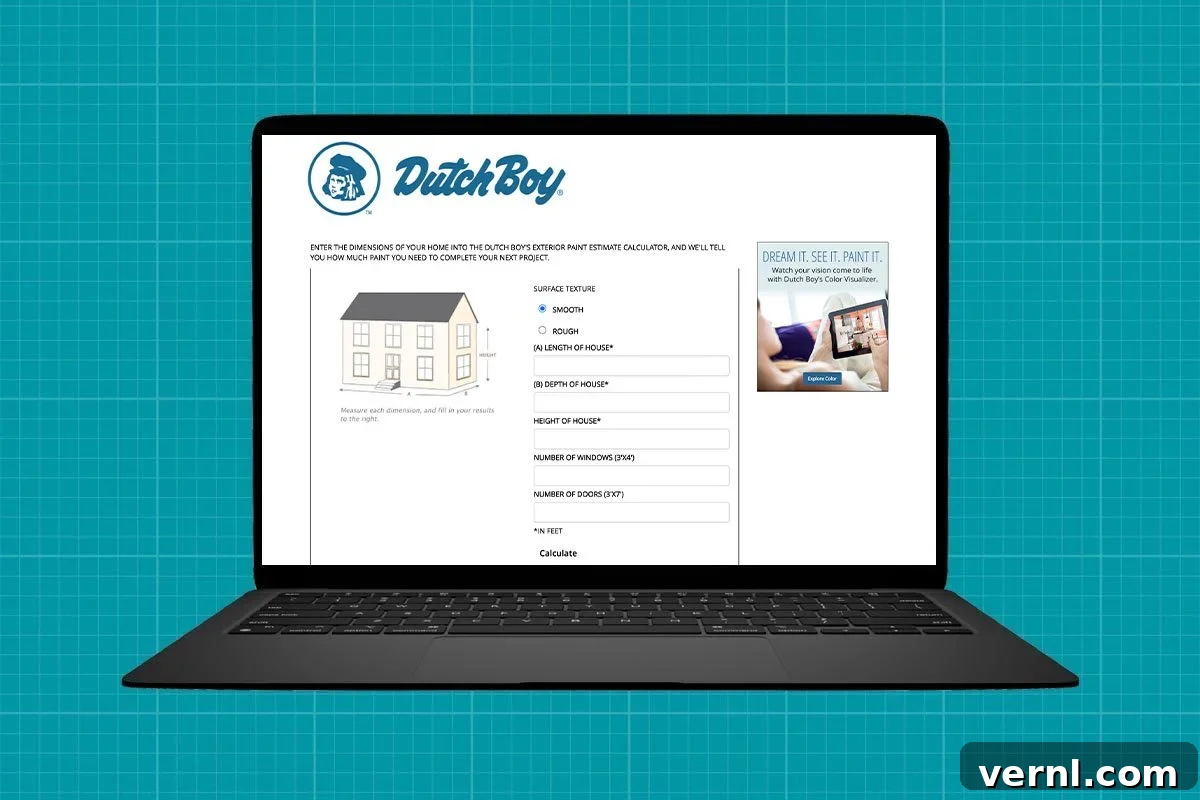
Dutch Boy’s Exterior Paint Calculator is an excellent choice for those seeking a quick yet reliable estimate without getting bogged down in excessive detail. While it doesn’t delve into the same level of granularity as Sherwin-Williams or Valspar, it still captures essential information that impacts paint usage. Notably, it accounts for siding texture and the number of windows and doors, providing a solid foundation for its estimate. If you’re looking for a good ballpark figure for your exterior painting project, perhaps for initial budgeting or to get a general idea of your paint needs, the Dutch Boy calculator will serve you well, balancing simplicity with adequate accuracy.
Conclusion: Paint Smarter, Not Harder
Embarking on an exterior painting project for your home is a significant undertaking, promising a fresh look and enhanced protection. By prioritizing accurate measurement and leveraging the power of an online paint calculator, you are not just simplifying a complex task; you are making a smart, informed decision that will save you time, money, and reduce environmental waste. The rise in paint prices underscores the importance of precision more than ever, making these digital tools indispensable for any DIY homeowner.
Remember, the success of your project hinges on meticulous preparation. Take the time to measure each side of your home thoroughly, carefully accounting for all non-paintable areas and unique architectural features. Once you have these precise figures, input them into a reputable exterior paint calculator, paying close attention to factors like surface texture and the number of coats required. With these steps, you’ll confidently purchase the correct amount of paint, minimizing trips to the store and ensuring a smooth, efficient painting process.
Embrace the power of planning and technology. With the right measurements and the assistance of an online paint calculator, your exterior painting project will not only be more manageable but also yield stunning, long-lasting results that you can be proud of for years to come. Paint smarter, not harder, and transform your home with confidence!