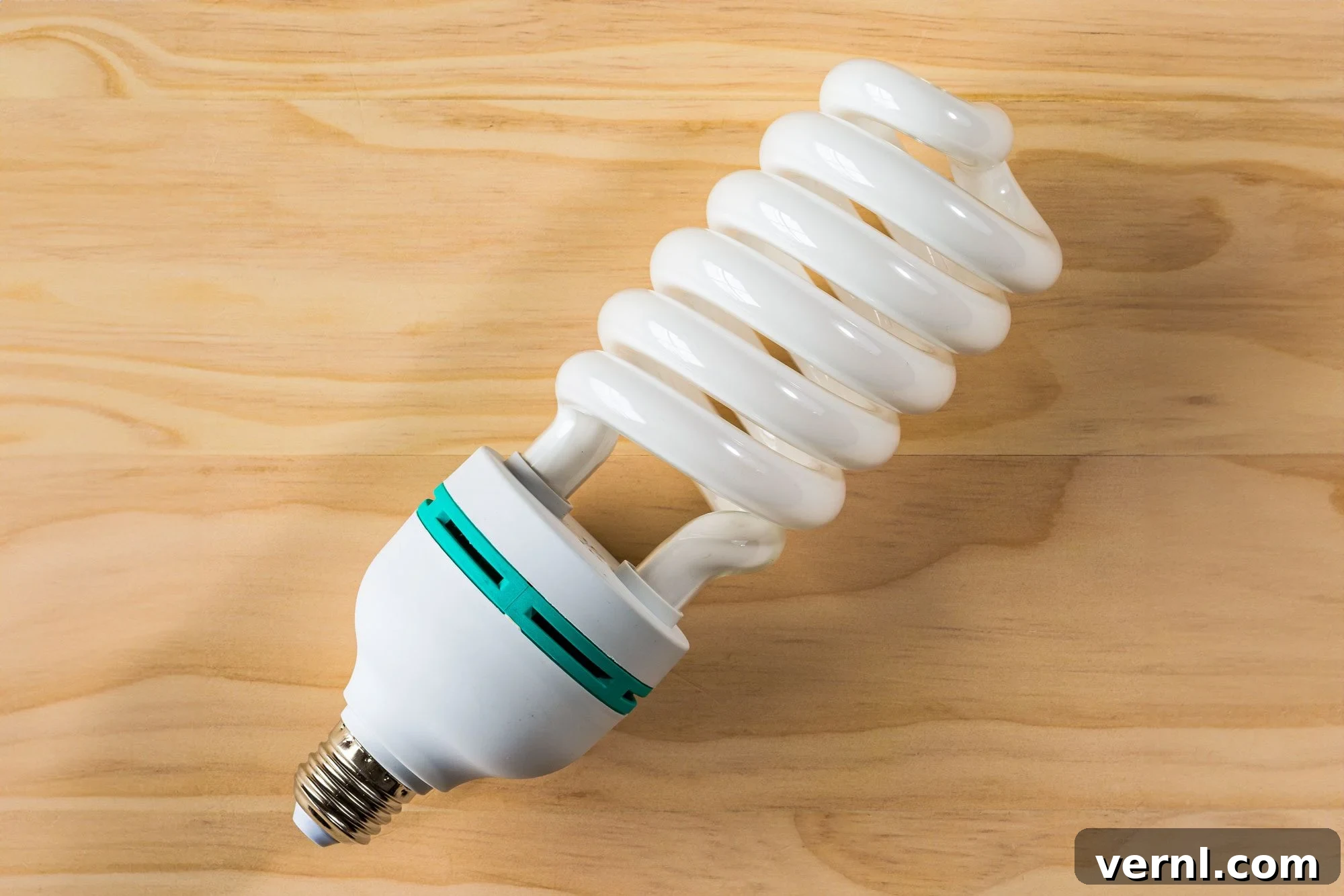
For nearly a century, traditional fluorescent lights – those long, slender tubes often found in school gyms, grocery stores, and commercial settings – were synonymous with utilitarian, cost-effective illumination. While undeniably functional, they weren’t exactly chosen for their aesthetic appeal. In residential environments, their presence was largely confined to practical spaces like garages or basements. However, a significant leap in lighting technology arrived in the 1970s with the invention of compact fluorescent lamps (CFLs). These innovative bulbs successfully bridged the gap between raw energy efficiency and domestic usability, offering the efficiency of their larger fluorescent counterparts in a more familiar, incandescent-like form factor.
“The primary drive behind the development of compact fluorescent lamps was the urgent need for smaller, more energy-efficient light bulbs that could outperform the traditional incandescent bulbs,” explains Terry McGowan, the esteemed director of engineering at the American Lighting Association. CFLs emerged as a pivotal technology, offering households and businesses a more sustainable lighting option before the widespread adoption of modern LED technology.
In this comprehensive guide, we delve deep into the world of CFL bulbs, drawing insights from industry experts like Terry McGowan and Dara Greaney, CEO of LEDLightExpert.com. We’ll explore the fundamental principles behind CFL technology, compare their performance and characteristics against classic incandescent bulbs (the familiar glass globes with a glowing filament) and cutting-edge light-emitting diodes (LEDs), which are rapidly redefining the landscape of modern illumination. Understanding these differences is crucial for making informed choices about the lighting solutions in your home or business.
Understanding Compact Fluorescent Lamps (CFLs)
At their core, compact fluorescent lamps are simply miniaturized versions of the larger fluorescent tubes commonly seen in retail establishments and industrial warehouses. While lighting professionals and electricians often refer to them as “lamps” rather than “light bulbs,” for practical purposes, the terms can be used interchangeably. According to McGowan, “It’s essentially a method to engineer a fluorescent lamp that mimics the size and shape of an incandescent lamp.” The lengthy fluorescent tube is cleverly shrunk down, typically into a distinctive spiral or U-bend configuration, allowing the CFL to seamlessly fit into standard incandescent light sockets.
The operational mechanism of fluorescent lamps, including CFLs, relies on a sophisticated interplay of gases and electrical currents. Each bulb contains a small quantity of gas, along with a tiny but critical amount of mercury. When electricity is applied, it excites the mercury and gas, generating ultraviolet (UV) light. This invisible UV light then interacts with a specialized phosphor coating applied to the inner surface of the tube. This coating effectively converts the UV radiation into the visible light that illuminates our spaces. Another defining characteristic of CFLs is the integrated ballast, a crucial electronic component responsible for regulating the flow of electricity through the bulb. In traditional, linear fluorescent tube fixtures, the ballast is housed within the fixture itself. However, a key innovation in most CFL designs was the relocation of this ballast directly into the base of the light bulb, simplifying installation and enabling its compact form.
When selecting a CFL bulb, it’s essential to shift your focus from watts to lumens. Watts measure the amount of energy a bulb consumes, whereas lumens quantify the total light output or brightness. Because CFLs are significantly more energy-efficient than incandescents, they produce far more light per watt. Therefore, comparing wattage directly between different bulb types can be misleading. Always check the bulb’s packaging for its lumen rating and the incandescent wattage equivalent to ensure you’re getting the desired brightness while maximizing energy savings.
Exploring the Varieties of CFL Bulbs
While early CFL designs were relatively straightforward, the evolution of the technology has led to a diverse range of options tailored for various applications and user preferences. Understanding these different types can help you select the most suitable CFL for your specific needs:
- Integrated Ballast CFLs: This is the most common and widely recognized type of CFL. In these bulbs, the spiral or U-bend fluorescent tube sits directly atop the ballast, which is neatly integrated into the screw-in base. This design offers maximum convenience, as the bulb can be directly screwed into any standard incandescent socket without requiring specialized fixtures. They are essentially plug-and-play replacements for traditional bulbs.
- Non-Integrated Ballast CFLs: Unlike their integrated counterparts, these CFLs do not have the ballast built into their base. As a result, McGowan notes that they tend to be lighter and potentially more cost-effective. However, their use necessitates a lighting fixture that already incorporates an external ballast. These are more common in commercial or specialized lighting setups where the ballast is part of the fixture’s permanent wiring, offering greater flexibility in bulb design and replacement.
- Dimmable, Non-Dimmable, and Three-Position CFLs: Advancements in technology have introduced dimmable CFL options, allowing for adjustable light levels. However, dimming fluorescent lamps can sometimes present challenges. McGowan points out that achieving satisfactory dimming performance often requires more expensive and complex circuitry within the bulb, which can lead to a less smooth dimming experience compared to incandescents or LEDs. For optimal results and to avoid issues like flickering or reduced lifespan, it is crucial to purchase CFL bulbs explicitly labeled as dimmable if you intend to use them with a dimmer switch. Three-position CFLs, on the other hand, offer multiple brightness settings (e.g., low, medium, high) without requiring a separate dimmer switch, typically by cycling through settings with a standard wall switch.
- Diverse Base Types: CFLs are available with a variety of base types to accommodate different fixtures. The most common is the standard Edison screw base, designed to fit traditional incandescent sockets. However, you can also find CFLs with pin bases (e.g., 2-pin or 4-pin G24q), twist-and-lock bases, push-in bases, and other specialized configurations, particularly in commercial or task-specific lighting applications. Always verify the base type required by your fixture before purchasing a replacement bulb.
CFL Bulbs vs. Cutting-Edge LED Bulbs
The emergence of Light-Emitting Diodes (LEDs) represents another paradigm shift in lighting technology, fundamentally different from CFLs. McGowan describes LEDs as “solid-state” technology, meaning they contain no gas, no filaments, and no glass tubes. Instead, LEDs are small semiconductor chips crafted from metallic and metal alloy materials. When an electrical current passes through these diodes, they emit light through a process called electroluminescence. While some LEDs utilize a phosphor coating similar to CFLs to achieve specific light colors or temperatures, the core mechanism of light generation is entirely distinct. “It’s a completely different approach to creating light,” emphasizes Dara Greaney of LEDLightExpert.com.
Despite their distinct operational principles, CFLs and LEDs share some significant advantages over traditional incandescents. Both technologies consume substantially less energy than their predecessors, leading to considerable electricity bill savings. They also offer a wide spectrum of color temperatures and improved lifespans. However, LEDs generally surpass CFLs in terms of longevity and energy efficiency. While CFLs can typically last between 6,000 to 15,000 hours, according to McGowan, the rated life of quality LEDs can extend to an impressive 25,000 hours or even more, reducing the frequency and cost of bulb replacements. Although LEDs historically carried a higher upfront cost, Greaney notes that prices have steadily decreased, making them increasingly competitive with CFLs, especially when considering their long-term value and superior performance.
Beyond longevity and efficiency, LEDs offer several other benefits. They reach full brightness instantly, unlike some CFLs that may require a warm-up period. LEDs are also inherently more durable, as they lack fragile glass components or filaments. Furthermore, LEDs are much easier to dim smoothly and efficiently, and they do not contain mercury, making them a more environmentally friendly disposal option. Their compact size and directional light output also allow for greater design flexibility in fixtures and applications.
CFL Bulbs vs. Traditional Incandescent Bulbs
To fully appreciate the innovations of CFLs, it’s important to understand the technology they sought to replace: the incandescent light bulb. Incandescent bulbs produce light through a process of incandescence, which essentially means generating light from heat. Electricity is forced through a thin, resistive wire filament, typically made of tungsten, which heats up to extreme temperatures, causing it to glow brightly. This method, while simple and effective, is remarkably inefficient. The vast majority of the energy consumed by an incandescent bulb is converted into heat rather than light. According to the U.S. Department of Energy (DOE), nearly 90% of the energy consumed by an incandescent bulb is lost as heat, making it a very inefficient light source.
CFLs, while still producing some heat as a byproduct of their operation, are vastly more efficient at converting electrical energy into visible light. McGowan highlights this stark contrast: a typical CFL can produce between 50 to 70 lumens per watt, whereas an incandescent bulb of similar light output manages only about 10 lumens per watt. This superior efficiency translates directly into significant energy savings for consumers. Another compelling advantage of CFLs over incandescents is their lifespan. Incandescent bulbs have a notoriously short operational life, topping out at around 1,000 hours on average. In contrast, CFLs offer a dramatically longer lifespan, typically ranging from 6,000 to 15,000 hours, meaning fewer bulb replacements and less waste over time.
The Future: Are CFL Bulbs Being Phased Out?
The era of compact fluorescent lamps is slowly but surely drawing to a close, as global energy efficiency standards continue to tighten and superior LED technology becomes more prevalent and affordable. Current federal energy efficiency standards in the U.S. mandate that light bulbs sold must achieve a minimum output of 45 lumens per watt. While CFLs largely meet this threshold, a new, more stringent standard is on the horizon. McGowan anticipates that the Department of Energy (DOE) will soon raise this standard to a demanding 100 lumens per watt. This upcoming change will effectively disqualify most CFLs, with their typical output of 50–70 lumens per watt, from being sold in the general consumer market. “This shift is highly probable within the next one to two years,” McGowan predicts. Dara Greaney adds, “While there might be a few specialized carve-outs for specific industrial applications, even these exceptions are becoming fewer and are gradually being phased out.”
Despite this broader trend, a complete and instantaneous disappearance of all traditional lighting types is unlikely. McGowan notes, “It’s improbable that every type of fluorescent or even incandescent lamp will vanish entirely, as there are niche applications where LEDs currently do not perform optimally.” A prime example he offers is the oven light. Both fluorescent lamps and LEDs can struggle with the high temperatures found inside an oven. Consequently, McGowan suggests that “incandescent oven lamps are likely to remain in production for quite some time,” highlighting that specific environmental demands can dictate the persistence of older technologies.
Understanding Hazards Associated with CFL Bulbs
One of the most significant environmental and health concerns associated with compact fluorescent lamps is their mercury content. “Every fluorescent lamp contains a small droplet of mercury,” McGowan confirms. Mercury, a naturally occurring metallic chemical element, is also a potent neurotoxin. In CFLs, it plays a crucial role in conducting electricity and generating UV light, which is then converted into visible light. While the mercury is safely contained within the sealed glass tube during normal operation, it becomes a hazard if the bulb breaks. This is precisely why proper disposal of CFLs is not merely a recommendation but a necessity to prevent the release of mercury vapor into the air, and its potential contamination of soil and groundwater, posing risks to both human health and ecosystems.
Exposure to mercury, even in small amounts, can have adverse effects on the nervous system, kidneys, and lungs, particularly for vulnerable populations such as children and pregnant women. While the amount of mercury in a single CFL bulb is relatively small (typically around 1 to 5 milligrams), the cumulative effect of widespread improper disposal can be substantial. Therefore, understanding the risks and adhering to safe handling and disposal practices are paramount for environmental stewardship and public health.
Responsible Disposal of Old CFL Bulbs
Given the mercury content, the only safe and environmentally responsible method for disposing of old CFL bulbs is through recycling. Simply tossing them into regular household garbage is highly discouraged, as the bulb is likely to break during transit or at the landfill, thereby releasing the mercury into the environment. Recycling CFLs ensures that the mercury, along with other valuable components such as the electrical ballast, glass, and metals, can be safely recovered and reused. According to the U.S. Environmental Protection Agency (EPA), nearly every component of a CFL can be recycled, minimizing waste and conserving resources.
Where to Recycle Old CFL Bulbs
Finding appropriate recycling options for CFLs is becoming increasingly accessible. Many municipalities and local government agencies offer collection points for these bulbs, though you may need to take them to a designated city recycling center or a hazardous waste facility. This is because standard sanitation workers who collect curbside recycling are typically not equipped to handle fragile, mercury-containing items without the risk of breakage. Additionally, numerous home improvement centers and large retail stores provide in-store recycling programs for CFLs, making disposal convenient for consumers.
The EPA recommends utilizing comprehensive online databases to locate local recycling options. A highly effective resource for this purpose is Search.Earth911, which provides an extensive listing of recycling centers across the country. It’s also important to be aware of state-specific regulations. Currently, six U.S. states have enacted bans on the landfill disposal of CFLs and other fluorescent tubes: California, Maine, Massachusetts, New Hampshire, Vermont, and Washington. These laws underscore the serious commitment to preventing mercury pollution and promoting sustainable waste management practices.
Choosing the Optimal Light Bulb for Your Home
When considering the best light bulb for your home, especially focusing on energy efficiency, light output quality, and overall versatility, the overwhelming consensus among lighting experts leans towards LEDs. Light-emitting diodes have emerged as the leading solution, offering a superior combination of performance and sustainability.
“High-quality LEDs deliver the finest light experience,” asserts Greaney. A common misconception or concern when transitioning to LEDs is about the “warmth” or color temperature of the light. However, modern LED technology offers an expansive range of color temperatures, from very warm, inviting yellows (similar to traditional incandescents) to cool, crisp blues. The packaging of LED bulbs clearly indicates their color temperature, measured in Kelvins (K), allowing consumers to choose the ambiance they desire. For truly exceptional light quality, especially for indoor applications, Greaney advises looking for an LED with a high Color Rendering Index (CRI). “Aim for a good CRI above 90 for indoor spaces, or above 70 for outdoor lighting, and you will be rewarded with outstanding light quality that accurately renders colors.” Beyond CRI and color temperature, LEDs also offer features like instant-on brightness, excellent dimming capabilities, smart home integration, and a multitude of design options, making them the most adaptable and efficient lighting choice for contemporary homes.
Meet Our Esteemed Lighting Experts
Our insights are informed by the profound expertise of two leading figures in the lighting industry:
Terry McGowan has dedicated his entire professional career to the intricate world of lighting. Beginning his journey at GE Lighting immediately after college, he later established and successfully ran his own lighting design business. Today, he holds the distinguished position of Director of Engineering at the American Lighting Association, where he continues to shape and influence the industry’s technical standards and advancements.
Dara Greaney is a highly respected lighting expert and the Chief Executive Officer of LEDLightExpert.com, a prominent e-commerce retailer specializing in advanced lighting solutions. His work primarily focuses on the cutting-edge realm of LED technology and innovative fixture design, continually pushing the boundaries of efficient and effective illumination.
Key Information Sources
- U.S. Environmental Protection Agency (EPA): Comprehensive guidance on “Recycling and Disposal of CFLs and Other Bulbs that Contain Mercury.”
- U.S. Department of Energy (DOE): Detailed resources and information on “LED Lighting.”
- Energy Star: Educational content and insights on “Learn about CFLs.”