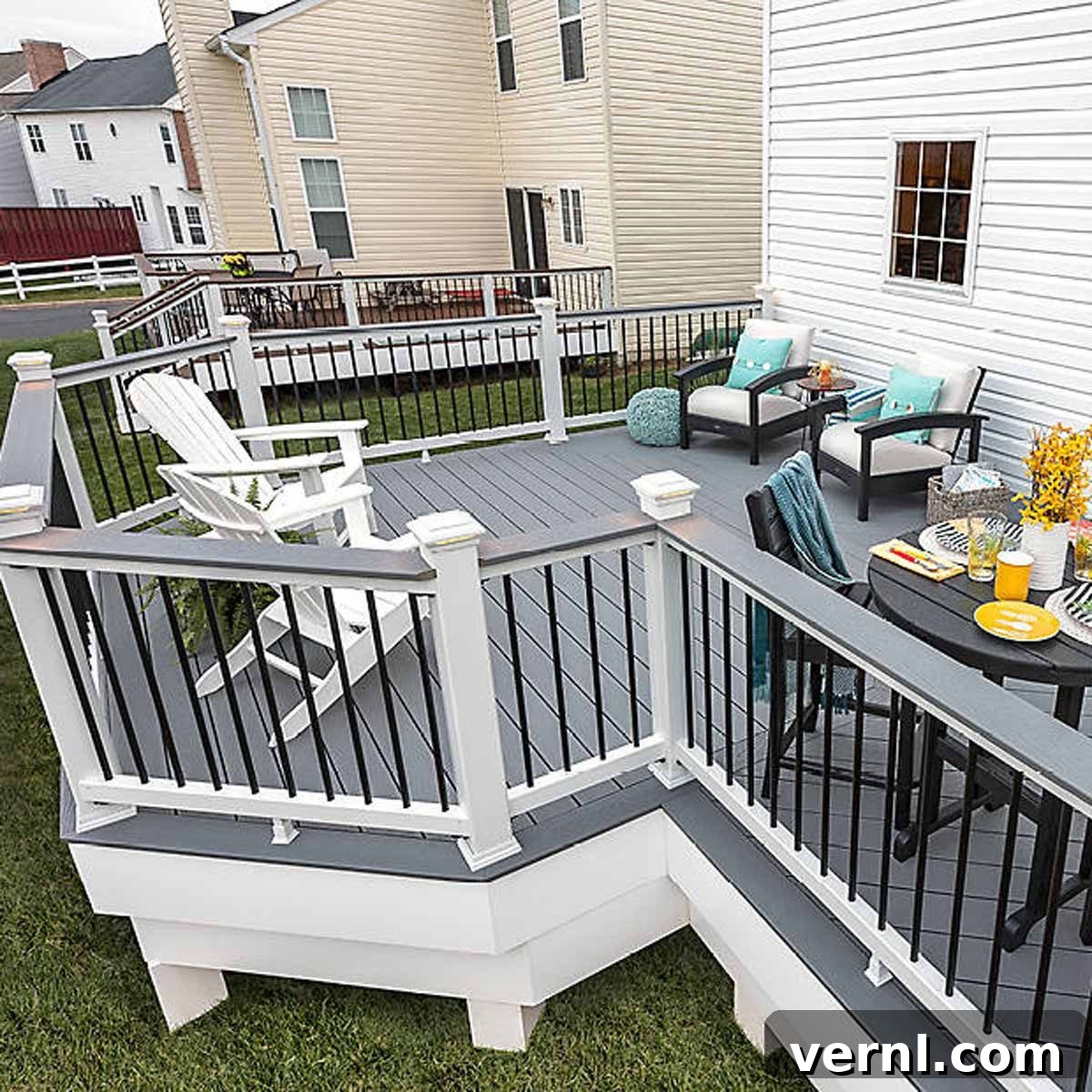
Embarking on a deck construction project is an exciting endeavor that promises to enhance your outdoor living space and boost your home’s value. However, a successful and stress-free build hinges on meticulous planning and an accurate understanding of the financial commitment involved. Before you even lift a hammer, there are two fundamental steps that cannot be overlooked: securing the necessary permits and developing a comprehensive, detailed materials list. While the dramatic fluctuations in lumber prices from a few years ago have somewhat stabilized, costs remain significant. Unexpected expenses can quickly transform an exciting project into a financial burden, making a precise budget indispensable.
Every substantial deck build, whether tackled by a seasoned professional or a first-time DIYer, inevitably encounters its share of unforeseen challenges and design modifications. Factors like irregular soil conditions, sloped terrain, and hidden obstacles can influence labor time and, consequently, costs if you’re hiring contractors. However, if you’re undertaking the build yourself, labor costs are primarily your time investment. The key to predictable material expenses lies in having a clear vision of your deck’s dimensions, design specifications, and, crucially, the type of decking materials you intend to use.
This guide outlines a strategic approach to compiling an exhaustive materials list for your decking project, helping you anticipate costs and manage your budget effectively. By systematically breaking down each component, from the foundation to the finishing touches, you can minimize surprises and build with confidence.
Calculating the Cost of Decking Materials
The choice of decking surface material is arguably the most significant factor influencing your deck’s overall cost and aesthetic appeal. The market offers a diverse range of options, each with its unique price point, durability, and maintenance requirements. Understanding these differences is crucial for making an informed decision that aligns with both your budget and your lifestyle.
- Pressure-Treated Pine or Fir: This is generally the most budget-friendly option, typically ranging from $2 to $5 per square foot. Pressure-treated wood is chemically treated to resist rot, decay, and insect infestation, making it suitable for exterior use. While economical and widely available, it requires regular sealing and staining to maintain its appearance and prolong its lifespan. It may also be prone to splintering and checking over time.
- Premium Hardwoods (Ipé, Tigerwood, Cumaru): For those not constrained by budget, exotic hardwoods offer unparalleled beauty, durability, and longevity. Priced from $7 to $20 per square foot, these woods are incredibly dense, naturally resistant to rot, insects, and decay, and often boast striking grain patterns and rich colors. They require minimal maintenance, often weathering to an elegant silver-gray patina if left untreated, or maintaining their vibrant hues with periodic oiling. However, their hardness can make them challenging to work with, requiring specialized tools and fasteners.
- Composite and Pure PVC Decking: Representing a mid-range option, composite and PVC decking materials from leading suppliers like Trex, AZEK/TimberTech, and Fiberon typically fall between $5 and $22 per square foot. These engineered products offer excellent low-maintenance properties, resisting rot, splinters, and insect damage. Composite decking is made from a blend of recycled wood fibers and plastic, while PVC decking is 100% plastic. Both come in a wide array of colors and textures, often mimicking natural wood. They are a popular choice for homeowners seeking durability and minimal upkeep, though they can absorb heat and may scratch depending on the product line.
- Rot-Resistant Softwoods (Redwood, Cedar): Perennial favorites for their natural beauty and inherent resistance to rot and insects, redwood and cedar are slightly more expensive than pressure-treated lumber but often a bit cheaper than composites. These woods offer a charming, rustic aesthetic and are lightweight and easy to work with. They do, however, require periodic sealing to preserve their color and protect against UV damage and moisture.
Decking materials are commonly priced by the square foot, simplifying cost estimation. However, some lumberyards, particularly for redwood or cedar, may list prices by the linear foot. Converting linear foot pricing to square foot pricing is straightforward for standard board widths. For example, if you’re using standard 6-inch decking boards (which typically measure 5 1/2 inches wide in practice), you’ll need approximately two boards to cover a foot of width (accounting for the standard 1/4-inch gap between boards). Therefore, simply double the linear foot price to get the approximate square foot price. Similarly, if you encounter 4-inch boards (actual 3 1/2 inches wide) priced by the linear foot, you would triple the price to find the equivalent per-square-foot cost.
Once you’ve determined the per-square-foot cost of your chosen decking material, the next step is to accurately measure your deck’s total surface area in square feet. Multiply this area by your per-square-foot material cost. To account for cutting waste, errors, and potential future repairs, it’s a best practice to add a 10 percent overage to your total square footage calculation. This small buffer can prevent costly delays and return trips to the lumberyard.
- Example: Let’s say you’re planning a 10×10-foot redwood deck. If redwood is priced at $2.24 per linear foot for 6-inch boards at your local supplier, the cost per square foot would be $4.48 ($2.24 x 2). A 100-square-foot deck would initially cost $448. Adding a 10 percent overage ($44.80) brings the estimated decking material cost to $492.80.
Calculating the Cost of Foundation Lumber
When it comes to the structural components of your deck—the posts, beams, and joists—your material choices are significantly more limited. For safety, longevity, and code compliance, pressure-treated pine or fir is virtually the only realistic and recommended option. These materials are specifically engineered to withstand the rigors of outdoor environments, particularly contact with the ground and exposure to moisture, which are critical for a deck’s foundation.
While the idea of using natural redwood or cedar for the foundation might seem appealing for aesthetic consistency, it is strongly discouraged. These untreated woods, though naturally rot-resistant to some degree, are not designed for ground contact or continuous exposure to high moisture levels typically found beneath a deck. Using them would not only escalate costs significantly but also drastically reduce the deck’s lifespan, making it susceptible to premature rot and structural failure. Pressure-treated wood rated for ground contact is formulated to prevent these issues, ensuring your deck’s stability and durability for decades.
Dimensional pressure-treated lumber is always sold by the linear foot. Calculating the total cost is straightforward: simply measure the total linear footage required for each dimension of lumber. For instance, you’ll need 4x4s or 6x6s for posts, 2x8s, 2x10s, or 2x12s for beams, and typically 2x6s, 2x8s, or 2x10s for joists, depending on your deck’s span and load requirements. Add up the total length in feet for each lumber type, then multiply by your supplier’s per-linear-foot price. For example, if your plan calls for four 8-foot 4×4 posts (32 linear feet total), two 12-foot 2×10 beams (24 linear feet total), and ten 10-foot 2×8 joists (100 linear feet total), you would calculate the cost for each component separately and then sum them up.
Savvy builders often explore options to reduce costs. If you have a contractor’s account at a lumberyard, you might qualify for a discount, which can lead to substantial savings on a large project. If not, consider asking a contractor friend to purchase the lumber on your behalf, potentially leveraging their trade discounts. Always compare prices from different suppliers, as pricing can vary significantly between large home improvement stores and independent lumberyards. Don’t forget to factor in a 10% overage for foundation lumber as well, to account for cuts, mistakes, and potential future structural repairs.
Stairs, Railings, and Trim: Essential Additions
Beyond the main deck surface and foundation, several crucial components contribute significantly to both the functionality and aesthetics of your deck: stairs, railings, and trim. Neglecting to include these in your initial budget can lead to significant cost overruns.
Railings: Building codes in most regions mandate a railing for any deck surface located more than 30 inches above the adjacent ground level. Railings are not merely decorative; they are essential safety features designed to prevent falls. Code requirements typically specify minimum height, maximum baluster spacing (often 4 inches or less, meaning a 4-inch sphere cannot pass through), and handrail graspability. The material choices for railings are extensive, including wood (pressure-treated for posts, cedar or redwood for balusters and top rails), composite, PVC, metal (aluminum or steel), or even cable rail systems. Each material offers a different look, maintenance level, and price point.
Stairs: If your deck requires a railing, it almost certainly requires stairs for access. Stair construction involves several components: stringers (the angled supports that define the rise and run of the steps, typically made from 2×12 pressure-treated lumber), treads (the horizontal surfaces you step on), and sometimes risers (the vertical boards between treads). While stringers must be pressure-treated for structural integrity and ground contact, treads can be made from a variety of materials to match or complement your deck surface, including natural redwood or cedar, composites, or even durable vinyl.
Fascia Trim: While not a structural necessity, fascia trim significantly enhances the finished look of your deck. It’s typically applied to the perimeter joists, covering the exposed ends of the deck joists and giving the deck a clean, polished appearance. Trim can be chosen to match your decking material (e.g., composite fascia for a composite deck) or a contrasting material for visual interest (e.g., redwood trim on a pressure-treated deck). It also offers a degree of protection to the rim joist.
To calculate the cost for these features, you’ll need to determine the total linear footage for each dimension and material required. For example:
- Posts: 4x4s for railing posts (often spaced every 6 feet or at corners).
- Railing Framework: 2x4s or 2x6s for top and bottom rails.
- Balusters/Spindles: 2x2s or specialty balusters for vertical infill.
- Stair Stringers: 2x12s, cut to form the steps.
- Stair Treads: Often 2x6s or matching decking material.
- Trim/Fascia: 1x8s or 1x10s for perimeter trim.
Measure the linear feet of each component, multiply by its per-linear-foot price, and, once again, factor in a 10 percent overage for waste and cuts. These elements, though often overlooked, can collectively add a substantial amount to your project’s overall cost, so careful calculation here is vital.
Hardware and Fasteners: The Unsung Heroes
The structural integrity and longevity of your deck rely heavily on the quality and quantity of hardware and fasteners used. These components, while small, are absolutely critical and represent a non-negotiable expense that must be thoroughly accounted for.
When assembling the deck’s foundation, you’ll need an array of specialized hardware. This includes post bases or post anchors that secure your posts to concrete footings, robust joist hangers to connect deck joists to beams or ledger boards, and sturdy hurricane ties or angle brackets for additional structural reinforcement, especially in areas prone to high winds. Lag screws, carriage bolts, and washers will be necessary for strong beam-to-post and post-to-foundation connections. While these items aren’t cheap individually, you can often achieve significant savings by purchasing them in bulk. For example, buying a box of 100 joist hangers may cost less than $100, whereas buying them individually could easily amount to $200 or more. Always prioritize quality and code-compliant hardware, as these are directly responsible for the deck’s safety and stability.
In addition to structural hardware, you’ll need thousands of screws for both assembling the sub-structure and attaching the decking boards. For the foundation, use exterior-grade, corrosion-resistant screws (often galvanized or coated) specifically designed for pressure-treated lumber. When it comes to attaching the decking, your fastener choice depends largely on the decking material and desired aesthetic:
- Visible Deck Screws: For traditional wood decking, exterior-grade deck screws (often composite-compatible or stainless steel for maximum corrosion resistance) are commonly used. These are driven directly through the deck board into the joist. While economical and strong, the screw heads remain visible on the deck surface.
- Hidden Fasteners: If you’re installing composite, PVC, or grooved-edge hardwood decking, you may opt for hidden fastening systems. These typically involve clips or specialized screws that attach to the side grooves of the boards, creating a clean, fastener-free deck surface. Hidden fasteners offer a premium look and a barefoot-friendly surface but generally come at a higher cost and may require more specialized installation techniques.
Regardless of the type, fasteners are almost always more economical when purchased in bulk. It’s usually a wise investment to buy more screws and clips than your initial estimate, as having extra on hand prevents project delays from running out and provides a reserve for future repairs or modifications. Ensure all fasteners are rated for exterior use and compatible with your decking material to prevent corrosion and staining.
Don’t Forget These Incidentals: Hidden Costs of Deck Building
Beyond the major material categories of lumber, hardware, and fasteners, several predictable yet often overlooked incidental costs can significantly impact your total budget. Failing to account for these can lead to unpleasant financial surprises:
- Building Permit: This is a mandatory expense in nearly all jurisdictions for new deck construction or significant renovations. The cost of a building permit can vary widely, from $100 to $600 or more, depending on your location, the size of your deck, and local permit fee structures. The permit process also typically involves inspections at various stages of construction, ensuring your deck meets local safety and structural codes. Operating without a permit can lead to fines, forced demolition, and difficulties selling your home in the future.
- Site Preparation & Drainage: Before construction begins, your site might require preparation. This could involve clearing brush, minor grading, or even demolishing an old structure. If you’re building on sloped terrain or in an area prone to water accumulation, proper drainage solutions are critical to prevent erosion, protect your deck’s foundation from moisture damage, and prevent water from pooling near your home’s foundation. This might entail installing French drains, improving surface grading, or extending downspouts. The expense here can range from minor to significant, depending on the scope of work required.
- Ready-Mix Concrete or Pier Blocks: The foundation posts of your deck will need solid support. This typically involves setting posts in concrete footings or resting them on pre-cast concrete pier blocks. The cost for concrete (whether ready-mix delivered or bags mixed on-site) or pier blocks rarely adds more than $200-$400 to the total cost of an average deck project. However, ensuring proper footing depth and diameter, as dictated by local frost line requirements and soil conditions, is vital for long-term stability.
- Finishing Materials: If you’re building with natural wood, whether pressure-treated, redwood, or cedar, you’ll need to account for finishing materials. These include stains, sealers, or paints, which protect the wood from UV radiation, moisture, and mildew, while also enhancing its appearance. The type of finish (transparent, semi-transparent, solid stain) and the size of your deck will determine this cost, and remember that reapplication will be a recurring maintenance expense every few years.
- Tool Rental: If you’re a DIY builder, you might not own all the specialized tools required for deck construction. Consider renting items like a post-hole digger, concrete mixer, heavy-duty miter saw, circular saw, or a specialized joist hanger nailer. Rental fees can add up, so factor these into your budget.
- Delivery Fees: Many lumberyards charge a delivery fee, especially for large orders of heavy lumber. Inquire about these fees when comparing material prices.
- Waste Disposal: Deck construction generates a significant amount of waste, including lumber scraps, concrete bags, and old deck materials if you’re replacing an existing structure. Budget for a dumpster rental or consider the costs associated with hauling debris to a local landfill or recycling center.
- Safety Equipment: Don’t skimp on safety. Include costs for essential personal protective equipment (PPE) like safety glasses, work gloves, hearing protection, and sturdy work boots.
By thoroughly researching and budgeting for each of these categories, you can create a realistic financial plan for your deck project, minimizing unexpected costs and ensuring a smoother, more enjoyable building experience. A well-planned deck is not just a structure; it’s an investment in your home and lifestyle.