Understanding Home Electricity: A Comprehensive Guide to Watts, Volts, Amps, and Ohms
Embarking on any home improvement project, especially those involving your electrical system, can feel daunting without a foundational understanding of how electricity works. However, the core concepts of electricity are surprisingly logical and interconnected. Think of them as a harmonious family where each member plays a vital role. Before you tackle any electrical repairs, installations, or home wiring projects, familiarizing yourself with key electrical terms like Watts, Volts, Amps, and Ohms will empower you to approach tasks smarter, safer, and with unwavering confidence. This guide will demystify these fundamental units, explain their relationships, and provide essential safety advice to ensure your electrical endeavors are successful.
What Exactly is a Watt? Understanding Electric Power
Watts (W) are the units of electric power, serving as a direct measure of how much energy an electrical device consumes or produces over time. When you think of electricity actively working in your home – whether it’s heating a room, illuminating your living space, or powering an appliance – you’re thinking about wattage. It quantifies the rate at which electrical energy is converted into another form of energy, such as heat, light, or mechanical motion.
Consider a portable electric space heater rated at 500 watts. This rating indicates that the heater consumes 500 watts of power every second it is turned on to generate heat. The higher the wattage, the more power an appliance uses, which often translates to greater output (e.g., brighter light, more heat) and potentially higher energy bills. Understanding wattage is crucial for energy efficiency and selecting the right devices for your home.
You’ll frequently encounter wattage when choosing light bulbs. When replacing a burned-out bulb, you typically check its wattage to find a new one that produces an equivalent amount of light. However, with the rise of energy-efficient LED technology, bulbs are now often advertised by their “equivalent wattage” (e.g., a 10W LED bulb producing light equivalent to a 60W incandescent), highlighting the power savings. Additionally, appliance nameplates are almost always marked with the product’s wattage rating, giving you clear insight into its power demands.
What is a Volt? The Pressure Behind Electric Flow
Voltage (V) represents the electrical potential difference or “pressure” that compels electric current to flow through a conductor, such as a wire. You can liken voltage to the water pressure in a pipe; without sufficient pressure, water won’t flow effectively. Similarly, without voltage, electric current remains stagnant.
In North America, residential utility systems typically deliver electricity to your home’s main service panel at two primary voltage levels: 240 volts and 120 volts. This dual-voltage system allows homes to power a wide array of appliances efficiently. Major electrical appliances, which require more power to operate, commonly utilize 240 volts. This category includes high-demand items like electric ranges, clothes dryers, water heaters, central air conditioning units, and certain home heating systems. These appliances are designed to draw significant power, and the higher voltage allows them to do so without requiring excessively large and costly wiring.
Conversely, the majority of household items and general-purpose circuits operate on 120 volts. This covers everything from your lamps, televisions, computers, and small kitchen appliances to most wall outlets in your living areas. Understanding these voltage distinctions is vital for safe appliance installation and ensuring that your home’s electrical system can adequately support all your devices without overload.
What is an Amp? Measuring the Rate of Electric Flow
Amperage (A), often shortened to “amps,” measures the actual rate at which electric current flows through an electrical circuit. If voltage is analogous to water pressure, then amperage is like the volume or rate of water flow through a pipe. A higher amperage means more electrons are moving past a given point in the wire each second.
When you’re working with your home’s electrical panel – whether installing new branch circuits, altering existing ones, or replacing components – you’ll notice fuses or circuit breakers of varying sizes, rated in amps. These devices are critical safety mechanisms, designed to trip or blow if the current flow exceeds a safe limit for that specific circuit, preventing overheating and potential fires.
Common general-purpose lighting and receptacle outlet circuits are typically rated for 15 amps. In modern construction, you’ll increasingly find dedicated 20-amp circuits in areas like kitchens, bathrooms, and laundry rooms, specifically designed to handle the higher current demands of appliances such as dishwashers, refrigerators, microwaves, and washing machines. These dedicated circuits prevent overloading when multiple high-draw appliances are used simultaneously.
Larger appliances naturally require higher amperage circuits. Electric clothes dryers and electric water heaters, for instance, are commonly supplied by 30-amp circuits. Air-conditioning units, electric ranges, and wall-mounted electric ovens can demand even more, often requiring 30, 40, or even 50-amp circuits, depending on their power ratings.
The entire electrical system in your home must be meticulously coordinated to ensure safe operation. Crucially, the amp rating of a fuse or circuit breaker directly dictates the minimum size of the wire required for that circuit and its overall capacity limitations. Attempting to draw more amps than a circuit is rated for – or using wire that is too small for the amperage – can lead to dangerous overheating, wire damage, and electrical hazards. If you need to increase the amperage capacity of a circuit, you must also install appropriately larger gauge wire to safely handle the increased current.
What is an Ohm? Quantifying Electrical Resistance
An Ohm (Ω), represented by the Greek letter Omega, is the unit of measurement for electrical resistance. Resistance is the opposition a material presents to the flow of electric current. Every electrical conductor, regardless of how efficient it is, possesses some inherent resistance. Think of resistance as friction for electricity; it impedes the smooth flow of electrons.
Copper wire, widely used in residential wiring due to its excellent conductivity, still has a measurable resistance. Aluminum wire, another good conductor often found in commercial, industrial, and utility installations, also has its own resistance characteristics. The amount of resistance depends on the material, its length, and its cross-sectional area. Just as a small garden hose restricts the flow of water more than a large fire hose, a thinner electrical wire will have higher resistance than a thicker one of the same material and length.
Understanding ohms becomes particularly useful when troubleshooting electrical circuits. When you use a multimeter – a versatile tool for diagnosing electrical issues – some of its settings and readings will be expressed in Ohms. For example, when checking the continuity of a new fuse, a properly functioning fuse should present approximately zero Ohms of resistance. This “zero” reading indicates that the electrical path is complete and uninterrupted, confirming the fuse is good.
Conversely, if you suspect a defective fuse, a broken light switch, or a faulty component, a multimeter reading of anything significantly other than zero (or an “open loop” indication) would likely signal a blown fuse, a broken circuit, or an internal fault. Always consult your multimeter’s user manual to ensure safe operation and accurate interpretation of readings. Proficiency with a multimeter, and understanding Ohm readings, is an invaluable skill for diagnosing and repairing electrical issues effectively.
The Fundamental Relationship: Watts, Volts, Amps, and Ohms (Ohm’s Law)
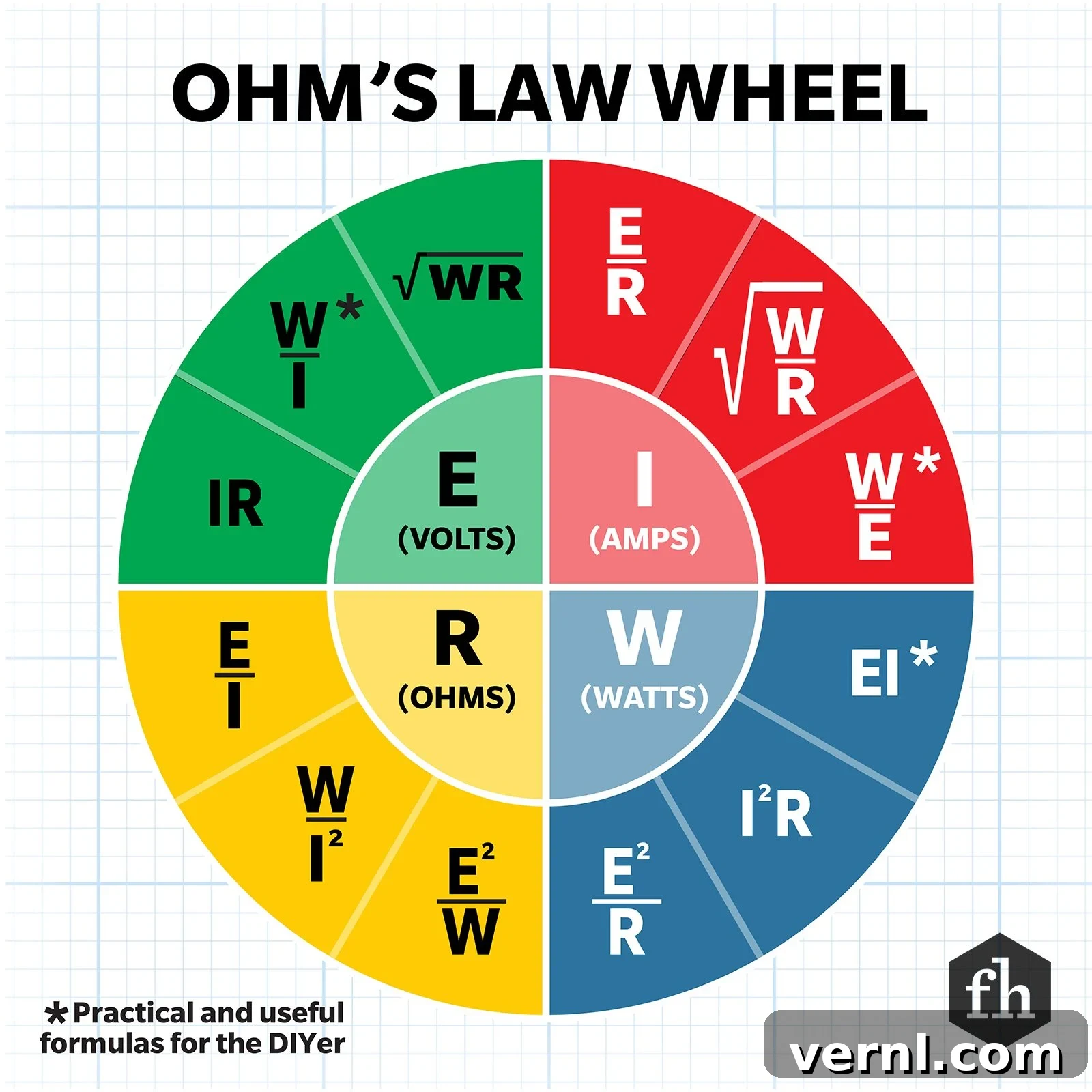
The beauty of basic electricity lies in the straightforward mathematical relationships between Watts, Volts, Amps, and Ohms. If you know any two of these variables, you can readily calculate the others. This interconnectedness is governed by fundamental principles, with Ohm’s Law being the cornerstone for understanding basic circuits. Ohm’s Law, named after German physicist Georg Simon Ohm, describes the relationship between voltage (V), current (I, for intensity), and resistance (R):
- V = I × R (Voltage = Current × Resistance)
- I = V ÷ R (Current = Voltage ÷ Resistance)
- R = V ÷ I (Resistance = Voltage ÷ Current)
Complementing Ohm’s Law is the Power Law, which relates power (P, in Watts) to voltage (V) and current (I):
- P = V × I (Power = Voltage × Current)
These formulas are incredibly useful, and the Ohm’s Law Wheel (often combined with the Power Law) serves as a visual aid to help quickly recall these relationships.
Practical Application: Sizing a Circuit with Ohm’s Law
Let’s illustrate these principles with a practical example. Imagine you’re installing an electric space heater in your garage. You found a powerful 5,000-watt (or five-kilowatt, 5kW) space heater at the hardware store that’s perfect for heating your workspace. Now, you need to determine the appropriate circuit size for this appliance.
First, check the appliance’s nameplate. It specifies the space heater is rated at 5kW (5,000 watts) and must be supplied with 240 volts. Our goal is to solve for the current (amps), represented by the letter ‘I’. Looking at the Ohm’s Law Wheel or recalling the Power Law (P = V × I), we can derive the formula for current:
I = W / E (where I = amps, W = watts, E = volts)
Now, substitute the known values into the formula:
I = 5,000 watts ÷ 240 volts
Calculating this gives us:
I = 20.83 amps
However, for continuous loads – electrical devices that operate for three hours or more, like a space heater on a cold day – electrical codes (such as the National Electrical Code in the US) mandate a safety factor of 125 percent. This is to ensure the circuit and wiring do not overheat under prolonged use, providing an additional margin of safety.
So, we apply the safety factor:
20.83 amps × 1.25 = 26.04 amps
Based on this calculation, the space heater requires a circuit capable of safely delivering approximately 26 amps. Therefore, a standard 30-amp branch circuit would have adequate capacity to supply electricity continuously and safely for this space heater. This example clearly demonstrates how understanding these basic electrical relationships allows for informed and safe electrical planning.
Prioritizing Safety in Home Electrical Work
Electricity is an invisible force that we often take for granted, yet it demands profound respect. Working with your home’s electrical system doesn’t have to be dangerous or overly complicated, provided you understand its principles, treat it with caution, and meticulously follow basic safety precautions. Neglecting safety can lead to severe injury, electrocution, or even fire. Always remember: when in doubt, call a qualified electrician.
- Master Your Tools: Before starting any work, learn how to safely use electrical tools and testers. This includes understanding their functions, proper handling, and limitations. A multimeter, for example, is indispensable but only if used correctly.
- Verify Tester Functionality: Always ensure your electrical tester or multimeter is working properly before using it to check circuits. Test it on a known live circuit first, then on the circuit you intend to work on, and then again on a known live circuit to confirm it’s still functional. This “three-point check” prevents false readings.
- Always De-Energize Circuits: This is arguably the most critical safety rule. Before performing any work on an electrical circuit, ALWAYS turn off the power at the main service panel. Never assume a circuit is off just because a switch is flipped. Use your tested electrical tester to confirm the absence of voltage.
- Lock Out, Tag Out: To prevent anyone from inadvertently restoring power while you are working, place a clear label, sign, or, ideally, a dedicated circuit breaker lockout device at the electrical panel. These inexpensive devices physically prevent a breaker from being switched back on, adding a vital layer of protection. They are readily available at home centers and online.
- Wear Appropriate Personal Protective Equipment (PPE): Always wear safety glasses to protect your eyes from sparks or debris. Non-conductive gloves made of leather, rubber, latex, or nitrile – and critically, ensure they are dry – provide insulation. Wear clothing made from natural fibers like cotton, as synthetic materials can melt and cause severe burns if they catch fire.
- Maintain a Dry, Insulated Work Environment: Never stand or kneel on a wet or damp surface when working with electricity, as water is an excellent conductor. Always use sturdy, proper footwear, and if working outdoors or in a potentially damp area, place a dry, non-conductive piece of wood or a specialized non-conductive mat beneath you to provide additional insulation from the ground.
- Use Insulated Tools: Whenever possible, use tools featuring rubber or plastic-coated handles specifically rated for electrical work. These non-conductive handles offer an important layer of protection against accidental contact with live wires, significantly reducing the risk of electrical shock.
- Never Work in the Dark: Ensure adequate lighting in your workspace. Trying to work on electrical components in dim light increases the risk of making mistakes, misidentifying wires, and accidental contact with live parts.
- Understand Grounding: Ensure all your electrical installations and repairs adhere to proper grounding principles. Grounding provides a safe path for electricity to flow in case of a fault, protecting people and equipment from dangerous current surges.
- Consult Professionals When Needed: If a task feels beyond your skill level, or if you encounter complex wiring, unusual readings, or any uncertainty, do not hesitate to call a licensed electrician. Their expertise ensures the job is done safely and correctly, protecting your home and family.
By understanding these fundamental electrical components and diligently adhering to safety protocols, you can confidently approach home electrical projects, enhancing your living space’s functionality and safety for years to come.