

Choosing the Best Grass for Your Lawn: A Comprehensive Guide to Lush, Healthy Turf
Cultivating a vibrant, healthy lawn begins with a fundamental decision: selecting the right grass for your specific climate, prevailing conditions, and personal lifestyle. When you align your grass choice with these crucial factors, you dramatically enhance your prospects of growing the resilient and beautiful lawn you’ve always dreamed of. This guide will walk you through the distinct characteristics of cool-season and warm-season grasses, empowering you with the knowledge to make an informed decision for your outdoor space.
Essential Grass Terms: A Brief Glossary for Lawn Selection
To navigate the world of lawn grasses effectively, understanding a few key terms is essential. This glossary will provide you with the foundational vocabulary needed to make the best choice for your yard:
- Cool-Season Grass: These grass varieties are best suited for regions characterized by cold winters and mild to moderate summers. They exhibit their most vigorous growth during the cooler temperatures of spring and fall, often entering a semi-dormant state during the heat of summer. Common in Northern climates and higher elevations.
- Warm-Season Grass: Thriving in the Southern and Southwestern United States, warm-season grasses prefer consistently warm temperatures and often flourish in humid conditions. They grow actively throughout the summer months and typically go dormant, turning brown, when temperatures drop below freezing.
- Tillers: These are individual vegetative shoots that emerge from the base of a “mother” grass plant. Each tiller consists of a stem and several leaf blades, contributing to the density of the turf. Grasses that primarily spread via tillers are known as bunch-type grasses.
- Rhizomes: Acting as underground stems, rhizomes are a primary method of horizontal spread for some grasses. They grow beneath the soil surface, rooting at intervals to produce new shoots and creating a dense, interconnected sod that helps fill in bare spots.
- Stolons: Similar to rhizomes in function, stolons are above-ground runners or lateral stems that spread horizontally across the soil surface. They root at their nodes, giving rise to new shoots and allowing certain grasses to expand rapidly and efficiently.
- Bunch Type: This classification describes grasses that grow in distinctive clumps or bunches, primarily expanding through the production of new tillers from the base of the parent plant. Unlike spreading grasses, they do not produce extensive rhizomes or stolons, often requiring overseeding to maintain a uniform appearance.
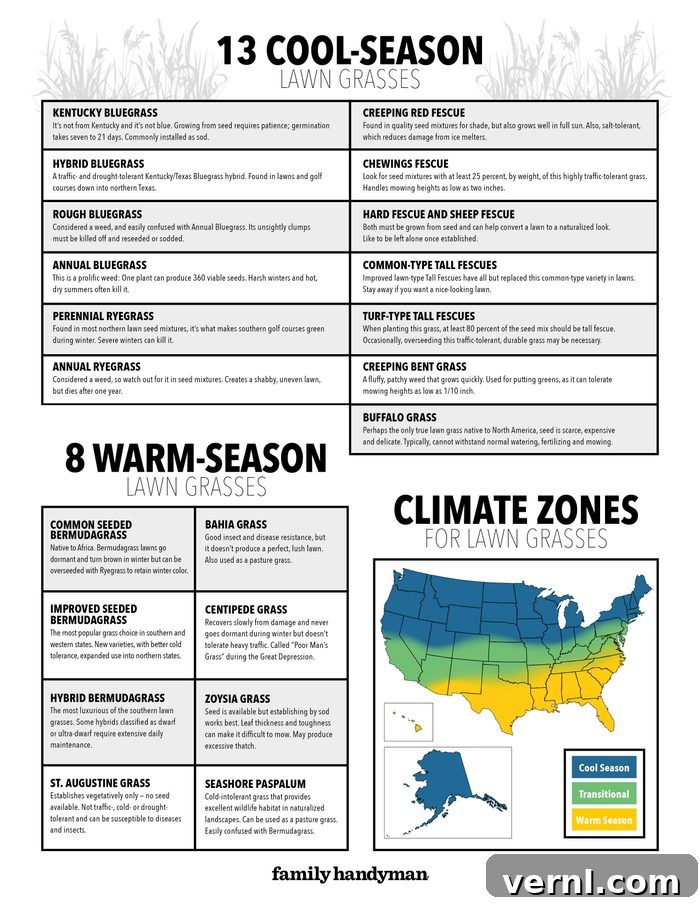
Download the PDF version of this comprehensive grass chart for easy reference.
13 Superior Cool-Season Lawn Grasses for Northern Climates
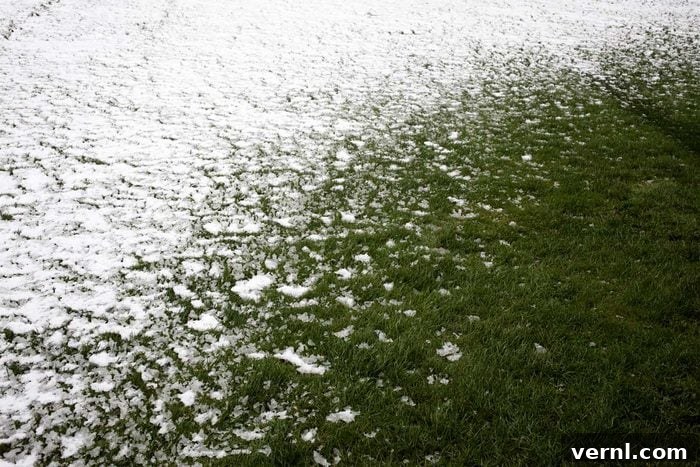
Cool-season grasses are renowned for their ability to thrive in regions with cold winters and mild summers, exhibiting their peak growth during spring and fall. These grasses are typically found in the Northern U.S. and at higher elevations. Understanding their unique traits is key to selecting the perfect cool-season lawn.
Kentucky Bluegrass (Poa pratensis)
- Identification: Displays a vibrant medium to dark-green color and a medium leaf texture. Its leaves are distinctively boat-shaped at the tip. This grass is known for its aggressive spreading habit via an extensive network of rhizomes, which creates a dense, interwoven sod.
- Ideal Location: Widely cultivated across almost all areas north of Interstate 80, Kentucky Bluegrass flourishes in climates with mild summers, cold winters, and ample full sun exposure. It’s a staple in northern lawns and parks.
- Why Plant It: Homeowners choose Kentucky Bluegrass for its exceptional durability and winter hardiness. It possesses a remarkable ability to recover quickly from drought conditions and heavy foot traffic, making it ideal for active families. It blends seamlessly with other cool-season grasses, rapidly forming a tightly knit, resilient turf.
- Key Considerations: Despite its name, this grass is European in origin, not from Kentucky, and its color is green, not blue. While it can be grown from seed, patience is crucial as germination can take anywhere from seven to 21 days. For quicker establishment, it is very commonly installed as sod, providing an instant lawn. It requires consistent moisture and moderate fertilization for optimal health and appearance.
Hybrid Bluegrass (Poa arachnifera x Poa pratensis)
- Identification: Exhibits a rich, dark-green color and a medium-fine leaf texture, retaining the characteristic boat-shaped leaf tip of its bluegrass lineage. It spreads efficiently through rhizomes, contributing to a robust root system.
- Ideal Location: Primarily finds its niche in the challenging transition zone, where it uniquely thrives in hot, dry, and even moderately shady conditions that would stress many other cool-season grasses.
- Why Plant It: Its deep-penetrating root system is a significant advantage, providing superior heat and drought tolerance for northern lawns. This enhanced resilience means a greener, healthier lawn even during summer heatwaves, reducing water dependency.
- Key Considerations: This innovative hybrid is a cross between Kentucky Bluegrass and Texas Bluegrass, specifically bred for improved stress tolerance. It’s often blended with turf-type tall fescue seed to create versatile, high-performance mixtures. Hybrid Bluegrass boasts excellent traffic tolerance, making it a reliable choice for active home lawns and golf courses, extending its viable range as far south as northern Texas.
Rough Bluegrass (Poa trivialis)
- Identification: Distinguished by its light-green color and soft, delicate leaf blades. It spreads aggressively by stolons, often manifesting in lawns as unattractive, coarse clumps that contrast sharply with finer turf types.
- Ideal Location: Prefers U.S. regions that consistently remain cool and wet, or in perpetually shady and over-watered lawn areas. It flourishes where moisture levels are high and sustained.
- Why Plant It: Generally, homeowners should avoid planting Rough Bluegrass deliberately in a desired lawn area. Its use is extremely limited, perhaps only as a last resort for very moist, moderately shaded locations in specialized, non-aesthetic turf applications.
- Key Considerations: Widely regarded as a weed in most cultivated lawns due to its invasive nature and clumping growth. Alarmingly, some seed companies still include it in shade grass mixtures, which can inadvertently introduce problems. There is no known selective herbicide control for Rough Bluegrass. Patches, which are easy to confuse with Annual Bluegrass, typically require complete eradication before the area can be successfully reseeded or sodded with a preferred grass.
Annual Bluegrass (Poa annua)
- Identification: Appears as distinctive apple-green patches that vary widely in size. It frequently displays conspicuous whitish seedheads, even when mown short. This grass grows as a bunch-type, creating isolated clumps rather than a uniform spread.
- Ideal Location: This truly ubiquitous plant is found literally everywhere across all seven continents, ranking among the top five most common plants globally. It favors moist, cool areas and heavy, compacted soils. You’ll frequently spot it on golf courses and residential lawns that receive ample fertilizer and water.
- Why Plant It: Under no circumstances should Annual Bluegrass be intentionally planted for a lawn. It is universally considered a weed due to its invasive nature, undesirable appearance, and seasonal die-back.
- Key Considerations: A crucial tip: avoid buying cheap grass seed, as it is highly likely to contain Annual Bluegrass seeds as a contaminant. It is sometimes confused with Rough Bluegrass and various Bentgrasses. This prolific seeder is incredibly efficient; a single plant can produce up to 360 viable seeds, ensuring its widespread and persistent presence. While harsh winters and hot, dry summers can kill mature plants, its rapid reseeding capability ensures its return.
Perennial Ryegrass (Lolium perenne)
- Identification: Characterized by a medium-green color and a distinctive shiny underside to its leaf blades, a useful identification marker. It exhibits a bunch-type growth habit, forming dense clumps and improving turf density quickly.
- Ideal Location: Thrives in sunny locations and is particularly prominent in Southern states, where it’s widely used as a temporary winter grass to provide green color when warm-season grasses are dormant.
- Why Plant It: Homeowners choose Perennial Ryegrass for its incredibly fast establishment from seed, providing quick ground cover and erosion control. It also boasts improved wear tolerance, making it a good companion in high-traffic areas alongside other turf grasses.
- Key Considerations: Perennial Ryegrass, which bears a visual resemblance to Kentucky Bluegrass, is a common component in most Northern lawn seed mixtures, valued for its rapid germination and establishment. It’s extensively utilized on golf courses and athletic fields due to its resilience; it’s the reason Southern golf courses maintain their vibrant green appearance throughout the winter months. However, homeowners in extremely cold regions should note that severe winters can occasionally lead to die-back.
Annual Ryegrass (Lolium multiflorum)
- Identification: Recognizable by its apple-green color and a noticeably coarse texture. It holds the distinction of germinating and growing faster than almost any other grass type, displaying a strong bunch-type growth habit.
- Ideal Location: Found throughout the U.S., it is often seen in agricultural pastures, roadside stabilization projects, and temporary groundcover applications where quick establishment is paramount.
- Why Plant It: Primarily chosen for its very low cost and extremely rapid growth when the primary goal is temporary groundcover or soil stabilization, not aesthetic turf quality. Annual Ryegrass is also valuable as a “nurse crop” to protect slower-growing, more desirable grasses as they establish, and where temporary groundcover is needed.
- Key Considerations: For a desirable, high-quality home lawn, Annual Ryegrass is generally considered a weed; therefore, it’s strongly advised to avoid seed mixtures containing it. Its significantly faster and taller growth rate compared to permanent turf grasses can quickly lead to a shabby, uneven lawn appearance. Fortunately, as an annual, it completes its life cycle within one year and then dies, allowing for eventual replacement with more suitable, permanent turf.
Creeping Red Fescue (Festuca rubra ssp. rubra)
- Identification: Presents a pleasing medium-green color and an exceptionally fine texture, which contributes to a delicate appearance. It spreads moderately by rhizomes, creating a reasonably dense turf, and once established, it exhibits a slow growth rate.
- Ideal Location: Widely distributed throughout the Northern U.S., particularly thriving in shady roadside and utility areas with infertile, sandy soil. It’s also a common component in low-maintenance lawns where minimal input is desired.
- Why Plant It: An excellent choice for homeowners looking to expand the overall diversity of their medium to heavily shaded lawn areas. It’s particularly beneficial if you’re aiming to reduce reliance on fertilizers and water, as it performs well under lower nutrient levels and less frequent irrigation.
- Key Considerations: Creeping Red Fescue is a valuable component in high-quality seed mixtures formulated for shade, yet it demonstrates surprising adaptability, growing well even in full sun conditions. It integrates effectively with other Northern grasses and exhibits good salt-tolerance, a key advantage that helps mitigate turf damage from ice melters used on sidewalks and driveways during winter.
Chewings Fescue (Festuca rubra ssp. commutata)
- Identification: Boasts an attractive medium to dark-green color and an extremely fine texture, contributing to excellent turf density. It maintains a distinct bunch-type growth habit, forming tight, upright clumps.
- Ideal Location: Thrives across the Northern U.S., particularly in well-maintained lawns with well-drained soil. It’s highly versatile, tolerating a wide range of light conditions from full sun to heavy shade.
- Why Plant It: Incorporating Chewings Fescue is a strategic choice for enhancing the genetic diversity of your lawn, significantly improving its density, and naturally reducing weed infiltration, especially in shady areas where competitive grasses might struggle.
- Key Considerations: When purchasing seed, look for mixtures containing at least 25 percent by weight of this highly traffic-tolerant fine fescue to ensure robust performance. It grows particularly well in combination with Kentucky Bluegrass and can effectively handle mowing heights as low as two inches, making it suitable for various lawn aesthetics.
Hard Fescue (Festuca trachyphylla) (Festuca ovina var.)
- Identification: Characterized by a medium-dark to bluish-green leaf color and a very fine texture. Its bunch-type growth habit can sometimes lead to a clumpy appearance in very low-maintenance settings.
- Ideal Location: Found throughout the Northern U.S. in areas where minimal intervention is desired, such as cemeteries, old parks, naturalized areas, roadsides, and other “no-mow” zones. It performs well in conditions ranging from full sun to heavy shade.
- Why Plant Them: These grasses are perfectly suited for those looking to transition a traditional lawn to a naturalized look, or for homeowners who desire a truly hands-off approach, effectively eliminating the need for regular watering, fertilizing, or even mowing.
- Key Considerations: Hard Fescues are not suitable for all lawn types, especially manicured ones. They must typically be grown from seed, as they are not commonly available as sod. Some varieties possess a unique aesthetic due to their fine leaf texture and distinctive blue-green coloration. Once established, these grasses prefer to be left undisturbed, thriving on minimal intervention.
Common-Type Tall Fescues (Festuca arundinacea)
- Identification: Often presents a coarse, somewhat weed-like appearance due to its rigid, broad leaf blades. It grows in a distinct bunch-type habit, forming individual clumps rather than a uniform spread.
- Ideal Location: Historically prevalent throughout the Transition Zone in pastures, native landscapes, roadsides, older lawns, parks, and common grounds where a refined turf aesthetic is not the primary objective.
- Why Plant It: If turf quality and density are secondary concerns, common-type tall fescue offers a more budget-friendly option compared to improved turf-type varieties, providing basic ground cover at a lower initial cost.
- Key Considerations: For homeowners aspiring to a beautiful, uniform, and refined lawn, it is strongly advisable to avoid common-type tall fescues. Improved “lawn-type” tall fescues have largely superseded these older varieties in modern lawn applications due to their superior aesthetics and performance. Critically, these grasses are not winter hardy and should not be used in Northern states, where they will likely suffer severe winter injury. Notable named varieties include K31, Alta, and Fawn.
Turf-Type Tall Fescues (Schedonorus arundinaceus)
- Identification: Boasts an attractive dark-green color and a medium texture with rigid, somewhat pointy leaves. It develops a deep, penetrating root system, enhancing its resilience. This grass maintains a consistent bunch-type growth habit.
- Ideal Location: Widely favored throughout the transition zone, this grass is excellent for actively used, low to moderately maintained lawns, playgrounds, and ball fields. It adapts remarkably well to conditions ranging from full sun to moderate shade and thrives in nearly all soil types.
- Why Plant Them: An excellent choice for homeowners seeking a relatively “take-it-easy” lawn that demands less fertilizer and water, yet still prioritizes exceptional traffic tolerance and durability for active family use and play.
- Key Considerations: To cultivate a successful turf-type tall fescue lawn, ensure that at least 80 percent of the seed mix by weight consists of tall fescue for optimal density and performance. Occasional overseeding may be necessary to maintain optimal density, especially as it can be slow to recover from severe wear. Newer varieties have significantly improved cold hardiness, making them better adapted to extreme Northern winters. Most modern varieties also contain a beneficial endophyte fungus, which naturally enhances resistance to common lawn insects.
Creeping Bentgrass (Agrostis stolonifera)
- Identification: Features an olive to lighter green color and an exceptionally fine texture, giving it a soft, velvety touch. It spreads aggressively by stolons, forming a very dense, low-growing mat.
- Ideal Location: Primarily found in the Northern two-thirds of U.S. states, particularly in mostly sunny areas with well-drained, lighter soils. It is famously the grass of choice for golf courses, especially putting greens, and specialized bowling lawns due to its ability to be mown extremely short.
- Why Plant It: If your ultimate dream is to have a home putting green and you are fully prepared for extensive, daily maintenance, Creeping Bentgrass offers unmatched surface quality. However, its application for typical residential lawns is quite limited due to its demanding care requirements.
- Key Considerations: It frequently appears as a fluffy, patchy weed in conventional home lawns, growing quickly and often confused with Rough Bluegrass and Annual Bluegrass. Cultivating it to putting green standards requires specialized equipment and very frequent, precise care, as it can tolerate mowing heights as incredibly low as 1/10-inch.
Buffalograss (Buchloe dactyloides)
- Identification: Displays a distinct grayish-green color and medium to fine-textured leaves. It typically forms an open, thin turf density and spreads effectively by stolons, creating a somewhat sparse, native look.
- Ideal Location: Indigenous to North America, Buffalograss thrives throughout the Canadian plains down to southern Texas, especially in dry regions with limited rainfall and abundant full sun. It is perfect for native, passively used lawns and general turf areas where a natural aesthetic and minimal input are desired.
- Why Plant It: Ideal for homeowners seeking a truly native, extremely low-maintenance lawn. It significantly reduces or even eliminates the need for synthetic fertilizers, supplemental watering, and chemical pesticides, promoting an eco-friendly and sustainable landscape.
- Key Considerations: As perhaps the only true lawn grass native to North America, good quality seed can be difficult to locate and is often expensive. While remarkably tolerant of many harsh environmental conditions, Buffalograss can be easily outcompeted and squeezed out by more aggressive, introduced lawn grasses. Paradoxically, typical lawn care practices such as normal watering, fertilizing, and frequent mowing can be detrimental to its establishment and long-term health, as it naturally thrives on neglect and lean conditions.
8 Versatile Warm-Season Lawn Grasses for Southern Climates
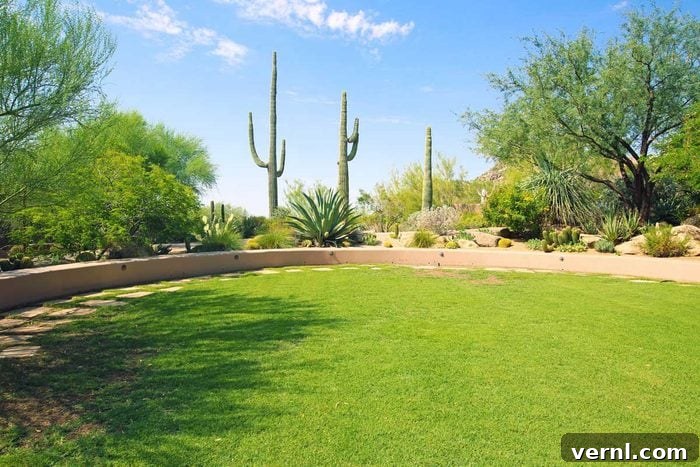
Warm-season grasses are the undisputed champions of hot, sunny climates, flourishing in temperatures where cool-season varieties falter. They exhibit vigorous growth during the prolonged summer months and enter dormancy, turning a characteristic brown, when temperatures begin to drop in the cooler seasons. Choosing the right warm-season variety ensures a resilient and beautiful Southern lawn.
Common Seeded Bermudagrass (Cynodon dactylon)
- Identification: Characterized by its dull, light-green color and a medium leaf texture. It forms a loosely netted turf that often lacks the density of improved varieties, spreading effectively via both rhizomes (underground stems) and stolons (above-ground runners).
- Ideal Location: Commonly found in full-sun native grass areas, roadsides, and older Southern lawns where basic ground cover is sufficient and a pristine appearance is not the main goal.
- Why Plant It: It’s primarily chosen when turf quality and a perfectly manicured appearance are secondary concerns, and initial cost savings are a significant factor in lawn establishment.
- Key Considerations: Curiously, Bermudagrass is actually native to Africa, not the island of Bermuda. A notable characteristic is its dormancy during winter months, which causes Bermudagrass lawns to turn brown. Many homeowners in colder parts of its range choose to overseed it with Ryegrass in the fall to maintain a green color throughout the winter season.
Improved Seeded Bermudagrass (Cynodon dactylon)
- Identification: Features a more attractive darker green color and a medium leaf texture. It provides significantly superior turf density compared to common types, and its deeper penetrating root system enhances its overall resilience and drought tolerance.
- Ideal Location: Ideal wherever full sun is available and a higher standard of lawn quality is desired. This includes well-maintained ball fields, golf courses, parks, and upscale residential lawns across the Southern and Western states.
- Why Plant It: This variety offers a significantly better-looking lawn, combining strong resistance to common diseases and insect pests with excellent traffic tolerance and improved cold hardiness, making it a robust choice for active families and demanding landscapes.
- Key Considerations: Bermudagrass is the most popular lawn grass choice across the Southern and Western states due to its adaptability and resilience. Continuous breeding efforts have led to new varieties with much better cold tolerance, successfully expanding its use into parts of the transition zone and even some Northern states. It can sometimes be confused with crabgrass due to similarities in its leaves and seed heads, particularly when unmown. The pioneering Improved Seeded Bermudagrass, ‘Guymon,’ was first released in 1987, marking a significant advancement in turf quality.
Hybrid Bermudagrass (C. dactylon x C. transvaalensis)
- Identification: Renowned for its intense dark-green color and exceptionally superior turf density, forming a very fine and uniform surface. It is a fast-growing grass that spreads vigorously through both stolons and rhizomes, creating an incredibly tight mat.
- Ideal Location: Predominantly used in Southern golf course putting greens, high-end university and professional athletic fields, elite residential lawns, and commercial properties that receive full sun and demand the highest aesthetics.
- Why Plant It: Opt for Hybrid Bermudagrass when you demand the absolute pinnacle of turf quality, exceptional traffic tolerance, rapid recovery from damage, and supreme turf density, aiming for the finest-looking lawn in the entire neighborhood.
- Key Considerations: This is often regarded as the “luxury car” of Southern lawn grasses due to its elite performance and demanding nature. Some hybrids are specifically classified as dwarf or ultra-dwarf varieties, offering even finer texture but requiring extensive, often daily, specialized maintenance, including frequent mowing and precise fertilization, to maintain their pristine condition.
St. Augustinegrass (Stenotaphrum secundatum)
- Identification: Features a distinctive medium to dark-green color with very broad, flat leaf blades that terminate in blunt, rounded tips. It spreads exclusively by stolons, forming a thick, dense, carpet-like turf.
- Ideal Location: Thrives in humid and tropical regions, extending along Florida’s Atlantic Coast to the Texas Gulf Coast. It is a popular choice for well-maintained areas, including residential lawns, parks, and commercial properties that receive full sun to moderate shade.
- Why Plant It: An excellent option if you have a moderately low-maintenance site situated in a hot, humid climate, especially if your lawn receives some shade during the day. It offers a lush, tropical aesthetic that withstands Southern heat.
- Key Considerations: Native to the Gulf Coast, West Indies, and Western Africa, St. Augustinegrass establishes vegetatively; no seed is commercially available, meaning it must be planted via sod, plugs, or sprigs. It is generally not traffic-, cold-, or drought-tolerant compared to other warm-season grasses and can be susceptible to various diseases and insect pests, requiring attentive and consistent care to maintain its health and appearance.
Bahiagrass (Paspalum notatum)
- Identification: Presents a dark green color and a medium-coarse leaf texture. It develops a deep, extensive root system but is relatively slow to establish from seed and generally slow-growing. It spreads via weak stolons, which are less aggressive than those of Bermudagrass.
- Ideal Location: Prevalent throughout Florida’s Atlantic Coast to the Texas Gulf Coast, and in other hot, dry regions where full sun to light shade is common. It particularly excels in areas with sandy soils and limited irrigation.
- Why Plant It: An ideal selection if you reside in a hot, dry region with restricted access to water, or if your soil is heavy and drains poorly. Bahiagrass is highly valued for being an easy-care lawn, requiring minimal input once established, making it perfect for low-maintenance landscapes.
- Key Considerations: Bahiagrass is also widely utilized as a pasture grass due to its durability and resilience. A common aesthetic concern for homeowners is its tendency to produce unsightly, tall seed heads, which may necessitate frequent mowing to keep the lawn neat. While some new lawn-type varieties are available offering improved aesthetics, it is known for good natural insect and disease resistance. However, it may not be the best choice for those desiring a perfectly lush, uniform, and manicured lawn.
Centipedegrass (Eremochloa ophiuroides)
- Identification: Distinguished by its light apple-green color and medium-coarse texture. It possesses a shallow root system and spreads by stolons, forming a relatively dense, low-growing turf that creates a carpet-like appearance.
- Ideal Location: Flourishes throughout the Florida Atlantic Coast to the Texas Gulf Coast in low-maintenance lawns where water is plentiful, the soil is sandy and acidic, and there is full sun to light shade.
- Why Plant It: An excellent option if your primary goal is to reduce mowing frequency and you have naturally sandy, infertile, and acidic soil, as it thrives in these less-than-ideal conditions where other grasses may struggle.
- Key Considerations: Centipedegrass is native to China and Southeast Asia. During the Great Depression era, it earned the nickname “Poor Man’s Grass” due to its low maintenance requirements and ability to grow in challenging soils. It does not tolerate heavy foot traffic well, recovers slowly from damage, and uniquely for a warm-season grass, it never truly goes dormant during the winter, though its growth significantly slows down.
Zoysiagrass (Zoysia japonica)
- Identification: Ranges from a light to medium-green color with a medium to coarse leaf texture. It is renowned for forming an incredibly dense sod and developing a deep, penetrating root system. It spreads efficiently via both rhizomes and stolons, creating a very tough and wear-resistant turf.
- Ideal Location: Widely adopted throughout the hot, dry areas of the transition zone and along the West Coast. It is a premium choice for well-maintained residential lawns and commercial properties that receive full sun to light shade.
- Why Plant It: Select Zoysiagrass for its exceptional quality, combining superior heat and cold tolerance, making it a highly resilient turf for actively used lawns. Its natural density effectively crowds out weeds, reducing the need for herbicides.
- Key Considerations: Native to Asia, Zoysiagrass seed is available, but establishing it by sod or plugs is generally recommended for quicker and more uniform results. The thickness and toughness of its leaf blades can make it challenging to mow with standard equipment, sometimes requiring a sharp reel mower. Furthermore, it has a tendency to produce excessive thatch, which may necessitate occasional dethatching to maintain its health and vigor.
Seashore Paspalum (Paspalum vaginatum)
- Identification: Displays a vibrant medium green color and a medium to coarse leaf texture. It spreads aggressively and effectively through both rhizomes (underground stems) and stolons (above-ground runners), forming a dense, durable turf.
- Ideal Location: Thrives along the Gulf Coast and other coastal or salty areas, making it an excellent choice for residential lawns, ball fields, and golf courses where there is full sun to medium shade and adequate moisture.
- Why Plant It: This grass is an unparalleled choice when you desire an elite-quality lawn that can tolerate very low mowing heights and heavy use, even if your soil and irrigation water source have a high salt concentration. It is uniquely salt-tolerant among turf grasses.
- Key Considerations: Seed for Seashore Paspalum is not commercially available; therefore, this cold-intolerant grass must be established vegetatively using sod, sprigs, or stolons. It provides excellent wildlife habitat in naturalized landscapes and can also be used as a pasture grass. Its appearance can sometimes lead to confusion with Bermudagrass, but its superior salt tolerance and ability to thrive in coastal conditions truly set it apart.